Mauna: Silence and What Cannot Be Said
The Teaching Beyond Words
The previous lesson explored when words fail. This lesson goes deeper, into what lies beyond words entirely. The Vedic tradition understood silence not as absence of speech but as its ground, and developed sophisticated methods for transmitting what cannot be said. From the three-fourths of speech that 'do not move' to the teaching through mauna, this lesson explores the unsayable.
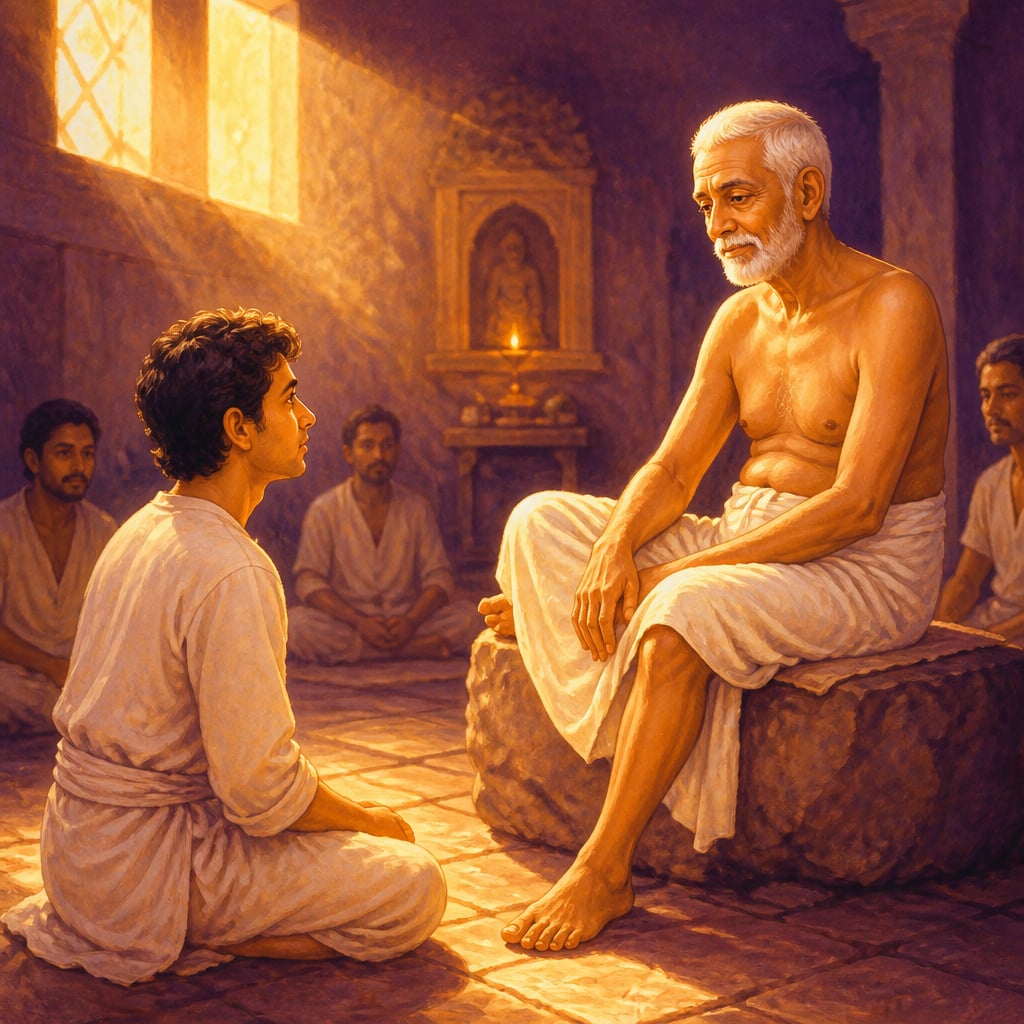
The young seeker traveled to Tiruvannamalai with a burning question. He had studied the scriptures, debated with scholars, practiced the prescribed disciplines. Still, the question remained: "Who am I?"
He found the sage sitting in the old hall, surrounded by devotees. The seeker waited for his moment, then approached: "Bhagavan, please tell me, who am I? What is the Self?"
Ramana Maharshi looked at him with penetrating stillness. Then, nothing. No words. The sage simply gazed, unblinking, present.
Minutes passed. The seeker's mind churned: Why doesn't he answer? Is this a test? Should I ask again?
More minutes. The churning began to slow. In the absence of words to grasp, something else emerged, a space where the question itself began to dissolve.
Later, the seeker would say: "He answered my question by showing me where answers come from."
The Ground from Which Speech Arises
The Rig Veda's teaching about the four quarters of speech (RV 1.164.45) tells us that three-fourths lie hidden, they "do not move." We speak only the fourth, outermost layer. But what are those silent three-quarters?
They are not inferior to speech but its source. Speech arises from silence the way waves arise from the ocean. The wave is real, but it is not separate from the water; and when the wave subsides, the water remains.
The Vedic sages understood this experientially. Before the mantra could be spoken, there was the intention to speak. Before the intention, there was awareness. Before awareness differentiated into "I" and "world", what? This "what" cannot be answered in words, because words are already differentiated. The answer would have to come from before words.
This is why the tradition developed mauna, sacred silence, as a teaching method. Not silence as refusal to speak, but silence as pointing toward the ground from which speech emerges.
Dakshinamurti: The Archetype of Silent Teaching
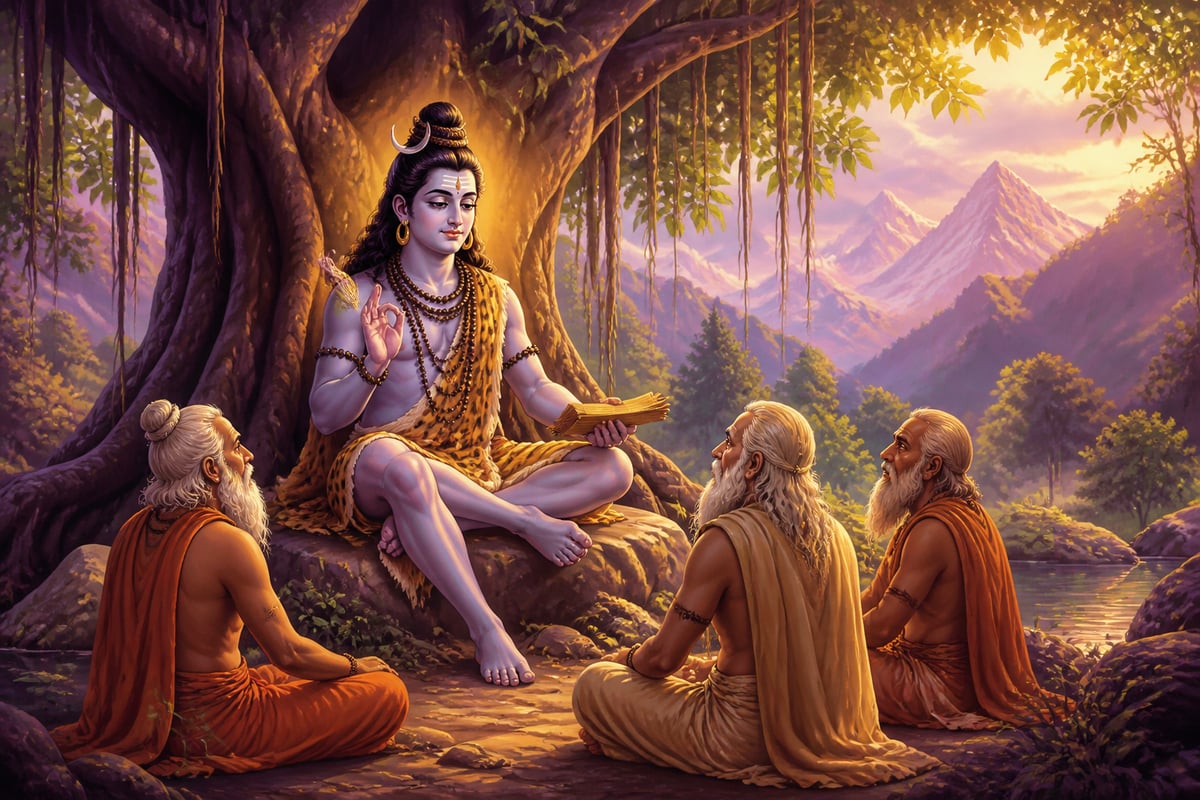
The image is unforgettable: Shiva as Dakshinamurti, seated beneath a banyan tree, facing south (dakshina). Around him sit four aged sages, the Sanakadi Rishis, among the first beings created. They are old; he appears young. They have questions; he has no words.
The Dakshinamurti Stotra, attributed to Adi Shankaracharya, describes the scene:
mauna-vyakhya-prakatita-parabrahma-tattvam
"The truth of the Supreme Brahman is revealed through the exposition of silence."
How does silence "expound"? The sages approach with doubts born of conceptual complexity. Shiva responds not by adding more concepts but by pointing to what precedes concepts. In his silence, the sages find that their questions dissolve, not answered but transcended.
This is apophatic teaching: not filling the mind with content but emptying it to the point where direct recognition becomes possible. The words would get in the way. Silence makes space.
What the Mantras Reveal About Silence
The Rig Veda is paradoxical: a collection of sacred speech that repeatedly points beyond speech.
asya vamasya palitasya hotuh tasya bhrata madhyamo asty ashna trtiyo bhrata ghrtaprstho asya atra apashyam vishpatim saptaputram
"Of this ancient, hoary invoker, the middle brother is the hungry one; the third brother has ghee on his back. There I beheld the lord of the clans with his seven sons."
Dirghatamas's riddles deliberately resist literal interpretation. The verse doesn't yield meaning through analysis, it yields meaning through the reader's recognition that meaning must come from elsewhere. The mantra forces you out of the verbal realm.
Similarly, the Nasadiya Sukta's questions, "Who truly knows? Who can declare it here?", are not rhetorical devices. They point to the impossibility of capturing origin in language. The origin of everything cannot be one of the things that originated. To speak of it is already to be downstream.
Traditional Wisdom: Para Vak and the Source of Speech
Sayana and later commentators developed the four-level model of speech that explains silence's primacy:
Para Vak (transcendent speech): Undifferentiated awareness before any vibration. Silent. One with the source.
Pashyanti Vak (visionary speech): The first differentiation, an intention without yet form. Still silent but pregnant with expression.
Madhyama Vak (middle speech): Thought-formation. Inner speech. The mental formulation before vocalization.
Vaikhari Vak (manifest speech): Spoken words. What we hear. The fourth quarter.
Notice: only at the fourth level does audible speech appear. Three levels precede it, all operating in what we'd call "silence." But these levels aren't empty, they're full. Para Vak isn't the absence of speech but its infinite potentiality. Silence contains all possible speech before any actual speech.
This reframes everything. When a teacher sits in mauna, they're not withholding speech, they're abiding in the level from which speech arises. The student who can meet them there receives transmission directly, without the reduction that verbalization requires.
In an age of constant verbal noise, social media, notifications, commentary, the Vedic understanding of silence offers medicine. Not as escape but as contact with source. Understanding silence's fullness transforms it from uncomfortable absence into nourishing presence. The three-fourths that 'do not move' remain available to those who learn to access them.
Living This Today: Three Faces of Meaningful Silence
Silence's power is not lost to modernity. Three contemporary expressions reveal its ongoing force:

Vipassana's Ten Days: When S.N. Goenka brought Vipassana meditation to the world, he structured it around ten days of complete silence. No speaking, no reading, no writing, no eye contact. Why?
Because verbal processing creates a constant commentary that obscures direct experience. In silence, the meditator begins to observe what actually arises in consciousness, sensations, impulses, patterns, without the overlay of narrative. The teaching happens not through instruction (though some is given) but through what emerges when the verbal overlay stops.
Over 200,000 people complete Vipassana courses annually worldwide. Most report that the silence, initially uncomfortable, becomes the teaching's core vehicle.
Japanese Ma (間): In Japanese aesthetics, ma, negative space, pause, emptiness, is not absence but presence of a different kind. The empty space in an ink painting is not where the painting isn't; it's essential to what the painting is.
Apple's design philosophy, famously influenced by Zen Buddhism, applies this principle. The white space on an iPhone screen isn't wasted real estate, it allows the present element to emerge with clarity. Steve Jobs reportedly said, "Design is not just what it looks like... it's how it works." Ma makes things work by providing the silence in which signal becomes audible.
The Moment of Silence: Why, at memorials and funerals, do communities observe silence together? Not because there's nothing to say, often there's too much. The moment of silence acknowledges what words cannot carry: grief too deep for expression, respect too profound for description, solidarity that exceeds any statement.
This is collective Para Vak, a community abiding together in what precedes speech. The practice persists because it works: something is transmitted in that shared silence that no eulogy could accomplish.
When to Choose Silence
The Rishis didn't choose silence because speech was bad. They recognized that different situations require different levels of Vac:
- Vaikhari (spoken) for practical instruction, ritual coordination, daily life
- Madhyama (mental) for contemplation, inner work, preparation
- Pashyanti (visionary) for creative inspiration, artistic expression, prophecy
- Para (silent) for transmission of what cannot be reduced to concept
The error is not speaking too much but speaking when silence would serve better. When someone is grieving, often presence without words transmits more than condolences. When a student is on the verge of insight, a teacher's silence can be more potent than explanation.
Ramana Maharshi explained his method: "Silence is the true teaching. It is the supreme teaching. It is suitable only for the most advanced seekers. The others are unable to draw full inspiration from it." But even those "others" could benefit from some silence, moments when the verbal mind rests and something deeper can surface.
Depth psychology recognizes that much of psychic life operates below verbal awareness. Jung's 'collective unconscious,' attachment patterns, somatic memory, these influence us from the silent depths. Accessing them often requires non-verbal methods: art therapy, somatic work, dream analysis.
Executive coach Marshall Goldsmith emphasizes listening without responding. When leaders create space, genuinely attending without planning their reply, insights emerge that advice would have blocked. The leader's silence creates room for the other's wisdom.
Systems often communicate through what's not happening rather than what is. The absence of complaints, the silence in a meeting room, the missing data, these negative spaces reveal as much as positive signals, for those who learn to read them.
Therapist Carl Rogers emphasized 'unconditional positive regard' and reflective presence. Sometimes the most powerful intervention is being fully present without interpretation. The client's own insight emerges in the space created by non-intrusive attentiveness.
Servant leadership often means 'holding space' rather than directing. When a team is struggling, the leader who sits with them, present but not fixing, often catalyzes breakthrough more effectively than advice would.
In complex systems, intervention often backfires. Donella Meadows's 'places to intervene' ends with the recognition that sometimes the highest leverage is to step back, to allow the system's inherent wisdom to emerge without interference.
Your Path Forward
How might you work with silence, not as absence but as presence?
First, notice when words are inadequate. That inadequacy is not a bug but a feature, it's showing you the edge of the fourth quarter. What lies beyond that edge? Not more words.
Second, practice being present without verbal processing. Even brief moments, sitting with a friend in companionable silence, watching a sunset without internal commentary, can reveal what constant speech obscures.
Third, recognize when others are offering silence. A skilled listener who doesn't rush to respond; a meditation teacher who holds space without filling it; a community's moment of stillness, these are invitations to the unsayable.
The next lesson explores what happens when we fail to read symbols correctly, when literal reading destroys what symbolic reading could reveal. But first, we had to visit the source. Because the symbols point to something. And that something lies in the silent three-quarters.
Case studies
Three Faces of Meaningful Silence: Vipassana, Ma, and the Moment
**Vipassana's Ten Days**: S.N. Goenka's Vipassana movement requires participants to maintain complete silence for ten days. No speaking, no reading, no writing, no gestures, no eye contact. Over 200,000 people complete these courses annually. Why does silence, initially experienced as deprivation, become the core teaching vehicle? Participants consistently report that by days 4-5, when the verbal mind quiets, a different quality of awareness emerges. Direct observation becomes possible. The teaching isn't *about* meditation; it's *through* the silence that removes the usual verbal overlay. **Japanese Ma (間)**: In Japanese aesthetics, *ma* is the negative space that defines positive form. The empty space in an ink painting; the pause in a Noh drama; the gap in a rock garden. Western design traditionally fills space; Japanese design lets emptiness speak. Steve Jobs, deeply influenced by Zen Buddhism, applied *ma* to Apple design. The abundant white space on an iPhone screen isn't wasted, it allows the present element to emerge clearly. Silence gives signal room to be heard. **The Moment of Silence**: At memorials, funerals, and commemorations, communities observe silence together. Why not speeches, which could articulate grief? Because some dimensions of human experience exceed articulation. Collective silence acknowledges what words cannot carry, and in that acknowledgment, something is transmitted that no eulogy achieves.
All three expressions embody the Vedic teaching: the three-fourths of speech that 'do not move' are not absent but full. Vipassana creates conditions for experiencing Para and Pashyanti levels of awareness, what lies beneath verbal processing. The ten days strip away Vaikhari and eventually Madhyama, revealing the silent depths. Japanese *ma* applies the principle aesthetically: the silence (empty space) is where meaning lives. The ink strokes are Vaikhari; the white space is the surrounding fullness of Para. The moment of silence is communal Para Vak, a group abiding together in what precedes speech. The shared stillness transmits what no individual utterance could. The Rig Veda's model illuminates all three: silence is not absence but ground; not deprivation but plenitude.
Vipassana centers now exist in over 90 countries. Apple became the world's most valuable company in part through design philosophy shaped by silence. Moments of silence remain powerful rituals precisely because they work, they communicate what words cannot. These are not nostalgic traditions but living applications of what the Rishis understood: the fourth quarter of speech needs the three silent quarters to mean anything.
Meaningful silence is not cultural artifact but perennial wisdom in contemporary form. Whether in meditation, design, or collective ritual, creating space for what lies beyond words remains essential to communication, and to life.
Digital detox retreats, silent meditation apps, and 'deep work' protocols all respond to the same modern crisis: constant noise drowning out the signal. The deliberate creation of silence, whether in product design through white space or in personal practice through meditation, has become a counter-cultural act with measurable benefits.
Vipassana courses are offered by donation only, with over 300 permanent centers globally. Apple's design guidelines specifically mandate minimum white-space requirements. Studies show that moments of silence in memorial services are rated as 'most meaningful' more often than any spoken element.
From Dakshinamurti to Ramana: The Unbroken Lineage of Silent Teaching
**The Archetype**: Shiva as Dakshinamurti sits beneath a banyan tree, eternally young, facing the four aged Sanakadi Rishis. They have traveled the cosmos accumulating knowledge. They approach with questions. He says nothing. The Dakshinamurti Stotra celebrates what happens next: 'mauna-vyakhya-prakatita', through the exposition of silence, supreme truth is revealed. The sages' doubts dissolve. Not answered but resolved in a dimension where questions do not arise. This became the archetype of the silent guru, present, still, transmitting without words. **The Embodiment**: Thousands of years later, in the 20th century, Ramana Maharshi actualized the archetype. At his hall in Tiruvannamalai, seekers from around the world came with questions. Many received verbal responses. But those who came when Ramana was in mauna received something different. The pattern repeated countless times: a seeker asks; Ramana gazes; silence extends; something shifts. Heinrich Zimmer, Carl Jung's colleague, visited and wrote that Ramana's silence was 'more eloquent than any treatise.' Jung himself called Ramana 'the whitest spot in India.' Ramana explained: 'Silence is unceasing eloquence... Verbal instruction is weaker than silence. Silence is permanent and benefits the whole of humanity.'
The continuity from Dakshinamurti to Ramana demonstrates that silent teaching is not myth but method. The Vedic understanding of four levels of speech explains how it works: When the guru abides in Para Vak, undifferentiated awareness, and the student approaches with genuine seeking, transmission can occur directly. The guru doesn't 'give' anything; rather, the student recognizes what was always present, in the space created by the guru's stillness. RV 10.71.3 says speech was found 'dwelling in the Rishis', not coming from them but residing in them. Ramana embodied this: Vac lived in him, and those who could meet him at that level received transmission without the reduction that words require. Dakshinamurti is the principle; Ramana was its modern demonstration.
Ramana's influence extends far beyond those who sat with him. His teaching, or rather his method, has shaped contemporary spirituality worldwide. The principle that the highest teaching occurs beyond words is now widely recognized, even in secular contexts. Ramana Ashram at Tiruvannamalai receives hundreds of thousands of visitors annually. Many come for darshan at Ramana's samadhi, participating in a transmission that continues beyond physical presence.
Silent teaching is not archaic mysticism but a sophisticated technology of transmission. The Rishis understood its basis; Dakshinamurti embodied its archetype; Ramana demonstrated its contemporary possibility. The teaching remains available to those who can receive it, in the silence between words.
The surge of interest in contemplative practices among tech professionals in Bangalore and Silicon Valley points to a hunger for transmission that goes beyond information transfer. Podcasts, books, and online courses proliferate, yet people still seek in-person teachers, recognizing that presence communicates something that content cannot.
The Dakshinamurti Stotra, attributed to Adi Shankaracharya, contains 10 verses describing Shiva as the silent teacher. Ramana Maharshi spent approximately 17 years in near-total silence after arriving at Arunachala in 1896. His ashram recorded that many visitors reported transformative experiences simply from sitting in his presence, without verbal exchange.
Reflection
- When was the last time you sat in intentional silence, not as deprivation but as practice? What did you notice in the silence that verbal processing usually obscures?
- If 'the truth of Supreme Brahman is revealed through the exposition of silence,' what might this mean for how you approach the deepest questions in your life?
- If three-fourths of speech lies in silence, what are the implications for our civilization's emphasis on verbal expression, information, and communication?