Pratika: Fire, Light, Water, Dawn, Why These Symbols
The Deliberate Choice Behind Vedic Imagery
The Rishis didn't randomly select Fire, Light, Water, and Dawn as their central symbols. Each was chosen for its unique capacity to carry meaning across multiple dimensions, physical, psychological, and cosmic. This lesson explores why these specific images, and how they work together as a unified system of understanding.
The fire crackled in the pre-dawn darkness. The young priest had been awake since the fourth watch, preparing. Now, as the first gray light touched the eastern horizon, he lifted the ladle of ghee, clarified, purified, transformed from milk by fire, and poured it into the flames. "Agnim ile purohitam," he chanted. "I invoke Agni, the priest placed before."
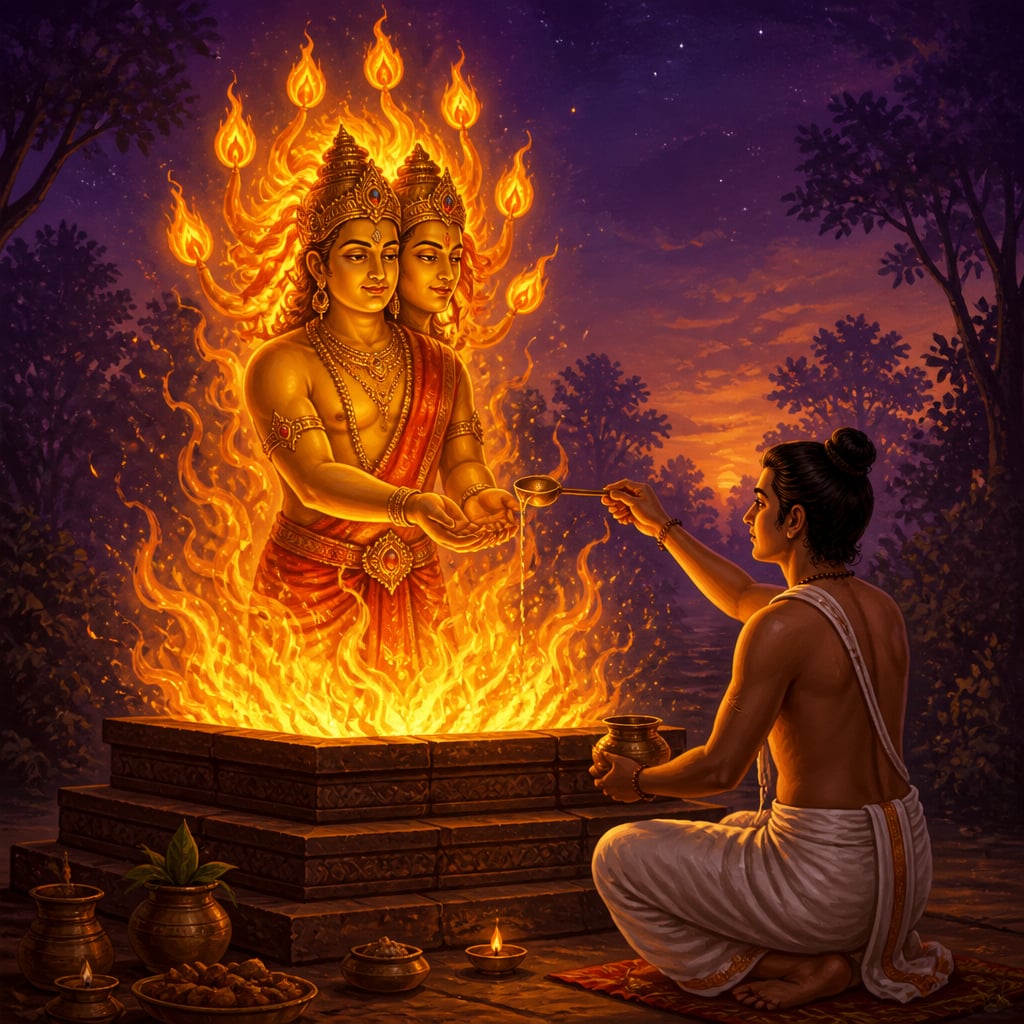
But why fire? Of all the images in the world, why did the Rishis begin their most sacred text with flame?
The Question of Specific Symbols
The Rig Veda could have used any imagery. The Rishis observed mountains, rivers, animals, stars, seasons, an entire cosmos of potential symbols. Yet four images appear again and again, woven through the text like threads in a tapestry: Agni (Fire), Jyoti (Light), Apas (Water), and Ushas (Dawn).
This was not accident or primitive instinct. The Rishis were sophisticated symbol-makers who understood something modern semiotics confirms: specific symbols carry specific capacities. A generic image communicates generically. A precisely chosen symbol resonates at multiple levels simultaneously, physical, psychological, cosmic. The question is not "why use symbols?" but "why these symbols?"
Agni: The Transformer Between Worlds
Fire transforms. It takes solid wood and releases light, heat, and smoke that rises upward. This physical reality became the perfect symbol for the transformative process itself, whether of matter, mind, or spirit.
The very first verse of the Rig Veda declares:
agnim ile purohitam yajnasya devam ritvijam hotaram ratnadhatamam
"I invoke Agni, the priest placed before, the divine minister of the sacrifice, the invoker, the greatest bestower of treasures."
Notice the layering. Agni is physical fire, but also the "priest placed before" (purohita), the intermediary between human and divine. He is the "invoker" (hota), the one who calls. He transforms offerings into something the gods can receive, just as he transforms gross into subtle, ignorance into knowledge, the earthbound into the rising.
Sri Aurobindo in The Secret of the Veda identifies Agni psychologically as "the divine Will" and "the flame of aspiration." When you feel the burning desire to know, to grow, to transcend, that is Agni within. The Rishis chose fire not because they worshipped flames, but because fire is transformation made visible.
Ushas: The Threshold of Awakening

Dawn is not day. It is the transition, the moment when darkness yields to light but light has not yet fully arrived. This liminal quality made Ushas perfect for symbolizing awakening consciousness.
The Ushas Suktas are among the most beautiful in the Rig Veda:
ud u shriyo usaso rocamana asthu citram divah duhitaro vibhatih
"Rise up! The radiant Dawns are shining forth, the beautiful daughters of heaven, bringing their varied gifts."
Ushas is always plural in feeling, she comes daily, each dawn a renewal. She is "daughter of heaven" (divah duhitarah), mediating between the celestial and terrestrial. She brings "varied gifts" (citram), possibilities that didn't exist in the darkness.
Psychologically, Ushas represents those moments when understanding begins to break through confusion, when the "night" of unknowing starts yielding to the "day" of clarity. The Rishis didn't worship sunrise; they recognized in sunrise the perfect symbol for every awakening.
Apas: The Flow and Purification

Water flows downward, fills every shape it enters, purifies what it touches, and sustains all life. These physical properties made Apas the natural symbol for grace, purification, and the life-giving flow of consciousness.
apo hi shtha mayobhuvah ta na urje dadhatana mahe ranaya caksase
"Waters, you are the source of happiness. Give us nourishment, that we may behold great joy."
The Rig Veda places water among the most sacred symbols because water does something fire cannot: it cleanses without destroying. Fire transforms through consumption; water transforms through permeation. Both are necessary.
In the Vedic ritual, water is offered before, during, and after the fire ceremony. The interplay is deliberate: fire rises, water descends; fire consumes, water nourishes; fire illuminates, water reflects. Together they model a complete cycle of transformation.
Jyoti: The Self-Luminous Principle
Light differs from fire. Fire is the source of light; light is what fire produces. The Rishis distinguished carefully: Agni transforms, but Jyoti reveals. Light doesn't change what it touches, it shows what was always there.
tamaso ma jyotir gamaya, "Lead me from darkness to light", captures this. The prayer is not for creation but for revelation. The truth is already present; what's needed is illumination to see it.
Jyoti became the symbol for consciousness itself, the awareness that knows, the witness that observes, the light by which everything else becomes visible. When the Upanishads later speak of the jyotisham jyotih, "the light of lights", they draw on this Vedic foundation: there is a luminosity that is not created but self-existent, not an object of awareness but awareness itself.
The System: How Four Symbols Work Together
The genius of Vedic symbolism lies not in individual images but in their interrelation. Consider:
- Dawn (Ushas) initiates the cycle, darkness yields to possibility
- Fire (Agni) transforms, the offering is consumed, the aspiration rises
- Light (Jyoti) illuminates, what was hidden becomes visible
- Water (Apas) integrates, the insight is absorbed, purified, made nourishing
This is not linear but cyclical. Each dawn, the cycle renews. Each fire ritual, the cycle repeats at the personal level. The Rishis didn't choose four random symbols; they chose four that together model a complete process of transformation and realization.
Sayana notes that these symbols appear at every level of Vedic interpretation: adhyatmika (spiritual/psychological), adhidaivika (relating to the devas), and adhibhautika (physical). Fire is simultaneously flame, divine will, and cosmic creative force. This multivalence is not ambiguity but richness, each level true, each reinforcing the others.
Understanding why the Rishis chose specific symbols, rather than dismissing them as 'nature worship', opens the Vedas to genuine reading. Fire is a teacher; dawn is a teacher; water is a teacher. But they teach different lessons, in different ways, for different aspects of the path. The specificity is the teaching.
Living This Today: When One Symbol Carries Many Truths
In 2010, India needed a symbol for its currency. The rupee had no distinctive mark like the dollar ($) or euro (€). The government held a competition, and D. Udaya Kumar's design won, a symbol that now appears on every Indian banknote.
Look at ₹ carefully. It combines the Devanagari "र" (Ra, the first letter of Rupaya) with the Latin "R" (for international recognition). Two parallel horizontal lines evoke the Indian flag's stripes and the mathematical symbol for equality. In one simple glyph: Indian identity, global currency standard, national symbolism, and economic aspiration.
This is what the Rishis did with Fire, Light, Water, and Dawn. Each symbol works at multiple levels simultaneously. The physical reality (flame, sunrise, river) anchors the symbol in direct experience. The psychological meaning (aspiration, awakening, purification) connects to inner life. The cosmic dimension (divine intermediary, cyclical renewal, sustaining flow) links individual to universe.
Generic symbols can't do this. A random image carries only the meaning assigned to it. Fire, light, water, and dawn carry meaning inherent to their nature, meanings the Rishis discovered rather than invented.
Symbol therapy uses carefully chosen images to access and transform emotional states. A client afraid of change might work with fire imagery; one seeking clarity might work with light. The symbol must match the need, generic images don't create transformation.
Brand symbols succeed when they tap inherent meanings. Apple's bitten apple suggests knowledge (Eden) and accessibility (a bite taken). Nike's swoosh suggests movement and victory. Arbitrary logos require massive marketing spend; resonant symbols communicate immediately.
Systems maps use specific visual conventions (stocks, flows, feedback loops) because these correspond to real system dynamics. A box represents accumulation because boxes hold things; arrows represent flow because arrows show direction. The symbol should match the reality it represents.
Depth psychology teaches that everything can be 'read', dreams, symptoms, slips of tongue, life patterns all carry meaning for those who learn the grammar. The Rishis applied this to the natural world itself.
Pattern recognition, reading the 'text' of market movements, team dynamics, cultural shifts, distinguishes great leaders from competent managers. The skill is noticing what phenomena are 'saying.'
Systems thinking treats observable events as symptoms of underlying structures. A supply shortage, a market crash, a disease outbreak are 'texts' that reveal deeper patterns when read correctly.
Your Path Forward
The next time you see flame, a candle, a cooking fire, a lamp at a temple, pause. Ask: what is being transformed here? What rises? What is released?
The next time you witness dawn, notice the transition itself, not the darkness before, not the full light after, but the threshold moment. What might be awakening in you?
The Rishis didn't worship these elements. They read them, as a naturalist reads tracks, as a physician reads symptoms, as a poet reads the face of a beloved. The symbols are teachers, if we learn to see.
The next lesson explores what happens when we fail to read symbolically, when words create confusion rather than clarity.
Case studies
The Indian Rupee Symbol: Layered Meaning in a Single Glyph
In 2010, India held a national competition to design a symbol for the rupee, joining the exclusive club of currencies with distinctive marks (like $ and €). The winning design by D. Udaya Kumar, an IIT Bombay postgraduate, beat 3,000+ entries. What made it work? Look at ₹ carefully. It combines the Devanagari letter 'र' (Ra, first letter of Rupaya) with the Latin 'R' (for international recognition). Two parallel horizontal lines evoke the Indian flag's stripes and the mathematical symbol for equality (=). The negative space forms an asymmetric shape suggesting forward movement. In one simple glyph: Indian identity, global currency standard, national symbolism, and the aspiration toward economic equality, all working simultaneously without contradiction.
The rupee symbol succeeds for exactly the same reason Vedic symbols succeed: multiple layers of meaning inherent to the chosen form. Udaya Kumar didn't assign arbitrary meaning to a random shape, he discovered a configuration where the elements (Devanagari, Latin, parallel lines) naturally carry their meanings. This is what the Rishis did with Fire, Water, Light, and Dawn. They didn't randomly assign meaning; they found images whose natural properties correspond to psychological and cosmic realities. Fire inherently transforms; it doesn't need to be 'told' to symbolize transformation. The meaning is discovered, not invented, which is why it resonates.
The ₹ symbol was officially adopted in 2010 and now appears on all Indian currency and keyboards worldwide. It required no marketing campaign to explain; the symbol communicates immediately because its components inherently carry their meanings.
Great symbols are not arbitrary conventions but discovered correspondences, forms whose natural properties align with the meanings they need to carry. The Rishis chose fire, light, water, and dawn for the same reason Udaya Kumar chose Devanagari + Latin + parallel lines: the elements already carry the meaning.
National symbols, corporate logos, and even emoji design all follow the principle of layered meaning. The most enduring symbols, from the Olympic rings to the Indian tricolor, work because their visual properties naturally correspond to the meanings they carry, rather than being arbitrary assignments.
The rupee symbol competition received 3,331 entries. Only 5 finalists were considered; Udaya Kumar's design was selected for its elegant integration of multiple layers of meaning in a form that could be easily handwritten.
Kumbh Mela: Why Only These Waters at These Times
The Kumbh Mela is the largest gathering of humanity on Earth, up to 120 million pilgrims over weeks. But it doesn't happen just anywhere. It rotates between exactly four locations: Prayagraj (where Ganga, Yamuna, and the invisible Saraswati meet), Haridwar (where Ganga enters the plains), Nashik (on the Godavari), and Ujjain (on the Shipra). Why these specific waters? Why not the Kaveri, the Narmada, or any other sacred river? And why only during specific astronomical conjunctions, when Jupiter enters certain signs? The answer lies in the symbolic system. The Triveni Sangam at Prayagraj represents the meeting of three forms of consciousness (Ganga as jnana/knowledge, Yamuna as karma/action, Saraswati as bhakti/devotion). The astronomical timing links terrestrial water to cosmic cycles. The specific rivers carry specific symbolic weight that other waters, however sacred, cannot replicate.
This is the Vedic principle of symbolic specificity in action. The Rishis didn't treat all water as equivalent, just as they didn't treat all fire or all light as equivalent. Specific waters at specific times at specific confluences create specific effects. The Kumbh Mela embodies the Rig Vedic understanding that Apas (waters) are 'mayobhuva' (source of happiness) and 'urje' (nourishment), but not all waters equally. The Triveni Sangam is to other waters what the Vac Sukta is to ordinary speech: the same element, but at a level of power that ordinary instances cannot reach.
The Kumbh Mela has continued for over 2,000 documented years, with the same four locations and the same astronomical timing. The 2019 Prayagraj Kumbh Mela drew approximately 120 million visitors over 49 days, the largest human gathering ever recorded.
The endurance of the Kumbh Mela demonstrates that symbolic specificity matters. Generic water-bathing rituals exist everywhere, but they don't draw 120 million people. The specific waters, at the specific confluence, at the specific astronomical moment, carry meaning that no substitute can replicate. The Rishis understood this about all their symbols.
Place-specific experiences, from wine terroir to pilgrimage routes like the Camino de Santiago, thrive because location carries meaning that no substitute can replicate. The tourism industry's shift toward 'experiential travel' reflects this understanding: specific places at specific times create irreplaceable encounters.
The 2019 Kumbh Mela at Prayagraj drew an estimated 240 million visitors over 49 days, with approximately 50 million attending on the single busiest bathing day (February 4, Mauni Amavasya). The gathering was visible from space via satellite imagery, covering a temporary city of over 32 square kilometers.
Reflection
- Which of the four Vedic symbols, Fire, Light, Water, or Dawn, most resonates with your current life situation? What might that resonance be telling you?
- The Rishis 'read' fire, water, light, and dawn as texts carrying meaning. What in your environment might be 'speaking' to you if you learned to read it?
- If symbols carry meaning inherent to their nature, fire truly does transform, dawn truly marks transition, what does this suggest about the relationship between physical reality and meaning?