Svādhyāya: Learning as a Lifelong Process

The Seer Who Never Stops Seeing

For the Vedic tradition, learning isn't a destination but a continuing journey. Even the greatest Rishis described themselves as still learning. Through the guru-shishya lineage system and the concept of endless refinement, we explore what it means to treat knowledge not as possession but as ongoing relationship.

The old Rishi sat beneath the banyan tree, his students gathered around him. After decades of teaching, his reputation had spread across the land. Students traveled great distances to learn at his feet.

"Guru-ji," one young brahmachari asked, "you have realized the highest truths. You have seen what we can only imagine. What more is there for you to learn?"
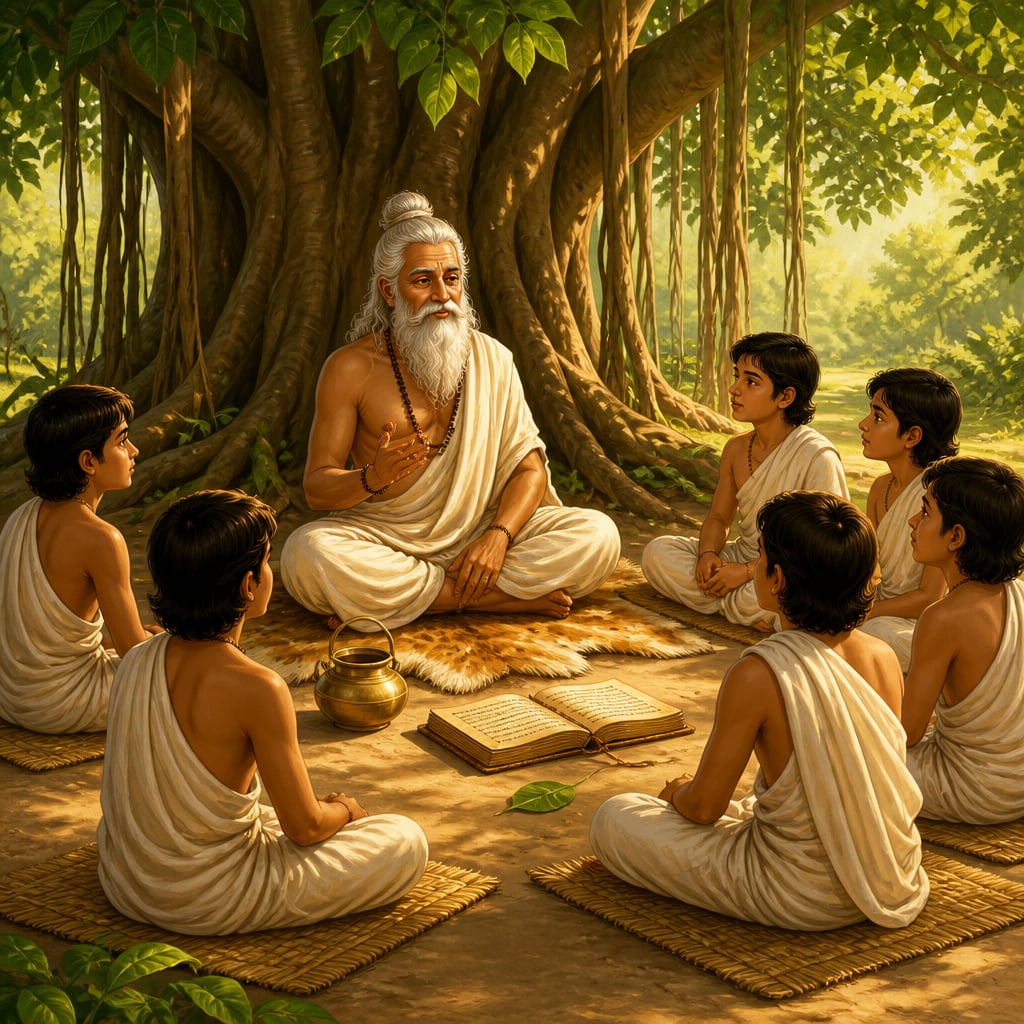
Old Rishi teaching students beneath a banyan tree

The old teacher smiled, the same smile his own guru had worn when asked similar questions fifty years before.

"I have been learning for sixty years," he said quietly, "and I feel I have only just begun. The more clearly I see, the more I realize I have not seen. Each insight opens new questions. The seer who thinks he has finished seeing has already gone blind."

The Never-Ending Journey

The Vedic tradition understood something that modern education often forgets: learning is not a container to be filled but a capacity to be developed. Knowledge isn't something you acquire once and possess forever, it's a relationship that deepens over time.

This understanding appears in the tradition's fundamental structure. The guru-shishya śṛṅkhalā (chain or lineage) extends backward through countless generations and forward without limit. Each teacher was once a student; each student becomes a teacher. The chain has no first link and no last, it's ongoing transmission of living wisdom.

The Vedic āśrama system encoded lifelong learning into the structure of life itself:

Brahmacharya (student phase): Formal learning under a guru Gṛhastha (householder phase): Learning through worldly engagement Vanaprastha (forest-dwelling phase): Learning through contemplation and withdrawal Sannyasa (renunciate phase): Learning through complete dedication to realization

Notice: every phase includes learning. The method changes; the learning doesn't stop. The householder learns what the student couldn't; the renunciate discovers what the householder missed. Each stage reveals what the previous stage concealed.

What the Mantras Reveal

The Rig Veda itself presents learning as ongoing journey. Consider the famous prayer:

"Ā no bhadrāḥ kratavo yantu viśvataḥ"

"Let noble thoughts come to us from every side."

Word by word: ā (toward us) naḥ (us) bhadrāḥ (noble/auspicious) kratavaḥ (thoughts/inspirations) yantu (may they come) viśvataḥ (from all directions).

This isn't the prayer of someone who has completed learning, it's the prayer of one who remains open, inviting wisdom from any direction. The greatest seers maintained this openness; their greatness partly consisted in it.

Another revealing verse:

"Vidyāvinayasampanne brāhmaṇe gavi hastini"

(From the Bhagavad Gita, but reflecting Vedic sensibility)

"In the learned and humble brahmin, in the cow, in the elephant..."

The wise see with equal vision, but this means they can learn from anyone and anything. The elephant teaches patience; the cow teaches generosity; the humble person teaches more than the proud scholar. Learning has no fixed source because wisdom appears everywhere.

The Lineage as Living Tradition

The guru-shishya paramparā (lineage) wasn't merely academic transmission, it was the tradition's mechanism for keeping knowledge alive across centuries.

Each generation faced the same challenge: receive wisdom from teachers who received from their teachers, absorb it deeply enough to make it your own, then transmit it to the next generation who will face circumstances you cannot imagine. The tradition survived not by rigid preservation but by adaptive transmission.

Consider what this requires:

Deep reception: Not just memorizing but understanding well enough to answer questions your teacher never faced Living embodiment: The teaching must show in how you live, not just in what you say Adaptive transmission: Finding words and methods that reach students whose world differs from yours Honest acknowledgment: Being clear about what you know, what you believe, and what you're still learning

The best teachers in the tradition were also the best students, never losing the beginner's openness even as mastery deepened.

Traditional Wisdom

Present-day Shankaracharya teaching shishyas at matha mantapa

Shankaracharya established four mathas (monasteries) across India, each maintaining a lineage that continues today. The current Shankaracharyas are the 70th+ generation in unbroken succession. They received, embodied, and transmitted, adapting to circumstances from medieval kingdoms to British colonialism to the digital age.

The tradition says: "Śiṣya-pratiṣṭhā bhavati guruḥ", "The guru becomes established through the students." The teacher's realization is tested by what emerges in those they teach. This creates accountability across generations: your teacher's teacher's teacher's teaching lives in you.

Sri Ramakrishna in devotional rapture at Dakshineswar

Sri Ramakrishna, in the 19th century, demonstrated this living quality. Though deeply realized, he continued to experiment, to learn from his disciples, to let his understanding deepen. When asked why he still performed spiritual practices, he said: "Do you stop eating once you've learned what food tastes like?"

In a world of accelerating change, the organizations and individuals that thrive are those that keep learning. The Vedic tradition offers a proven model: learning isn't something you complete but something you are. This insight, embedded in āśrama and paramparā structures, remains relevant, perhaps more than ever.

The Modern Parallel

Peter Senge's concept of the "learning organization" captures this Vedic insight in modern terms. In The Fifth Discipline, Senge argues that organizations capable of continuous learning outperform those that don't, not because they start smarter but because they keep getting smarter.

The characteristics Senge identifies parallel the tradition:

Personal mastery: Individuals committed to ongoing development (the brahmachari's attitude maintained for life) Mental models: Examining the assumptions that shape perception (watching for adhyāsa) Shared vision: Alignment around purpose (the tradition's shared commitment to liberation) Team learning: Collective inquiry that exceeds individual capacity (vāda, the dialogue tradition) Systems thinking: Seeing patterns and interconnections (the Rishi's holistic perception)

Senge found that the most resilient companies weren't those with the best initial strategy but those that could learn and adapt continuously. The same principle applies to individuals: the seer who stops seeking stops seeing.

Research on 'intellectual humility' shows it correlates with better decision-making, more accurate self-assessment, and greater learning over time. Those who acknowledge what they don't know learn more than those who pretend certainty.

Jim Collins's 'Level 5 Leaders' combine fierce determination with profound humility. They keep learning from everyone, including subordinates. Their organizations outperform because the leader models continuous development.

Donella Meadows emphasized that systems thinkers must remain 'willing to be disturbed', to have their mental models challenged by new data. Closed systems stagnate; open systems evolve. The same applies to minds.

Research on 'generativity' (Erikson's middle-adulthood stage) shows that concern for future generations correlates with well-being and meaning. Being a link in a chain, receiving and transmitting, satisfies deep human needs.

Leadership experts emphasize 'leadership development' as a primary responsibility of leaders. Your most lasting impact isn't what you accomplish directly but who you develop. Great leaders create great leaders.

Knowledge management theory recognizes that organizations' most valuable assets are often tacit knowledge held by individuals. When experienced people leave without transmitting what they know, the organization loses irreplaceable wisdom.

Your Path Forward

The Vedic insight inverts a common assumption. We often think of learning as something we do until we know enough, then we shift to applying what we've learned. The tradition suggests this is backwards. Learning isn't preparation for life; it is life. The goal isn't to finish learning but to keep learning better.

You might ask yourself: In what areas have I stopped learning, assuming I know enough? Where have I become a teacher who no longer feels like a student? What would it mean to approach even my expertise with beginner's mind?

The old Rishi's response to his students wasn't false modesty, it was accurate perception. Sixty years of seeing had shown him how much there is to see. Each clearing of vision revealed new horizons. The journey doesn't end because the territory is infinite.

This brings us to our final lesson in this chapter: How does this ancient understanding of knowledge through experience apply to our current moment? What relevance does the draṣṭā tradition have for 2026 and beyond?

Case studies

Peter Senge and the Learning Organization

In the 1990s, Peter Senge observed that most organizations optimize for current performance at the expense of future learning capacity. They exploit what they know without exploring what they don't. Short-term success often preceded long-term failure. In contrast, a few organizations maintained what Senge called 'generative learning', the capacity not just to adapt but to expand capability. He identified five disciplines: personal mastery, mental models, shared vision, team learning, and systems thinking.

Senge's 'learning organization' parallels the paramparā structure. Personal mastery is the lifelong brahmachari attitude. Examining mental models is watching for adhyāsa. Shared vision is the tradition's commitment to liberation. Team learning is vāda. Systems thinking is the Rishi's holistic perception. Senge independently arrived at a structure the Vedic tradition had maintained for millennia.

'The Fifth Discipline' became one of the most influential management books ever written. Organizations that implemented its principles, Toyota, Visa, some education systems, showed sustained performance that more rigidly structured competitors couldn't match. The insight that learning capacity trumps fixed knowledge proved prescient for the digital age.

The organizations (and individuals) that thrive over time aren't those that start with the most knowledge but those that keep learning best. The Vedic insight that learning never ends isn't mystical idealism, it's practical wisdom proven in contexts from ancient āśramas to modern corporations.

Companies that invest in continuous learning infrastructure, from internal universities at Google and Amazon to rotation programs at consulting firms, consistently outperform those that rely on hiring finished expertise. The learning organization concept has moved from management theory to competitive necessity.

Senge's research showed that the average lifespan of Fortune 500 companies dropped from 75 years in 1955 to 15 years by 1995. The companies that survived were disproportionately those that maintained learning culture.

The Shankaracharya Paramparā: 1,200 Years of Living Transmission

In the 8th century CE, Adi Shankaracharya established four mathas (monasteries) at the four corners of India: Sringeri in the south, Puri in the east, Dwarka in the west, and Joshimath in the north. Each was entrusted to one of his four primary disciples with the charge to maintain and transmit the teaching. Each matha established its own paramparā, an unbroken line of succession that continues to this day, over 1,200 years later.

This paramparā demonstrates living transmission in action. Each Shankaracharya received from their predecessor, embodied the teaching in their own life and era, and transmitted to their successor. The teaching adapted to medieval kingdoms, Mughal rule, British colonialism, and modern India, remaining recognizably the same while speaking to each context. The tradition stayed alive because each link was both student and teacher, receiver and transmitter.

The four mathas continue to function today. The current Shankaracharyas are the 70th+ generation in their respective lineages. They run educational institutions, maintain the textual tradition, give teachings that draw thousands, and initiate disciples who will continue the chain. What Shankara taught lives because people keep receiving, embodying, and transmitting it.

Wisdom survives across centuries not through books alone but through living embodiment. Each generation receives what the previous generation could give; adds their own insight and adaptation; and transmits to the next who will do the same. Being a link in such a chain is both privilege and responsibility.

The revival of mentorship and apprenticeship models in tech (coding bootcamps, design apprenticeships) and traditional crafts (artisan guilds, culinary training) reflects a growing recognition that certain knowledge transfers only through sustained personal relationship, not through documentation or video courses.

The four Shankaracharya mathas have maintained unbroken guru-shishya succession for over 1,200 years. The Sringeri Sharada Peetham has had 36 pontiffs since its founding. Each matha preserves specific Vedic recitation traditions (shakhas), with the combined tradition maintaining oral transmission of texts dating back over 3,000 years.

Reflection

More in Draṣṭā: Knowing Through Experience

All lessons in Draṣṭā: Knowing Through Experience · Rig Vedic Philosophy course