Bhrama: Errors, Blind Spots & Correction

Why Seers Need Correction Too

Even the clearest perception can be mistaken. The Vedic tradition didn't claim infallibility, it built correction into the system. Through the famous rope-snake error, the vāda debate tradition, and how later texts refined earlier insights, we explore the epistemology of error and the structures that enable genuine knowledge to emerge.

A traveler walks at dusk through an unfamiliar path. In the dim light, he sees a coiled snake blocking his way. His heart races. He freezes. Every faculty of perception tells him: this is a snake, and it is dangerous.

Then a companion arrives with a lamp. In clearer light, the traveler sees: it was a rope all along. The perception was vivid, complete, compelling, and entirely wrong.
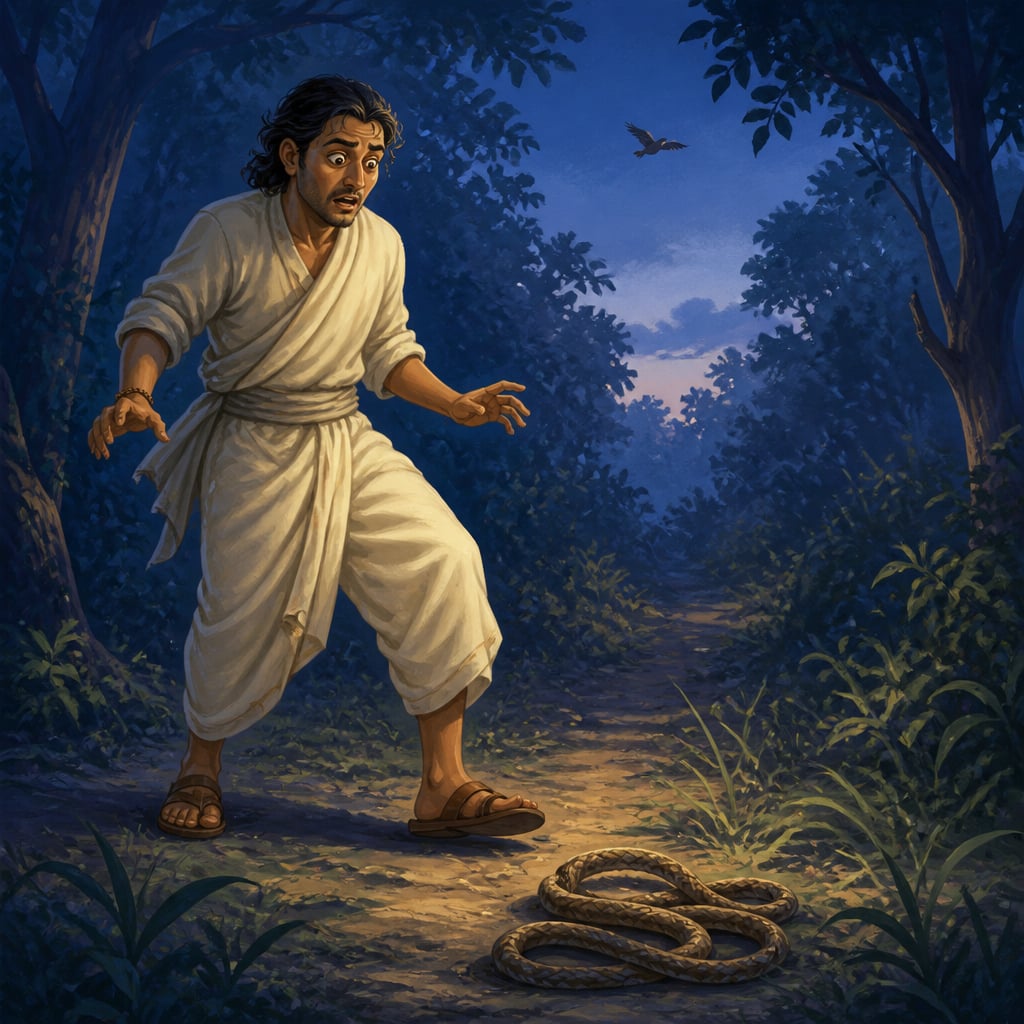
Traveler mistaking a rope for a snake at dusk

This scenario, called rajju-sarpa bhrama (the rope-snake error), became the central teaching example in Indian epistemology. Not because philosophers enjoyed discussing snakes, but because it poses a fundamental question: If perception this vivid can be mistaken, how do we ever trust what we see, outer or inner?

The Problem the Tradition Faced

The Vedic emphasis on direct experience as evidence creates a problem: What if the experience is wrong? The traveler genuinely perceived a snake. His perception met several validity criteria, it was determinate (he could describe it clearly), it arose from his sense organs, it produced appropriate response. Yet it was false.

The tradition didn't ignore this problem. It developed sophisticated analyses of error that remain philosophically relevant today.

The Nyāya school analyzed the conditions that produce error:

Defects in the instrument (doṣa): The traveler's eyes functioned poorly in dim light. Similarly, a disturbed mind perceives inaccurately. The instrument of perception must be functioning properly.

Defects in the conditions (samskāra): Dusk created ambiguity. Proper conditions matter for accurate perception, just as a scientist needs controlled conditions for valid observation.

Superimposition (adhyāsa): The traveler's mind projected "snake" onto the rope, drawing on past experience and fear. This is the core mechanism of error: imposing one thing's characteristics onto another.

Shankara made adhyāsa central to his philosophy. In the opening of his Brahma Sutra Bhashya, he defines it: "Adhyāsa is the superimposition of the attributes of one thing onto another, like perceiving a rope as a snake." For Shankara, all worldly confusion follows this pattern: we superimpose the unreal onto the real.

Built-In Correction Mechanisms

The tradition's response to error wasn't denial but methodology. If perception can be mistaken, we need structures that catch and correct mistakes. Several emerged:

Subsequent perception (bādha): The rope-snake error is corrected by better perception, bringing a lamp, looking more closely. Later, clearer perception overrules earlier, confused perception. This means the seer must remain open to revision.

Coherence checking: Valid perception should cohere with inference and other pramāṇas. If what I "see" contradicts what I validly infer or what reliable testimony reports, something needs investigation.

Predictive failure: Error reveals itself when predictions fail. If I perceive a snake and act accordingly, but my actions produce no snakebite, no movement, no response, the failure of consequences reveals the error.

Community verification: Multiple trained observers perceiving the same phenomenon provides stronger evidence than individual perception. The Rishis compared notes; divergent reports signaled the need for investigation.

The Vāda Tradition: Institutionalized Correction

Indian philosophy developed formal debate (vāda) as a correction mechanism. This wasn't argumentation for victory but structured inquiry for truth.

The traditional vāda had specific rules:

Vada debate in a stone-pillared temple courtyard

Philosophers like Shankaracharya traveled across India engaging in public debates. These weren't ego contests, they were epistemological audits. A philosopher's position was only as strong as its ability to withstand structured challenge.

The tradition distinguished three types of discourse:

Only vāda produces knowledge. The other forms may display cleverness but don't correct error.

Textual Self-Correction

The Vedic tradition also shows correction happening across texts and time. Later Upanishads refine earlier insights. The Mundaka Upanishad distinguishes parā and aparā vidyā, a refinement of how knowledge operates. The Mandukya Upanishad's analysis of consciousness states (waking, dream, deep sleep, turīya) develops models only hinted at in earlier texts.

This wasn't seen as contradiction but as deepening. The tradition imagines a conversation across time, later seers building on, refining, and sometimes correcting earlier perceptions.

Medieval scholar inscribing margin commentary on manuscript

The bhāṣya (commentary) tradition institutionalizes this. Shankara comments on the Upanishads; later philosophers comment on Shankara. Each generation has the task of clarifying, developing, and where necessary correcting what came before.

In an era of polarized certainty, the Vedic approach to error offers wisdom. Not skepticism (doubting everything) but structured humility: knowing how error works, building correction into practice, and remaining open to bādha (sublation by clearer perception). This enables genuine knowledge to emerge.

The Modern Parallel

Daniel Kahneman's research on cognitive biases reveals the same structure the Indian philosophers analyzed, just with different vocabulary.

Kahneman identifies systematic errors in human cognition: confirmation bias (seeing what we expect), availability bias (overweighting vivid memories), anchoring (excessive influence of initial information). These aren't random mistakes, they're predictable patterns of adhyāsa, superimposing our expectations onto raw experience.

His solution parallels the Vedic approach: we can't eliminate bias, but we can build structures that catch it. Checklists. Peer review. Pre-mortems that ask "What could go wrong?" Statistical thinking that overrides intuition in specific domains.

The scientific method itself is an institutionalized correction mechanism: hypotheses must survive attempts at falsification; results require replication; peer review catches errors the original researcher missed. Science doesn't claim individual scientists are unbiased, it builds correction into the system.

Daniel Kahneman's 'Thinking, Fast and Slow' documents systematic cognitive biases: confirmation bias, availability heuristic, anchoring. These are forms of adhyāsa, projecting expectations onto evidence. Awareness of specific biases enables targeted correction.

Ray Dalio's 'Principles' emphasizes 'radical open-mindedness', the recognition that your first perception may be adhyāsa. Bridgewater's culture of challenge institutionalizes correction: every position must survive structured opposition.

Systems theorists note that we often see 'events' while missing 'structures', a form of adhyāsa where we project simple causation onto complex systems. Recognizing this pattern enables seeing the deeper structures.

Carol Dweck's 'growth mindset' research shows that those who view ability as developable outperform those who view it as fixed. Acknowledging limits isn't weakness, it's the condition for growth. Dirghatamas models this millennia earlier.

Jim Collins's 'Good to Great' found that the best leaders combined fierce resolve with deep humility, the 'Stockdale Paradox.' They acknowledged brutal facts while maintaining faith in the mission. This balance requires genuine acceptance of what you don't know.

Adaptive management in ecology builds 'management experiments' into conservation practice, acknowledging that we don't know enough to get it right the first time. This institutionalizes learning from error rather than pretending certainty.

Your Path Forward

The Vedic insight is uncomfortable but liberating: even genuine seers can err. The response isn't skepticism (doubting everything) or dogmatism (trusting too easily). It's building correction into your practice of knowing.

You might ask yourself: What structures do I have for catching my own errors? Who in my life has permission to tell me I'm wrong? When was the last time I changed my mind about something significant because evidence overruled my initial perception?

The tradition models epistemological humility, not as weakness but as the condition for genuine knowledge. The seer who can't be corrected will eventually be wrong without knowing it. The seer who welcomes correction keeps approaching truth.

This leads to our final question before modern application: If knowledge requires ongoing correction, what does it mean to learn? The Rishis understood learning not as acquiring fixed truths but as a lifelong process of refinement, the subject of our next lesson.

Case studies

Kahneman and Tversky: Mapping the Mechanisms of Error

In the 1970s, psychologists Daniel Kahneman and Amos Tversky began documenting systematic errors in human judgment. They found that people don't make random mistakes, they make predictable mistakes following identifiable patterns. Confirmation bias leads us to notice evidence that supports existing beliefs. Availability bias makes vivid memories seem more representative than they are. Anchoring bias causes first information to disproportionately influence later judgment. These biases operate automatically, below conscious awareness.

Kahneman and Tversky independently mapped what Shankara called adhyāsa, systematic superimposition of expectation onto reality. Their 'heuristics' are specific forms of projection. Their solution, awareness of specific biases plus structural interventions (checklists, protocols, peer review), parallels the Vedic approach: not eliminating error but building correction mechanisms.

Kahneman's work won the Nobel Prize in Economics and transformed fields from medicine to finance. 'Nudge' policies design environments that correct for predictable biases. The insight that error is systematic and correctable has proven more powerful than hoping for perfect perception.

Knowing how error works enables targeted correction. We don't need perfect perception, we need awareness of how projection operates and structures that catch it. This is the modern scientific expression of an ancient Vedic insight.

Debiasing training is now standard in fields from medicine (diagnostic error reduction) to hiring (structured interviews that reduce unconscious bias). Understanding that human perception systematically distorts in predictable ways has become a practical tool for better decision-making across industries.

Kahneman's book 'Thinking, Fast and Slow' has sold over 3 million copies. His framework is now standard in behavioral economics, medical training, and organizational decision-making, evidence that understanding error mechanisms has practical value.

The Vāda Tradition: Philosophy as Mutual Correction

Indian philosophy developed formal debate (vāda) as an institution. At major centers like Nalanda and Varanasi, philosophers engaged in structured discourse with specific rules. The vādin (proponent) stated a thesis; the prativādin (opponent) raised objections; both had to acknowledge valid points; fallacies were named and catalogued; a neutral madhyastha (judge) determined the outcome. This wasn't performance, it was epistemological peer review. A position that couldn't survive structured challenge wasn't considered established.

The vāda tradition institutionalizes the recognition that individual perception has blind spots. No matter how clearly a philosopher sees, another trained mind may perceive what they miss. The tradition built correction into its structure rather than relying on individual infallibility. Shankaracharya's digvijaya (conquest of the quarters) wasn't conquest for glory, it was subjecting his positions to the most rigorous available challenge.

This tradition produced sophisticated philosophy that addressed objections in advance, because every philosopher knew they would face structured opposition. The richness of Indian philosophical literature partly reflects this culture of mutual challenge. Positions refined through generations of vāda tend to be robust.

Knowledge benefits from institutionalized challenge. The vāda tradition shows that taking error seriously doesn't mean distrust, it means building structures that catch what individual perception misses. This social dimension of epistemology complements individual insight.

Peer review in science, red teams in cybersecurity, and devil's advocates in strategic planning all institutionalize the vada principle: knowledge improves when systematically challenged. Organizations that build structured opposition into their decision processes catch errors that individual perception consistently misses.

The formal vada (debate) tradition at Nalanda required mastery of at least 5 of the 16 Nyaya categories before a scholar could participate. Nalanda hosted scholars from Korea, China, Tibet, Indonesia, and Persia between the 5th and 12th centuries CE. The Chinese pilgrim Xuanzang studied there for 5 years (631-636 CE) and recorded detailed accounts of its debate protocols.

Reflection

More in Draṣṭā: Knowing Through Experience

All lessons in Draṣṭā: Knowing Through Experience · Rig Vedic Philosophy course