Prajñā: Insight vs Information
When Knowing About Is Not the Same as Knowing
The Vedic tradition distinguishes between vidyā (transformative knowledge) and mere information. Through a guru-shishya dialogue and the story of Yajnavalkya and Maitreyi, we explore why the Rishis valued direct insight over accumulated data, and what this means for genuine understanding.
"Guru-ji, I have memorized every syllable of the mantras. I know the correct intonation, the precise rhythm, the proper accent. Why do I still feel empty?"

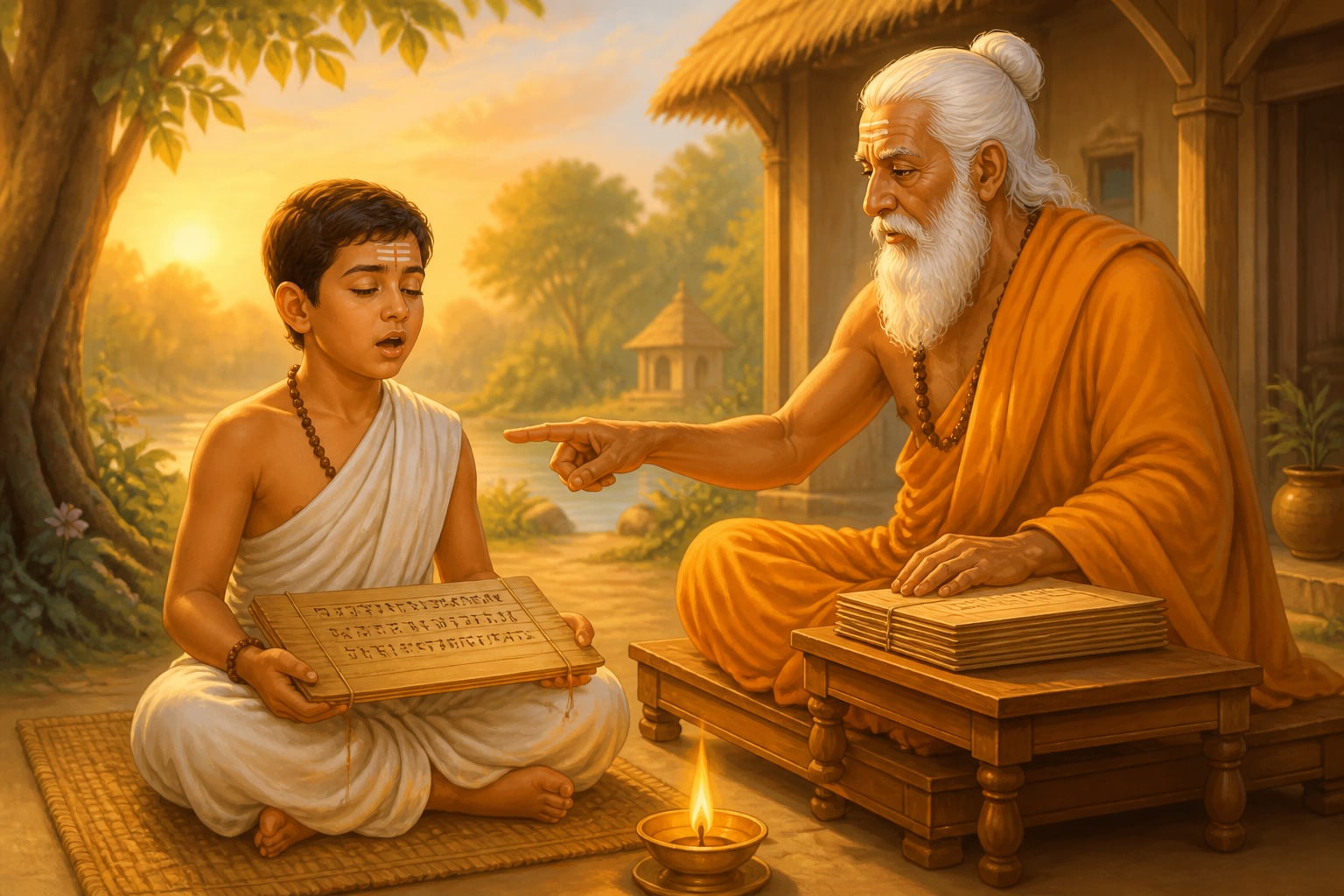
The old teacher smiled. He had waited three years for this question. The young brahmachari had arrived eager to learn, and learn he did, absorbing the Vedas like the Saraswati absorbs rain. But absorption is not understanding.
"Tell me," the guru said, "when you recite the Gayatri at dawn, what do you see?"
"I see... the words. The syllables. I ensure I make no errors."
"And that is why you feel empty. You have learned to speak to the sun. You have not yet learned to see it."
The Difference the Rishis Named
The Vedic tradition makes a distinction that modern education often misses: the difference between jñāna (knowledge that transforms) and mere vṛtti (mental information). Both involve knowing, but they are not the same.
The student in our story had acquired what the tradition calls śābda-jñāna, knowledge from words. He could recite, explain, and analyze. But this is like having a detailed map of a territory you have never visited. The map is useful, but it is not the journey.
The Rishis used another term: aparā vidyā (lower knowledge) versus parā vidyā (higher knowledge). The Mundaka Upanishad states it directly:
"dve vidye veditavye... parā caivāparā ca"
"Two kinds of knowledge must be known, the higher and the lower."
The lower includes all the Vedas, grammar, etymology, meter, astronomy, everything that can be transmitted through words. The higher? That which makes the knower directly perceive the imperishable.
What the Mantras Reveal
The Rig Veda itself encodes this distinction. Consider Dirghatamas's famous riddle:
"Catvāri vāk parimitā padāni tāni vidur brāhmaṇā ye manīṣiṇaḥ"
"Speech has four measured quarters; those who are wise among the brahmins know them."
Word by word: catvāri (four) vāk (speech) parimitā (measured) padāni (quarters/steps) tāni (these) viduḥ (know) brāhmaṇāḥ (brahmins) ye (who) manīṣiṇaḥ (are wise).
The verse continues: "Three are hidden in secret; humans speak only the fourth."
This is not mystification, it's precision. Ordinary speech, the fourth quarter, deals with information. But meaning has deeper layers accessible only through refined perception. A scholar might analyze the grammar; a seer perceives what the grammar points toward.
Another mantra from Dirghatamas makes the point explicit:
"Uttvāḥ paśyan na dadarśa vācam uttvāḥ śṛṇvan na śṛṇotyenām"
"One who merely looks does not see speech; one who merely hears does not hear it."
Looking is not seeing. Hearing is not understanding. The Rishi distinguishes between the surface activity and the depth of perception.
Yajnavalkya's Teaching
The most famous illustration comes from the Brihadaranyaka Upanishad. The great sage Yajnavalkya prepares to renounce the world. His wife Maitreyi asks if wealth will make her immortal.
"No," Yajnavalkya replies. "Through wealth, there is no hope of immortality."
Maitreyi's response became legendary: "yenāhaṃ nāmṛtā syām, kim ahaṃ tena kuryām?"
"What shall I do with that which will not make me immortal?"
This is the pivot point. Maitreyi wasn't interested in information about immortality, she wanted the knowledge that is immortality. The distinction matters. Yajnavalkya responds not with more information but with direct instruction on perceiving the Self:
"ātmā vā are draṣṭavyaḥ śrotavyo mantavyo nididhyāsitavyaḥ"
"The Self should be seen, heard, reflected upon, and meditated upon."
Notice the first word: draṣṭavyaḥ, it should be seen. Not learned about. Not memorized. Seen. This is the draṣṭā principle applied to self-knowledge.
Traditional Interpretations
Sayanacharya explains that the "four quarters of speech" represent increasingly subtle levels: vaikharī (audible speech), madhyamā (mental speech), paśyantī (illumined speech), and parā (transcendent speech). Only the first is accessible through information; the others require refined perception.
Sri Aurobindo interprets this as the difference between mental knowledge and supramental vision. In The Life Divine, he writes: "Mind can reflect the truth but cannot contain it wholly... There is a knowledge by identity which is the basis of all true knowledge."
Adi Shankaracharya made this distinction the foundation of his teaching. In his debates across India, he encountered scholars with encyclopedic knowledge of scriptures. His method was to push past information to insight: "You have learned what the texts say. Have you realized what they mean?"
In an age of information overload, the Vedic distinction matters more than ever. We have access to more data than any previous generation, yet insight remains rare. Understanding that information and insight operate differently helps us redirect attention from accumulation to transformation.
Insight in Our Time
The distinction between insight and information has never been more relevant, or more neglected.

Consider Srinivasa Ramanujan, the mathematician who arrived in Cambridge with notebooks full of theorems he couldn't prove conventionally. His collaborator G.H. Hardy was astonished: "He had never learned what a proof was. And yet his results were true." Ramanujan described his process as the goddess Namagiri writing equations on his tongue during sleep. Whatever the mechanism, he saw mathematical truths that others could only approach through laborious derivation.
Or consider medical diagnosis. In 2016, a study at Johns Hopkins found that experienced physicians correctly diagnosed complex cases 20% more often than algorithms fed the same data. The doctors couldn't always explain their reasoning. They saw patterns, in the patient's gait, skin tone, the way they described symptoms, that raw information missed.
AI systems like ChatGPT represent the apotheosis of information processing. They can analyze, synthesize, and generate text from vast datasets. What they cannot do is see. They correlate patterns without perceiving meaning. This isn't a criticism, it's a clarification. The machine processes the fourth quarter of speech with unprecedented power. The first three quarters remain inaccessible to it.
Cognitive science distinguishes 'thin-slicing' (expert intuition built through deep engagement) from 'data processing' (pattern-matching without understanding). Malcolm Gladwell's 'Blink' documents how experts in art, therapy, and sports see in seconds what analysis takes hours to deduce, because they perceive at a deeper level.
Jeff Bezos's '70% information rule' states that good leaders act when they have 70% of the data, because insight fills the gap. Waiting for 90% often means analysis paralysis. The distinction isn't about ignoring data but about seeing beyond it.
Peter Senge's 'Fifth Discipline' distinguishes 'detailed complexity' (many variables) from 'dynamic complexity' (patterns over time). Data addresses the first; insight perceives the second. Systems thinkers see structures that data alone cannot reveal.
Carl Rogers's research showed that therapy works not through information (patients usually know what's wrong) but through conditions that enable insight. The same facts, experienced with presence and acceptance, suddenly transform. Knowing about trauma isn't healing; insight into it is.
Leadership development research shows that most training fails to produce behavioral change. What works is 'crucible experiences' (Warren Bennis), moments of insight that reorganize how leaders see. You can't lecture someone into leadership; something must shift.
Donella Meadows noted that the deepest leverage in systems is 'the mindset out of which the system arises.' Changing rules changes behavior; changing how people see changes everything. Information alters the rules; insight alters the seeing.
Your Path Forward
The Vedic insight invites a personal question: Where in your life are you accumulating the fourth quarter while neglecting the other three?
You might know a great deal about meditation without ever sitting still. You might have read every book on leadership without ever leading. You might understand relationship psychology without ever being truly present with another person.
The guru's response to his student wasn't "study more." It was "see." The shift from information to insight isn't about quantity, it's about the quality of attention. Maitreyi didn't need more data about immortality. She needed the perception that transforms the knower.
This leads to the next question: If insight comes through seeing, what exactly are we meant to observe? The Rishis turned their attention to both outer nature and inner experience, the subject of our next lesson.
Case studies
Ramanujan and the Goddess: Mathematical Insight Beyond Information
Srinivasa Ramanujan arrived at Cambridge in 1914 with notebooks full of thousands of mathematical formulas. He had almost no formal training, no knowledge of proofs, standard methods, or the accumulated information of Western mathematics. Yet his results, when Hardy and Littlewood examined them, were profoundly true. Some took decades to prove; some remain unproven but verified computationally. When asked about his method, Ramanujan said the goddess Namagiri wrote equations on his tongue during dreams. Hardy, the atheist, could only say: 'He had never learned what a proof was. And yet his results were true.'
Ramanujan exemplifies the distinction between aparā vidyā (lower knowledge, mathematical technique) and parā vidyā (higher knowledge, direct perception of mathematical truth). He saw what others had to derive. His method wasn't information processing but something closer to the draṣṭā's vision, direct perception of patterns that exist in the 'supreme imperishable space' of mathematical reality.
Ramanujan's notebooks continue to yield discoveries a century later. His 'lost notebook,' rediscovered in 1976, contained results that connected to black hole physics and string theory, fields that didn't exist in his lifetime. The most recent complete proof of one of his formulas came in 2012. He didn't process information to these conclusions; he saw them.
Information and technique are valuable but not ultimate. The deepest insights in any field may come through perception rather than derivation. The Vedic framework doesn't dismiss learning, it contextualizes it as preparation for seeing.
Breakthrough innovations in fields from mathematics to music frequently come through sudden insight rather than incremental reasoning. Google's famous '20% time' and 3M's innovation culture both attempt to create conditions for the kind of intuitive leaps that Ramanujan experienced naturally.
Of Ramanujan's approximately 3,900 results, most have been proven true. Several anticipated theories developed 50+ years after his death. His 'mock theta functions' are now understood to connect to quantum black holes.
Yajnavalkya and Maitreyi: The Original Question
In the Brihadaranyaka Upanishad, the sage Yajnavalkya prepares to renounce the world and divide his wealth between two wives. Katyayani accepts her portion. Maitreyi asks the pivotal question: 'If this whole earth filled with wealth were mine, would I be immortal through it?' Yajnavalkya says no. Maitreyi responds: 'Then what shall I do with that which will not make me immortal?' She wasn't being dramatic, she was applying the transformation criterion. Information about wealth, even spiritual information, wasn't what she sought.
Maitreyi's question distinguishes two types of seekers: those who accumulate (even spiritual knowledge) and those who seek transformation. Yajnavalkya responds not with more information but with direct instruction: 'The Self should be seen.' The teaching that follows isn't doctrine to be memorized but a pointer to direct perception. This dialogue became foundational precisely because it clarifies what spiritual inquiry actually seeks.
The Yajnavalkya-Maitreyi dialogue became one of the most influential passages in Indian philosophy. Adi Shankaracharya cited it repeatedly in establishing Advaita Vedanta. The question 'yenāhaṃ nāmṛtā syām, kim ahaṃ tena kuryām?' became a litmus test for spiritual seriousness, cutting through accumulation to transformation.
The distinction between information and insight isn't academic, it determines whether seeking leads to realization or endless accumulation. Maitreyi's question remains relevant: Is what you're pursuing capable of transforming you, or just informing you?
The distinction between information accumulation and genuine understanding is the central challenge of modern education. Students with access to unlimited information through the internet still struggle with wisdom, confirming Maitreyi's ancient question: does what you are accumulating lead to what truly matters?
The Brihadaranyaka Upanishad, one of the oldest Upanishads (c. 700 BCE), contains 6 chapters and is the longest of all Upanishads. The Yajnavalkya-Maitreyi dialogue appears twice (in chapters 2 and 4), and Maitreyi is one of the earliest named women philosophers in recorded history.
Reflection
- What is one thing you know a great deal about but haven't truly seen, where information hasn't become insight?
- Why might the guru have waited three years before addressing his student's emptiness?
- Can a machine ever have insight, or is information processing fundamentally different from seeing?