Pratyakṣa: Observation of Nature and Self

Two Laboratories of the Vedic Seer

The Rishis maintained two complementary fields of observation: the external world of nature and the internal world of consciousness. Through hymns to Dawn, Fire, and the Seasons, we discover how Vedic seers saw the outer and inner as mirrors of each other, and why genuine insight requires attending to both.

The Rishi sat facing east, awaiting Uṣas, the Dawn. The horizon lightened from black to indigo to rose. The first birds stirred. The fire beside him, carefully tended through the night, cast its steady glow against the coming light.

He watched the transition, darkness yielding to light, formlessness to form, possibility to actuality. Then, at the moment the sun crested the horizon, he closed his eyes and turned his attention inward.
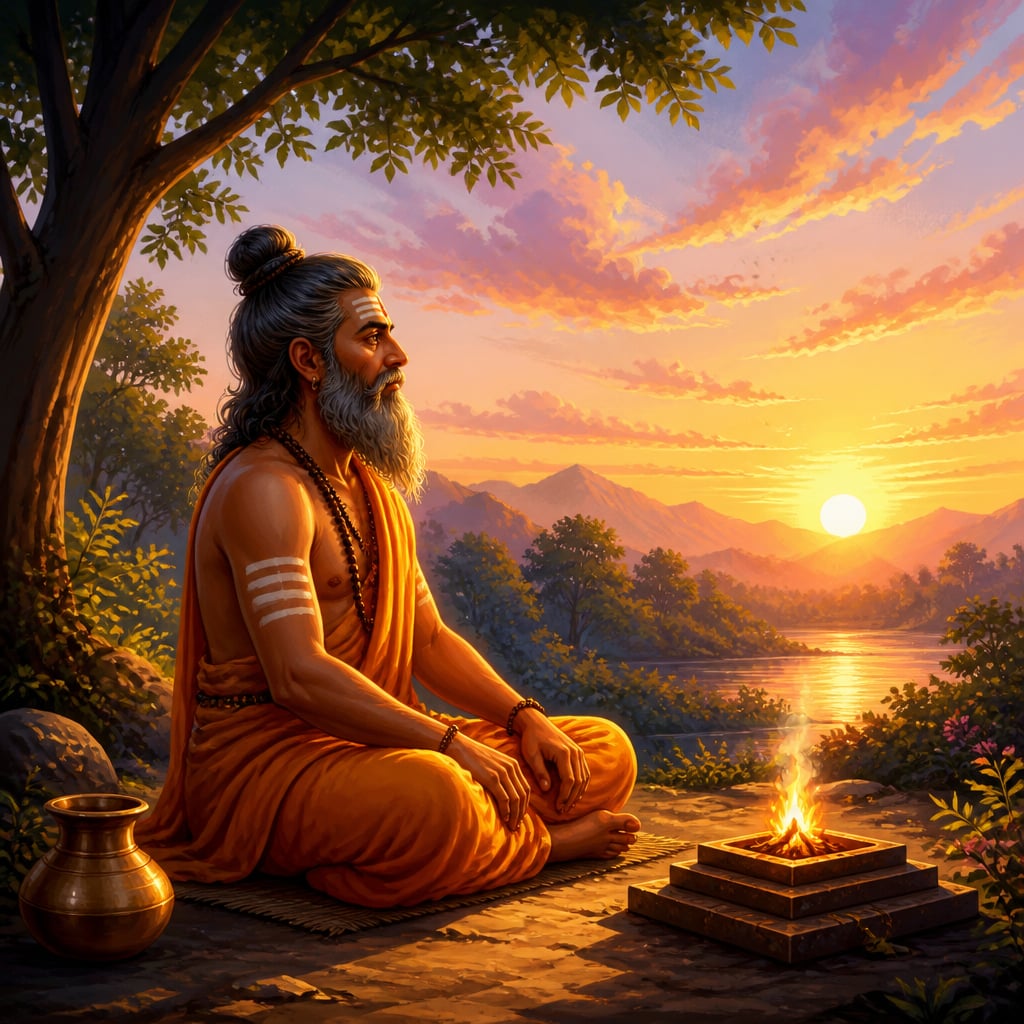
Rishi greeting Ushas at dawn

There too, he observed a dawn. Thoughts emerged from the darkness of sleep. Awareness kindled. The inner world, like the outer, moved from potential to manifest. Two dawns, two laboratories, one observer.

The Twin Fields of Observation

The Vedic seers were not mystics who rejected the world for pure introspection, nor were they naturalists who ignored inner experience. They moved between two fields of observation, bahir (outer) and antar (inner), treating both as legitimate sources of knowledge.

The Rig Veda's hymns reflect this dual attention. The Uṣas Suktas (Dawn Hymns) describe not just the physical sunrise but the arising of consciousness itself. The Agni Suktas (Fire Hymns) explore both the transformative power of physical fire and the inner fire of awareness and aspiration. The Ṛtu Suktas (Season Hymns) map cosmic cycles onto the rhythms of human life.

This wasn't metaphor for poetry's sake. The Rishis genuinely observed that outer and inner reality follow parallel patterns. Understanding one illuminated the other.

What the Mantras Reveal

The most celebrated Dawn hymn opens with this observation:

"Uṣā uchanti prathamā purastaāt divaspṛthivyorantarikṣāt"

"Dawn shining forth, the first, from the east, from heaven, earth, and the space between."

Word by word: uṣāḥ (dawn) uchanti (shining) prathamā (first) purastāt (from the east) divaḥ (from heaven) pṛthivyoḥ (and earth) antarikṣāt (from mid-space).

The verse positions Dawn as emerging from all three cosmic realms, suggesting that true dawn is not merely solar but a universal arising. The seer who watches outer dawn learns to watch inner dawn.

Another revealing verse from the Agni hymns:

"Agniṃ dūtaṃ vṛṇīmahe hotāraṃ viśvavedasam"

"We choose Agni as messenger, the priest who knows all things."

Agni, fire, is both the physical element and the inner flame of awareness. The Rishi observes fire's behavior: it transforms what it receives, it rises upward, it illuminates darkness, it requires tending. These are not metaphors imposed on fire but characteristics observed in fire and then recognized within.

The Correspondence Principle

The Rishis worked from a fundamental insight that modern systems thinking has rediscovered: patterns repeat across scales. The macro and micro reflect each other.

Sayanacharya explains this as adhidaiva (cosmic), adhibhuta (natural), and adhyatma (psychological) interpretations of the same phenomenon. A hymn to Indra slaying Vritra can be read as cosmic (light overcoming darkness), natural (rain breaking through drought), or psychological (consciousness breaking through obstruction). All three are valid; the pattern is one.

Sri Aurobindo developed this extensively in The Secret of the Veda: "The Veda uses the physical universe as a symbolic representation of an inner reality. The gods are not merely powers of nature; they are powers of consciousness. But this symbolism is not arbitrary, it is based on the fact that the outer and inner are built on the same plan."

This is not primitive animism or loose metaphor. It's systematic observation of correspondence, the same patterns appearing in outer nature and inner experience.

Seeing Nature, Knowing Self

The practical implication is profound: to know yourself, observe nature; to understand nature, observe yourself.

Consider how the Rishis observed fire. They noted that Agni:

Then they observed inner awareness with the same precision. Consciousness also:

The parallel is not constructed but discovered. Fire and awareness genuinely share these characteristics. The Rishi who watches fire carefully is also learning about consciousness.

A Modern Parallel

John Muir observing a bee in a Sierra Nevada meadow

John Muir, the Scottish-American naturalist, stumbled upon this Vedic principle through pure observation. Spending years alone in the Sierra Nevada wilderness, he began with scientific observation of glaciers, trees, and watersheds. But the deeper he looked at nature, the more clearly he saw himself reflected.

"I only went out for a walk," he wrote, "and finally concluded to stay out till sundown, for going out, I found, was really going in."

Muir discovered that meticulous attention to the natural world led to self-knowledge, not through introspection about himself but through losing himself in observation of the other. The boundary between observer and observed softened. He reported experiences remarkably similar to what the Rishis describe.

This wasn't unique to Muir. Rachel Carson, author of Silent Spring, described how her careful observation of tidal pools led to insights about interconnection that transformed her worldview. Charles Darwin's patient observation of finches led him to see patterns that reorganized his understanding of life itself, and profoundly changed how he understood his own place in existence.

The Method

The Vedic method involves systematic attention to both fields:

Bahir-Dṛṣṭi (Outer Observation):

Antar-Dṛṣṭi (Inner Observation):

Correspondence Recognition:

Patanjali teaching disciples beneath a pipal tree

Patanjali, centuries later, would systematize this inner observation as Yoga. His method, precisely observing mental modifications (vrtti) with the same rigor one would observe natural phenomena, codified what the Rishis practiced implicitly.

In an era of specialization, we've separated science (outer observation) from contemplation (inner observation). The Vedic integration offers a more complete epistemology: reality is known through both windows, and insights from each illuminate the other. This unified approach is increasingly relevant as systems thinking, ecology, and contemplative science converge.

Ecopsychology research shows that nature immersion correlates with psychological well-being, but the Vedic insight goes deeper: observing nature trains the faculty of observation itself. What you learn watching a river applies to watching your mind.

Peter Senge's systems thinking encourages leaders to observe organizational patterns like naturalists observe ecosystems. The parallel isn't metaphor, organizations genuinely behave like living systems. The observation skills transfer.

Fritjof Capra's 'The Web of Life' shows how understanding ecological systems requires seeing patterns that also appear in social and cognitive systems. Nature is a laboratory for all systems understanding.

Carl Jung's concept of 'active imagination' involves observing inner images with the same objectivity one would apply to outer phenomena. The technique mirrors the Vedic dual observation, same method, different field.

The metaphor of 'keeping the fire alive' in organizations isn't merely poetic. Motivation, culture, and vision require the same tending as physical fire, fuel, air, attention. Leaders who understand fire understand teams.

Thermodynamic principles (transformation, entropy, energy flow) apply to information systems, organizational systems, and mental systems. The pattern is one; the domains differ. Understanding one helps understand all.

Your Path Forward

The modern world tends to separate science (outer observation) from spirituality (inner reflection). The Vedic insight suggests this separation is artificial and impoverishing.

You might ask: What would it mean to observe your inner world with the same patience and precision you'd bring to watching a sunrise? And conversely: What might you learn about yourself by truly watching fire, water, wind, or light?

The Rishis' dawn observations weren't aesthetic appreciation, they were empirical investigation of reality through its two accessible windows: the world outside and the world within. Both are laboratories. Both yield knowledge. Neither is complete alone.

This leads to the next question: If inner observation is valid evidence, how do we distinguish genuine insight from mere imagination? The Rishis had answers, explored in our next lesson.

Case studies

John Muir: Going Out Was Really Going In

John Muir spent years alone in the Sierra Nevada wilderness, beginning as a scientific observer documenting glaciers, flora, and geological formations. He brought rigorous observation to nature, measuring, mapping, noting patterns. But something unexpected happened. The deeper his observation went, the more the boundary between observer and observed dissolved. 'I only went out for a walk,' he wrote, 'and finally concluded to stay out till sundown, for going out, I found, was really going in.' His nature journals increasingly recorded not just external phenomena but transformations in his own perception and understanding.

Muir discovered the Vedic principle of correspondence through pure practice. He didn't know Sanskrit or read the Upanishads, yet he arrived at the same insight: outer observation and inner observation are not separate endeavors but complementary aspects of a single inquiry. Nature became his laboratory for self-knowledge, precisely what the Rishis practiced by the Saraswati.

Muir became not just a naturalist but a mystic-naturalist whose writings inspired the American conservation movement. His insight that 'when we try to pick out anything by itself, we find it hitched to everything else in the universe' echoes the Vedic understanding of interconnection. His careful observation of nature led to environmental ethics, outer seeing transformed inner values.

Deep observation of the external world leads naturally to self-knowledge. The Vedic dual-laboratory approach isn't mystical technique but natural development: attend carefully enough to anything outside, and you learn about what's inside. Muir proved this through decades of practice.

Forest bathing (shinrin-yoku), nature therapy, and wilderness programs for mental health all build on the same observation: sustained, attentive engagement with the natural world produces inner transformation. The prescription to 'go outside' is now backed by clinical evidence showing reduced cortisol, improved immune function, and enhanced creativity.

Muir's journals contain over 10,000 pages of observations. Studies of his writings show a progressive evolution from purely scientific description to increasingly integrated nature-self insights over his 40+ years of wilderness observation.

Patanjali's Systematic Inner Observation

Around 2nd century BCE, Patanjali systematized the observation of mental phenomena with the same rigor the Rishis had applied to observing nature. His Yoga Sutras begin with a precise definition: 'yogaś citta-vṛtti-nirodhaḥ', yoga is the cessation of the modifications of mind. But before cessation comes observation. Patanjali catalogs the vṛttis (mental modifications) with taxonomic precision: right knowledge, wrong knowledge, imagination, sleep, memory. He notes their qualities, their causes, their interactions, exactly as a naturalist would classify species.

Patanjali applied the Rishis' observation method to the inner field alone, creating what might be called 'inner naturalism.' His approach wasn't mystical escape but empirical investigation. He observed mental phenomena with the same patient precision the Uṣas poets brought to watching dawn. The method is identical; the field shifted from outer to inner.

The Yoga Sutras became the foundational text of systematic inner observation, influencing not just Hindu practice but Buddhist meditation, Jain contemplation, and eventually Western psychology. William James called Patanjali's approach 'the most systematic introspection ever undertaken.' Modern mindfulness derives much of its observational method from this lineage.

The method the Rishis developed for observing nature, patient, precise, non-interfering attention, transfers directly to inner observation. Patanjali proved that the mind can be studied with the same rigor as the physical world. The two laboratories use the same method.

Mindfulness-Based Stress Reduction (MBSR), now prescribed by physicians worldwide, applies Patanjali's core method: patient, non-interfering observation of mental phenomena. The technique has been validated in over 18,000 published studies, making the Yoga Sutras' approach one of the most empirically supported psychological interventions in existence.

Patanjali's Yoga Sutras contain exactly 196 aphorisms organized into 4 chapters (padas). The text systematizes the Ashtanga (eight-limbed) path of yoga. William James cited Indian contemplative traditions in 'The Varieties of Religious Experience' (1902), and modern neuroscience research has published over 6,000 peer-reviewed studies on meditation since 2000.

Reflection

More in Draṣṭā: Knowing Through Experience

All lessons in Draṣṭā: Knowing Through Experience · Rig Vedic Philosophy course