Vac: Speech as Action

Why the Rishis Believed Words Create Reality

Explore Vac, the Vedic understanding that speech is not merely communication but creative action. Through the Vak Sukta and the stories of Chanakya and modern business leaders, discover why the Rishis saw spoken words as forces that shape reality itself.

The young Brahmin walked into the palace at Pataliputra uninvited. He was not particularly impressive to look at, dark-skinned, with a broken tooth that made his smile unsettling. But when he began to speak in the court of the Nanda king, something shifted.
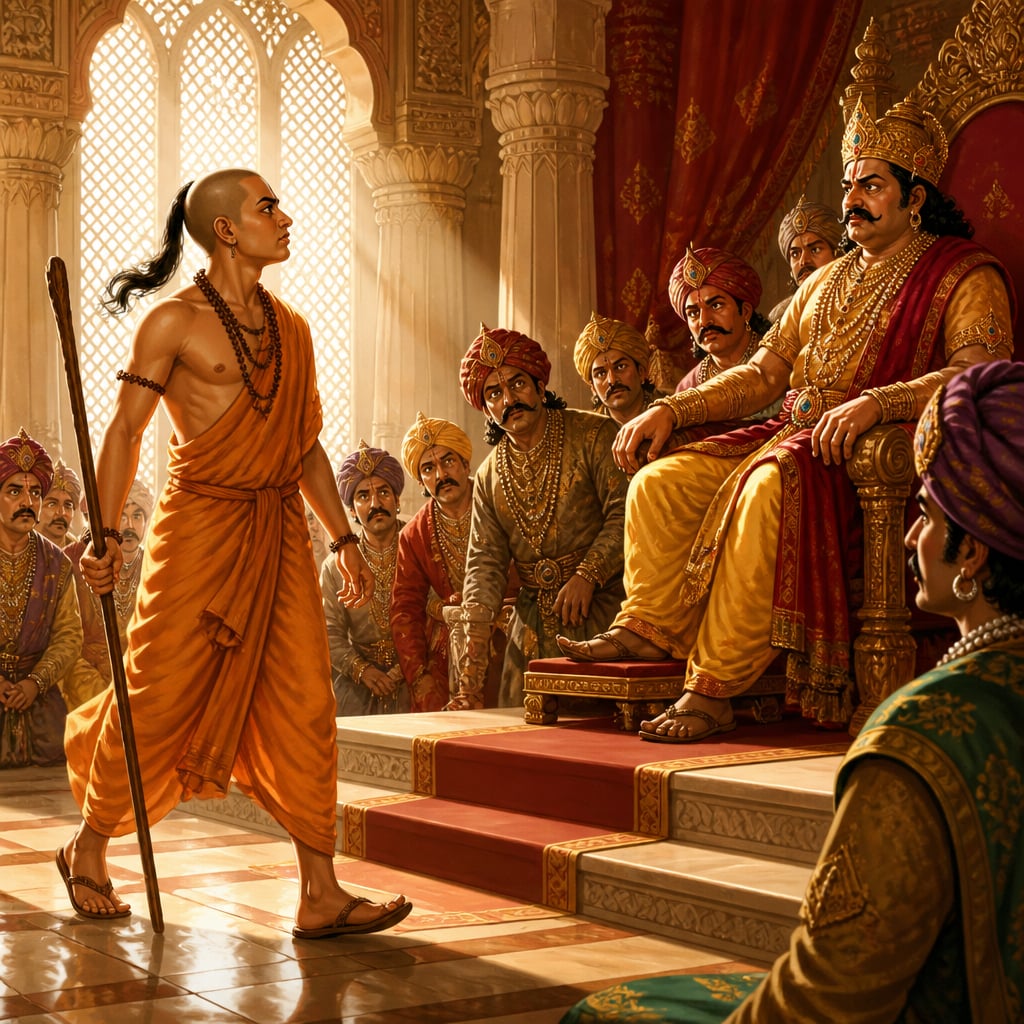
Chanakya enters Nanda court at Pataliputra

"Your dynasty," he said, "will end."

The courtiers laughed. The king ordered him thrown out. But Chanakya's words that day were not a prediction, they were the first action in a sequence that would, within years, bring the mighty Nanda empire to its knees and install a new dynasty in its place.

The Rishis of the Rig Veda would not have been surprised. They understood something that modern leaders often forget: speech is not merely description of reality. Speech creates reality.

A word of context as we explore this teaching: Understanding Vac as the Rishis did transforms how we approach communication. Modern leaders often treat speech as secondary to 'real' action. The Vedic perspective reveals that speech is the primary action, the force that shapes what actions become possible. This insight is particularly relevant in an age where leaders must inspire, align, and mobilize through words more than through direct physical action.

The Vedic Discovery

In the Vedic worldview, Vac (वाच्), speech, was not simply a tool for communication. She was a goddess, a cosmic force, the very power by which creation itself came into being.

Goddess Vac speaking with luminous threads of creation

The Vak Sukta (RV 10.125) presents the goddess Vac speaking in the first person:

"अहं रुद्रेभिर्वसुभिश्चराम्यहमादित्यैरुत विश्वदेवैः" "I move with the Rudras, with the Vasus, with the Adityas and all the Devas."

This is not metaphor. The Rishis experienced speech as a force that moves through reality, accompanying the cosmic powers, shaping what comes into being. When a Rishi spoke a mantra correctly, they were not asking for rain, they were participating in the process by which rain manifests.

How Speech Creates

The creative power of speech operates through three mechanisms the Rishis identified:

Sankalpa-Vac: Speech that crystallizes intention. When a leader articulates a vision, they transform vague possibility into defined direction. The words themselves become the container that shapes subsequent action.

Satya-Vac: Speech aligned with cosmic truth (Rta). The Rishis believed that words spoken in alignment with deeper reality carry power precisely because they resonate with what already wants to emerge.

Mantra-Vac: Speech with accumulated power. Certain words, through repetition and association, acquire potency beyond their semantic meaning. A leader's signature phrases become mantras that move teams without requiring fresh argument.

Sayana's Teaching

The great commentator Sayana, explicating the Vak Sukta, emphasized that Vac is kriya-shakti, the power of action. He writes that speech is "the instrument by which the sacrifice is accomplished," meaning that words are not preliminary to action but are themselves action.

This insight transforms how we understand leadership communication. When a leader speaks, they are not preparing for action, they are acting. The speech itself sets forces in motion.

Aurobindo's Deeper Reading

Sri Aurobindo, in The Secret of the Veda, interprets Vac as the "faculty of divine expression which calls the gods into manifestation." For Aurobindo, every act of truthful speech participates in the cosmic process of bringing potential into actuality.

The leader who speaks with clarity about what their organization can become is not merely motivating, they are, in the Vedic sense, invoking. They are calling forth capacities that exist in potential but require articulation to manifest.

The Modern Resonance

Mukesh Ambani announcing Jio at the 2016 Reliance AGM

In 2016, at Reliance Industries' Annual General Meeting, Mukesh Ambani announced that Jio would offer free data and voice calls. Industry analysts called it impossible. Competitors dismissed it as marketing.

But Ambani's speech that day was not description, it was creation. The words themselves restructured the entire Indian telecom industry. Within two years, multiple competitors had collapsed or merged. Hundreds of millions of Indians came online. The digital economy transformed.

Ambani understood, perhaps intuitively, what the Rishis knew explicitly: certain speeches do not reflect reality, they generate it.

The pattern appears across transformative leadership. When Satya Nadella first articulated Microsoft's "growth mindset" culture, he was not describing what existed, he was speaking into existence what would emerge. When APJ Abdul Kalam described "India 2020," his words became seeds that germinated in the minds of a generation.

The Leader's Responsibility

If speech creates reality, then every word a leader speaks carries weight. The Rishis understood this as vak-tapas, the discipline of speech. It includes:

Careless speech, in the Vedic view, is not merely inefficient, it is destructive. It scatters the creative power of Vac, dissipating the leader's capacity to bring intention into manifestation.

Cognitive behavioral research confirms that self-talk shapes neural pathways. The stories we tell ourselves literally construct our experienced reality, the Vedic insight that 'I speak, therefore it becomes' is neurologically accurate.

Vision articulation research (Collins & Porras, Kotter) shows that clearly spoken organizational visions outperform unspoken ones by orders of magnitude, not because speech motivates but because it creates shared reality.

Complex systems are shaped by 'strange attractors.' A leader's clearly articulated vision functions as such an attractor, organizing chaotic possibilities into coherent direction.

Your Path Forward

The Vedic insight invites a fundamental reframe: What if your words are not commentary on your leadership but are themselves the substance of your leadership?

Consider: In the past week, what realities have you spoken into existence, intentionally or carelessly? What visions remain unarticulated, trapped in potential because you have not yet found the words to invoke them?

The Rishis did not speak lightly. They understood that Vac, properly employed, is one of the most powerful forces available to human beings. In the lessons that follow, we will explore how this power operates through ethics, narrative, silence, and trust.

But it begins here, with the recognition that shook Chanakya's listeners and that should shake us: Words are not about reality. Words are how reality comes to be.

Case studies

Mukesh Ambani's Jio Launch: Speech That Disrupted an Industry

On September 1, 2016, at Reliance Industries' Annual General Meeting, Mukesh Ambani announced that Jio would offer free voice calls forever and free data until December 31. The Indian telecom industry had never seen such an offer. Competitors Airtel, Vodafone, and Idea called it 'predatory' and 'unsustainable.' Analysts questioned the business model. The words seemed impossible.

Ambani's AGM speech exemplified Sankalpa-Vac, speech that crystallizes intention into direction. His words were not describing an existing reality or making a prediction. They were creating a new reality. The moment the words were spoken, every competitor, regulator, investor, and consumer had to respond to a world that had not existed before the speech.

Within two years, India's telecom landscape was unrecognizable. Vodafone and Idea merged to survive. Several smaller players exited the market. Data prices dropped by over 95%. India went from having among the world's most expensive mobile data to the cheapest. Over 400 million Indians came online for the first time. Ambani's words had literally restructured an industry.

The Vedic understanding of Vac explains why certain announcements have disproportionate impact: they are not communications about reality but creative acts that generate new reality. The leader who understands speech as action wields a transformative tool.

Major corporate announcements can reshape entire industries overnight. When Jensen Huang unveiled NVIDIA's AI strategy or when Satya Nadella announced Microsoft's OpenAI partnership, the words themselves restructured competitive dynamics, investment flows, and talent migration before any product shipped.

Jio acquired 100 million subscribers in 170 days, faster than any telecom company in history. Data consumption in India increased 10x within three years of the speech.

Chanakya's Counsel: Words That Built an Empire

In the 4th century BCE, a Brahmin named Kautilya (later known as Chanakya) was humiliated in the court of the Nanda king. According to tradition, he untied his shikha (sacred topknot) and vowed: 'I will not tie this again until I have destroyed the Nanda dynasty.' The words were spoken to an audience of one, but they set in motion one of history's most remarkable transformations. Chanakya would find, train, and counsel Chandragupta Maurya to overthrow the Nandas and establish the Mauryan Empire.

Chanakya understood Vac at the deepest level. His vow was not prediction or hope, it was Sankalpa that created an unalterable trajectory. More importantly, his counsel to Chandragupta demonstrates how speech builds capacity. Through words, teaching, advising, strategizing, Chanakya transformed an ordinary young man into an emperor. The Arthashastra itself is crystallized Vac, speech so precise it could guide a kingdom.

The Mauryan Empire became the largest empire in Indian history, eventually encompassing most of South Asia. Chandragupta's grandson Ashoka would spread Dharma across Asia. The empire's founding demonstrates how words, a vow, counsel, teaching, can reshape the political geography of a subcontinent.

Chanakya exemplifies the Vedic insight that speech is action. His vow created commitment. His counsel created capability. His text created institutional memory. At every level, words were not preliminary to action, they were the primary action from which military and political action followed.

Strategic advisors who operate behind the scenes, from political consultants to corporate board members, demonstrate that the most consequential speech often happens in private. The words that shape policy, strategy, and institutional direction are frequently spoken in rooms far from public attention.

Chanakya's Arthashastra contains 6,000 sutras organized across 15 books, covering everything from statecraft to espionage. It guided Indian governance for over 800 years before being lost and rediscovered in 1905.

Reflection

More in Vāc: Speech, Influence & Authority

All lessons in Vāc: Speech, Influence & Authority · Rig Vedic Leadership course