Mauna: Silence as Leadership
When Not Speaking Is the Most Powerful Speech
Explore Mauna, the Vedic understanding that silence is not the absence of speech but a form of Vac itself. Through the Buddha's 'noble silence' and Warren Buffett's investment philosophy, discover when not speaking creates more power than any words could.
A monk approached the Buddha with a question that had tormented philosophers for centuries: "Does the self exist after death?"
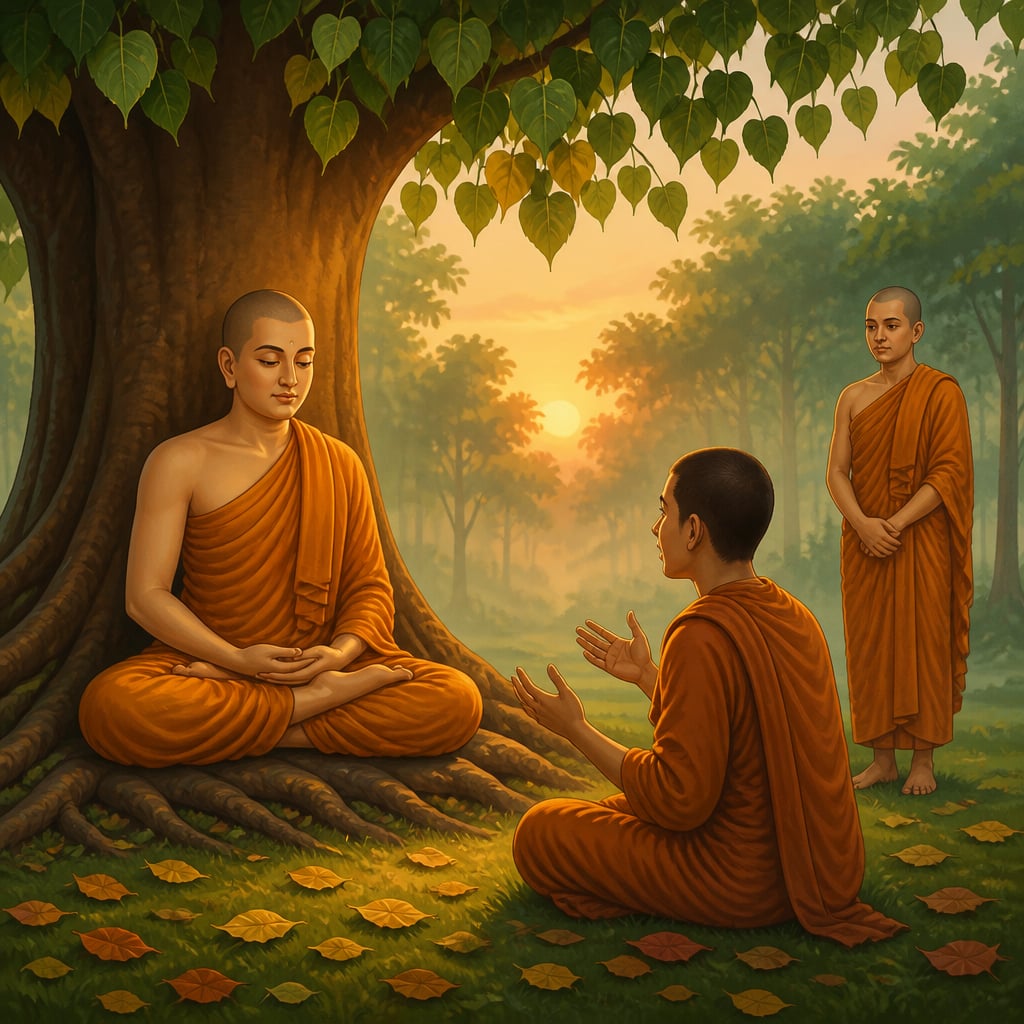
The Buddha was silent.
The monk tried again: "Does the self not exist after death?"
Silence.
"Does the self both exist and not exist after death?"
Silence.
"Does the self neither exist nor not exist after death?"
The Buddha remained silent. The monk, confused, eventually left.
Ananda, the Buddha's attendant, asked why he hadn't answered. The Buddha explained: "Any answer I gave would have been wrong, not because the question has no answer, but because the question itself emerges from wrong understanding. Sometimes the most truthful response is no response."
This was not the silence of ignorance. This was mauna, the strategic, powerful silence that accomplishes what speech cannot.
This insight carries weight because: In an age of constant communication, social media, 24-hour news, open-plan offices, the capacity for strategic silence is increasingly rare and increasingly valuable. The Vedic understanding of mauna offers a counterweight to the assumption that more communication is always better.
The Vedic Understanding
We have spent three lessons exploring the creative power of Vac, speech. But the Vedic tradition understood something equally important: speech's power comes partly from its contrast with silence.
The Rig Veda speaks of four levels of Vac:
"चत्वारि वाक् परिमिता पदानि" "Speech has four measured quarters."
The fourth and deepest level, Para Vac, is beyond ordinary speech. It is the silence from which speech emerges and to which it returns. The leader who speaks from this depth speaks rarely, but speaks with the weight of the unspoken.
Mauna as Active Vac
The Sanskrit tradition distinguishes multiple forms of silence:
Kashtha-Mauna: Silence of the body, physical non-speaking, which may or may not involve mental stillness.
Susupti-Mauna: Silence in deep sleep, absence of awareness, not a conscious practice.
Maha-Mauna: Great silence, the conscious choice to not speak, undertaken with full awareness of what could be said.
Para-Mauna: Supreme silence, the silence of one who has transcended the need for speech, where silence and expression become one.
For leaders, Maha-Mauna is most relevant: knowing what you could say, choosing not to say it, and letting that choice communicate.
Sayana on the Power of Restraint

Sayana, in his commentary, notes that the Vedic ritualists practiced vak-samyama, restraint of speech, as a form of tapas (transformative discipline). This was not suppression but concentration.
When speech is conserved, its eventual expression carries accumulated force. The leader who speaks constantly dissipates power. The leader who speaks rarely gathers it.
Aurobindo's Insight
Sri Aurobindo connects mauna to the deeper nature of consciousness:
"In the silence is heard the voice of the Divine.", Letters on Yoga
For Aurobindo, silence is not empty but full, pregnant with possibility. When a leader maintains silence in the face of noise, they hold space for truth to emerge. Sometimes the clearest insight comes not through analysis but through the stillness that allows seeing.
The Buddha's Method
The Buddha's silence on certain questions, known as the avyakata (unanswered) questions, was a deliberate teaching technique.
When asked metaphysical questions about the nature of the universe, the afterlife, or the ultimate nature of the self, the Buddha often remained silent. Later Buddhist commentators explained this as ariya-mauna, noble silence.
The Buddha's reasoning was practical:
- Some questions arise from wrong premises
- Some answers would create more confusion than clarity
- Some truths cannot be spoken but must be experienced
- Sometimes the question itself is the obstacle
This is not evasion. It is the recognition that speech has limits, and that sometimes the most honest thing a leader can do is not pretend speech can accomplish what it cannot.
The Buffett Method

Warren Buffett has built the most successful investment record in modern history partly through silence.
In an industry where analysts speak constantly, on television, in research notes, in quarterly calls, Buffett speaks remarkably little. His annual letter to shareholders is studied like scripture precisely because it is rare. His investment decisions are announced, not explained, until long after they are complete.
This is business mauna. Buffett understands:
- Silence preserves optionality: Explaining strategy invites countermoves.
- Silence accumulates weight: When Buffett speaks, markets move, because he so rarely speaks.
- Silence avoids commitment to premature conclusions: By not predicting, he avoids being wrong in public.
- Silence signals confidence: Not responding to critics suggests their criticism doesn't warrant response.
Berkshire Hathaway's "quiet period" philosophy, not commenting on investments, not responding to rumors, not engaging with short-term noise, is mauna as corporate strategy.
When Silence Communicates
Silence speaks in specific situations:
When the question is wrong: Like the Buddha's metaphysical questioner, sometimes answering validates a flawed premise. Not answering invites the questioner to reconsider.
When emotions are high: Speaking into anger often escalates. Silence can create space for de-escalation.
When you don't know: Pretending to know destroys credibility. "I don't know" is speech; silence is sometimes better, it doesn't even validate the expectation that you should know.
When speaking would foreclose possibility: Once you commit verbally, options narrow. Silence keeps doors open.
When presence is enough: Sometimes what people need is not advice but accompaniment. Being there without speaking can be more powerful than any words.
The Discipline of Mauna
Mauna is not natural for most people. It requires discipline:
Comfort with discomfort: Silence creates social tension. Mauna requires tolerance for that tension.
Confidence in one's position: Speaking often comes from anxiety, the need to fill space, to assert, to be seen as having answers. Mauna requires confidence that you don't need to speak to be respected.
Trust in emergence: Mauna requires faith that what needs to arise will arise, that not speaking doesn't mean nothing happens.
Wisdom about timing: The Vedic understanding is not that silence is always best, but that it has its kala, its right time. The art is discernment.
The Dangers of Mauna
Silence is not always wisdom. The tradition recognizes:
Cowardly silence: Not speaking when speech is needed, when injustice occurs, when clarification would help, when people need guidance.
Arrogant silence: Silence that communicates contempt rather than wisdom.
Confused silence: Not speaking because you don't know what to say, masquerading as strategic choice.
Negligent silence: Failing to communicate necessary information because it's easier not to.
True mauna is conscious choice from a place of fullness. Avoiding speech from emptiness or fear is not mauna, it is abdication.
Research on 'wise reasoning' by psychologist Igor Grossmann shows that acknowledging uncertainty, saying 'I don't know', is associated with better decision-making and is perceived as more credible than false confidence.
Susan Cain's research on introverted leaders shows that they often outperform extroverts in certain contexts because they listen more, speak less, and create space for others' contributions. Mauna creates collaborative space.
In complex adaptive systems, over-intervention prevents emergence. Leaders who maintain silence allow patterns to develop that premature speech would disrupt. Mauna is non-interference that enables system intelligence.
Your Path Forward
The Vedic insight challenges modern leadership culture, which rewards constant communication. We are trained to fill airtime, to demonstrate knowledge, to have answers.
But consider: What would happen if you spoke 30% less in meetings? If you paused longer before answering? If you let questions hang without immediately responding?
The Buddha's silence on metaphysical questions was his teaching. Buffett's investment silence is his strategy. Both understand what the Rishis knew:
Vac is powerful. And sometimes, the most powerful Vac is the silence that makes all speech meaningful.
Case studies
Warren Buffett: The Discipline of Quiet Power
In a financial world of constant commentary, CNBC appearances, analyst calls, quarterly guidance, Twitter pronouncements, Warren Buffett has built the most successful long-term investment record in modern history through systematic silence. Berkshire Hathaway does not provide quarterly earnings guidance. Buffett rarely comments on market movements. He does not respond to critics. His annual letter is studied precisely because it is his only extended communication each year.
Buffett practices vak-samyama, restraint of speech that accumulates power. His silence serves multiple functions: it preserves optionality (competitors don't know his moves), accumulates weight (when he speaks, markets move), avoids commitment to premature conclusions (he is rarely wrong in public because he rarely predicts in public), and signals confidence (not responding to critics suggests their criticism doesn't merit response).
Berkshire Hathaway has compounded at approximately 20% annually for over five decades, a record unmatched in financial history. Buffett's reputation as the 'Oracle of Omaha' comes partly from his silence: like an oracle, he speaks rarely and cryptically, making his pronouncements seem profound. The discipline of mauna has created both financial returns and legendary status.
Buffett demonstrates that mauna is not weakness but strategy. In contexts where constant communication is expected, systematic silence differentiates. It creates scarcity value for speech, preserves strategic flexibility, and projects unshakeable confidence. His success is partly built on what he doesn't say.
In an age of constant social media commentary and executive hot takes, strategic silence stands out as a differentiator. Leaders like Tim Cook at Apple or Bernard Arnault at LVMH speak publicly far less than their peers, and each statement carries correspondingly greater weight. Scarcity of speech creates authority.
$1,000 invested in Berkshire Hathaway in 1965 would be worth over $30 million today. Buffett speaks to the press perhaps a few times per year. The ratio of returns to words is perhaps the highest in business history.
The Buddha's Noble Silence: Avyakrita Questions
Throughout his teaching career, the Buddha was asked metaphysical questions: Is the universe eternal or not? Is it finite or infinite? Does the self continue after death? Are the body and self the same or different? The Buddha consistently refused to answer these questions, maintaining what later tradition called 'noble silence.' When pressed, he explained through the parable of the poisoned arrow: a man shot with an arrow shouldn't refuse treatment until he knows the archer's name, caste, and motivations.
The Buddha's avyakrita represents wisdom about the limits of speech. Some questions arise from wrong premises, answering them validates the wrong frame. Some truths cannot be spoken but must be experienced. Some answers would create more confusion than clarity. The Buddha's mauna was not ignorance but the recognition that speech has limits, and that sometimes the most helpful teaching is non-teaching.
The Buddha's selective silence became a teaching method adopted across Buddhist traditions. It directed attention away from metaphysical speculation toward practical liberation. It also created profound respect: a teacher willing to say 'I won't answer that' demonstrated integrity that endless philosophical discourse would not have achieved.
The Buddha demonstrates that avyakrita, strategic non-answering, is itself a form of wisdom communication. Leaders constantly face questions they should not answer: competitive intelligence, personnel matters, premature strategy. The Buddha's method shows that not answering can be more honest and more effective than any response.
Skilled executives regularly decline to answer questions about unreleased products, ongoing negotiations, or personnel decisions. This disciplined non-answering is not evasion but wisdom: premature disclosure can harm stakeholders, limit future options, and create expectations that constrain strategy. Knowing what not to say is as important as knowing what to say.
The Buddha categorized 14 specific questions as 'avyakrita' (undeclared), consistently declining to answer them across 45 years of teaching. This disciplined silence is documented in over 20 suttas of the Pali Canon.
Reflection
- In your recent communications, where did you speak when silence might have been more powerful? What made you fill that silence with words?
- The Buddha said some questions should not be answered. What questions in your life might be avyakrita, better left unanswered because the question itself is wrong?
- If three-quarters of Vac is unspoken (Para, Pashyanti, Madhyama), what does this suggest about the relationship between what we say and what we know?