Stuti: Praise, Narrative and Morale

How Speech Builds Collective Energy and Fighting Spirit

Explore Stuti, the Vedic art of praise that builds collective energy. Through the speeches of Chhatrapati Shivaji and the calm leadership of MS Dhoni, discover how different styles of speech create team morale and fighting spirit.

The fortress of Pratapgad loomed above the Sahyadri hills. Below, Afzal Khan's massive army waited, forty thousand soldiers against a fraction of that number. Every military calculation said the Marathas should negotiate, flee, or surrender.
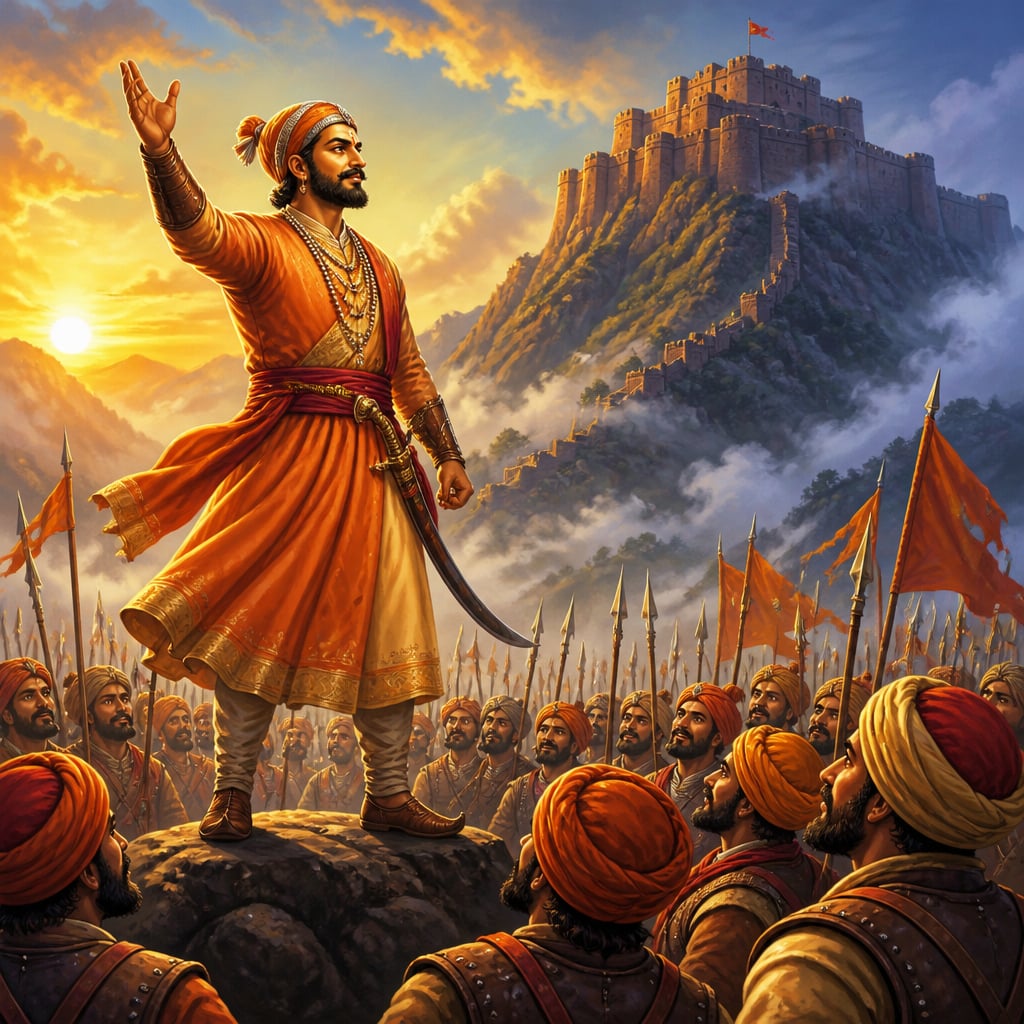
Shivaji addressing his Maratha soldiers at Pratapgad

But Shivaji had been speaking to his men for days.

Not about strategy. Not about numbers. About identity.

"We are the sons of this soil," he told them. "Our mothers' milk was mixed with the water of these hills. This is not a war for territory, it is a war for svadharma, for our own nature. They fight for plunder. We fight for our children's future. They have numbers. We have dharma."

When the battle came, those outnumbered soldiers fought as if each were worth ten. Afzal Khan was killed. His army scattered. An empire took notice.

The Rishis of the Rig Veda would have recognized what Shivaji was doing. He was performing stuti, praise that transforms ordinary people into extraordinary forces.

As we explore this principle: In modern organizations obsessed with metrics and criticism, the Vedic emphasis on stuti offers a counter-approach. Research consistently shows that positive-to-negative feedback ratios affect team performance. The Rishis understood this thousands of years ago: what you praise, you increase.

The Vedic Art of Stuti

The Rig Veda is, in large part, a collection of stuti, hymns of praise. But these are not flattery. They are speech designed to invoke and amplify power.

A Rishi praising Indra at a battle-eve altar

When the Rishis praised Indra before battle, they were not simply asking for help. They were performing a speech-act that raised collective energy:

"इन्द्रं वर्धन्तो अप्तुरः कृण्वन्तो विश्वमार्यम्" "Increasing Indra, making all noble, the waters flow."

The praise itself was understood to increase Indra's power. Speech that acknowledged strength created more strength. This was not wishful thinking but observed psychological reality: people rise to the image held of them.

Three Types of Stuti

The Vedic tradition distinguished multiple functions of praise-speech:

Deva-Stuti: Praise of cosmic powers. In leadership terms, this is articulating the larger purpose, connecting individual effort to forces greater than any one person. Shivaji's invocation of dharma was Deva-stuti in secular form.

Vira-Stuti: Praise of heroic qualities. This speech acknowledges and amplifies the strengths already present in the team. It makes people aware of their own capacities.

Vamsha-Stuti: Praise of lineage and identity. This connects individuals to a story larger than their own lives, ancestral achievement, organizational heritage, civilizational purpose.

Effective morale-building speech typically weaves all three: cosmic purpose, present capacity, inherited legacy.

Sayana on the Power of Praise

Sayana, commenting on the stuti hymns, notes that praise is not description but invocation. The Rishi does not merely observe Indra's strength, the Rishi calls forth Indra's strength through the act of praising it.

This transforms how we understand leadership communication. Praise is not reward for past performance. Praise is investment in future performance. When you speak of someone's strength, you strengthen them.

Aurobindo's Psychological Reading

Sri Aurobindo interprets the Vedic stuti as addressing forces within the human being. When the Rishis praise Indra's courage, they are calling forth the Indra-principle, the force of courageous action, within themselves and their community.

"The hymn is the voice of the human soul addressing the gods in their own language.", The Secret of the Veda

This interpretation suggests that praise-speech works by activating capacities that already exist. The leader who praises a team's resilience is not inventing a quality, they are making the team aware of and connected to their actual resilience.

Two Styles of Stuti: Shivaji and Dhoni

Stuti can take dramatically different forms while serving the same function.

Shivaji's Fire: His speeches were passionate, invoking identity and dharma with emotional intensity. He created tejas, fire, in his soldiers. His words were designed to raise energy, to make men feel capable of the impossible.

MS Dhoni offering a calm instruction in an ICC final

Dhoni's Cool: MS Dhoni's captaincy was famous for calm speech, understated praise, quiet confidence, composure under pressure. Rather than raising energy externally, he created conditions where players found their own centered strength.

Both are stuti. Shivaji's approach amplifies from outside; Dhoni's approach removes obstacles so inner capacity can emerge. The Vedic framework includes both: some situations need fire, others need stillness.

The Modern Science

Contemporary research confirms what the Rishis intuited:

Pygmalion Effect: Teachers who believe students are capable produce higher-performing students, even when the "capability" was randomly assigned. The belief, communicated through speech and behavior, becomes self-fulfilling.

Psychological Safety: Amy Edmondson's research shows that teams where members feel acknowledged and appreciated take more risks and perform better. Praise creates conditions for excellence.

Narrative Identity: Psychologist Dan McAdams demonstrates that the stories people tell about themselves shape their actual behavior. Leaders who tell teams they are resilient have more resilient teams, not through magic but through identity formation.

The Elements of Effective Stuti

Vedic stuti follows patterns that modern leaders can adapt:

Specificity: The Rishis praise specific qualities ("Indra of the thunderbolt") not vague positivity. Effective praise names particular strengths.

Story Connection: Stuti often recounts previous victories, connecting present challenge to proven capacity. "Remember when..." is powerful speech.

Purpose Linkage: The praise connects individual effort to larger purpose. The soldier is not just fighting, he is protecting dharma. The employee is not just working, she is building something meaningful.

Appropriate Register: Shivaji's fire fit his context. Dhoni's cool fit his. Stuti must match the situation and the people.

The Dhoni Method

MS Dhoni's verbal leadership deserves special attention because it demonstrates that stuti need not be loud.

In countless pressure situations, World Cup finals, Champions Trophy semifinals, IPL playoffs, Dhoni's communication style remained remarkably consistent:

This is stuti as dhairya, steadiness. Rather than adding external energy, Dhoni's speech removed anxiety, allowing players to access their own skill. His calm was itself praise: it communicated that the situation was within his team's capacity.

The Pygmalion Effect (Rosenthal & Jacobson, 1968) demonstrated that teachers' expectations shape student performance, even when expectations are randomly assigned. What we speak about people, they become.

Kim Scott's 'Radical Candor' framework emphasizes that praise should be specific and sincere. Generic praise ('Good job!') doesn't build capacity; specific praise ('Your analysis of the risk factors was exactly what we needed') does.

Positive feedback loops in systems amplify initial conditions. A leader's praise initiates a positive loop: praise → confidence → better performance → more genuine grounds for praise.

Your Path Forward

The Vedic insight challenges modern leadership habits. We often wait to praise until after success. The Rishis praised before battle, during challenge, as a way of building capacity rather than merely rewarding outcome.

Consider:

Shivaji's outnumbered soldiers won at Pratapgad because they had already won the battle of morale. Dhoni's teams performed under pressure because they had been spoken to in ways that removed pressure.

The lesson is clear: Stuti is not flattery and not reward. Stuti is speech that creates capacity. The leader who masters this art multiplies force, not through resources, but through words that transform what people believe about themselves.

Case studies

MS Dhoni: The Art of Calm Stuti

Throughout his captaincy career spanning 2007-2019, MS Dhoni led India to victories in the T20 World Cup (2007), ODI World Cup (2011), and Champions Trophy (2013). What distinguished his leadership was not motivational speeches but composed communication. In final-over situations, when every cricket fan's heart races, Dhoni's conversations with bowlers were remarkably calm. Former teammates describe his messages as simple: 'You know what to do.' 'Just bowl your strengths.' 'This is normal.'

Dhoni practiced stuti as dhairya, steadiness rather than fire. His calm communicated more than words: 'This is within our capacity.' By not panicking, he praised his team's ability to handle pressure. By trusting them with simple instructions, he affirmed their competence. This is Vedic stuti in understated form, the absence of anxiety as itself a statement of confidence.

India's win percentages in close matches under Dhoni were among the highest in cricket history. Players consistently describe feeling 'calm' when Dhoni was behind the stumps. The 2011 World Cup final six, Dhoni promoting himself and finishing with a boundary, exemplified the mindset he created: unshakeable confidence that this was normal, manageable, within capacity.

Dhoni demonstrates that stuti need not be loud. Sometimes the most powerful praise is composed trust, communicating through calmness that you believe in your team's capacity. His method worked because it was authentic to his nature and appropriate to high-pressure sports contexts where added excitement can impair performance.

Research on high-performance teams in surgery, aviation, and sports consistently shows that calm, composed leadership under pressure improves outcomes. The leader who projects steadiness rather than urgency in crisis moments enables better decision-making from everyone around them.

Under Dhoni's captaincy, India won 110 ODI matches, the most by any Indian captain. His win percentage in ICC knockout matches (finals and semifinals) was significantly higher than statistical expectations.

Shivaji's Speeches: Fire That Built an Empire

In 1659, Shivaji faced the Adilshahi general Afzal Khan at Pratapgad. Khan commanded an army of 40,000; Shivaji had perhaps 10,000. Every strategic calculation suggested Maratha defeat. But for weeks before the confrontation, Shivaji had been speaking to his soldiers, not about tactics but about identity. 'We are the sons of this soil. Our dharma is to protect our mothers, our temples, our way of life. They fight for plunder; we fight for existence. They have numbers; we have truth.'

Shivaji performed all three types of stuti simultaneously: Deva-stuti (connecting the fight to dharma), Vira-stuti (acknowledging his soldiers' courage), and Vamsha-stuti (invoking their identity as sons of Maharashtra's soil). His speeches created tejas, fire, that expanded his soldiers' sense of what was possible. Numbers became irrelevant because identity had been transformed.

At the meeting, Shivaji killed Afzal Khan with concealed weapons (the famous 'wagh nakh' incident). His prepared troops then ambushed Khan's leaderless army. The victory at Pratapgad became legendary, proof that narrative and morale could overcome material disadvantage. This victory was the foundation of the Maratha Empire that would eventually dominate the subcontinent.

Shivaji demonstrates tejas-stuti, praise that adds fire. His approach worked because he connected individual soldiers to purposes larger than themselves and reminded them of an identity capable of extraordinary action. The battle was won in speech before it was fought in the field.

Before critical presentations, product launches, or negotiations, the best leaders invest in building their team's belief in the mission's significance. Pre-meeting speeches at companies like Salesforce, or locker room talks before championship games, demonstrate that connecting people to purpose before the challenge begins multiplies their performance.

At the Battle of Pratapgad (1659), Shivaji's force of 1,000 Maratha soldiers defeated Afzal Khan's army of 10,000 by combining strategic terrain advantage with morale built through speeches that invoked dharmic purpose.

Reflection

More in Vāc: Speech, Influence & Authority

All lessons in Vāc: Speech, Influence & Authority · Rig Vedic Leadership course