The Border Sentinels

BSF, ITBP, and SSB - Guarding Every Border

BSF at Pakistan and Bangladesh borders. ITBP at 18,000 feet on the China border with motto 'Shaurya-Dridhata-Karma Nishtha.' SSB guarding Nepal and Bhutan borders. The paramilitary heroes who stand vigil in the harshest conditions, never making headlines but always protecting India.

The Invisible Line

India has over 15,000 kilometers of land borders with seven countries: Pakistan, China, Nepal, Bhutan, Bangladesh, Myanmar, and Afghanistan (through PoK). Guarding these borders - from the frozen Himalayas to the swamps of the Sundarbans, from the deserts of Rajasthan to the jungles of the Northeast - is an enormous task.

The Indian Army guards the Line of Control with Pakistan and the Line of Actual Control with China. But the rest of India's borders - equally dangerous, equally vital - are guarded by paramilitary forces: the Border Security Force (BSF), the Indo-Tibetan Border Police (ITBP), and the Sashastra Seema Bal (SSB).

These forces rarely make headlines. There are no movies about their heroism, no national days in their honor. But they stand vigil every day, in every weather, against every threat - so that the rest of India can sleep in peace.

The Border Security Force - Seema Suraksha Bal

The BSF is India's largest border guarding force - over 250,000 personnel strong. It guards two of India's most dangerous borders: Pakistan (2,289 km) and Bangladesh (4,096 km).

The Pakistan Border: From the scorching deserts of Rajasthan to the marshy creeks of Gujarat, BSF personnel face not just harsh terrain but active hostility. Pakistani Rangers on the other side, smugglers trying to push drugs and weapons, terrorists attempting infiltration - the threats are constant.

BSF personnel routinely engage Pakistani firing along the International Border. They intercept smugglers in the dead of night. They discover and destroy tunnels built for infiltration. Every year, they suffer casualties - shot by Pakistani fire, killed by IEDs, martyred in encounters with infiltrators.
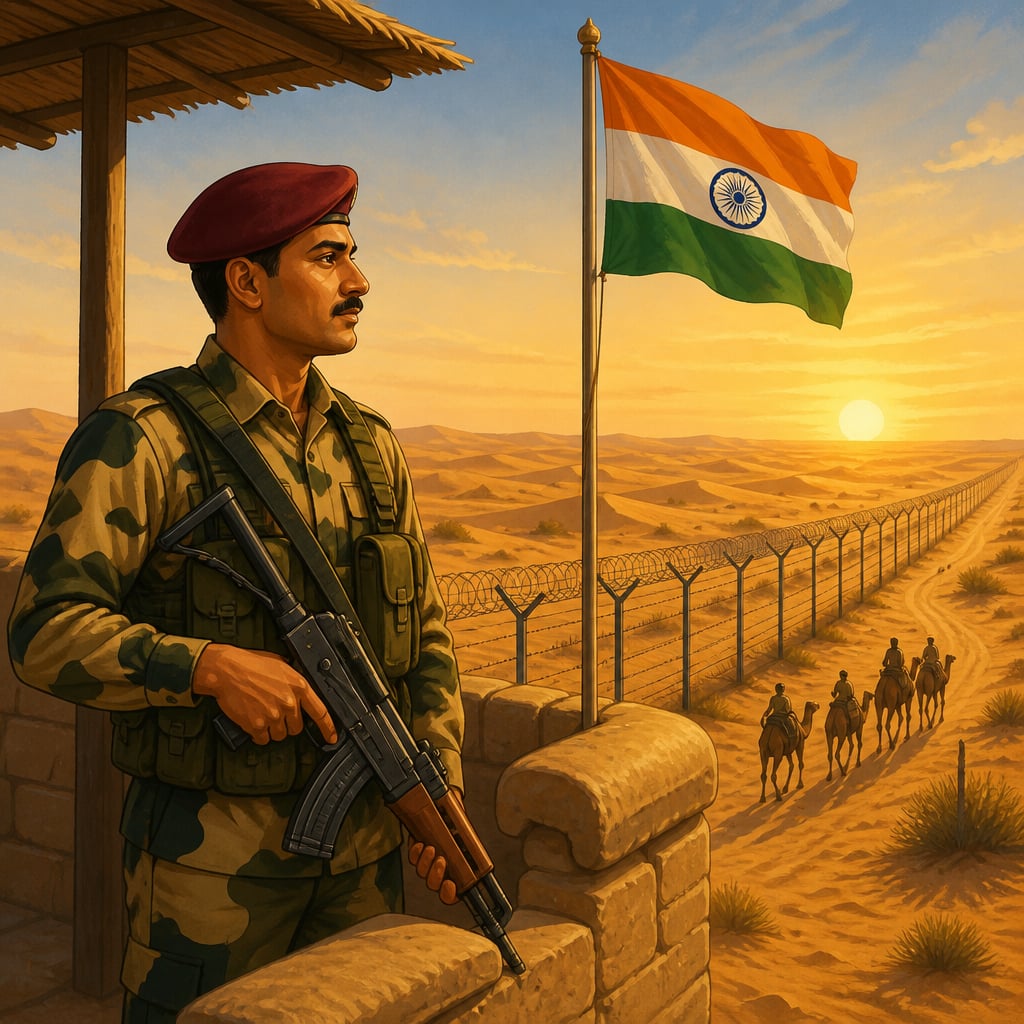
BSF jawan on watch at Thar Desert international border post at sunrise

The Bangladesh Border: The Bangladesh border presents different challenges. It runs through some of the most difficult terrain in India - the Sundarbans mangroves, the hills of the Northeast, the river islands of Assam. The threats here are infiltration, cattle smuggling, drug trafficking, and human trafficking.

BSF personnel patrol in waist-deep water in monsoons, on boats in the rivers, on foot through jungles teeming with tigers. They face smugglers who would rather kill than be caught. They stop trafficking networks that exploit desperate people.

The Motto: The BSF's motto is "Duty unto Death" - a reminder that for border guards, every day could be the last. The force has received 2 Ashoka Chakras, 11 Kirti Chakras, and over 100 Shaurya Chakras - testimony to the courage of its personnel.

ITBP - The Himveers

Roped ITBP Himveers patrolling a frozen Ladakh ridge at eighteen thousand feet

If the BSF guards India's most hostile borders, the ITBP guards its most inhospitable: the 3,488 km border with China, from Ladakh in the west to Arunachal Pradesh in the east.

The ITBP was raised in 1962, immediately after the Chinese betrayal, specifically to guard the Himalayan frontier. Its personnel are called "Himveers" - the brave ones of the Himalayas.

Life at 18,000 Feet: ITBP personnel serve at altitudes where oxygen is scarce, temperatures drop to -40°C, and winds can knock a man off his feet. They patrol glaciers, climb mountains, and man posts where helicopters cannot land for months at a time.

At these altitudes, simple tasks become ordeals. Walking requires gasping for breath. Water freezes in canteens. Frostbite is a constant threat. Yet ITBP personnel maintain vigil, patrol their sectors, and stand ready to face Chinese incursions.

The Motto: ITBP's motto is "Shaurya-Dridhata-Karma Nishtha" - Valor, Determination, and Devotion to Duty. The force has received 2 Kirti Chakras, 6 Shaurya Chakras, and over 130 Police Medals for Gallantry.

Galwan and Beyond: When Chinese forces clashed with Indian troops at Galwan in June 2020, ITBP personnel were among those who fought. The force has been at the forefront of the LAC standoff, conducting patrols, building defenses, and maintaining the watch against Chinese aggression.

SSB - The Friends Force

The Sashastra Seema Bal guards India's borders with Nepal (1,751 km) and Bhutan (699 km). Unlike the hostile borders with Pakistan and China, these are open borders with friendly nations. But open borders create their own challenges.

The Nepal Border: The India-Nepal border is unfenced and open. Citizens move freely across. This openness is wonderful for friendly relations but creates security vulnerabilities. Terrorists, criminals, and smugglers exploit the open border to enter India.

SSB personnel must distinguish between legitimate cross-border movement and criminal activity. They must maintain security without disrupting the friendship between peoples. It requires a different kind of vigilance - watching for threats among friends.

The Bhutan Border: The Bhutan border runs through some of the most remote terrain in the Northeast - hills covered in dense forest, valleys accessible only on foot. SSB personnel patrol these areas, often in small teams, far from support.

The Motto: SSB's motto is "Service, Security, Brotherhood" - reflecting its dual role as border guard and friend of border communities. The force engages in civic action, medical camps, and community outreach alongside its security duties.

The Central Reserve Police Force - Internal Guardians

While not strictly a border force, the CRPF deserves mention as India's largest paramilitary force - over 300,000 personnel. The CRPF is deployed wherever internal security is threatened: Kashmir, the Northeast, Naxal-affected areas.

The Pulwama Sacrifice: On February 14, 2019, a suicide bomber attacked a CRPF convoy in Pulwama, Kashmir. 40 CRPF personnel were martyred in a single attack - the deadliest terrorist strike on Indian forces in decades.

The names of those martyrs should not be forgotten. They came from across India - Punjab, UP, Rajasthan, Maharashtra, Tamil Nadu. They were young men with families, dreams, futures. They died because they chose to serve.

The Pulwama attack led to the Balakot airstrikes - India's response showing that such sacrifices would not go unavenged.

The Naxal Theater: CRPF personnel face a different but equally deadly enemy in central India - Maoist insurgents who have been fighting the Indian state for decades. Operations in dense jungles against an enemy that knows the terrain intimately, that uses IEDs and ambushes, have claimed hundreds of CRPF lives.

The April 2021 Bijapur ambush killed 22 CRPF and other security personnel. The 2017 Sukma ambush killed 25. These are not isolated incidents but part of a long, grinding war that gets little attention.

The Heroes We Don't Know

Paramilitary personnel receive less recognition than Army soldiers. Their sacrifices are noted in brief news reports, then forgotten. There are no films celebrating BSF valor, no songs about ITBP courage.

Yet consider what they do:

BSF constables stand post in the Thar Desert where temperatures reach 50°C, or in the Rann of Kutch where the ground itself seems to dissolve in monsoons.

ITBP jawans patrol at 18,000 feet in temperatures that freeze metal, where a simple slip can mean death.

SSB personnel trek through Himalayan forests where mobile phones don't work and help is days away.

CRPF troops conduct operations in jungles where any bush might hide an IED, any village might shelter insurgents.

They do this for modest salaries, limited facilities, and little public recognition. They do it because someone must.

Gallantry Under Anonymity

Paramilitary forces have their own gallantry awards: the Police Medal for Gallantry (PMG), Shaurya Chakra, Kirti Chakra, and Ashoka Chakra. Hundreds of personnel have received these honors.

Some stories:

Inspector Mohan Chand Sharma (AC Posthumous): Delhi Police Special Cell officer killed during the Batla House encounter in 2008. He led the assault on terrorists, was shot multiple times, and died ensuring the terrorists were neutralized.

ASI Tukaram Omble grabbing Ajmal Kasab's rifle barrel at a Mumbai street

ASI Tukaram Omble (AC Posthumous): Mumbai Police officer who caught Ajmal Kasab alive during 26/11. When Kasab tried to shoot him, Omble grabbed the gun barrel with his bare hands, taking the bullets in his body but preventing Kasab from escaping. His sacrifice ensured the only surviving terrorist could be brought to justice.

Constable Mahavir Prasad (KC Posthumous): BSF constable who single-handedly held off Pakistani attackers until reinforcements arrived. Wounded multiple times, he continued firing until his last breath.

These stories are rarely told. The heroes remain anonymous even in death.

The Families Left Behind

For every paramilitary jawan who serves, there is a family waiting - a wife who doesn't know when her husband will return, children who grow up seeing their father a few weeks a year, parents who worry every time the phone rings.

Paramilitary personnel are often posted far from home for years. Leave is scarce. Communication is difficult from remote posts. The family sacrifice is as real as the soldier's sacrifice.

When a jawan is martyred, the family receives compensation and a job offer for one member. But no compensation can replace a father, a son, a husband. The widows of paramilitary martyrs often struggle with bureaucracy, loneliness, and the task of raising children alone.

The Challenges Ahead

India's paramilitary forces face growing challenges:

Technology Gap: Smugglers and terrorists increasingly use drones, encrypted communications, and sophisticated equipment. The forces must keep pace.

Manpower Shortage: Despite their size, the forces are stretched thin across vast borders. Modernization and smart deployment are essential.

Hostile Terrain: Climate change is making some areas even more inhospitable. Glaciers are shifting, flooding is increasing, and extreme weather events are becoming more common.

Evolving Threats: From drug drones on the Punjab border to cyber threats everywhere, the nature of border security is changing.

Morale and Welfare: Better pay, housing, and facilities are essential to attract and retain quality personnel.

Duty Unto Death

The BSF motto captures the essence of paramilitary service: "Duty Unto Death."

Every day, over 900,000 paramilitary personnel wake up knowing they might not return home. They stand on borders where bullets fly, in jungles where IEDs lurk, at heights where the air itself is hostile.

They don't do it for glory - there is none. They don't do it for money - the pay is modest. They do it because India needs them, because someone must stand between the nation and its enemies.

The border sentinels are the first line of defense - before the Army, before diplomacy, before anything else. When infiltrators try to cross, it is a BSF constable who stops them. When Chinese patrols probe our territory, it is an ITBP jawan who confronts them. When smugglers try to exploit open borders, it is an SSB trooper who intercepts them.

They are the invisible warriors of India's borders - unseen, unsung, indispensable.

Seema Suraksha Bal. Himveers. Border Sentinels.

Duty unto death.

And so they serve, every day, on every border that defines India.

Key figures

ASI Tukaram Omble

The Pulwama 40

The Himveers

Case studies

The Catch of Kasab

A terrorist is firing an AK-47 at passersby. He has killed dozens. Police arrive but are outgunned. How do you capture him alive when he wants to die?

Sometimes the most important thing is not to kill the enemy but to capture him. Omble understood that a living terrorist meant evidence, trial, and proof of Pakistani involvement. His sacrifice served justice.

The capture of Ajmal Kasab alive provided India with irrefutable evidence of Pakistan's involvement in the 26/11 attacks. In any investigation, from criminal cases to corporate fraud, a living witness or intact evidence trail is worth more than any amount of post-facto analysis. Omble's instinct to capture rather than kill changed the geopolitical narrative.

Duty at 18,000 Feet

You're posted at an altitude where oxygen is scarce, temperatures hit -40°C, and supplies can't reach you for months. Every step is exhausting. What keeps you going?

The greatest enemy is often not the opponent but the conditions. Overcoming hostile environment requires mental strength beyond physical capability.

Scientists working in Antarctic research stations, submarine crews on months-long deployments, and astronauts on the International Space Station all face extreme isolation and hostile environments. The psychological techniques developed for ITBP jawans at 18,000 feet, including structured routines, peer support, and mission focus, are now studied by space agencies planning long-duration missions.

The Pulwama Response

40 of your colleagues have been killed in a terrorist attack. The nation mourns. What happens next?

Sacrifice must not be futile. When personnel give their lives, the nation must honor them not just with memorials but with action that prevents future attacks.

After every major security failure, the public demands immediate action but quickly forgets the issue. The organizations that create lasting change are those that convert public outrage into institutional reform before attention fades. India's post-Pulwama Balakot strikes and post-26/11 coastal security overhaul both followed this pattern of converting anger into structural improvement.

Historical context

India's Paramilitary Evolution

Reflection

More in The Invisible Warriors

All lessons in The Invisible Warriors · Param Veer: Guardians of the Heights (1984-Present) course