The Line of Control

LOC Patrol Heroes - The Daily Vigil

Every day, soldiers patrol the 740-km Line of Control facing snipers, infiltrators, and ceasefire violations. This lesson honors the unnamed heroes of the daily vigil - the jawans who face death every patrol, the officers who lead in impossible terrain, the families who wait at home. The constant watch that never ends.

The Line That Never Sleeps

It stretches 740 kilometers through some of the most treacherous terrain on Earth. From the frozen heights of Siachen to the forested slopes of Poonch, from the ridges of Uri to the passes of Kupwara. This is the Line of Control - the de facto border between India and Pakistan in Kashmir.

And every single day, Indian soldiers patrol this line. In blizzards and monsoons, in summer heat and winter cold, in daylight and darkness. 24 hours a day, 365 days a year, for over 75 years.

What is the LOC?

The Line of Control was born in war. After the 1947-48 war with Pakistan, a ceasefire line was drawn. In 1971, after another war, this was formalized as the Line of Control through the Simla Agreement.

But the LOC is not a normal border. It is not marked by fences everywhere. It passes through villages, farms, forests, and mountains. In some places, the opposing forces are just 50 meters apart. In others, they share the same water source.

It is a line of permanent tension. A line where a moment's lapse can mean death.

The Daily Patrol

Every morning, patrols set out from hundreds of posts along the LOC. Their mission: detect infiltration, report movement, maintain presence. Simple words that hide mortal danger.

The patrol might walk through a forest where a sniper waits. They might step on an IED planted overnight. They might encounter Pakistani Border Action Teams (BAT) - specialized soldiers who cross the line to attack. Many patrols return safely. Some do not.

There are no medals for routine patrols. No news coverage for another successful day. The soldiers simply wake up the next morning and do it again.
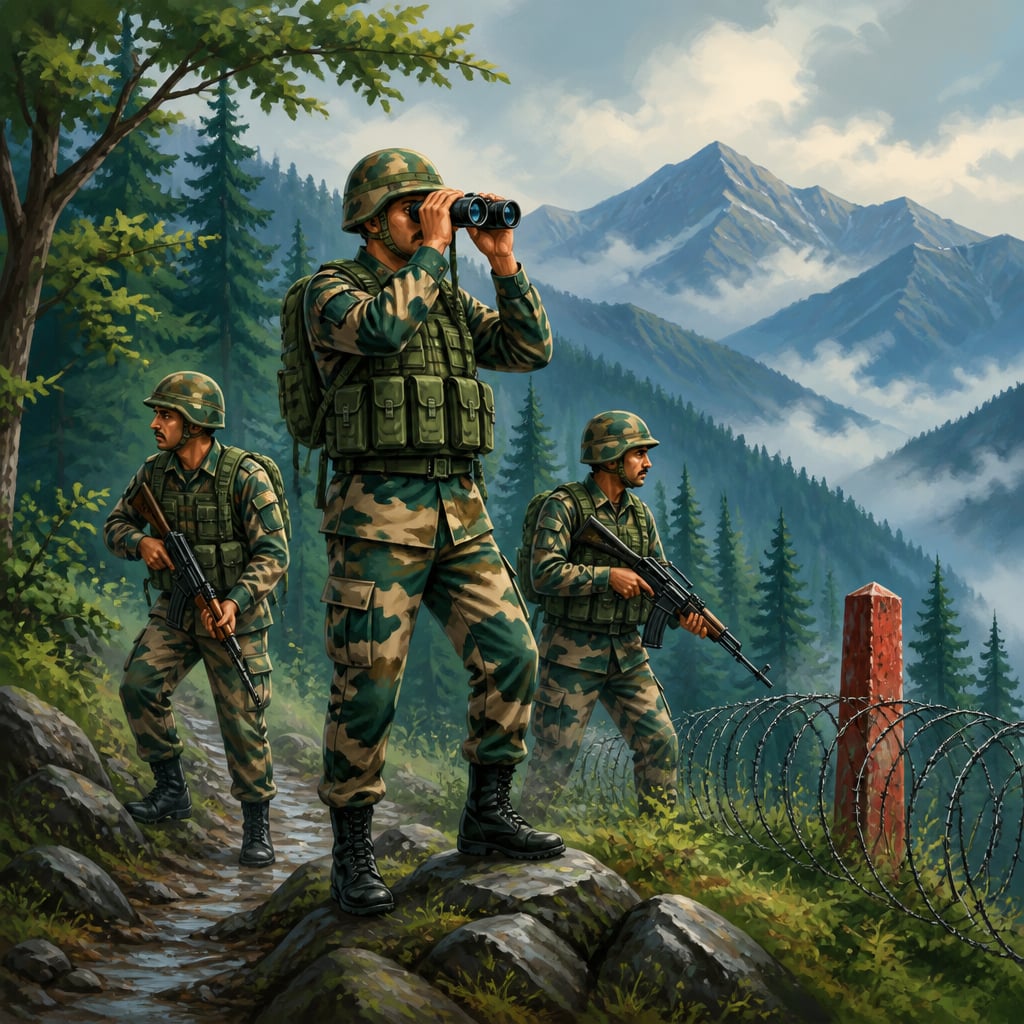
Indian Army patrol team moving along the Line of Control in Kashmir at dawn

The Unnamed Heroes

We know the names of Vikram Batra and Sandeep Unnikrishnan because their sacrifice was visible, dramatic. But what of the soldier killed by a sniper while checking his sector? What of the jawan who stepped on a mine while patrolling near Poonch?

Every year, dozens of soldiers die on the LOC - not in major battles, but in the daily grind of maintaining India's territorial integrity. Their deaths rarely make headlines. Their names are known only to their families and comrades.

These are the true everyday heroes. They don't seek glory. They don't expect recognition. They simply do their duty, knowing that today might be their last day.

Life at a Forward Post

Soldiers on watch at a forward LOC bunker post at dusk

Imagine living at a forward post on the LOC. The nearest town is hours away. Supplies come once a week - weather permitting. You share a bunker with five others. The toilet is outside, exposed to enemy observation.

In summer, the humidity breeds disease. In winter, temperatures drop to -20°C. The enemy is always watching - a careless moment, a silhouette against the sky, and a sniper's bullet finds you.

Yet soldiers volunteer for these posts. They serve 3-year tenures, sometimes extending for more. They do it because someone must. Because if they don't, the infiltrators will pour through. Because the village behind them - the village with children, with markets, with normal life - depends on their vigilance.

Ceasefire Violations

Despite the 2003 ceasefire agreement, violations are common. Pakistan uses artillery, mortars, and small arms fire against Indian positions and villages. These are not accidents - they are deliberate attacks meant to provide cover for infiltration or to simply kill Indian soldiers.

When a ceasefire violation occurs, Indian soldiers take cover in bunkers. They respond with "befitting reply" - fire for fire. Sometimes, they chase down infiltrators. Sometimes, they take casualties.

And then, when the firing stops, they resume their patrol. As if nothing happened.

The Families Back Home

A soldier's wife waiting at her village home with her daughter

For every soldier on the LOC, there is a family waiting. A mother who prays every night. A wife who dreads phone calls. Children who don't fully understand why Papa hasn't come home in six months.

Military families sacrifice too. They move frequently, disrupting children's education. They celebrate festivals without the man of the house. They live with constant anxiety - is he safe? Did he survive today's patrol?

When the worst happens, they bury their grief and carry on. Many military widows raise children alone, ensure they get educated, and often see them follow their father's footsteps into uniform.

The Response: India's Doctrine

India's response to LOC provocations has evolved. After major attacks, India has conducted surgical strikes (2016) and air strikes (2019). But day-to-day, the response is simpler: hold the line, respond to violations, and never give up an inch.

The LOC is not a place for grand strategy. It is a place for small, daily acts of courage. The patrol that goes out despite the threat. The officer who leads from front. The jawan who holds his post through a night-long barrage.

A Tribute to the Constant Watch

This lesson has no single hero. It has thousands. The unnamed jawans who have patrolled the LOC since 1949. The officers who have led them. The families who have supported them.

Some earned gallantry awards. Most earned nothing but the satisfaction of duty done. All of them - from the first soldiers on the Ceasefire Line in 1949 to the patrol that went out this morning - are heroes.

Because of them, India sleeps in peace. Because of their vigilance, infiltrators are stopped, attacks are prevented, and the nation remains secure. This is the tribute to the Line of Control - not a story of one battle, but of seven decades of daily valor.

The line never sleeps. Neither do they.

Key figures

The Anonymous LOC Soldier

Northern Command

LOC Military Families

Case studies

The Routine Patrol

You are a soldier on the LOC. Every morning, you go out on patrol. You know there may be snipers, IEDs, or ambushes. How do you maintain the mental strength to do this day after day?

Routine and discipline sustain courage over time. Heroism isn't always a single moment - sometimes it's getting up every day to face danger.

Healthcare workers during COVID-19 showed this same pattern: going to work every day knowing they could be infected, watching colleagues fall ill, yet continuing because patients depended on them. Sustained courage under ongoing threat, not a single dramatic moment, defines the majority of real-world heroism.

The Family's Sacrifice

Your spouse is deployed on the LOC for two years. You must raise children alone, manage the household, and live with constant anxiety. How do you cope?

Sacrifice extends beyond the battlefield. The families who support soldiers are heroes too.

Military spouse employment, children's education disruptions, and the psychological toll of long separations are challenges shared by families of diplomats, merchant navy officers, and long-haul truckers. Society benefits from their sacrifice but rarely accounts for the full cost borne by these families.

Historical context

The Line of Control (1949-Present)

Reflection

More in The Constant Watch - Counter-Insurgency

All lessons in The Constant Watch - Counter-Insurgency · Param Veer: Guardians of the Heights (1984-Present) course