Blue Helmets from India

UN Peacekeeping Heroes from Congo to Lebanon

India has been among the largest contributors to UN peacekeeping since 1950. From Captain Salaria's khukri charge in Congo (1961) to modern missions in South Sudan and Lebanon, over 200,000 Indian soldiers have served world peace. More than 170 have died doing so. The tradition of Dharmic protection extends beyond borders.

Warriors for World Peace

When we think of Indian soldiers, we picture them defending the Himalayas or fighting in Kashmir. But there's another story - one that takes Indian warriors to the jungles of Congo, the deserts of Egypt, the mountains of Lebanon, and the savannas of South Sudan.

Since 1950, India has been among the largest contributors to United Nations peacekeeping operations. Over 200,000 Indian troops have worn the Blue Helmet. More than 170 have given their lives - not defending India's borders, but keeping peace in lands far from home.

The First Blue Helmet: Korea 1950

India's peacekeeping journey began in 1950, when the Korean War erupted. India sent the 60th Parachute Field Ambulance - a medical unit - under Lt Col AG Rangaraj. They served in the most dangerous zones, treating wounded soldiers from both sides.

When the war ended, India chaired the Neutral Nations Repatriation Commission, handling the sensitive task of prisoner exchanges. This was the beginning of India's reputation as a trusted neutral party in global conflicts.

The Khukri Charge in Congo

In 1961, India sent troops to the newly independent Congo (now DR Congo), where civil war and secessionist movements threatened to tear the country apart.

On December 5, 1961, Captain Gurbachan Singh Salaria of 3/1 Gorkha Rifles was leading a small patrol near Elizabethville. His 16 Gorkhas encountered 90 Katangese gendarmes supported by armored cars. Outnumbered and outgunned, Salaria did what Gorkhas do.

"Jai Mahakali, Ayo Gorkhali!" he shouted, leading a charge with bayonets and khukris. In the fierce hand-to-hand combat, his men killed 40 enemies and knocked out both armored cars. Salaria was hit in the neck but continued fighting until he collapsed.
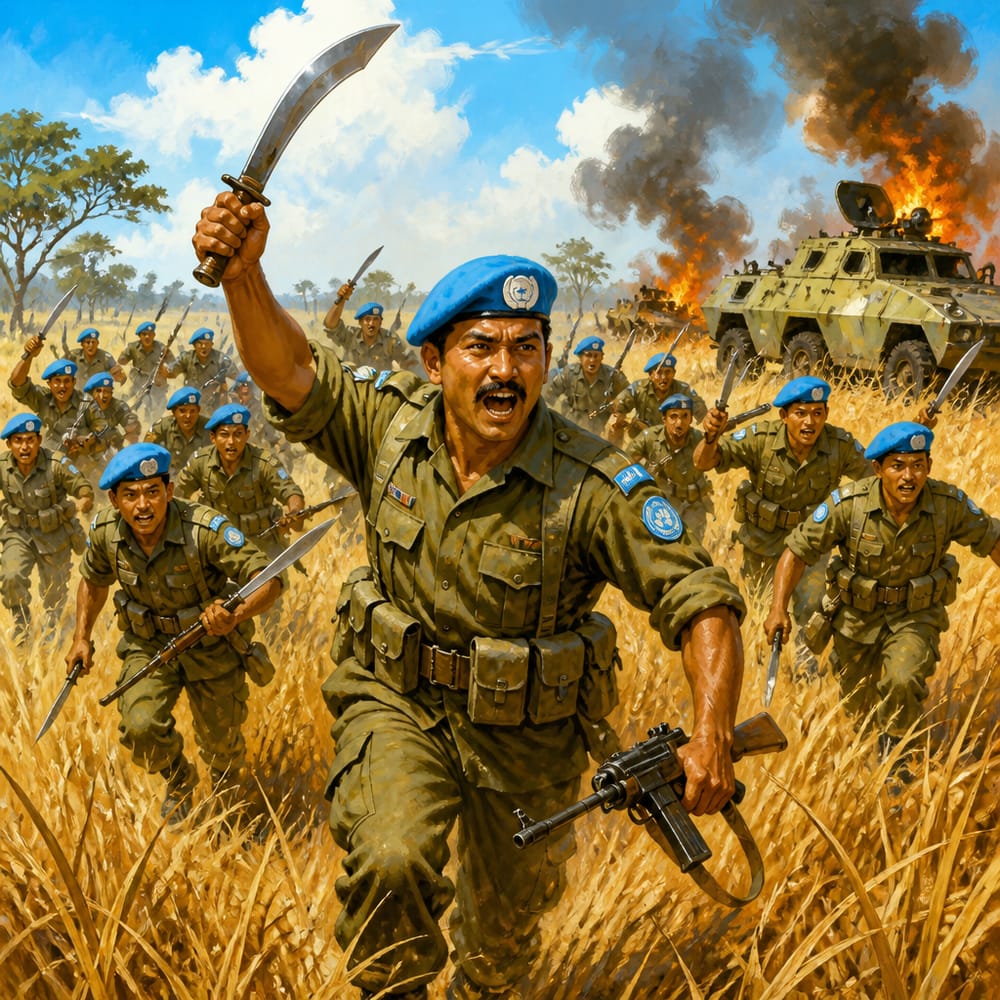
Captain Gurbachan Singh Salaria leading the Gorkha khukri charge in Congo 1961

He became the only Indian soldier to receive the Param Vir Chakra in a UN peacekeeping mission. His sacrifice prevented enemy reinforcements from encircling UN Headquarters, saving the entire mission.

Legends in Blue

Salaria was not alone. Indian peacekeepers have earned respect across the globe:

Brig Premindra Singh Bhagat, PVC - Already a PVC recipient from World War II (the first Indian), he commanded UN forces in the Congo. A sapper (engineer) who had cleared 15 minefields in 4 days in North Africa, now leading peacekeepers in Africa.

Major General Indar Jit Rikhye - Served as Military Adviser to two UN Secretaries-General. He was the face of UN peacekeeping during the 1967 Middle East crisis.

Lt Gen Satish Nambiar - First Force Commander of UNPROFOR in the former Yugoslavia (1992). Led peacekeeping in Europe's bloodiest conflict since WWII.

Modern Missions: Where India Serves Today

An Indian peacekeeper distributing aid at a UNMISS camp in South Sudan

UNMISS (South Sudan) - One of the largest UN missions, with over 2,000 Indian troops. India provides infantry battalions, engineers, and medical units. The mission protects civilians in a country torn by civil war.

UNIFIL (Lebanon) - Indian troops have served on the Israel-Lebanon border since 1998. They patrol one of the world's most volatile regions, maintaining peace between Hezbollah and Israel.

MONUSCO (DR Congo) - India has maintained troops in Congo since 1960. Generations of Indian soldiers have served in the same country where Captain Salaria earned his PVC.

The All-Female Police Unit

India's all-female police unit training Liberian women in Monrovia

In 2007, India made history by deploying the first-ever all-female Formed Police Unit (FPU) to a UN mission. Over 100 women police officers from India served in Liberia, patrolling streets, conducting investigations, and inspiring local women.

The Liberian women were amazed. They had never seen female police officers before. The Indian women showed them that women could be protectors, not just protected.

Why Do They Serve?

UN peacekeeping is voluntary. No Indian soldier is forced to wear the Blue Helmet. Yet thousands volunteer. Why?

Peacekeeping is Dharmic duty extended to the world. When innocent civilians are trapped in conflict zones, someone must protect them. When warring factions need a neutral force to maintain ceasefire, someone must stand between them.

Indian soldiers see this as an extension of their Kshatriya Dharma. Protection is not limited by borders. If the world needs peacekeepers, India provides them.

The Price of Peace

Peacekeeping is not peaceful. Over 170 Indian soldiers have died in UN missions - from ambushes in Congo to accidents in Cambodia, from illness in Sudan to attacks in Lebanon.

Their bodies are brought home with full military honors, the UN flag draped alongside the Tiranga. They died not for India's territory, but for India's ideals - that peace is worth fighting for, even in distant lands.

India's Legacy

Today, India remains one of the top contributors to UN peacekeeping. Indian troops are known for their discipline, professionalism, and respect for local populations. They build roads and hospitals. They train local forces. They protect civilians.

But more than that, they represent an idea: that a nation's strength can be used to help others, not just to defend itself. This is the legacy of the Blue Helmets from India - warriors for world peace.

Key figures

Captain Gurbachan Singh Salaria, PVC

Brig Premindra Singh Bhagat, PVC

Lt Gen Satish Nambiar

India's All-Female Police Unit

Case studies

Fighting for Others

You are asked to risk your life for people you've never met, in a country you've never been to, for no personal gain. Do you volunteer?

Dharma extends beyond borders. The strong have a duty to protect the weak, wherever they may be.

India's commitment to UN peacekeeping mirrors its growing role as a net security provider in the Indo-Pacific. As India seeks a permanent UNSC seat, this track record of putting soldiers in harm's way for global peace is its strongest credential. Service beyond borders builds the moral authority that economic power alone cannot.

Neutrality Under Fire

You are a peacekeeper. Both sides in a conflict accuse you of favoring the other. How do you maintain neutrality while still protecting civilians?

Impartiality requires active effort. True neutrality means treating all parties fairly, not favoring any side, while still fulfilling your duty to protect.

International organizations, NGOs, and multinational companies all face the challenge of maintaining neutrality in polarized environments. Whether mediating between warring factions or managing a diverse workplace, the skill of being fair without being passive is increasingly valuable in a divided world.

Historical context

India in UN Peacekeeping (1950-Present)

Reflection

More in The Constant Watch - Counter-Insurgency

All lessons in The Constant Watch - Counter-Insurgency ยท Param Veer: Guardians of the Heights (1984-Present) course