The Mountain Doctors
Army Medical Corps and Helicopter Evacuation Heroes
Behind every survivor was a medic. The Army Medical Corps and helicopter evacuation pilots worked miracles at extreme altitudes, evacuating wounded under fire. The unsung heroes who saved lives in conditions where survival itself was a challenge.
The Healers at War
When we speak of Kargil heroes, we think of soldiers charging bunkers, pilots flying impossible missions, officers leading from the front. We rarely think of the doctors, medics, and helicopter pilots who made sure those heroes survived their wounds.
But behind every soldier who lived to tell his story was a chain of medical professionals working in conditions that defied imagination. They performed surgery in tents at 14,000 feet. They evacuated the wounded while enemy bullets whipped past their helicopters. They made life-and-death decisions with equipment and resources that would be considered primitive in any hospital.
These are the Mountain Doctors of Kargil.
Medicine at the Edge of Survival
The human body is not designed to function at extreme altitudes. At 15,000 feet and above, the air holds less than half the oxygen available at sea level. Blood doesn't clot properly. Wounds heal slowly. The cold causes frostbite within minutes of exposure.
Now imagine treating combat wounds in these conditions.
The Army Medical Corps faced challenges that no medical textbook had prepared them for. Casualties arrived with gunshot wounds, shrapnel injuries, and blast trauma - all complicated by altitude sickness, hypothermia, and frostbite.
Every treatment protocol had to be modified. Medications that worked at sea level behaved differently in the thin air. Anesthesia was tricky when patients were already oxygen-deprived. Blood supplies froze if not kept warm constantly.
The doctors adapted. They improvised. They saved lives that should have been impossible to save.
The Helicopter Heroes
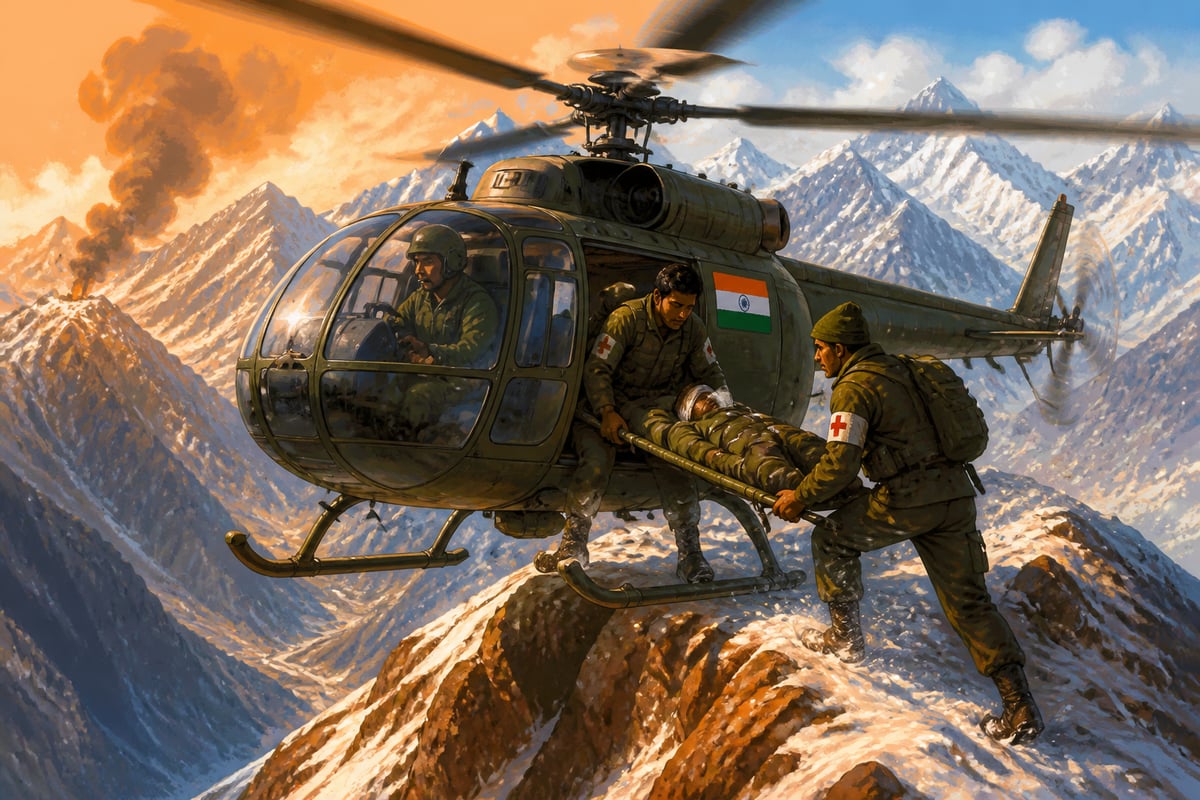
Getting the wounded off the mountain was often more dangerous than the battle itself.
Helicopters at extreme altitudes face severe performance limitations. The thin air provides less lift, making every kilogram critical. The margin between flying and crashing becomes razor-thin.
The pilots of the Army Aviation Corps flew into situations where the textbooks said flight was impossible. They landed on slopes where one slip would send the helicopter tumbling into ravines. They hovered under enemy fire while medics loaded the wounded. They flew at night, using night vision equipment that turned the mountains into green-tinged mazes.
Many of these evacuations happened under fire. The enemy knew that helicopters meant wounded soldiers being saved. They targeted the aircraft specifically, forcing pilots to land, load, and take off in seconds while bullets cracked past.
Yet the pilots kept flying. Every wounded soldier who reached a hospital owed their life to men who considered enemy fire just another obstacle to overcome.
The Field Hospitals
Between the battlefield and the base hospitals stood the field hospitals - tents and prefabricated structures where the first critical treatments happened.
These facilities operated around the clock. Surgeons worked by flashlight when generators failed. Nurses monitored patients in freezing conditions, keeping them warm with body heat when heating equipment broke down. Anesthetists administered carefully calibrated doses, knowing that even small errors could be fatal at altitude.
The field hospital at Dras became legendary. Operating in conditions that would shut down any civilian hospital, the medical teams there performed surgeries that saved hundreds of lives. They developed techniques for high-altitude trauma care that became standard procedures worldwide.

The First Aid Heroes

Before a wounded soldier reached a doctor, they were kept alive by medics and comrades with basic first aid training.
Every infantry platoon has soldiers trained in buddy aid - the immediate treatment that can mean the difference between life and death. In Kargil, these first responders applied tourniquets while under fire, performed emergency procedures in bunkers, and carried wounded comrades down impossible terrain.
Many of these first aid heroes were themselves wounded. Stories emerged of soldiers treating their comrades while bleeding from their own injuries, refusing evacuation until everyone else was safe.
The chain of survival started with these anonymous heroes - soldiers who put saving lives above their own safety.
The Numbers That Mattered
In conventional warfare, the ratio of wounded to killed is typically about 3:1 - three wounded for every soldier killed. In Kargil, the medical services achieved something remarkable: most soldiers who reached medical care survived.
The evacuation times were extraordinary. Wounded soldiers were being picked up from battlefield positions and delivered to surgical facilities within the "golden hour" - the critical window when timely treatment can prevent death.
This didn't happen by accident. It happened because helicopter pilots flew into impossible situations, medics braved enemy fire, and doctors performed miracles in tents.
The Invisible Wounds
Not all Kargil wounds were physical. The psychological toll of high-altitude combat left scars that no surgeon could repair.
The medical corps recognized this early. They deployed mental health professionals alongside trauma surgeons. They established protocols for identifying soldiers suffering from combat stress. They understood that saving a soldier's body meant nothing if their mind was broken.
This attention to mental health was progressive for its time. Many armies still treated psychological wounds as weakness. The Indian military, guided by its medical professionals, took a more humane approach.
Legacy of the Mountain Doctors
The medical lessons of Kargil transformed military medicine worldwide. The techniques developed for high-altitude trauma care, helicopter evacuation under fire, and field surgery in extreme conditions became standard teachings in military medical schools globally.
The doctors, medics, and pilots who served in Kargil rarely received the recognition given to combat soldiers. No Param Vir Chakras were awarded to medical personnel. Their names don't appear on monuments.
But ask any Kargil veteran who survived serious wounds, and they'll tell you about the medic who kept them alive, the helicopter pilot who flew through enemy fire, the surgeon who worked through the night. These are the heroes who made survival possible.
The Mountain Doctors of Kargil remind us that heroism takes many forms. Sometimes the greatest courage is not in taking lives but in saving them.
Key figures
Army Medical Corps
Founded 1764 as Bengal Medical Service, continues to present
Army Aviation Corps
Raised 1986, Kargil operations 1999
Case studies
Surgery in a Tent at 14,000 Feet
A soldier arrives at the field hospital at Dras with severe shrapnel wounds. He needs immediate surgery. But the temperature is below freezing, the generator is unreliable, and the thin air means less oxygen for both patient and surgical team. Standard surgical protocols don't account for these conditions.
Doctors Without Borders performs surgeries in war zones, refugee camps, and disaster areas where conditions are far from ideal. The COVID-19 pandemic forced hospitals worldwide to improvise ventilators, convert parking garages into ICUs, and adapt protocols on the fly. Adaptability under constraint is a medical skill as vital as any surgical technique.
Evacuation Under Fire
A helicopter pilot receives orders to extract wounded soldiers from a position that is still under enemy fire. The landing zone is a narrow ledge with a steep drop on one side. At this altitude, his helicopter is operating at the edge of its performance envelope. One mistake means death for everyone.
Helicopter EMS (emergency medical services) pilots in civilian life make similar calculations daily, balancing weather risks against patient survival odds. The principle of calculated risk, knowing your limits while pushing toward them for someone else's sake, applies to any high-stakes profession from aviation to emergency medicine.
Historical context
Kargil War, May-July 1999
Living traditions
- Armed Forces Medical Services Day: Celebrated on January 1 each year, this day honors the medical professionals who serve in the Indian armed forces. Kargil veterans are often invited to share their experiences.
Reflection
- Medical heroes rarely receive the same recognition as combat heroes. Why do you think this is? How can we better honor those who save lives in war?
- The helicopter pilots of Kargil flew missions that exceeded safety parameters to save wounded soldiers. How do we evaluate risk when lives are at stake? When is it right to take dangerous risks?
- The lesson mentions 'invisible wounds' - psychological trauma from combat. How should society support veterans dealing with these wounds? What can you do personally?