Jubar Top - Na Chodnu

Lieutenant Manoj Kumar Pandey - The Gorkha Way

Lt Manoj Pandey led multiple assaults in Kargil with 1/11 Gorkha Rifles. At Jubar Top, he charged into machine gun fire, destroying bunkers. Wounded in the shoulder and legs, he kept fighting until shot in the head. His last words: 'Na Chodnu' (Don't leave them).

The Boy Who Dreamed of the PVC

Most children dream of becoming doctors, engineers, or cricketers. Manoj Kumar Pandey dreamed of winning the Param Vir Chakra.
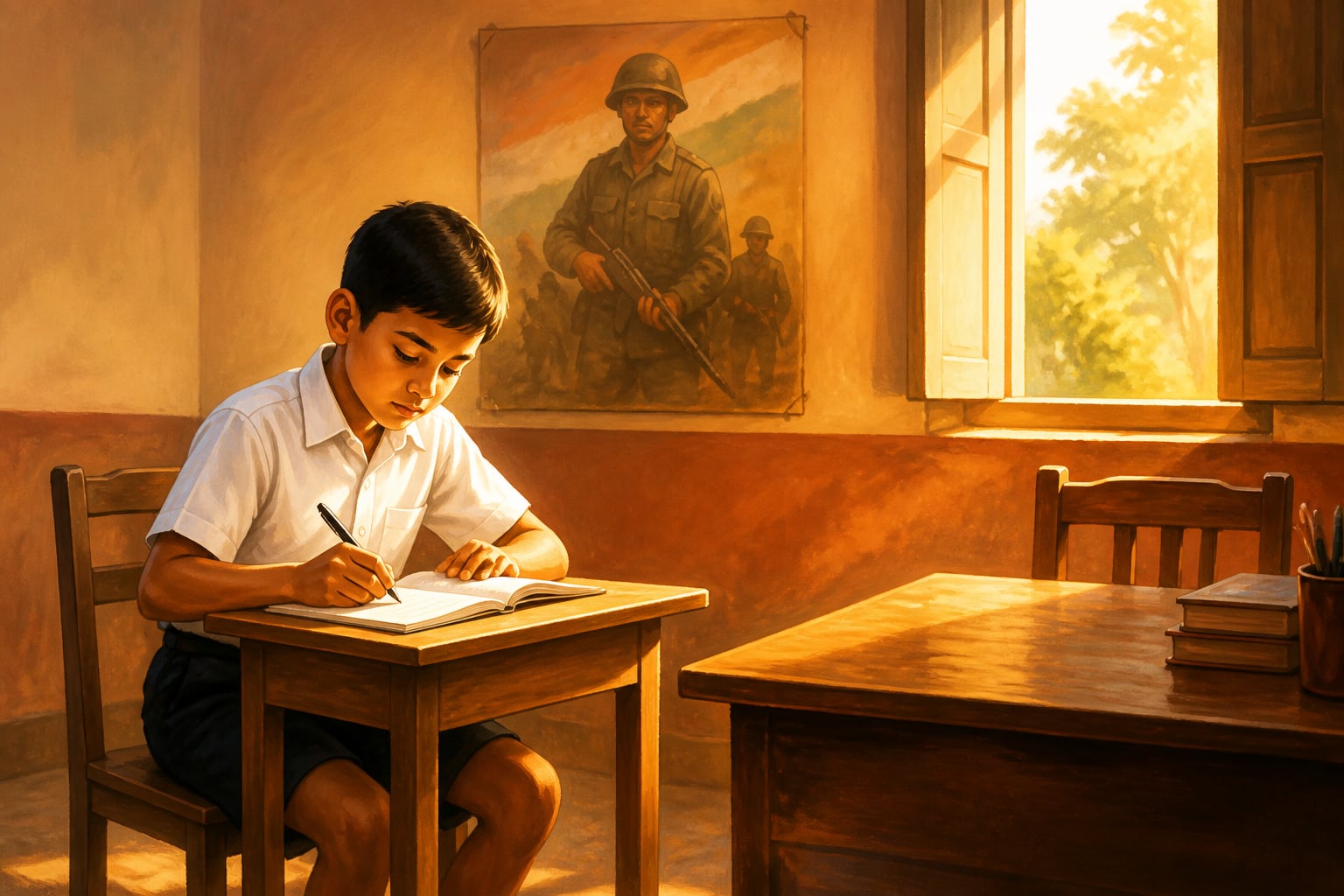
Young Manoj writing his soldier dream in his school diary

Born in Sitapur, Uttar Pradesh, young Manoj would tell anyone who would listen that he wanted to be a soldier and win India's highest gallantry award. His school diary contained a remarkable entry: "I will become an officer and get a PVC."

Most would dismiss this as a child's fantasy. For Manoj Pandey, it was destiny.

The Making of a Gorkha Officer

Manoj Pandey joined the National Defence Academy and was commissioned into 1/11 Gorkha Rifles - one of the most decorated regiments in the Indian Army. The Gorkhas have a warrior tradition spanning centuries, famous for their courage, their kukris (curved knives), and their battle cry: "Jai Mahakali, Ayo Gorkhali!" (Victory to Goddess Mahakali, the Gorkhas are here!)

As a young lieutenant, Pandey quickly earned the respect of his Gorkha soldiers. He led from the front, shared their hardships, and embodied the Gorkha spirit. They would follow him anywhere.

In the summer of 1999, that loyalty would be tested in the most brutal way imaginable.

The Battle for Batalik

The Batalik sector was among the most challenging in the Kargil War. Pakistani intruders had occupied multiple peaks, each one a natural fortress. The terrain was so difficult that simply reaching the enemy positions was a victory in itself.

Lieutenant Manoj Pandey led his platoon in assault after assault. He wasn't just directing his men - he was at the front of every charge, kukri in hand, embodying the Gorkha tradition of leading by example.

Between June 11 and July 3, 1999, he participated in clearing Khalubar, Jubar Top, and surrounding positions. Each battle added to his legend among his men.

Jubar Top - The Final Assault

On the night of July 2-3, 1999, Lieutenant Pandey led the assault on Jubar Top. The position was heavily fortified, with interlocking fields of machine gun fire designed to cut down any approaching force.

Pandey didn't care about the odds. As the assault began, he was the first man up the slope.

The first burst of enemy fire hit him in the shoulder. He kept climbing.

Another burst caught his legs. He kept climbing.

Reaching the first bunker, he pulled out a grenade, yanked the pin, and threw it in. The explosion silenced the machine gun. He moved to the next bunker and the next, clearing them one by one.

Lieutenant Manoj Pandey throwing a grenade into a Jubar Top bunker

His men followed, inspired by their lieutenant's superhuman determination. If their officer could fight with bullets in his body, how could they do any less?

"Na Chodnu" - Don't Leave Them

As the assault reached its climax, Lieutenant Pandey was clearing another enemy position when a burst of automatic fire hit him in the head. He fell.

But even as he fell, even as life left his body, he shouted his last words to his men: "Na Chodnu!" - "Don't leave them!"

Gorkha soldiers charging together with kukris drawn

In Gorkha tradition, abandoning the fight is unthinkable. Lieutenant Pandey's final command was to continue the assault, to finish what they had started, to honor the sacrifice of those who had already fallen.

His men obeyed. Jubar Top fell to India.

The Dream Fulfilled

Lieutenant Manoj Kumar Pandey was awarded the Param Vir Chakra posthumously. The boy who had written "I will become an officer and get a PVC" in his school diary had achieved his impossible dream.

He was 24 years old.

His citation reads: "Showing outstanding courage, presence of mind and determination, Lieutenant Manoj Kumar Pandey led an assault on Jubar Top...continuing to fight and encourage his men even after being grievously wounded."

But the cold official words cannot capture what his men witnessed that night - a young officer, bleeding from multiple wounds, refusing to stop, refusing to let his men down, fighting until his last breath and beyond.

The Gorkha Legacy

1/11 Gorkha Rifles earned the Battle Honour "Batalik" for their performance in Kargil. Lieutenant Pandey became the symbol of what the regiment represents - fearless leadership, unbreakable spirit, and the willingness to die rather than retreat.

The Gorkha tradition is simple: better to die than be a coward. Lieutenant Manoj Kumar Pandey lived and died by that creed.

Key figures

Lieutenant Manoj Kumar Pandey, PVC

1975-1999

1/11 Gorkha Rifles

Gorkha regiments trace to 1815, 1/11 GR raised 1918

Case studies

When a Childhood Dream Becomes Destiny

A young boy in Sitapur writes in his school diary: 'I will become an officer and get a PVC.' His family and teachers probably smiled at the childish ambition. The Param Vir Chakra is India's highest military honor - only 21 people have ever received it. What are the odds that a schoolboy's dream would come true?

Research on goal-setting shows that writing down specific aspirations dramatically increases the likelihood of achieving them. A Dominican University study found that people who wrote down goals were 42% more likely to achieve them. Pandey's childhood diary entry was not naive dreaming. It was the first step of a documented, deliberate path.

Leadership Until the Last Breath

Lieutenant Pandey is hit in the shoulder. He continues. He's hit in the legs. He continues. He's clearing bunkers one by one, bleeding from multiple wounds. Finally, a bullet to the head. As he falls, his last words are not about himself - they're a command to his men: 'Na Chodnu' - Don't leave them.

In crisis situations, from the Fukushima nuclear disaster to the Sully Sullenberger Hudson River landing, leaders who maintained composure and kept directing their teams until the very end saved lives. Leadership continuity under pressure is a trainable skill, not an innate gift.

Historical context

Kargil War, May-July 1999

Living traditions

Reflection

More in Kargil 1999 - Victory at Any Cost

All lessons in Kargil 1999 - Victory at Any Cost ยท Param Veer: Guardians of the Heights (1984-Present) course