The Air Warriors of Kargil

Sqn Ldr Ajay Ahuja and Flt Lt K. Nachiketa

The IAF's role in Kargil - flying at extreme altitudes never before attempted in combat. Sqn Ldr Ajay Ahuja was killed searching for downed pilot Flt Lt Nachiketa, who became a POW. The challenges of high-altitude air operations and the brotherhood of pilots.

War in the Thin Air

Most people think of Kargil as an infantry war - soldiers climbing mountains, fighting in bunkers, dying on peaks. But there was another war being fought above the mountains, in the thin air where jet engines struggle and human reflexes slow.

The Indian Air Force faced a challenge unlike any in its history. They had to fly combat missions at altitudes above 15,000 feet - heights where aircraft performance degrades dramatically, where missiles behave unpredictably, and where the margin for error disappears entirely.

No air force in history had attempted sustained combat operations at such altitudes. The IAF would write a new chapter in aerial warfare, and pay a heavy price for the knowledge.

The Restrictions

To avoid escalating the conflict into a full-scale war, the Indian government imposed strict restrictions on the IAF. Aircraft were not allowed to cross the Line of Control - they had to attack enemy positions while remaining within Indian airspace.

This made the pilots' job nearly impossible. They had to approach targets from predictable angles, giving the enemy time to prepare. They couldn't pursue Pakistani aircraft that ducked across the border. They were fighting with one hand tied behind their back.

But they flew anyway.

May 27, 1999 - The Day Everything Changed

On May 27, 1999, the air war turned deadly.

Flight Lieutenant K. Nachiketa was flying a MiG-27 ground attack mission against enemy positions near Batalik. His aircraft was hit - possibly by enemy fire, possibly by engine failure due to the extreme altitude. He ejected over enemy-held territory.
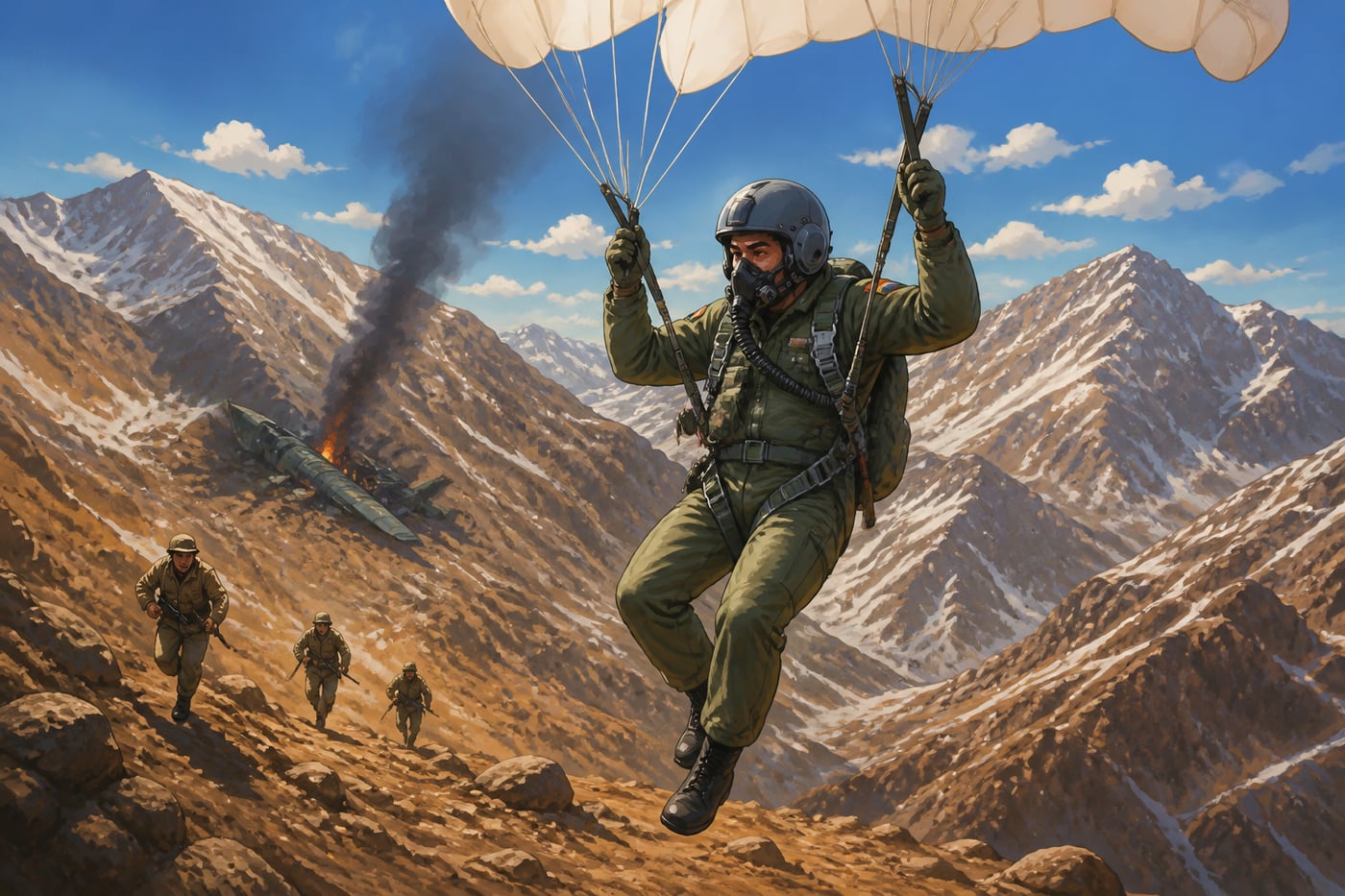
Flight Lieutenant Nachiketa parachuting after ejection over enemy territory

Nachiketa landed in Pakistani-controlled areas. He was immediately captured, becoming India's first prisoner of war in decades.

Word spread instantly through the IAF. A brother was down. Someone had to find him.

Squadron Leader Ajay Ahuja's Final Mission

Squadron Leader Ajay Ahuja was an experienced pilot flying a MiG-21 Bison. When he heard that Nachiketa was down, he didn't wait for orders. He flew toward the crash site, determined to locate his fellow pilot and guide rescue operations.

Squadron Leader Ajay Ahuja searching for Nachiketa in his MiG-21 over Kargil

What Ahuja didn't know was that Pakistani forces had set up an ambush. As his aircraft entered the search area, a surface-to-air missile - likely a Stinger - struck his MiG-21.

Ahuja ejected successfully. His parachute opened. He was alive.

But as he floated down, Pakistani soldiers on the ground opened fire on the helpless pilot. They shot him as he hung from his parachute - a violation of every law of war, every code of military honor.

Squadron Leader Ajay Ahuja was dead before he hit the ground. He was 32 years old.

The Brother Who Returned

Flight Lieutenant Nachiketa's capture became an international incident. Pakistan initially denied holding him, then admitted he was in their custody.

For eight days, Nachiketa was a prisoner. His family didn't know if he was alive or dead. The nation watched and waited.

Nachiketa released across the Wagah border on June 3, 1999

On June 3, 1999, Pakistan released Nachiketa through the Red Cross. He returned to India, thin and exhausted but alive. The nation celebrated his return.

But the celebration was tempered by grief for Ajay Ahuja, who had died trying to save him.

The Challenges of High-Altitude Air War

The Kargil air operations taught the world lessons that no one had learned before:

At extreme altitudes, jet engines produce less thrust because the air is thinner. Aircraft that are agile at sea level become sluggish above 15,000 feet.

Missiles and bombs behave differently in thin air. Guidance systems calibrated for lower altitudes can malfunction. Bombs fall differently, making precision targeting nearly impossible.

Pilots operating at these heights face reduced reaction times due to lower oxygen levels. Even with pressurized cockpits, the physical strain is enormous.

The IAF adapted on the fly, developing new tactics, new approaches, new ways of fighting in conditions no air force had mastered.

The Legacy of the Air Warriors

Squadron Leader Ajay Ahuja was awarded the Vir Chakra posthumously for his courage in attempting to rescue a downed comrade. His death highlighted both the brotherhood of pilots and the treachery of enemies who would shoot a helpless man.

Flight Lieutenant Nachiketa returned to flying and continued his career in the IAF. His experience as a POW gave him perspective that few pilots ever gain.

Together, their stories represent the air war over Kargil - courage at impossible altitudes, brotherhood that transcends personal safety, and the price paid when technology meets thin air and enemy missiles.

The Unseen Heroes

Behind every pilot who flew over Kargil were dozens of ground crew who kept the aircraft flying. Mechanics who worked through the night. Armourers who loaded weapons. Controllers who guided missions.

The air war was won not just by the pilots but by everyone who supported them. When an aircraft returned safely from a mission over those deadly peaks, it was a victory for hundreds of people who never left the ground.

The Air Warriors of Kargil - those who flew and those who made flight possible - proved that the Indian Air Force could operate in conditions that would defeat any other air force in the world.

Key figures

Squadron Leader Ajay Ahuja, VrC

1967-1999

Flight Lieutenant K. Nachiketa

Born 1973, captured May 27, 1999, released June 3, 1999

Case studies

The Decision to Search for a Downed Pilot

Squadron Leader Ajay Ahuja hears that a fellow pilot is down in enemy territory. The rescue helicopters can't reach the area. The downed pilot's location is uncertain. Flying toward the crash site means entering the engagement zone of enemy air defenses. What does he do?

The principle of 'no one left behind' extends beyond military settings. Mountain rescue teams, firefighters entering burning buildings for trapped colleagues, and even corporate leaders who refuse to lay off teams during downturns all operate on this principle. The bonds formed through shared adversity create obligations that transcend cost-benefit analysis.

Fighting at the Edge of Capability

The IAF is asked to conduct combat operations at altitudes above 15,000 feet - heights where no air force has ever sustained combat. Aircraft perform poorly. Missiles behave unpredictably. Pilots face physical strain. The government has also restricted aircraft from crossing the Line of Control, making attack approaches predictable.

SpaceX's early rocket failures did not stop engineers from attempting the next launch. ISRO's Mars Orbiter Mission succeeded partly because the team innovated under constraints that no other space agency had faced. Operating at the edge of known capability is where breakthroughs happen.

Historical context

Kargil War, May-July 1999

Living traditions

Reflection

More in Kargil 1999 - Victory at Any Cost

All lessons in Kargil 1999 - Victory at Any Cost ยท Param Veer: Guardians of the Heights (1984-Present) course