Sankatamochana: Rescuing Friends

Friendship means sacrifice

The Monkey and the Crocodile - friendship and betrayal. True friends risk for each other; betrayal has consequences.

Sankatamochana: Rescuing Friends

This was the day the four friends would remember forever.

It began peacefully. Laghupatanaka was sharing stories with Manthara by the lake while Hiranyaka and Chitranga rested nearby. None saw the hunter approaching through the reeds until it was too late.

The net fell over Manthara.

"Friends!" cried the tortoise, but there was no panic in his voice, only trust. "The hunter comes!"

What followed was sangha-shakti in action. Laghupatanaka flew up, cawing loudly to distract the hunter. Chitranga bounded into view, pretending to be lame, an irresistible target that led the hunter away from the lake. And Hiranyaka, the tiny mouse, set his sharp teeth to the net's ropes.
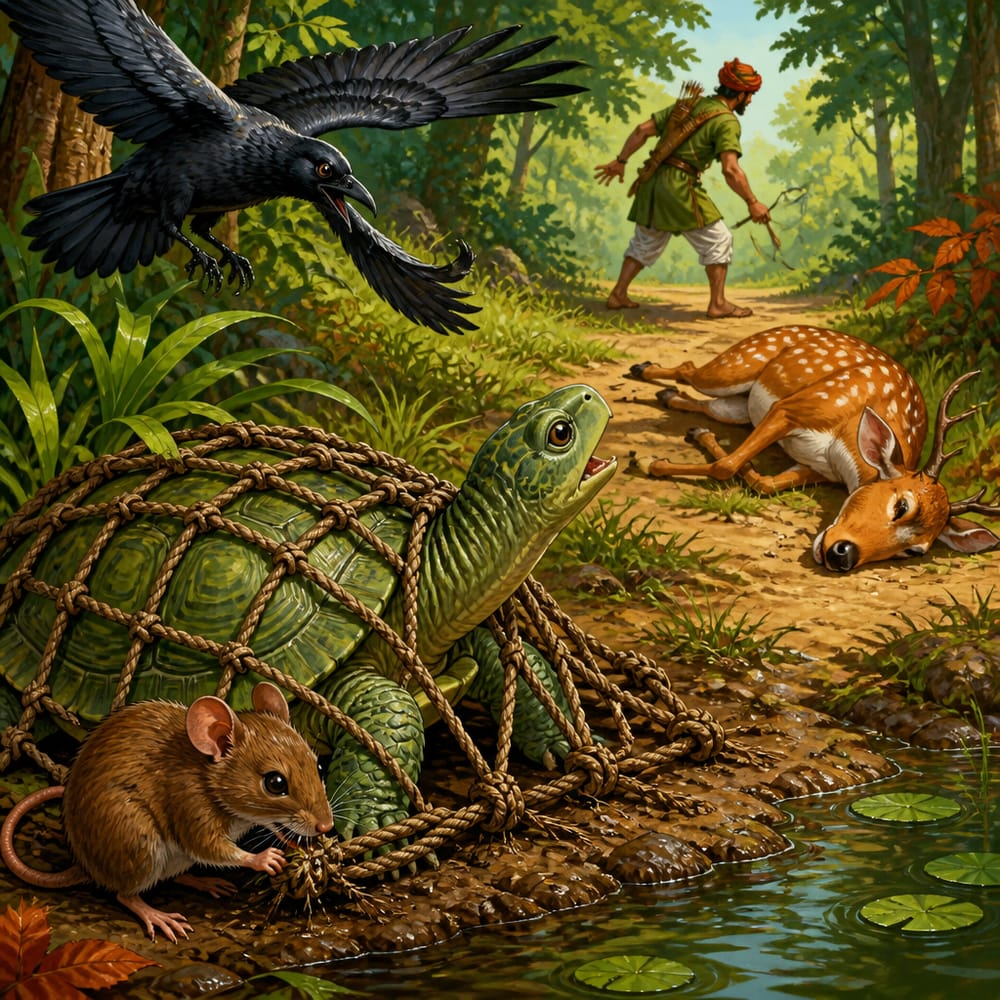
Friends rescuing Manthara from a hunter's net

By the time the hunter realized the deer was not truly injured and returned, Manthara was free, slipping into the water. The four escaped unharmed.

That evening, they gathered to reflect, not just on their escape, but on everything they had learned about friendship.


The Monkey and the Crocodile

"We were fortunate," said Hiranyaka. "But not all friends are so blessed. Let me tell you the tale of Raktamukha the monkey and Karalamukha the crocodile, a friendship that was almost destroyed by betrayal."

On the banks of a great river grew a rose-apple tree where a monkey named Raktamukha lived. The fruits were extraordinarily sweet, and Raktamukha was extraordinarily generous. When a crocodile named Karalamukha began swimming near the tree, the monkey threw down fruits for him.

Day after day, this continued. The crocodile would float beneath the tree, and the monkey would share his abundance. They talked. They laughed. They became friends.

"These are delicious," said Karalamukha one day. "May I take some to my wife?"

"Of course!" said Raktamukha. "Take as many as you wish."

The crocodile's wife was initially pleased with the sweet fruits. But as days passed, she grew suspicious.

"You spend so much time with this monkey," she said. "More time than with me. And these fruits, they are extraordinarily sweet. Imagine how sweet the monkey's heart must be, having eaten these fruits his whole life."

"What do you mean?" asked Karalamukha, though he already knew.

"I want to eat his heart," she said. "Bring it to me, or don't come home."

Karalamukha was torn. He loved his wife, but Raktamukha was his friend. Yet after much torment, he made his choice.


The next day, Karalamukha invited Raktamukha to visit his home.

"My wife wishes to meet the friend I speak of so often. Come, ride on my back across the river."

The trusting monkey agreed and climbed onto the crocodile's back. But halfway across the deep river, the crocodile began to sink.

"What are you doing?!" cried Raktamukha. "I cannot swim!"

"I am sorry, friend," said Karalamukha, unable to meet his eyes. "My wife desires your heart. I must kill you."

Monkey realizing the crocodile's betrayal mid-river

In that moment, Raktamukha understood everything, the invitation, the journey across deep water, the trap. Despair would have meant death. Instead, the monkey's wit saved him.

"Ah, why didn't you say so earlier!" he exclaimed. "I would gladly give my heart for your wife's happiness. But you see, we monkeys don't carry our hearts with us. I left mine in the rose-apple tree for safekeeping. Take me back and I will fetch it!"

The foolish crocodile believed this absurd claim and turned back toward the shore.

The moment they reached the tree, Raktamukha leaped to safety in the highest branches.

"Friend," he called down, his voice now cold, "no creature keeps its heart outside its body. You believed that because your heart is clearly missing, you have no loyalty, no honor, no friendship in you. Go back to your wife. But know this: our friendship is ended forever. You chose to betray me, and that choice cannot be unmade."

Karalamukha swam away in shame, having lost both his friend and his honor.


The Teaching

"The crocodile was not evil by nature," observed Chitranga. "He was weak. He let someone else, his wife, override his own judgment about right and wrong."

"That is a common form of betrayal," agreed Laghupatanaka. "Not active malice, but failure to stand firm. He knew betrayal was wrong, yet he did it anyway."

"And the monkey?" asked Manthara. "Was he wrong to trust?"

"No," said Hiranyaka firmly. "Trust is necessary for friendship. The monkey's trust was not his mistake, the crocodile's betrayal was. But notice: when betrayal became clear, the monkey did not waste time in grief. He acted. He used his wits to escape. And then, importantly, he ended the friendship."

This was a crucial teaching. Forgiveness has limits. Some betrayals are too deep. The monkey did not seek revenge, but he also did not pretend the friendship could continue as if nothing had happened.


Rescue Requires Risk

"Today we rescued Manthara," said Laghupatanaka. "But consider what each of us risked. I drew attention to myself, a crow is easy prey. Chitranga pretended injury before a hunter, one misstep and he would be dead. Hiranyaka worked in the open, visible to all predators."

"True rescue," said Hiranyaka, "requires tyaga, sacrifice. We did not calculate whether Manthara was 'worth' the risk. We simply acted, because he is our friend."

"That is the difference," said Manthara quietly, "between the crocodile and you. When his friendship was tested, he calculated: wife's demands versus friend's life. He chose calculation over loyalty. When your friendship was tested, you chose loyalty over safety."


The Course Concludes

Four friends together in moonlit forest

As the moon rose over the forest, the four friends sat in contented silence. They had learned much about mitralabha, the winning of friends:

"We have been fortunate," said Laghupatanaka. "To find each other. To learn these truths together. To survive this day."

"Fortune favors those who cultivate it," replied Hiranyaka. "We did not find each other by accident. We chose friendship. We nurtured it. We protected it. And today, it protected us."

Manthara, the eldest among them, spoke last: "The Panchatantra teaches that wisdom makes life better, but wisdom without friendship is cold. You are my mitra, my friends. And that is worth more than all the wisdom in all the texts."

The four friends settled in for the night, knowing that whatever challenges tomorrow brought, they would face them together.

Reflection

More in Suhrida: Well-Wishers

All lessons in Suhrida: Well-Wishers · Panchatantra: Mitralabha course