Durjanasangati: Bad Company

Choosing friends wisely matters

The Ungrateful Tiger and The Brahmin and the Snake. Avoid bad company; some friendships are dangerous.

Durjanasangati: Bad Company

Laghupatanaka the crow flew down to where Hiranyaka was enjoying the morning sun. "My friend, I must tell you something I observed yesterday."

"What troubled you, Laghupatanaka?" asked the mouse.

"I saw a young traveler help a man who later tried to rob him. It reminded me of the ancient tales our elders told, about the danger of misjudging character."

Hiranyaka nodded gravely. "The wise say: dushta-sangati brings ruin even to the good. Let me tell you the tale of the Ungrateful Tiger."


The Ungrateful Tiger

In a dense forest, an old tiger named Kruravyaghra fell into a deep pit dug by hunters. Too weak to climb out, he waited for days. When a Brahmin traveler passed by, the tiger called out piteously.

"O noble one! Please help me escape this pit. I am old and weak. I promise I will not harm you."

The Brahmin hesitated. "You are a tiger. Your nature is to kill."

"I have changed," the tiger pleaded. "I have grown old. I have learned dharma. I swear on the sacred Vedas that I will be forever grateful and never harm you."

Moved by these words, the kind Brahmin lowered a branch. The moment Kruravyaghra climbed out, his eyes changed.
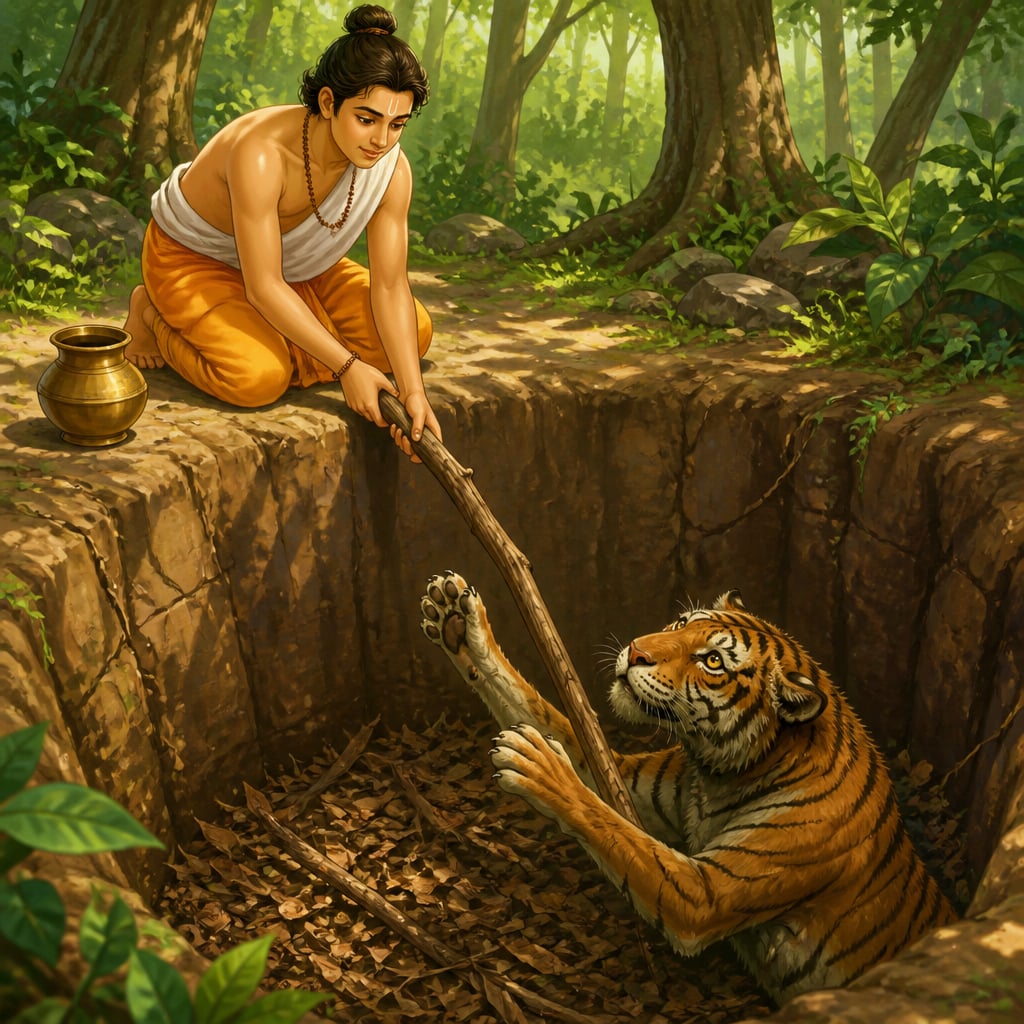
Brahmin lowering a branch to rescue tiger from pit

"Fool! You trusted a tiger? Now I am hungry, and you shall be my meal."

The Brahmin was horrified. "But you swore! You promised on the Vedas!"

"Hunger knows no oaths," laughed the tiger. "But since you helped me, I will be fair. Ask three witnesses. If any says I should spare you, I will."

Desperate, the Brahmin asked an old tree. The tree said: "Men cut my branches for shelter, then chop me down for firewood. Why should you be treated better?"

He asked a road. It said: "Men walk on me daily, giving nothing in return. Why expect gratitude from a tiger?"

Nearly hopeless, the Brahmin saw a fox nearby. The clever fox pretended confusion. "Wait, I don't understand. The tiger was in the pit, and you pulled him out using... yourself?"

"No, no!" said the tiger impatiently. "I was in the pit. He lowered a branch."

"I cannot picture this," said the fox. "Could you show me? Get back in the pit."

Fox tricks the ungrateful tiger back into the pit

The arrogant tiger, eager to prove his story, jumped back into the pit.

"Now, Brahmin," said the fox quietly, "walk away. And remember: never trust those whose nature is cruelty, no matter what they promise."


Chitranga the deer, who had joined them, spoke thoughtfully. "The tiger's nature did not change because of his words. We must judge character by patterns, not promises."

"Indeed," said Laghupatanaka. "Words are easy. Character is revealed over time."

Hiranyaka continued: "There is another tale that speaks to this, of a Brahmin who learned the hard way that some creatures cannot be reformed."


The Brahmin and the Snake

Brahmin warming the snake by a small fire

A kind Brahmin found a snake freezing in the winter cold. Taking pity, he placed it in his bag to warm it with his body heat.

When the snake revived, it immediately bit the Brahmin.

"Why?" cried the Brahmin as the venom spread. "I saved your life!"

"You knew what I was when you picked me up," replied the snake. "A snake bites. That is my svabhava, my essential nature. Your kindness does not change what I am."

The Brahmin died there, a victim of his own inability to distinguish between kindness and foolishness.


"These tales are harsh," observed Manthara, who had crawled closer to listen. "They seem to say: trust no one."

"No," corrected Hiranyaka. "They say: trust wisely. There is a difference between healthy caution and paranoid isolation. We four are proof that true friendship exists. But we chose each other carefully. We observed each other's character over time."

Laghupatanaka added: "The Brahmin's error was not kindness, it was blind kindness. He ignored clear warnings. The tiger was still a tiger. The snake was still a snake."

"How then do we know whom to trust?" asked Chitranga.

Hiranyaka replied: "Watch actions, not words. Look for consistency over time. Does someone behave well only when they need something? Do they keep small promises before you trust them with large ones? The wicked may disguise themselves, but they cannot maintain the disguise forever."


The Teaching Deepens

"There is another dimension," added Manthara slowly. "Sometimes we become like those we spend time with. Bad company corrupts not just through betrayal, but through influence."

This was the deeper lesson of durjanasangati. Even if a wicked companion never directly harms you, their attitudes, their cynicism, their disregard for dharma, these seep into your own character like water into soil.

"Choose friends," concluded Hiranyaka, "not just for how they treat you, but for who they are making you become."

The four friends sat in contemplative silence, grateful for each other, for companions who made each other better, not worse.

Reflection

More in Suhrida: Well-Wishers

All lessons in Suhrida: Well-Wishers · Panchatantra: Mitralabha course