Mitrapariksha: Testing True Friends
How to identify genuine friends
The crisis has passed, but it has revealed truths. The four friends discuss how danger tests friendship, separating fair-weather friends from true companions. Through reflection on their own experience and cautionary tales, they discover that actions in crisis reveal character more clearly than words in comfort.
After the Storm
Spring had come to the forest. The hunters were long gone, the trees had burst into new leaf, and the pond had risen with fresh rainwater. The four friends gathered in the dappled sunlight beneath the banyan tree, grateful to have survived the winter's dangers.
But Laghupatanaka was thoughtful.
"I flew over the eastern forest yesterday," he said. "I saw a herd of deer there, Chitranga's old herd, or what remains of it."
Chitranga looked up, surprised. "They survived the hunters?"
"Some of them," said Laghupatanaka. "But I noticed something. When I mentioned your name, some looked away. Others snorted with contempt. One doe said, 'Chitranga? He abandoned us in our hour of need. When the arrows flew, he was nowhere to be found.'"
Chitranga's eyes flashed with pain and anger. "Abandoned them? I was captured! I nearly died! Where were THEY when I was in the net?"
"That is exactly my point," said Laghupatanaka quietly. "They think you abandoned them. But the truth is, they abandoned you. When you were captured, not one came to help. Not one even looked for you. Yet they call YOU the betrayer."
Fair-Weather Friends
Manthara surfaced from the pond, his ancient eyes gleaming.
"This is a lesson the young must learn," he said. "There are two kinds of friends in this world: those who stay in good times only, and those who stay always. The first are called mitra-paksha, 'friends of the wing,' because they fly away when storms come. The second are called mitra-sadhu, 'friends of truth,' because their loyalty is not conditional."
"How do you tell the difference before the storm?" asked Hiranyaka.
"You often cannot," Manthara admitted. "That is the bitter truth. Many beings seem like true friends when times are easy. They share your food, laugh at your jokes, enjoy your company. But these same beings vanish when you need them most."
"Then friendship is a gamble?" asked Chitranga, still stinging from the memory of his old herd.
"Not entirely," said Manthara. "There are signs. Let me tell you what I have observed in my many years."
The Signs of True Friends
"First," said Manthara, "observe whether they remember your troubles even in good times. A fair-weather friend forgets your past struggles the moment the sun shines. A true friend asks, 'How is that wound healing?' or 'Did you resolve that conflict?' They hold your sorrows in their memory even when you are smiling."
Laghupatanaka nodded. "Hiranyaka does this. Even after the hunters left, he asked me every day how my old wing injury was feeling. He remembered."
"Second," continued Manthara, "notice whether they defend you when you are absent. A fair-weather friend may praise you to your face but say nothing when others criticize you behind your back. A true friend speaks up even when you cannot hear."
"Third, watch whether they celebrate your success or feel threatened by it. Fair-weather friends often become jealous when you prosper. True friends rejoice in your joy as if it were their own."
"Fourth, see whether they tell you hard truths. Fair-weather friends say only what you want to hear. True friends risk your displeasure by telling you what you need to know."

Chitranga thought of his old herd. Had any of them ever told him hard truths? Had they celebrated his achievements? Had they defended him? He could not remember a single instance.
The Tale of Two Geese and a Tortoise
Hiranyaka spoke up. "I know a story about this, about fair-weather friends and true friends. May I tell it?"
The others nodded.
In a lake far away, said Hiranyaka, there lived a tortoise named Kambugriva who had two close friends, a pair of geese named Sankata and Vikata. They had known each other for years and spent every day in pleasant conversation.
One year, a terrible drought came. The lake began to dry up. The geese were worried.
"We must fly to a new lake," said Sankata. "But what about Kambugriva? He cannot fly."
"We cannot leave him behind," said Vikata. "He is our friend."
They thought and thought, and finally devised a plan. They found a strong stick and told Kambugriva: "Bite the middle of this stick with your teeth. We will each hold one end and fly you to the new lake. But you must not open your mouth, not for any reason, or you will fall."
Kambugriva agreed. The geese lifted him into the air and began the long flight.
Below, people saw the strange sight, two geese carrying a tortoise on a stick.
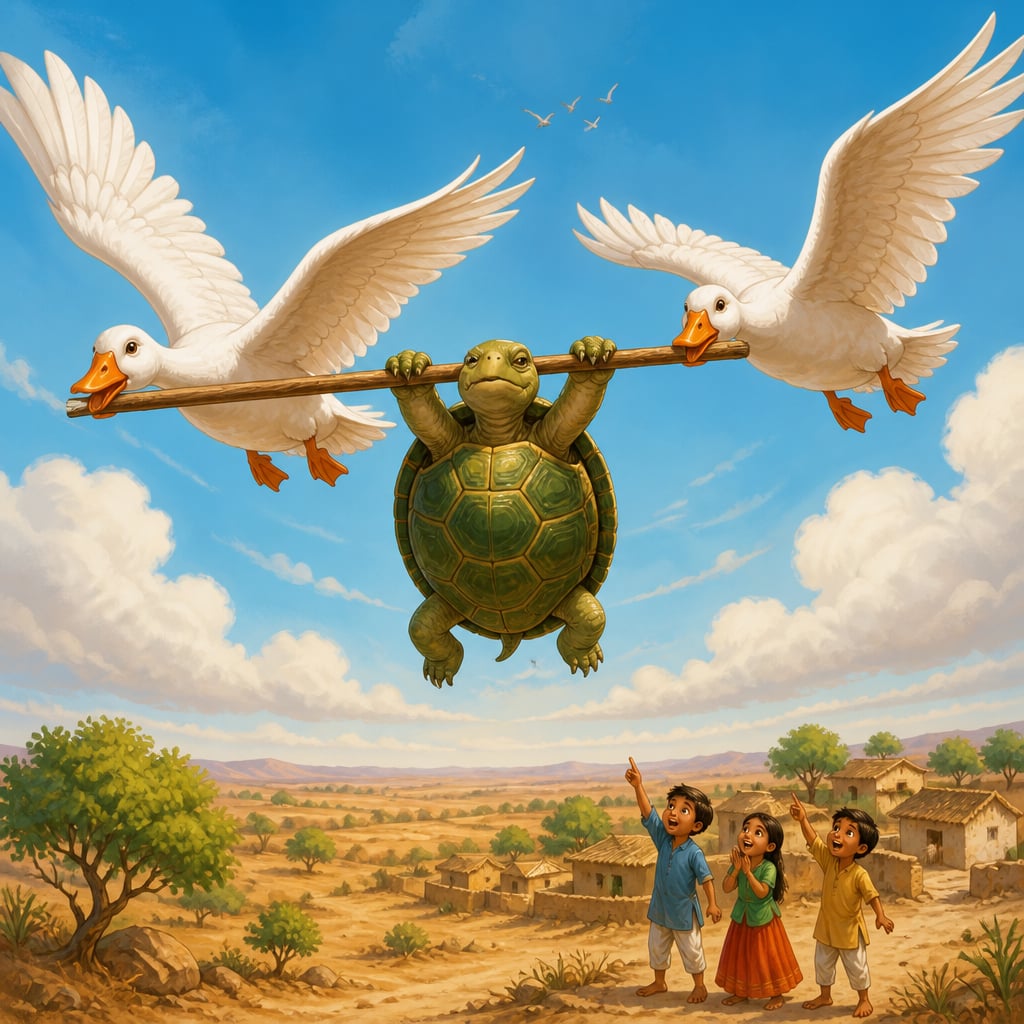
"Look at that foolish tortoise!" children laughed. "He looks ridiculous!"
Kambugriva heard the mockery and burned with shame. He wanted to shout back, to defend himself, to explain. And despite the geese's warning, he opened his mouth.
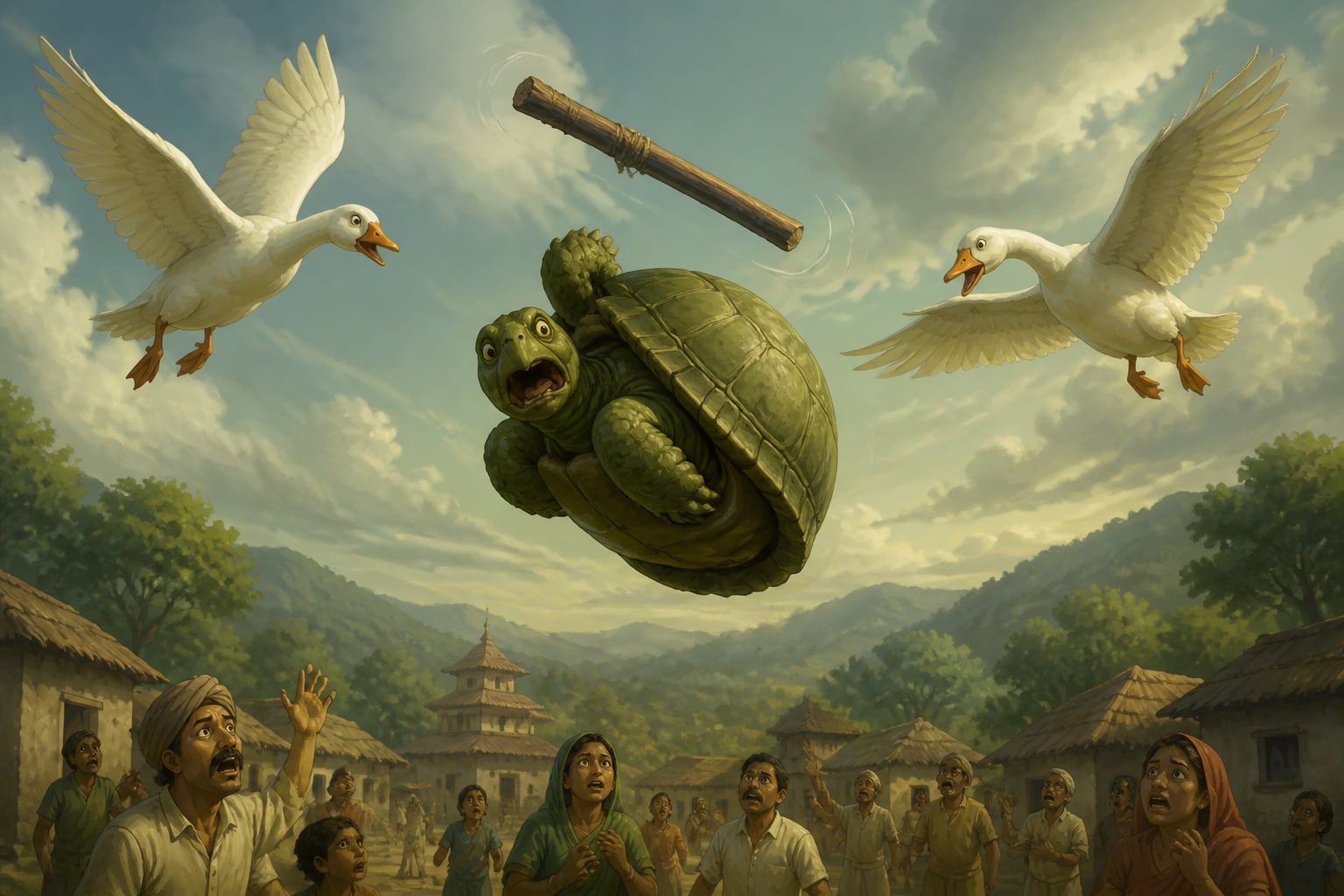
He fell to his death.
Hiranyaka paused. "The geese were true friends, they risked themselves to save him, they planned carefully, they warned him clearly. But Kambugriva could not control himself. He let his pride destroy what his friends had built."
True Friendship Goes Both Ways
Manthara spoke again. "This story teaches something important. True friendship must go both ways. The geese were true friends to Kambugriva. But was Kambugriva a true friend to them?"
"He didn't listen to their warning," said Chitranga slowly. "He let his pride overcome their wisdom."
"Yes," said Manthara. "True friendship is not just about having good friends, it is about being a good friend. Kambugriva failed his friends even as they saved him. He made their sacrifice meaningless."
Laghupatanaka added, "The test works both ways. We ask: 'Are my friends true?' But we must also ask: 'Am I a true friend to them?'"
The Four Friends Reflect
Chitranga looked at his three companions, the crow, the mouse, the tortoise. None of them were of his kind. None were deer. Yet each had proven more loyal than his entire herd.
"When I was in the net," he said quietly, "I thought I would die alone. My herd was gone. My family was taken by hunters long ago. I had no one. And then, you came. All of you. You risked yourselves for a stranger."
"You were not a stranger," said Hiranyaka. "You were our friend. That was all that mattered."
"But how did you know?" Chitranga pressed. "How did you know I would be worth saving? That I would not become like my old herd, present in good times, absent in bad?"
Laghupatanaka answered. "We did not know. Not with certainty. But we saw how you treated us when you first arrived, grateful, humble, generous. You shared your knowledge of the forest. You never complained. You asked about our troubles and remembered our answers. These small signs told us who you were."
"And now," said Manthara, "we know for certain. We have been through the fire together. You have proven yourself, as we have proven ourselves. This is the gift of crisis, it removes all doubt."
The Gift of Crisis
The afternoon sun filtered through the banyan leaves, casting patterns of light and shadow on the four friends.
"I used to fear danger," said Chitranga. "Now I understand that danger is not only a threat, it is a test. It shows us who we truly are and who truly cares for us."
"Better to face one danger with true friends," agreed Hiranyaka, "than to live in safety surrounded by false ones."
"The old texts say," Manthara concluded, "'In fire, gold is tested. In battle, heroes are proven. In hard times, the truth of friendship is revealed.' We have been through our fire. We have emerged as pure gold."
Laghupatanaka spread his wings in the sunlight. "Then let us be grateful for the hunters, in a way. They did not catch us. But they showed us what we have, and what we are to each other."
The four friends sat together in the spring sunshine, their bond now unbreakable, tested by crisis and proven true.
Reflection
- Think of a difficult time in your life. Who showed up, and who disappeared? Were there any surprises, people you expected to help who didn't, or people who helped unexpectedly?
- Kambugriva's geese friends did everything right, yet he still died. Does this mean true friendship can fail? Or does it mean something else about the nature of help?
- The verse says to know friends in crisis, heroes in battle, wives when wealth declines. Is it fair that we can only truly know people when they are tested? Should trust require proof?