Sankatakale: Friends in Need
True friends appear in crisis
The second chapter opens with new danger. Hunters return to the forest, and the four friends must face their greatest test. Through the famous tale of the Three Fish, they explore different approaches to crisis, preparation, adaptation, and denial, and discover that true friendship is proven not in peaceful times but in moments of peril.
The Shadow Returns
Winter had come to the forest. The leaves had fallen, the pond had grown cold, and a chill wind blew through the bare branches of the great banyan tree. The four friends had adapted to the season, Manthara burrowed into the mud at the bottom of his pond, Hiranyaka nested deep in his warm hole, Chitranga grew a thick winter coat, and Laghupatanaka found shelter in a hollow of the trunk.
But with winter came danger. The cold drove animals into the open searching for food, and hunters followed.
One morning, Laghupatanaka returned from his scouting flight with grim news.
"They are back," he said. "The same hunters who trapped Chitranga before. They have made camp at the forest's edge. They are setting traps along the deer trails."
Chitranga's eyes widened with fear. The memory of the net closing around him, the helplessness, the certainty of death, it all came flooding back.
"We escaped them once," said Hiranyaka, trying to sound brave. "We can do so again."
"Can we?" asked Manthara, rising from his mud bed to the water's surface. "Last time, we succeeded through surprise. They did not expect a tortoise as bait or a mouse to gnaw ropes. Now they may be prepared."
"Then what do we do?" asked Chitranga.
Manthara was quiet for a long moment. "Let me tell you a story," he said. "A story about three fish who faced a similar danger, and how their different responses determined their fates."
The Tale of the Three Fish
In a lake not far from here, said Manthara, there lived three fish who were friends. The first was named Anagatavidhata, "one who plans for what has not yet come." The second was Pratyutpannamati, "one who thinks quickly in the present moment." The third was Yadbhavishya, "one who says 'whatever will be, will be.'"
These three fish had lived in the lake their entire lives. It was a good lake, clean water, plenty of food, and few predators. But one day, two fishermen walked along the bank.
"Look at this lake," said one. "Full of fish! Let us come back tomorrow with our nets."
"Yes," agreed the other. "We will catch enough to feed the whole village."
The three fish heard this conversation.

Anagatavidhata spoke immediately. "We must leave tonight. The fishermen will return tomorrow, and their nets will trap us all. There is a river connected to this lake, I have seen it. If we swim there now, we will be safe."
Pratyutpannamati considered this. "Perhaps you are right. But perhaps the fishermen will not return. Let us wait and see. If they come, I will think of something."
Yadbhavishya laughed. "Leave our home? For something that might not even happen? You worry too much, Anagatavidhata. Whatever will be, will be. I will not abandon my lake for a rumor."
Anagatavidhata could not convince them. That very night, she swam through the channel to the river. Her friends stayed behind.
What Happened Next
The next morning, the fishermen returned with their nets. They cast them wide across the lake and began to pull.
Yadbhavishya was caught immediately. She thrashed and struggled, but the net held her fast. "I should have listened," she gasped as the fishermen hauled her to the bank. "Whatever will be... has come." She was the first fish to die that day.
Pratyutpannamati was also caught in the net. But she did not panic. Her name meant "quick-thinking," and she lived up to it. She stopped struggling and went completely still, floating as if already dead.
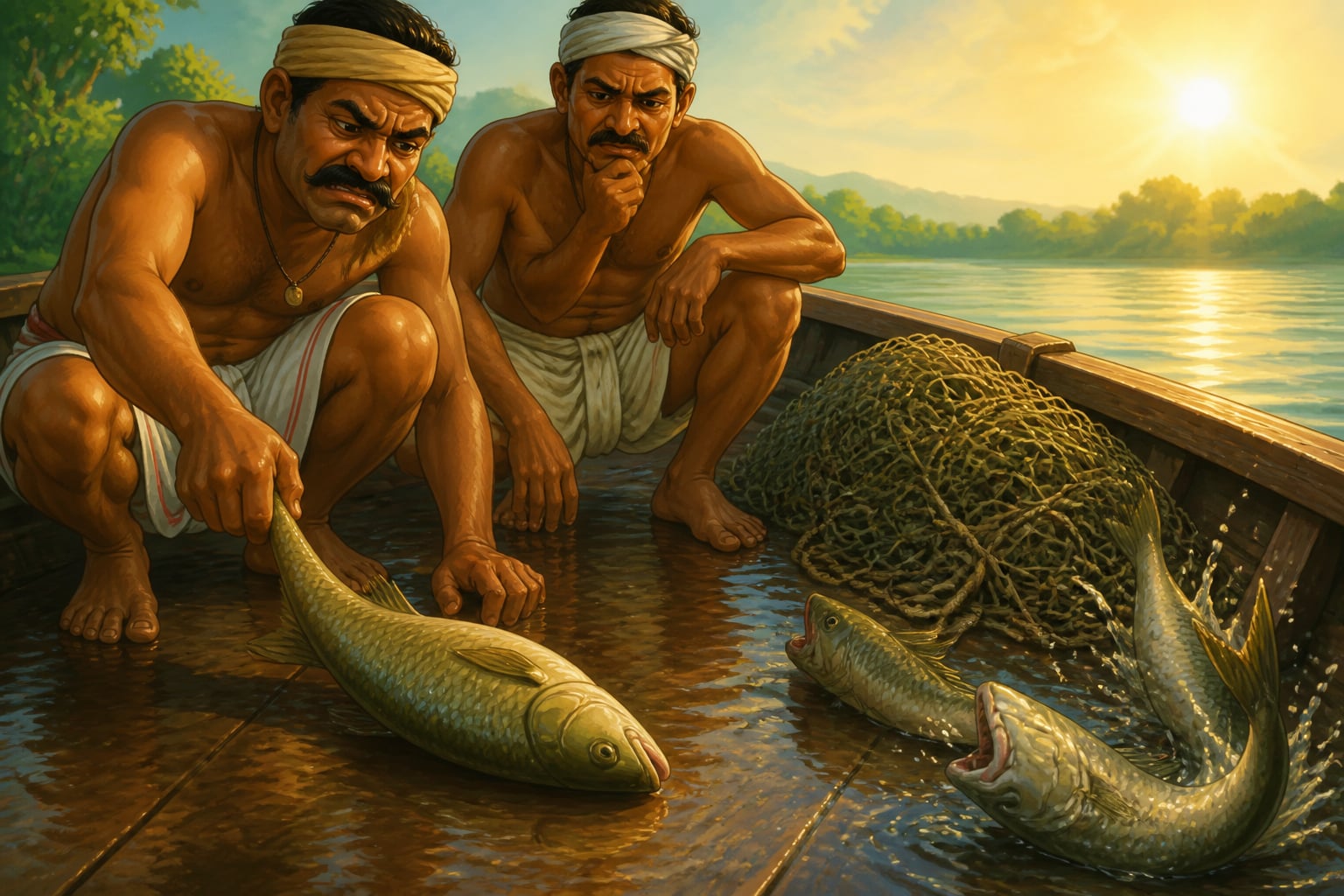
When the fishermen pulled up the net, they saw her motionless body.
"This one is already dead," said one fisherman with disgust. "It must have suffocated in the net. Throw it back, dead fish spoil quickly."
They tossed Pratyutpannamati back into the water. The moment she hit the surface, she darted away to the channel and swam to join Anagatavidhata in the river.
"You escaped!" said Anagatavidhata with relief. "But where is Yadbhavishya?"
Pratyutpannamati's eyes were sad. "She did not think. She did not plan. She is gone."
The Lesson of the Fish
Manthara finished his tale. The four friends sat in heavy silence.
"Three approaches to danger," the tortoise continued. "Anagatavidhata planned ahead, she saw the threat and acted before it arrived. Pratyutpannamati thought quickly, she adapted in the moment when caught. Yadbhavishya denied the danger, she trusted fate and paid with her life."
"Which approach is best?" asked Hiranyaka.
"All of them, in the right circumstances," Manthara replied. "Planning ahead is always wise when possible. But sometimes danger comes too fast to plan, then quick thinking saves you. The only approach that always fails is denial, pretending that danger does not exist simply because you do not wish to face it."
Laghupatanaka nodded. "So we must be all three fish at once. Plan what we can, be ready to adapt, and never deny what is happening."
"Yes," said Manthara. "And we have one advantage the fish did not: we have each other. Anagatavidhata could not force her friends to leave. But we, we can plan together, think together, and ensure that no one among us becomes Yadbhavishya."
Planning for the Crisis
Chitranga stood, his fear transforming into determination. "Then let us plan. Laghupatanaka, where exactly are the hunters setting their traps?"
The crow described the locations, along the deer trails, near the water sources, around the clearings where animals gathered.
"I will avoid those places," said Chitranga. "But what if I am caught despite our plans?"
"Then we adapt," said Hiranyaka. "I know all the tunnels in this forest. There are escape routes the hunters cannot see. If you are trapped near any of them, I can lead you out."
"And I will watch from above," said Laghupatanaka. "If I see you heading toward danger, I will call out. If you are caught, I will find the others immediately."
Manthara spoke last. "I am slow and cannot help in pursuit or escape. But I can think. When crisis comes, bring me the problem, and I will find the solution."
Chitranga looked at his friends, each offering what they had, each ready to risk themselves for the others.
"The fishermen caught the fish alone," he said quietly. "But we are not alone. We face this together."
The True Test
The hunters came closer over the following days. The four friends implemented their plan, Chitranga changed his paths, Hiranyaka mapped escape routes, Laghupatanaka kept constant watch, and Manthara stayed alert for opportunities.
There were close calls. Once, Chitranga nearly stepped into a hidden pit. Laghupatanaka's cry saved him. Another time, Hiranyaka spotted a new trap along a tunnel entrance and warned the others.
But through it all, they stayed together. They stayed alert. They adapted when plans failed. And they never, ever pretended that the danger was not real.
After two weeks, the hunters moved on. The forest had proven too difficult, too many animals seemed to know where the traps were, too many paths were suddenly abandoned, too many opportunities were somehow missed.

When they were finally sure the danger had passed, the four friends gathered beneath the banyan tree.
"We survived," said Chitranga, his voice full of wonder.
"Because we planned," said Laghupatanaka.
"Because we adapted," said Hiranyaka.
"Because we faced reality together," said Manthara. "This is what the story of the three fish teaches. In sankatakale, in times of crisis, those who plan survive. Those who adapt survive. Those who deny perish. And those who have true friends... they do more than survive. They triumph."
The winter wind still blew cold through the forest. But beneath the great banyan tree, four friends felt warmer than they had in weeks. They had faced the test of crisis and proven that their friendship was not just for pleasant times.
They were friends in need. And friends in need, as the old saying goes, are friends indeed.
Reflection
- Think of a time when you saw a problem coming but waited too long to act. What held you back? How might things have been different if you had responded like Anagatavidhata?
- What is the difference between Yadbhavishya's 'whatever will be' and genuine acceptance of fate? When does acceptance become dangerous denial?
- The verse says both the planner and the quick-thinker prosper. Are these skills equally valuable? Or is one approach generally better than the other?