Vividhamitra: Friends of All Kinds
Unlikely friendships can be strongest
The four friends reflect on what makes their unlikely friendship work. A crow of the sky, a mouse of the earth, a deer of the forest, and a tortoise of the water, they should be strangers. Yet their very differences create a bond stronger than any made between similar beings.
Four Elements, One Friendship
The summer had reached its height. The pond had shrunk, the leaves had yellowed, and even the great banyan tree seemed to droop in the heat. The four friends gathered in what shade remained, each seeking coolness in their own way.
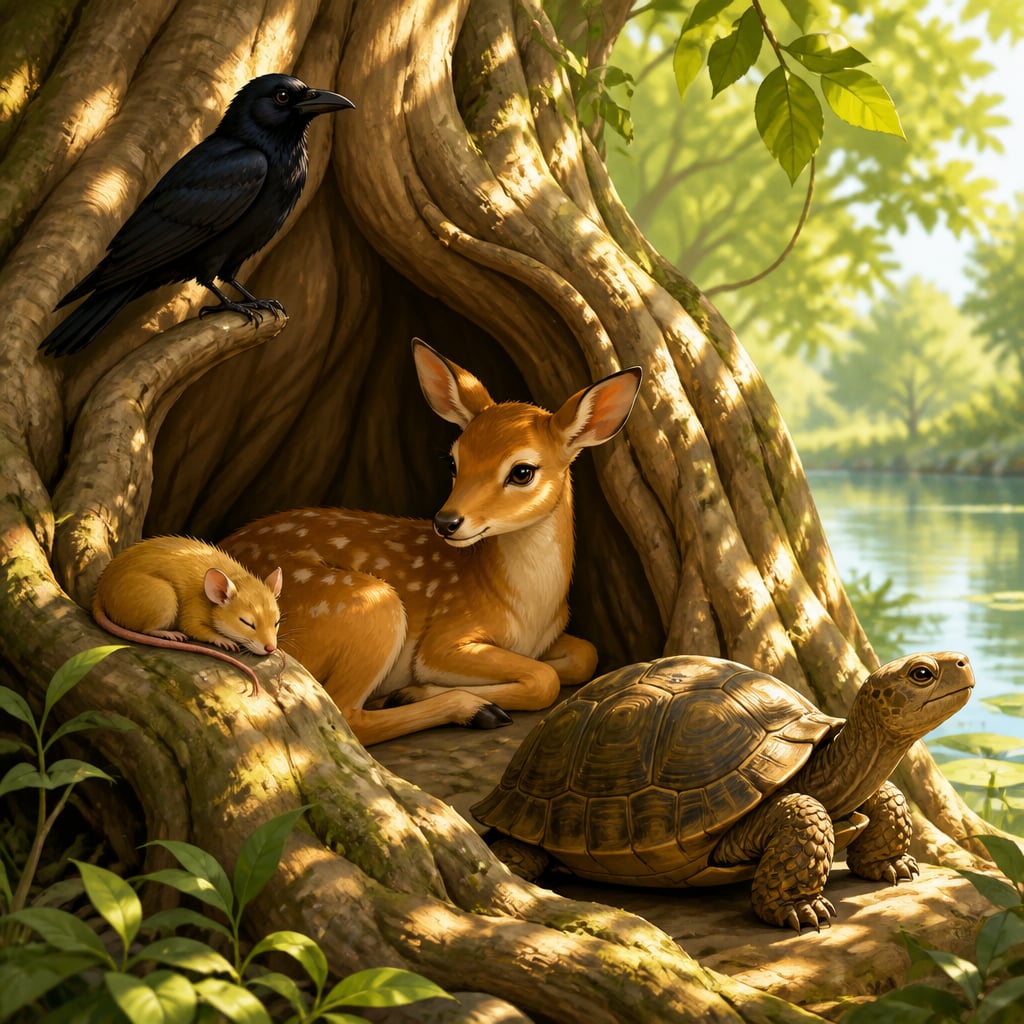
Laghupatanaka had found a hollow in the trunk where a breeze flowed through. Hiranyaka had dug a cool burrow deep beneath the roots. Chitranga lay in a depression where the earth was still moist from ancient groundwater. And Manthara floated in the center of his diminished pond, only his old eyes showing above the surface.
"I have been thinking," said Chitranga, breaking the drowsy silence, "about how strange we must look to others."
"Strange?" asked Hiranyaka.
"A crow, a mouse, a deer, and a tortoise," Chitranga continued. "What do we have in common? In nature's design, we should be strangers, or worse, some of us should be predator and prey."
Laghupatanaka cawed thoughtfully. "The crow and the mouse... yes, in other circumstances, I might have seen you as food, little friend."
"And the deer," added Manthara, "runs from all danger, while the tortoise hides and the crow flies away. We respond to threats so differently."
"Yet here we are," said Hiranyaka. "Closer than brothers of the same litter, more loyal than members of the same herd."
What Should Divide Us
Laghupatanaka flew down to a lower branch to be closer to his friends. "Let us speak plainly about what divides us, or should divide us. Perhaps in naming the walls, we can understand how we crossed them."
"I am of the sky," said the crow. "My world is above. I see far but understand little of what happens on the ground. I am quick to act, sometimes too quick. My kind is known for noise, for gossip, for gathering in loud murders that accomplish nothing. Crows are not trusted."
"I am of the earth," said Hiranyaka. "My world is below and between. I am small, fearful by necessity, always watching for danger. My kind is seen as pests, destroyers of grain, carriers of disease. Mice are not welcomed."
"I am of the forest," said Chitranga. "My world is the open glade and the running path. I am prey, my entire existence is organized around fleeing. My kind is seen as timid, as food for others, beautiful but helpless. Deer are not respected."
"I am of the water," said Manthara. "My world is slow and deep. I cannot run, cannot fly, cannot hide quickly. My kind is seen as passive, as living rocks, as creatures so old we have forgotten how to move. Tortoises are not valued."
A silence fell. Each had named their limitations, the stereotypes that should have kept them apart.
What Actually Unites Us
"And yet," said Hiranyaka after a moment, "none of those things describe who you are to me."
The others looked at him.
"Laghupatanaka, I do not see a noisy, untrustworthy crow. I see the friend who spoke to me first, who saw past my small form to my willing heart. I see eyes that watch over us, a voice that warns us, a loyalty that has never wavered."
"Chitranga," continued the mouse, "I do not see a timid deer. I see the one who invited me into friendship, who never made me feel small. I see courage in staying with us when you could have fled to safety, and generosity in sharing the forest's secrets."
"Manthara," he finished, "I do not see a slow old tortoise. I see the one who risked himself as bait to save Chitranga. I see wisdom that flows from you like water from a spring, counsel that has guided us through every difficulty."
Manthara's old eyes glistened. "Little one, you have named it well. We are united not by what we are, but by who we choose to be for each other."
The Strength in Difference
Laghupatanaka spoke again. "But it goes deeper than looking past differences. Our differences are our strength."
"How so?" asked Chitranga.
"Think of it," said the crow. "When danger comes from above, I see it. When danger comes from below, Hiranyaka senses it. When danger approaches through the forest, Chitranga hears it. When we need wisdom about whether to fight or flee, Manthara provides it. We cover each other's blind spots."
Hiranyaka nodded eagerly. "And in crisis, we each contribute what no other can. I gnaw ropes. You scout from the sky. Chitranga can run for help. Manthara can distract and deceive."
"If we were all crows," said Manthara, "we would all have the same abilities and the same weaknesses. A net would catch all of us. An arrow would threaten all of us. Our diversity is not an obstacle to overcome, it is a treasure to celebrate."
Chitranga rose to his feet, his eyes bright. "I understand now why I never found this kind of friendship among other deer. With them, I shared only fear. With you, I share everything, including strengths I do not possess."
The Four Elements Together
Manthara swam closer to the edge of the pond. "In the ancient teachings, there are four great elements: Vayu, the wind and sky; Prithvi, the earth; Agni, energy and movement; and Jala, water. We four embody these elements."
"Laghupatanaka is Vayu," he continued. "Swift, seeing all, carrying messages on the wind."
"Hiranyaka is Prithvi. Connected to the earth, knowing its tunnels and secrets, grounded and patient."
"Chitranga is Agni, not fire, but energy, movement, the spark of life that runs through the forest."
"And I am Jala. Slow as water, deep as water, shaping my surroundings not by force but by persistence."
Laghupatanaka cawed with delight. "The four elements, united! No wonder we are complete together. Each element needs the others, wind feeds fire, earth contains water, water nourishes earth, fire warms air. We are not just friends; we are a unity of nature itself!"
Why Unlikely Friends Last
"I have seen many friendships," said Manthara. "I have lived many centuries. And I have noticed something about unlikely friendships like ours."
The others listened.
"Friends who are alike often grow apart. They have nothing to learn from each other. They compete for the same resources, the same attention, the same roles. Eventually, similarity breeds boredom or rivalry."
"But friends who are different, truly different, grow together. Each day, Laghupatanaka teaches me about the sky I will never touch. Each day, Hiranyaka shows me the earth's hidden world. Each day, Chitranga reminds me what it means to move freely. I learn from you constantly, and you learn from me."
Hiranyaka added, "And we cannot compete. I will never fly. Chitranga will never swim. Laghupatanaka will never burrow. We each have our domain, our gift. There is no jealousy because there is no overlap."
"This is why," concluded Manthara, "the unlikely friendship is often the strongest. It is built on complement, not competition. On curiosity, not comparison. On appreciation of difference, not tolerance of it."
A Pact of Difference
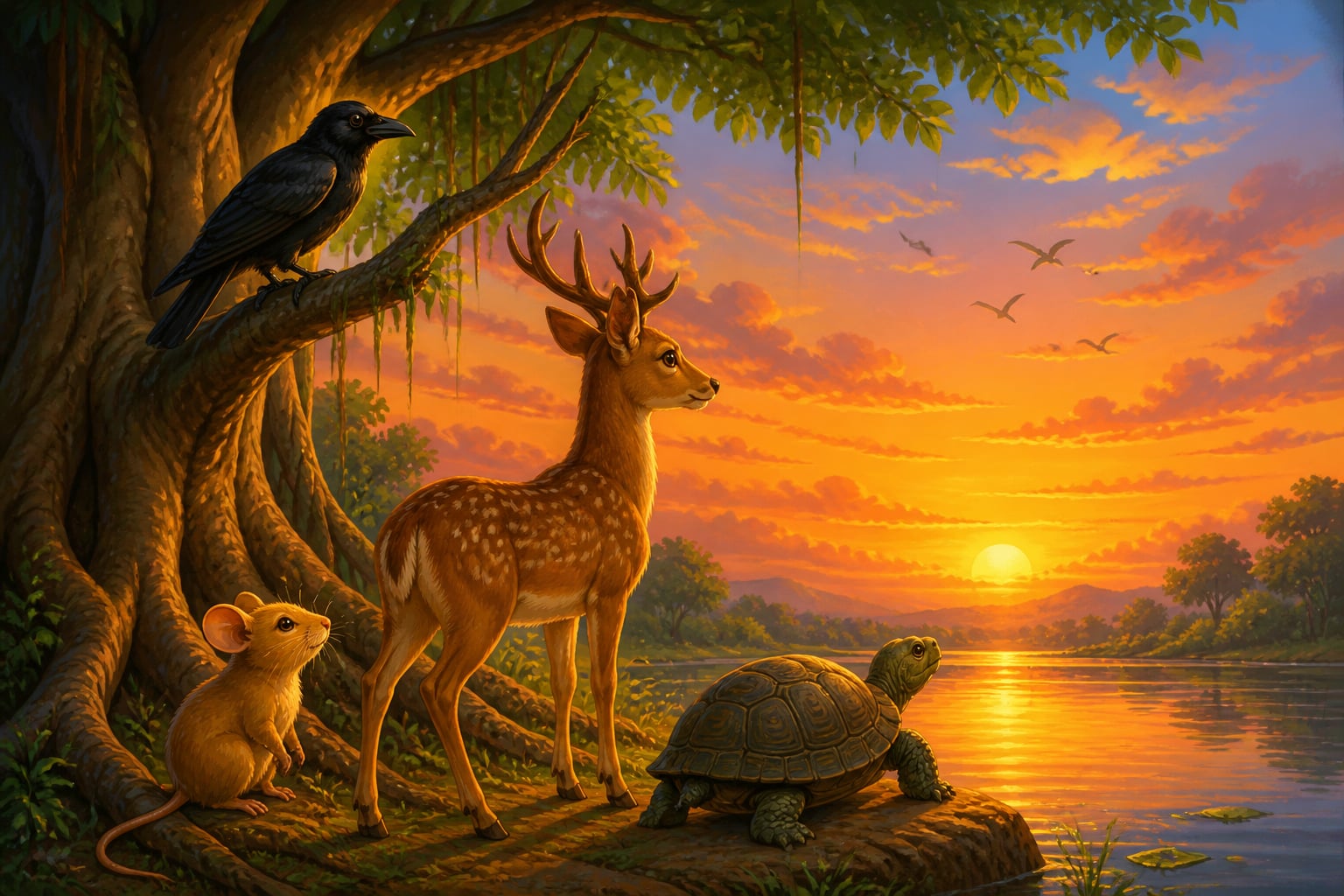
The sun began to set, painting the sky in colors that all four friends could see and appreciate in their own ways.
"Let us make a pact," said Laghupatanaka. "Not just of friendship, but of difference."
"What do you mean?" asked Chitranga.
"I mean this: we will never try to make each other the same. We will never wish the other were more like us. We will never be embarrassed by each other's natures."
Hiranyaka squeaked in agreement. "I am small, and I will stay small. I will not pretend to be bigger. And I will not be ashamed."
"I am slow," said Manthara, "and I will stay slow. I will not apologize for taking my time."
"I am prey," said Chitranga, "and I will remain alert. I will not pretend to be brave when I am not."
"And I am loud," cawed Laghupatanaka, "and I will keep cawing. I will not silence myself for anyone."
They looked at each other, four utterly different beings who had become one family.
"Vividhamitra," said Manthara softly. "Friends of all kinds. That is what we are. And that is what we shall remain."
The night fell gently on the banyan tree, on the pond, on the roots and branches that sheltered four friends who had nothing in common except everything that mattered.
Reflection
- Among your friends, what unique quality do you bring that no one else has? What would the group be missing without you?
- The four friends say that similar friends often grow apart through competition, while different friends grow together through complement. Have you observed this in your own life?
- The verse says beings of different species can become 'like family members' when bound by affection. What does this tell us about the nature of kinship, is family about blood, or about love?