Krutaghnata: Gratitude vs Ingratitude
Remember those who helped you
One evening, the four friends share stories about gratitude. Manthara tells the tale of a traveler who saved four beings from a well, a tiger, a monkey, a snake, and a goldsmith. The animals remembered their debt and repaid it generously. But the goldsmith, a human, proved that ingratitude makes beasts of men.
An Evening of Stories
The monsoon had come, and rain drummed steadily on the broad leaves of the banyan tree. The four friends had gathered in their sheltered spots, Laghupatanaka in a hollow of the trunk, Hiranyaka in his dry burrow, Chitranga beneath a natural awning of roots, and Manthara at the pond's edge, delighting in the fresh water swelling his home.
"On evenings like this," said Laghupatanaka, "my grandfather would tell stories. Tales of wisdom passed down through generations."
"Tell us one," urged Hiranyaka.
"Better still," said Manthara, his ancient voice like pebbles rolling in a stream, "let me tell you a tale I heard long ago. A story about gratitude and its opposite, and why the wise say that ingratitude is worse than any other sin."
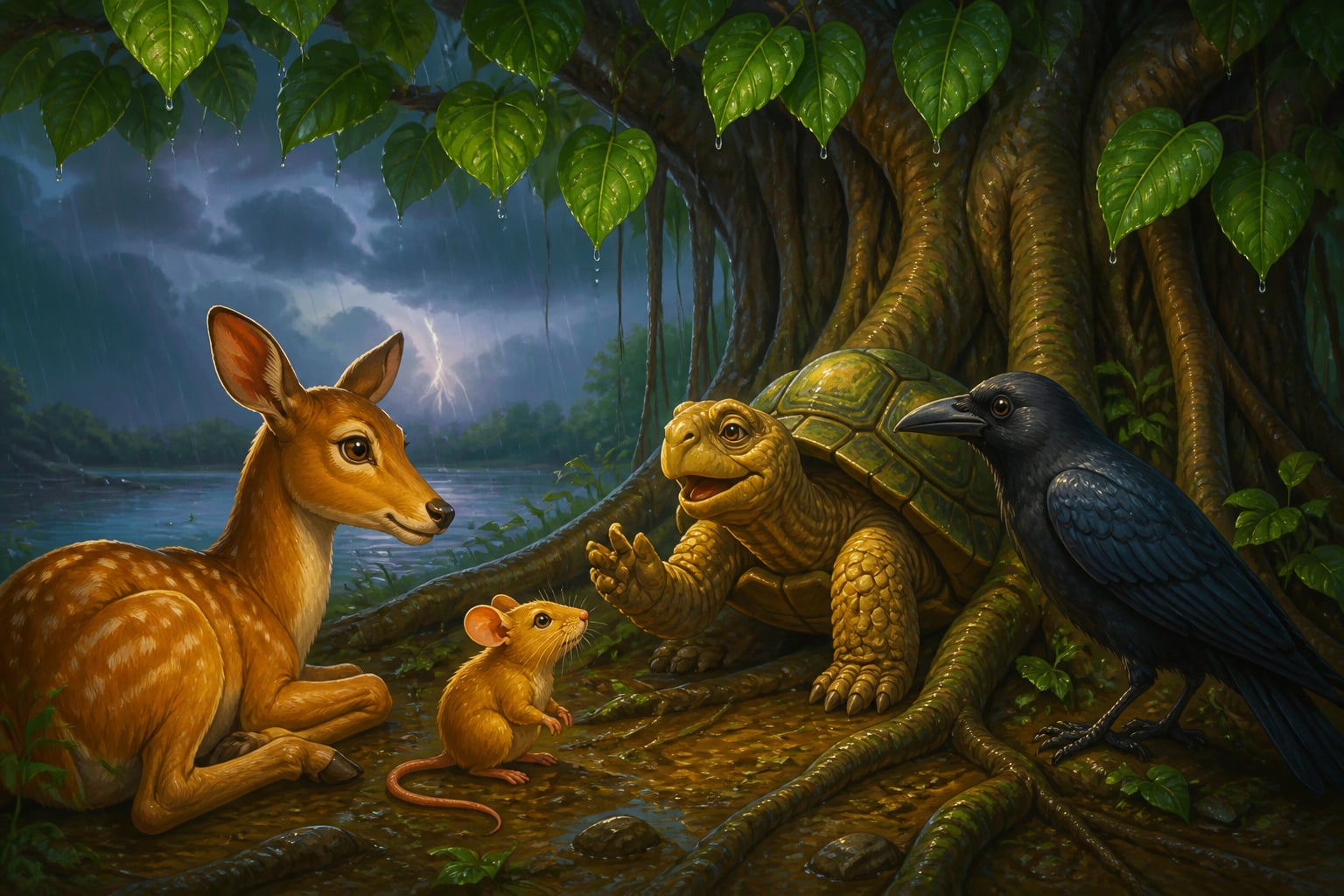
The friends settled in to listen as thunder rumbled in the distance.
The Well in the Forest
In a forest not unlike this one, said Manthara, there lived a Brahmin traveler named Dharmabuddhi, "one of righteous mind." He was poor but honest, making his way through the world by teaching the sacred texts to those who sought wisdom.
One day, walking through the forest, Dharmabuddhi heard cries for help. Following the sound, he came upon an ancient well, crumbling and half-hidden by vines. Peering over the edge, he saw four figures trapped below: a tiger, a monkey, a snake, and a goldsmith, a human man.
"Help us!" they cried together. "We fell into this well and cannot climb out!"
Dharmabuddhi's heart was moved by their plight. He found a strong vine and began lowering it into the well.
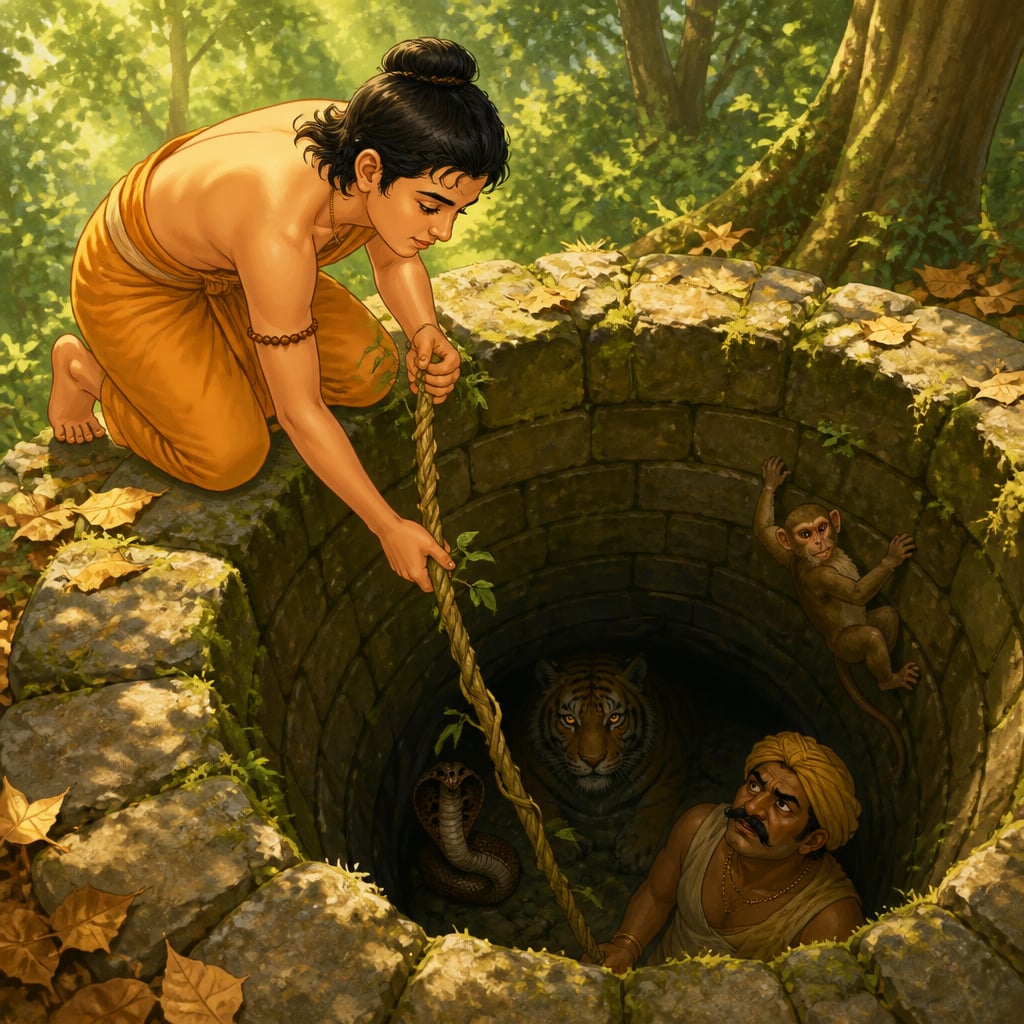
The tiger, seeing the vine descend, spoke first: "Noble Brahmin, pull me up! I am Mahabala, king of tigers. If you save me, I will be forever grateful. I live in a cave at the foot of the eastern hills, come to me whenever you need help."
The goldsmith called up: "Do not trust the tiger! He is a beast who will devour you! Save me first, I am a human like yourself, a craftsman named Kantaka. I live in the city of Brahmapura. I will repay your kindness with gold and jewels!"
But Dharmabuddhi, being righteous of mind, thought: "All beings deserve compassion. Let me save them in the order they were trapped."
He pulled up the monkey first, a clever creature named Kapila who had been gathering fruit when he fell.
"Blessed Brahmin," said Kapila, bowing low, "I live in the great fig tree by the river bend. Come to me, and I will share whatever fruits and roots the forest provides."
Next came the tiger, Mahabala. The goldsmith trembled as the great beast emerged, but Mahabala only bowed his massive head to Dharmabuddhi.
"You have shown courage in saving me despite the goldsmith's warning," the tiger said. "Such trust deserves reward. Remember my cave in the eastern hills."
Then came the snake, a cobra named Nagaraja, who coiled respectfully before the Brahmin.
"I am the son of the Serpent King," Nagaraja said. "Though humans fear my kind, you have shown mercy. If ever you are in danger, call my name, and I will come."
Finally, Dharmabuddhi pulled up the goldsmith, Kantaka. But as Kantaka climbed over the well's edge, something in his eyes shifted. Where gratitude should have shone, there was only calculation.
"Yes, yes, thank you," Kantaka said quickly. "Come to Brahmapura if you need... anything." And he hurried away without looking back.
Manthara paused in his telling. "Now, my friends, what do you suppose happened next?"
The Grateful Animals
Years passed. Dharmabuddhi continued his wandering life, sometimes prosperous, sometimes poor. One day, finding himself near the eastern hills with nothing to eat and nowhere to sleep, he remembered the tiger's promise.
"Surely," he thought, "a wild beast will not remember a kindness from so long ago."
But he was wrong. When he approached Mahabala's cave, the tiger recognized him immediately.
"My savior!" roared Mahabala joyfully. "You have come at last!"
The tiger offered Dharmabuddhi the finest food from his own stores, meat he did not eat, but fruits and grains he had gathered, knowing that someday his rescuer might come.
But there was more. "A prince hunting in my territory fell from his horse," Mahabala explained. "I found these upon him." The tiger pushed forward a collection of golden ornaments, rings, chains, a crown set with gems.
"Take them," Mahabala said. "They are yours. I have no use for such things, but they will help you."
Dharmabuddhi was overwhelmed. A wild tiger, feared by all, had remembered a kindness and repaid it tenfold.
As he journeyed on, he passed the great fig tree and found Kapila the monkey, who showered him with the sweetest fruits and showed him where pure water springs bubbled up from the earth.
"Stay as long as you wish," Kapila said. "Your friendship honored me. I only wish I could give more."
The Ungrateful Goldsmith
With the tiger's gold, Dharmabuddhi decided to visit Brahmapura to sell the ornaments and establish himself comfortably. And since the goldsmith Kantaka lived there, he thought to look him up, perhaps they could renew their acquaintance.
He found Kantaka's shop easily. The goldsmith had prospered, his shelves glittering with fine jewelry. When Dharmabuddhi entered, Kantaka recognized him instantly, but his face showed fear, not joy.
"You!" Kantaka hissed. "What do you want?"
"Only to say hello, old friend," Dharmabuddhi replied, surprised by the reception. "And perhaps you could help me sell these ornaments."
He showed the golden treasures. Kantaka's eyes went wide. He recognized them, the royal ornaments of the prince who had died in the forest. Ornaments that Kantaka himself had crafted.
In that moment, Kantaka made his choice. Instead of helping the man who had saved his life, he saw an opportunity.
"Wait here," he said smoothly. "I will fetch someone to appraise these."
But instead, Kantaka ran to the palace guards. "There is a murderer in my shop!" he cried. "He has the dead prince's jewels! He must have killed him!"
The guards seized Dharmabuddhi and threw him into the royal dungeon, where he awaited execution.
The Serpent's Justice
In the darkness of his cell, Dharmabuddhi remembered the snake's promise. With nothing to lose, he called out: "Nagaraja! Nagaraja! If you can hear me, I need your help!"
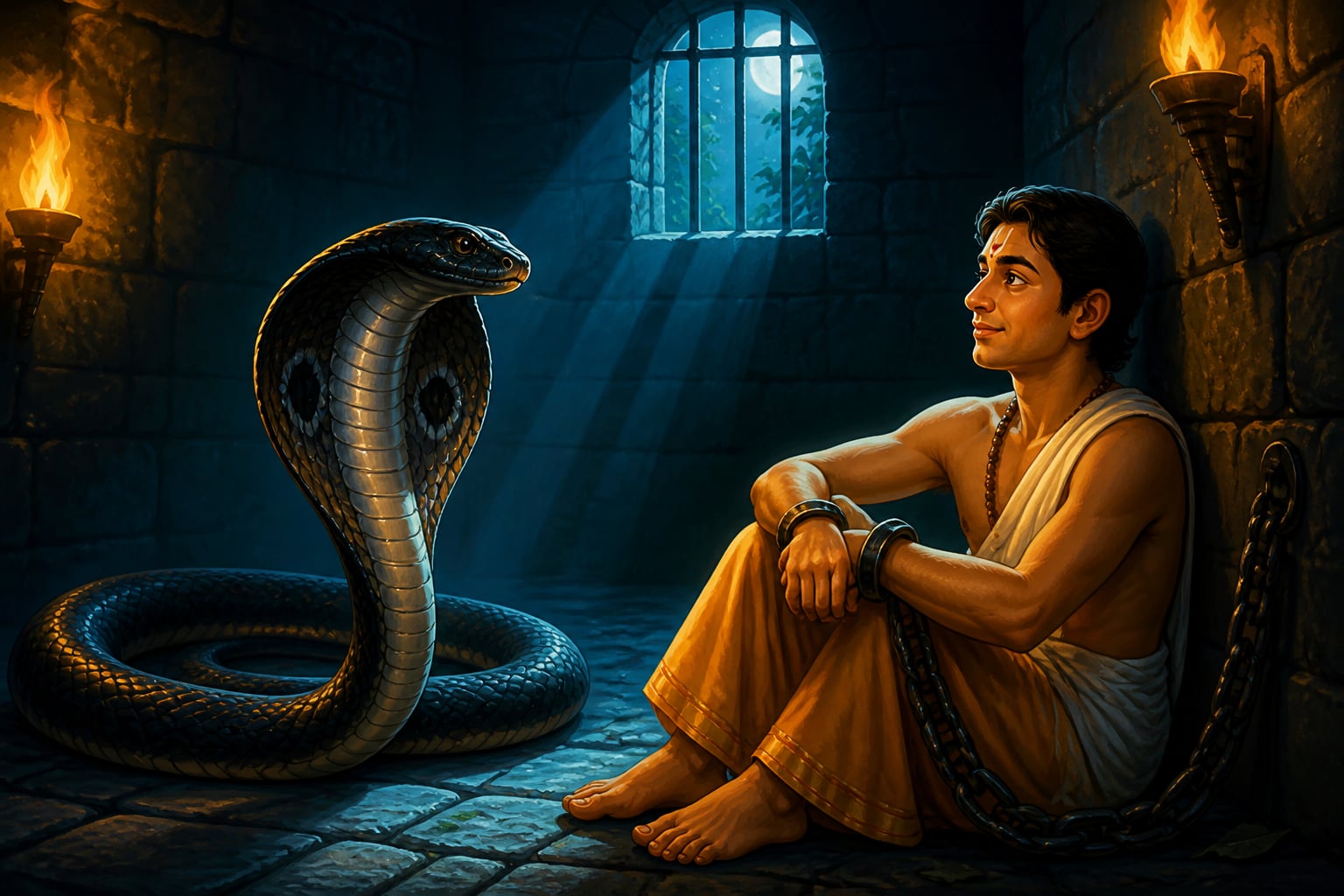
The cobra appeared, sliding through the prison bars like smoke.
"What has happened?" Nagaraja asked.
Dharmabuddhi told his story, the grateful animals, the ungrateful goldsmith, the false accusation.
Nagaraja's hood flared with anger. "I know this Kantaka. His heart was always poison. But do not fear. I will save you."
The snake slithered to the palace and bit the crown prince, not fatally, but enough to make him deathly ill. Then Nagaraja returned to Dharmabuddhi.
"When they bring the prince to you for healing, do exactly as I say..."
The next morning, the king's physicians could not cure the prince. In desperation, the king offered a reward to anyone who could save his son. Word spread through the kingdom, including to the dungeon.
"I know the cure," Dharmabuddhi called to the guards. "The snake that bit the prince told me in a dream."
Brought before the king, Dharmabuddhi applied the antidote Nagaraja had given him. The prince recovered immediately.
"You have saved my son," the king said in wonder. "But you were accused of murder. Explain yourself."
Dharmabuddhi told the whole story, the well, the four he had saved, the grateful animals, the treacherous goldsmith. The king sent guards to investigate.
They found the tiger's cave with evidence of the prince's fall, his horse nearby, signs of accident, no murder. They confirmed that Kantaka had crafted the original jewels. And they discovered that Kantaka had been seen near the forest when the prince disappeared, probably to collect debts from the nearby village.
The truth was clear. Kantaka, who owed his very life to Dharmabuddhi, had repaid kindness with false accusation.
Justice Served
The king's judgment was swift. Kantaka was stripped of his wealth and cast into the same dungeon where he had sent his rescuer. Dharmabuddhi was rewarded with the goldsmith's fortune and given a position of honor in the court.
But the true lesson, said Manthara, concluding his tale, was not about punishment or reward.
"The tiger, the monkey, and the snake were 'beasts', yet they remembered kindness and repaid it. The goldsmith was a 'human', yet he proved more beastly than any animal. This is why the wise say: judge beings by their actions, not their form. And never, ever forget those who helped you when you were helpless."
The Friends Reflect
The rain had softened to a gentle patter. Chitranga spoke first.
"I think of the hunters who would have killed me, and of you three who saved me. I could never be like Kantaka. The thought of betraying those who helped me... it makes me ill."
"Ingratitude is a kind of death," Laghupatanaka observed. "When you forget kindness, you kill something in yourself. Kantaka was dead inside long before the king punished him."
Hiranyaka nodded. "But gratitude is life. Every time we remember a kindness, we renew the bond. Every time we repay help with help, we grow stronger."
Manthara smiled. "You understand, then. Gratitude is not just good manners, it is the foundation of all true friendship. Without it, we are alone, no matter how many people surround us."
The four friends sat in comfortable silence, grateful for each other, grateful for the rain that brought life to their forest, grateful for the stories that taught them how to live.
And somewhere, in the pattern of the raindrops, they heard the echo of an ancient truth: Remember those who helped you, and you will never truly be alone.
Reflection
- Think of someone who helped you during a difficult time in your life. Have you adequately expressed your gratitude? What could you do this week to acknowledge their kindness?
- Why do you think the goldsmith, a human with reason and ethics, proved less grateful than the wild animals? What does this tell us about the relationship between intelligence and virtue?
- The verse says one drop of oil pollutes an entire stream, one act of ingratitude cannot be erased by many kindnesses. Is this fair? Can people truly never redeem themselves from a single betrayal?