Mitrasanchaya: Building Your Circle
Choose companions wisely
In this concluding lesson of the first chapter, the four friends reflect on how they came to choose each other. What qualities make someone worthy of friendship? How do you test character before extending trust? Through their reflections and a cautionary tale, they offer wisdom for building your own circle of true companions.
The Question of Choosing
Autumn had arrived. The leaves of the banyan tree had turned golden, and a pleasant coolness filled the air. The four friends gathered for what had become their favorite time, the quiet hour before sunset when the day's heat had faded but the night's chill had not yet begun.
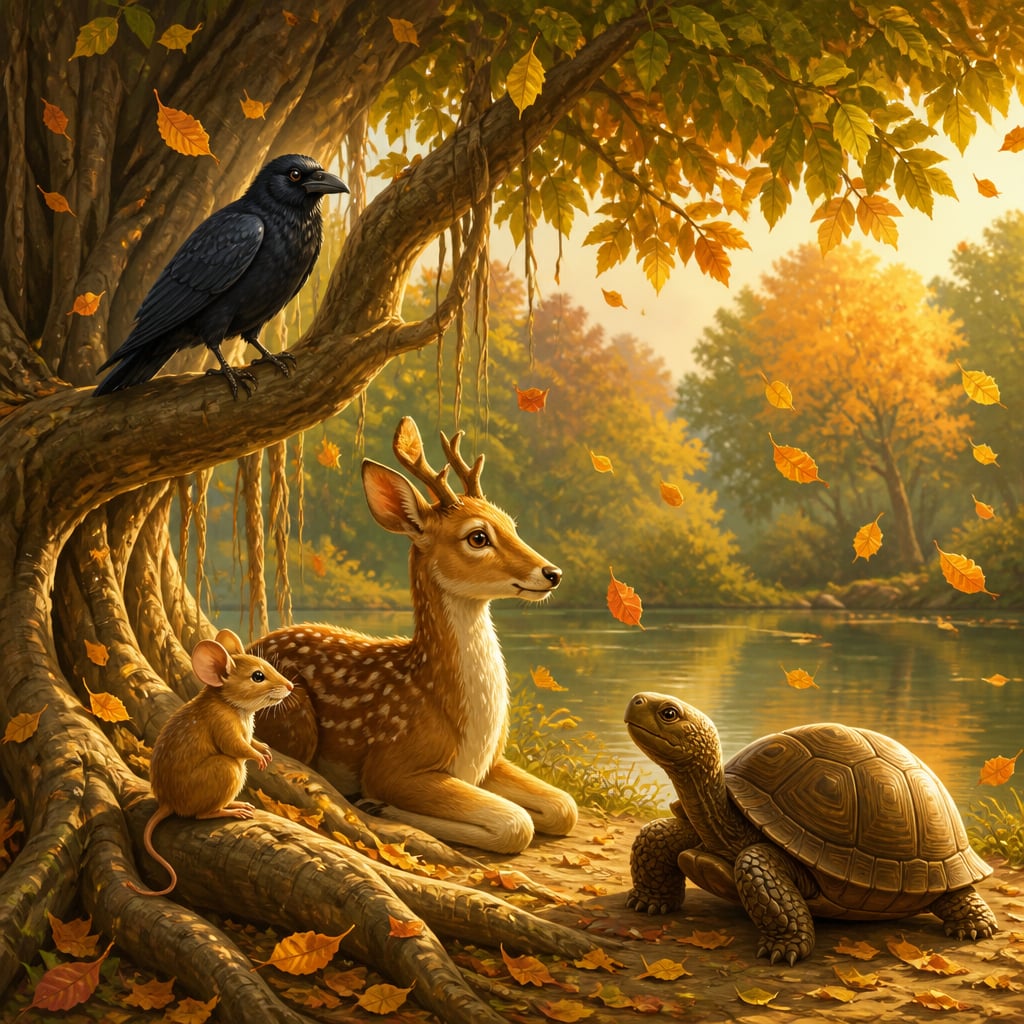
Chitranga had been thoughtful all day. Finally, he spoke.
"We have talked about what makes our friendship strong, about gratitude and helping and accepting our differences. But there is something we have not discussed: how did we know to trust each other in the first place?"
Laghupatanaka tilted his head. "What do you mean?"
"I mean, before we were friends, how did each of you decide that the others were worth trusting? When you first spoke to Hiranyaka, Laghupatanaka, you didn't know he would be loyal. When Manthara first offered to be bait, we didn't know he would succeed. How did we choose each other?"
The question hung in the air like the golden leaves.
The First Signs
Manthara spoke first, his voice thoughtful.
"When I watched the three of you from my pond, I noticed something. You were kind to each other when you thought no one was watching. Laghupatanaka would save the best berries for Hiranyaka. Hiranyaka would clear thorns from the path where Chitranga walked. These small acts told me your character."
"Observing behavior when people think no one is looking," Laghupatanaka repeated. "That is wise. Anyone can perform kindness for an audience. True character shows when there is no reward."
Hiranyaka nodded. "When I first heard Laghupatanaka's voice, I was afraid, crows eat mice. But he did not try to catch me. He asked how I was, as if I were an equal. That respect, offered without obligation, told me this was a different kind of crow."
Chitranga added, "When you all invited me to stay, you asked nothing in return. No conditions, no tests, just, 'stay with us, your friendship is enough.' That openness made me trust you. Genuine friendship does not negotiate terms."
The Five Tests
Manthara's eyes grew distant. "In my long life, I have learned five ways to test whether someone is worthy of friendship. Shall I share them?"
"Please," said all three.
"First: Observe them with those who cannot help them. How does someone treat a servant, a child, an animal, a stranger? Those who are kind only to the powerful reveal their true nature when power is absent."
"Second: Watch them in small adversities. When someone faces a minor inconvenience, a broken tool, a delayed meeting, a small loss, do they rage or accept it calmly? Those who cannot handle small troubles will collapse in large ones."
"Third: Listen to how they speak of absent friends. If someone gossips cruelly about others who are not present, they will do the same to you. The mouth reveals the heart."
"Fourth: Note whether they keep small promises. Someone who says 'I will meet you at sunrise' and arrives late without apology will also break larger promises. Reliability in small things indicates reliability in great ones."
"Fifth: See if they remember. Do they remember what you told them? Do they recall your concerns, your hopes, your fears? Friendship requires attention. Those who do not remember do not care."
The friends sat in appreciative silence.
A Tale of Mistaken Trust
"But," continued Manthara, "it is also important to know what NOT to trust. Let me tell you a story about a friendship that should never have been made."
In a forest long ago, there lived a bird named Kanthamani who was known for her beautiful singing. One day, a cat named Dirghakarni, "long-eared", approached her tree.
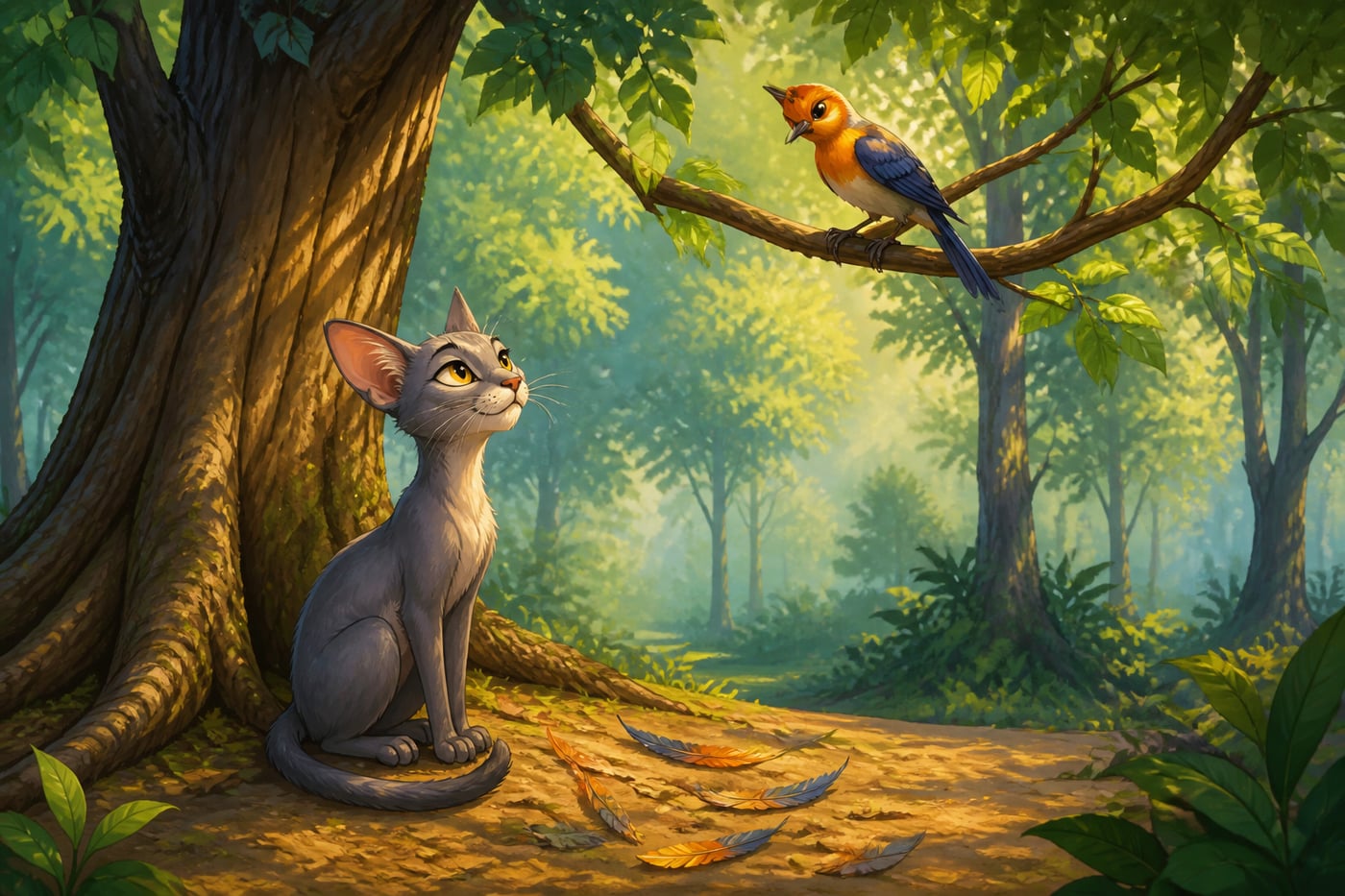
"O beautiful bird," said the cat, "your voice enchants me. I have become a vegetarian and renounced hunting. I wish only to hear your songs and be your friend."
Kanthamani was flattered. No one had praised her voice so sweetly. Against her instincts, she agreed to be friends with the cat.
For days, Dirghakarni came to the tree. He brought her seeds, warned her of other predators, and praised her singing. Kanthamani grew comfortable. She began to sleep while the cat kept watch.
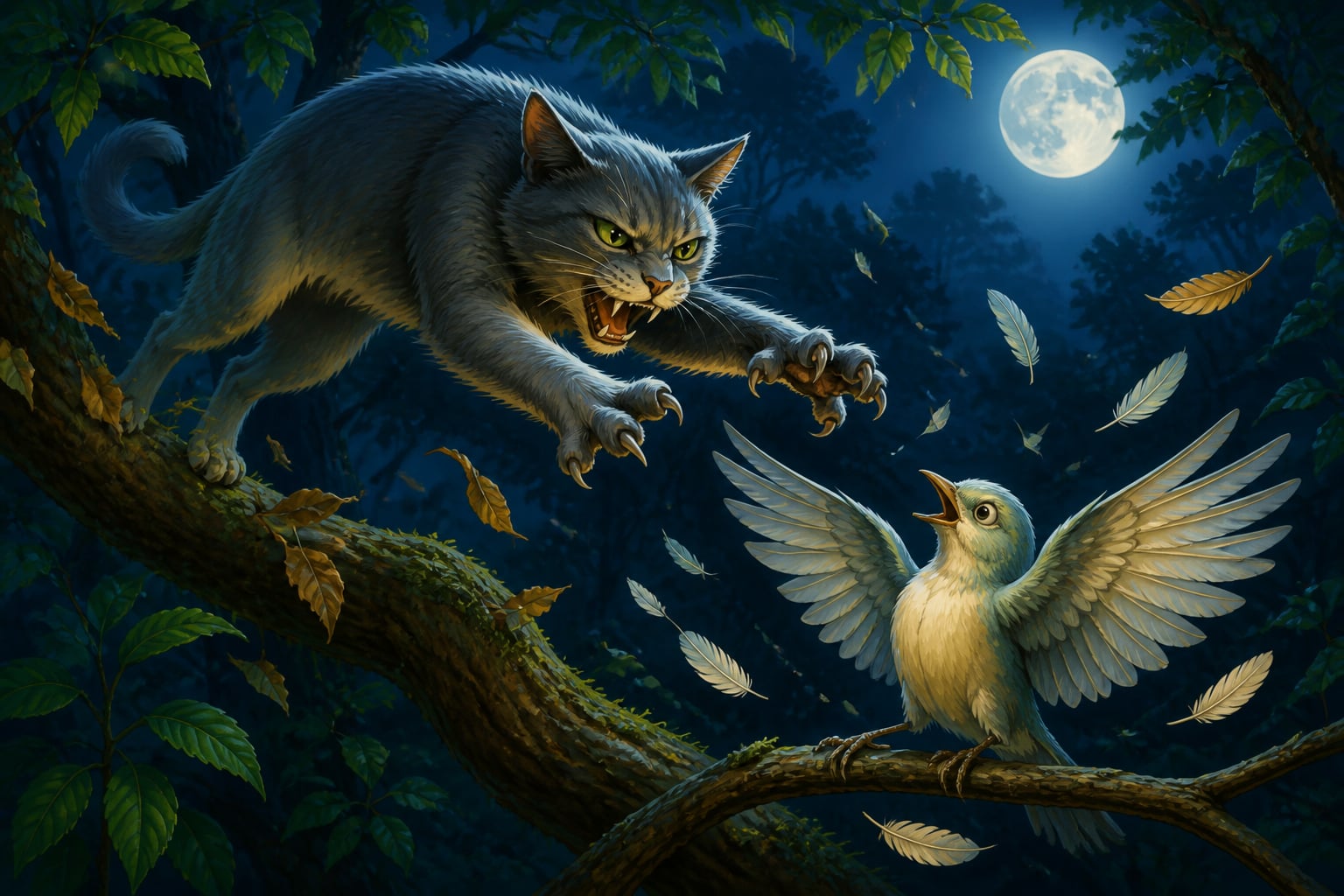
One night, when Kanthamani had flown down to a lower branch, Dirghakarni pounced.
"But, you were my friend!" Kanthamani cried.
"A cat cannot stop being a cat," Dirghakarni replied. "I told you what you wanted to hear. You believed because you wanted to believe. Your vanity was your undoing."
The Warnings
Manthara paused. "This story teaches several things about who NOT to befriend."
"Beware those whose flattery exceeds reason. True friends offer honest appreciation. Those who praise excessively often want something."
"Beware those who change their nature suddenly. A cat becoming vegetarian? A fierce rival becoming gentle? Profound change takes time. Sudden transformation is usually deception."
"Beware your own vanity. Kanthamani believed the cat because she wanted to be praised. We are most easily deceived when the lie flatters us."
"Beware ignoring your instincts. Deep down, Kanthamani knew cats eat birds. She ignored what she knew because the cat's words pleased her. When your gut says 'danger,' listen."
Laghupatanaka shifted uncomfortably. "I am a crow. Crows sometimes eat mice. Yet Hiranyaka trusted me."
"Did you claim to have changed your nature?" asked Manthara. "Did you flatter him excessively? Did you behave in ways contrary to your kind?"
"No," said Laghupatanaka. "I simply spoke to him with respect."
"That is the difference," said Manthara. "You did not deny your nature. You simply chose not to act on the part of your nature that would harm a friend. That is character, not deception."
The Circle Complete
Chitranga spoke again. "So the wisdom for choosing friends is this: watch their actions, not their words. Test them in small things. Trust your instincts. Beware flattery. And understand that true friends do not deny who they are, they simply choose, each day, to be their best selves for each other."
"Well summarized," said Manthara. "And there is one more thing: be the kind of friend worth having. If you want trustworthy friends, be trustworthy. If you want loyal friends, be loyal. If you want friends who remember, remember."
Hiranyaka spoke last. "I think we found each other because we were all looking for the same thing. Each of us had been alone, Laghupatanaka among noisy crows, Chitranga without his herd, Manthara in his pond, me in my hole. We were all seeking genuine connection in a world of shallow bonds. And somehow, we recognized each other."
"Like recognizes like," agreed Laghupatanaka. "Not in form, we could not be more different in form. But in intention, in hope, in the quality of our longing. We found each other because we were the same where it mattered."
The First Chapter Closes
The sun had set, and stars were beginning to emerge. The four friends had arrived at a moment of completion. They had discussed unity, mutual help, gratitude, the power of the small, the strength in diversity, and now, how to choose companions wisely.
"Our friendship was not luck," Manthara concluded. "It was built on choices, the choice to speak first, the choice to trust, the choice to help, the choice to stay. Every day, we choose each other again. That is what makes friendship endure."
Chitranga rose and looked at each of his friends, the crow on his branch, the mouse on his root, the tortoise at the water's edge.
"I came to this place with nothing," he said. "A wanderer without a herd, without hope. Now I have you. Now I have a circle. I will spend the rest of my days grateful for the accident that brought me to this banyan tree, and for the choices, yours and mine, that made us family."
The night deepened around them. In the forest, dangers still lurked. Hunters still set their traps. But beneath the great banyan tree, four friends rested secure in the knowledge that they had found what mattered most.
They had found each other.
And they had learned how to keep what they had found.
Reflection
- Think of Manthara's five tests. When you reflect on your closest friendships, which of these tests did your friends pass? Which tests would you add based on your own experience?
- Laghupatanaka is a crow who could eat mice, yet Hiranyaka trusted him. How is his situation different from the cat who claimed to have become vegetarian? What distinguishes genuine restraint from false transformation?
- The verse says nature cannot be changed by teaching, heated water returns to cold. If this is true, can people truly change? Or can they only learn to restrain what they cannot eliminate?