Sahaayata: Mutual Help
True friends support each other
After their victory over the hunters, the four friends discover that helping each other is not just for emergencies. Through drought, danger, and doubt, each friend finds ways to support the others. True friendship means giving help before it is asked for, and accepting help without shame.
After the Rescue
The victory over the hunters had proven what the four friends could accomplish together. But as the seasons turned and life resumed its peaceful rhythm beneath the great banyan tree, the friends discovered something deeper: helping each other was not just for moments of crisis. True friendship meant watching for ways to support one another every day.
The Crow's Vigilance
Laghupatanaka took it upon himself to be the eyes of the group. Each morning before the others woke, he would fly in widening circles around their territory, scanning for threats. He memorized the patterns of predators, which paths the jackals favored, when the hawks hunted, where the snake had made its den.
One day, he noticed a family of humans making camp near the eastern edge of the forest.
"They are not hunters," he reported to his friends. "They are travelers with children. But where travelers camp, thieves may follow. Chitranga, avoid the eastern meadow for now. Manthara, the stream by their camp feeds your pond, watch for clouded water."
Chitranga was puzzled. "But they pose no direct threat to us. Why do you spend your energy watching?"
"Because," Laghupatanaka replied, "a friend watches not just for danger, but for the conditions that might become danger. It is easier to avoid trouble than escape it."
This was the crow's gift to his friends, not just warnings, but foresight. He did not wait to be asked; he anticipated need.
The Mouse's Quiet Service
Hiranyaka was small, and his ways of helping were often invisible. When the rains came and Manthara's pond overflowed, the tortoise found himself stranded on a muddy bank, unable to climb the slippery slope back to the water.
"I shall wait until the mud dries," Manthara said patiently. "It will only be a day or two."
But Hiranyaka would not hear of it. That night, while the others slept, the little mouse worked. He dug tiny channels to drain the water from the bank. He gnawed small steps into the hardening mud. By morning, a gentle path led from where Manthara rested back to the pond.

Manthara woke to find his way clear.
"Who did this?" he asked, amazed.
Hiranyaka emerged from his hole nearby, yawning as if he had just woken. "Did what? Oh, the path? The water must have carved it as it drained."
But Manthara saw the tiny tooth marks in the mud. He said nothing, only smiled. Some help, he understood, is given quietly, asking for no recognition.
The Deer's Generous Nature
Of all the friends, Chitranga seemed to have the least to offer. He could not fly like Laghupatanaka, gnaw like Hiranyaka, or think as deeply as Manthara. But Chitranga had something else: he knew where the forest's best resources lay.
When the dry season came and water grew scarce, Chitranga remembered a hidden spring he had discovered in his wandering days, a cool pool sheltered in a rocky hollow, known only to him. He led his friends there, letting Manthara rest in the sweet water while Hiranyaka drank his fill.
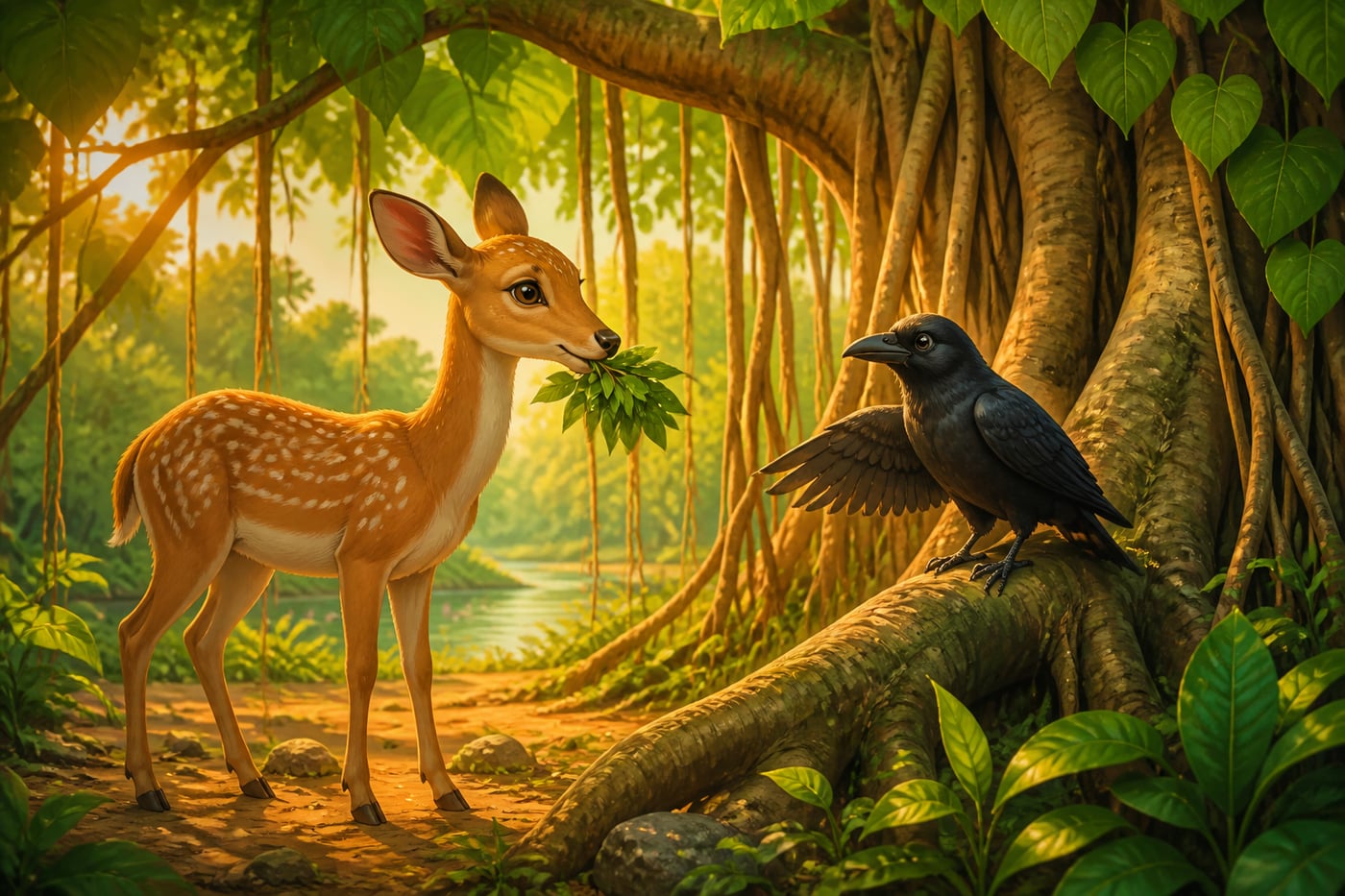
When Laghupatanaka's wing was injured by a falling branch, Chitranga carried leaves of healing herbs in his mouth, plants he had seen the forest healers use, and laid them at the crow's perch.
"I know little of medicine," Chitranga admitted. "But I have seen, and I remember. Perhaps these will help."
They did help. The herbs reduced the swelling, and within days Laghupatanaka flew again.
"You say you have little to offer," the crow told him. "But you offer exactly what is needed, exactly when it is needed. That is the greatest gift."
The Tortoise's Counsel
Manthara was old and slow, but his mind moved where his body could not. He became the counselor of the group, the one they turned to when they faced difficult decisions.
One day, Hiranyaka came to the pond's edge, troubled.
"A colony of mice has moved into the forest," he said. "They wish me to join them, to be their leader. They say I am famous now, the mouse who saved the deer. They offer me position, respect, a family."
"And what troubles you about this?" Manthara asked gently.
Hiranyaka was silent for a moment. "I would have to leave you. All of you. But they are my kind. Is it not natural to be with one's own?"
Manthara considered this carefully before speaking.
"What makes a family, little one? Is it sharing the same form? Or sharing the same heart? Those mice offer you what you were born as. But we offer you what you have become. Only you can decide which matters more."
Hiranyaka thought long about this. In the end, he visited the mouse colony, helped them establish their burrows safely, taught them the ways of the forest, but he returned to the banyan tree.
"They are my kind," he told Manthara. "But you are my family."
The Gift of Receiving
But there was one more lesson the friends had to learn. Helping is not complete unless the other is willing to receive.
Chitranga, proud by nature, found this difficult. When the others noticed he was limping, a thorn embedded deep in his hoof, he tried to hide it.
"It is nothing," he insisted, though pain flickered in his eyes. "I have survived worse alone."
Laghupatanaka landed on his back. "You do not have to survive alone anymore. That is what you seem to forget."
"But I do not want to be a burden," Chitranga confessed. "You have all done so much for me. I was a wanderer, homeless, hopeless. You gave me belonging. To need more feels... shameful."
Manthara spoke from the water's edge. "You gave us your knowledge of the forest, your speed in times of need, your gentle presence in times of peace. Are we not already in your debt? When you refuse our help, you deny us the chance to repay what you have given. Is that not its own kind of selfishness?"
Chitranga had never thought of it that way. Slowly, he lay down and extended his injured hoof. Hiranyaka, with delicate precision, gnawed around the thorn until it came loose. Laghupatanaka brought water on a broad leaf to clean the wound.
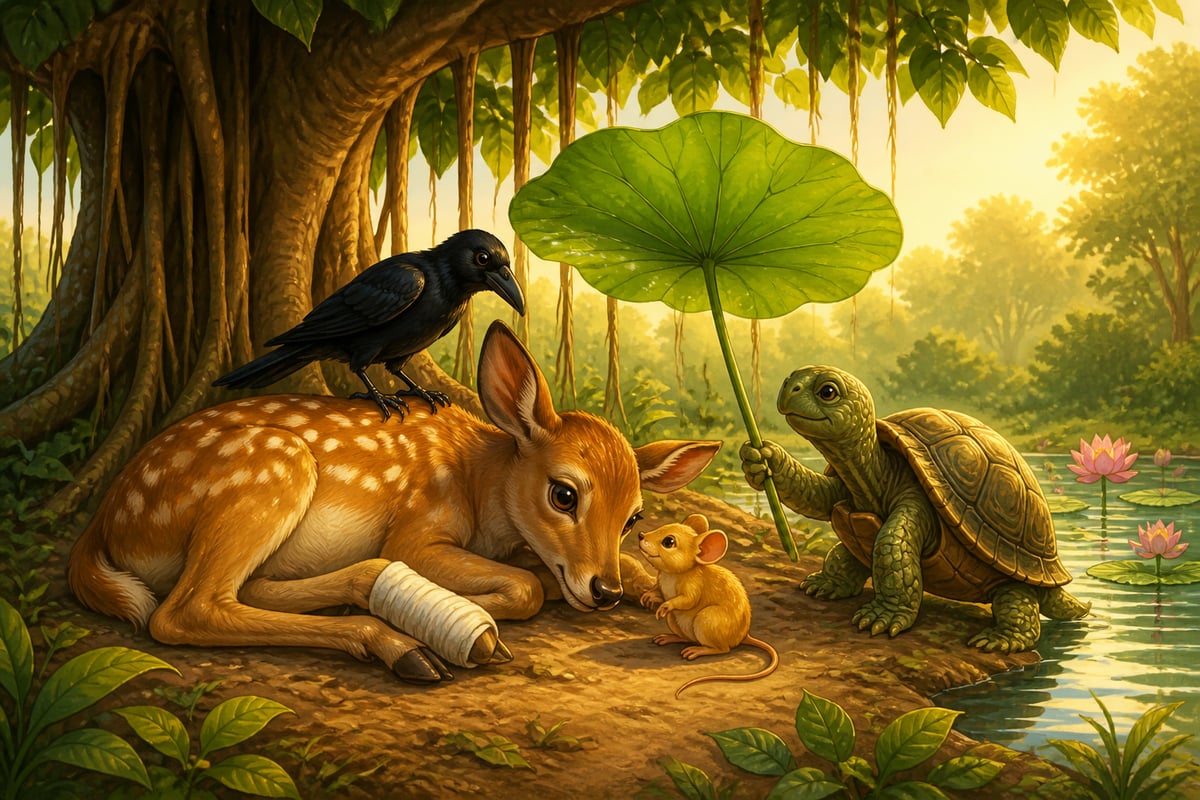
As his friends tended to him, Chitranga felt something release in his heart. He had learned to give. Now he was learning to receive.
The Complete Circle
That evening, the four friends gathered as always beneath the banyan tree. The sun painted the sky in shades of orange and gold, and the air was sweet with the scent of lotus from Manthara's pond.
"I have been thinking," said Laghupatanaka, "about what makes our friendship work."
"We help each other," offered Hiranyaka.
"Yes, but more than that," the crow continued. "We help before being asked. We accept help without shame. We give what we have, not what we think we should have. And we receive what is offered, not what we think we deserve."
Manthara nodded slowly. "The old texts speak of this. True help is a circle, not a line. It flows continuously, from each to all and from all to each. When that circle is complete, no one is weak and no one stands alone."
Chitranga, his hoof now healing cleanly, looked at his friends with gratitude. "I spent so long wandering alone, believing that needing others was weakness. Now I know that our need for each other is our greatest strength."
The stars emerged one by one as night fell over the forest. The four friends remained together, their circle complete, each giving, each receiving, each part of something greater than themselves.
And so the days continued, filled with small helps and quiet services, with watching and warning, with counsel and care. The four friends had learned that sahaayata, mutual help, was not just what you did in crisis. It was how you lived every day.
Reflection
- Think of a time when someone helped you without being asked. How did it feel? Now think of a time when you refused help, was pride involved in that refusal?
- Why do you think Hiranyaka helped Manthara secretly, without taking credit? What does anonymous help tell us about the helper's motivation?
- Manthara says that refusing help is 'its own kind of selfishness.' How can refusing to receive be selfish? What does this reveal about the nature of relationships?