Vadha: The Dance of Death

Bhima kills Kichaka at midnight

Draupadi becomes bait in a deadly trap. She tells Kichaka she has reconsidered, that she will meet him secretly in the dance hall at midnight. But in the darkness, it is not Draupadi who waits. Bhima, the cook who crushes wrestling opponents for sport, will finally release his rage. The commander of Matsya's armies is about to discover what it means to face a Pandava in the dark.

The Trap is Set

The day after her public humiliation, Draupadi found Kichaka.

She had spent the night planning with Bhima. The strategy was simple but required perfect execution, and required Draupadi to face her tormentor one more time.
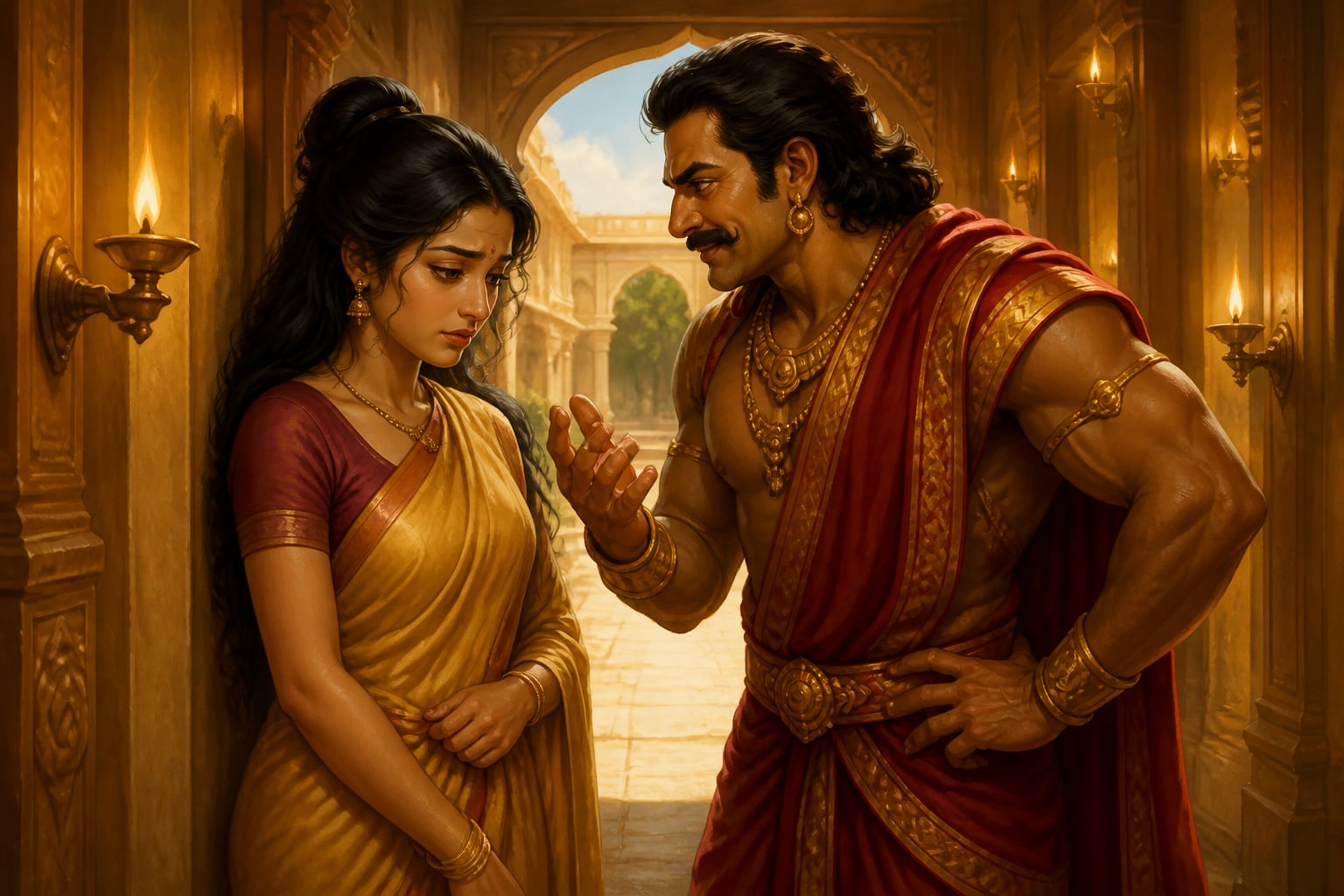
Draupadi luring Kichaka with feigned submission in the corridor

"Kichaka," she said, approaching him in the palace corridors. Her voice was different now, softer, more yielding.

The commander turned, surprised. Yesterday she had fled from him. Today she sought him out.

"Sairandhri. Have you come to accept what you cannot refuse?"

Draupadi lowered her eyes, the gesture of submission he expected. "I have... reconsidered. You are right. My gandharva husbands have not protected me. Perhaps they cannot. Perhaps... a powerful man like you would be a better protector."

Kichaka's eyes gleamed with triumph. "I knew you would see reason. Come to my quarters, "

"No." Draupadi shook her head. "Too many eyes. The queen suspects. If we are to meet, it must be in secret."

"Where?"

"The dance pavilion. At midnight. It will be empty. No one goes there after dark." She paused. "Come alone. And tell no one."

Kichaka smiled, the smile of a predator who believes his prey has surrendered. "Tonight, then. I will wait for you."

"No," Draupadi said. "I will wait for you. Come when the moon is highest."

She walked away, her heart pounding. She had done it. Kichaka would come. And Bhima would be waiting.

The Dance Hall

The nritya-shala, the dance pavilion, stood empty in the moonlight. It was where Arjuna, disguised as Brihannala, taught the princess Uttara. During the day, it echoed with music and the rhythm of dancing feet. At night, it was silent as a tomb.

Bhima arrived first. He had slipped away from the kitchens claiming illness. Now he waited in the darkness, hidden behind a pillar.

This was not the kind of battle he preferred. Bhima liked straightforward combat, armies clashing, mace against mace, the roar of war. This silent waiting, this ambush in the dark, felt wrong.

But he remembered Draupadi's face. He remembered her falling at Yudhishthira's feet. He remembered the cry, "Why do you not protect me?"

Tonight, he thought, I protect her.

Hours passed. The moon rose higher. And then: footsteps.

Kichaka Arrives

Kichaka entered the dance hall like a conqueror entering a defeated city. He had dressed in his finest clothes. He carried wine. He expected a woman grateful to receive his attention.

Instead, he found darkness.

"Sairandhri?" he called. "Where are you?"

A shape moved in the shadows. Someone was lying on the bed that had been set up in the center of the hall, Draupadi's bed, she had told him. Come to me there.

Kichaka approached, smiling. He reached out to touch the figure.

And the figure rose.

It was not Sairandhri. It was Bhima, the cook from the kitchens, the wrestler who entertained at feasts. But he did not look like a cook now. His eyes burned with rage. His hands, which kneaded bread, were reaching for Kichaka's throat.

"You, " Kichaka began.

He never finished.

The Dance of Death

Bhima struck first, grabbing Kichaka by the hair, the same way Kichaka had grabbed Draupadi. The commander was a skilled warrior, but he was unprepared. He had expected a woman's embrace, not an ambush.

"Who are you?" Kichaka gasped, struggling.

"One of her gandharva husbands," Bhima growled. "The one who kills."

They fought in silence, no war cries, no clash of weapons. This was not glorious combat. This was execution.

Kichaka was strong. He had commanded armies, killed thousands. But Bhima was Vrikodara, the wolf-bellied one, born with the strength of ten thousand elephants. And Bhima was fighting for something beyond himself.

Every time Kichaka landed a blow, Bhima remembered Draupadi's tears. Every time Kichaka struggled free, Bhima remembered her cry in the sabha. Every time his own rage threatened to make him careless, Bhima remembered that he could not fail her. Not again.

The fight lasted minutes that felt like hours. They crashed through the hall, knocking over lamps, overturning furniture. Kichaka fought with the desperation of a man who realizes he is going to die.

It was not enough.

Bhima at his full unmasked size grappling Kichaka by the hair in the moonlit dance pavilion at midnight, both massive figures locked in a silent struggle across the polished wooden floor.

The Final Blow

Bhima caught Kichaka in a grip from which there was no escape. He twisted the commander's arms behind his back. He forced him to his knees.

"Please, " Kichaka gasped. "Mercy, "

"Did you show mercy?" Bhima's voice was ice. "When she begged you to stop? When she fled to the sabha? When you kicked her in front of the court?"

Kichaka had no answer.

Bhima did not use a weapon. He used his hands, the same hands that had been forced to cook food, to knead bread, to serve those beneath his station. He crushed Kichaka like bread dough.

When it was over, nothing remained that looked like a man. The commander of Matsya's armies, the terror of neighboring kingdoms, was a shapeless mass on the floor of the dance hall.

Bhima stood over the body, breathing hard. The rage did not leave immediately. It had been building for years, since the dice game, since the exile, since every moment of watching Draupadi suffer while he could do nothing.

But as the moon moved across the sky, something in Bhima settled. Not satisfaction exactly. But completion. A debt had been paid.

The Aftermath

Draupadi found him there an hour before dawn.

She had been waiting, unable to sleep, terrified that something had gone wrong. When Bhima emerged from the dance hall, his clothes torn, his hands stained, she knew.

"It is done?" she asked.

"It is done."

Draupadi did not ask for details. She did not need to. The monster who had tormented her was dead. That was enough.

"The body," she said. "What about, "

"I will handle it. Go back to your quarters. The queen must not suspect you."

Bhima dragged Kichaka's remains to a cremation ground outside the city. When the body was found the next morning, it would look like a demon attack, no weapon wounds, no evidence of who had done it.

The palace would be in chaos. The queen would grieve. The king would wonder. But no one would think to blame the gentle cook from the kitchens.

The Kingdom Reacts

Sudeshna and Virata discovering Kichaka's body at dawn

When dawn broke and Kichaka's body was discovered, Matsya erupted.

The commander was dead. The man who had protected the kingdom, who had made their army feared, killed in the night like an animal.

Queen Sudeshna collapsed in grief. Her brother, arrogant, cruel, but still her brother, was gone.

King Virata was stunned. Kichaka had been the backbone of his army. Without him, Matsya was vulnerable. Already, neighboring kings would be hearing the news. Already, they would be calculating whether this was the moment to strike.

"Who did this?" Virata demanded. "How was our commander killed inside the palace?"

No one had answers. The guards had seen nothing. The servants knew nothing. It was as if a demon had descended, killed Kichaka, and vanished.

Suspicion fell on Sairandhri.

The Accusation

"She claimed gandharva husbands," Queen Sudeshna said, her voice cold with fury. "She said they would kill anyone who touched her. Kichaka touched her. Now he is dead."

"You think... gandharvas actually killed him?" Virata asked.

"I think she had something to do with it. I want her questioned. I want her punished."

But how do you punish a servant for divine intervention? The story of her gandharva husbands had been dismissed as fantasy. Now it seemed terrifyingly real.

Draupadi was summoned before the court. The same court that had watched her humiliation now looked at her with fear.

"Did you kill Kichaka?" Sudeshna demanded.

"I am a maid, my queen. How could I kill your brother, a commander of armies?"

"Your gandharva husbands, "

"My husbands protect me." Draupadi's voice was steady. "I warned Lord Kichaka. I warned everyone. No man can touch me and live. This is not murder. This is divine justice."

The court murmured. Divine justice. If gandharvas were real, if they could reach into a palace and kill a commander, who was safe?

Virata made a decision. "Release her. We cannot punish a woman for what gods have done. But Sairandhri, you will leave Matsya. As soon as may be arranged. Your presence here is... too dangerous."

Draupadi bowed. "As you wish, my king."

She walked from the court with her head high. Behind her, the nobles whispered. They did not know they had just witnessed the first crack in the Pandavas' disguise, or that a greater test was coming.

The Kauravas are about to discover where the Pandavas have been hiding...

Living traditions

The Kichaka story continues to resonate in discussions of workplace harassment and the limits of 'proper channels.' Activists note that when institutions fail to protect victims, as Virata's court failed Draupadi, individuals may feel justified in taking direct action. The story raises questions still debated today about when vigilante justice becomes acceptable.

Reflection

More in Virata Parva

All lessons in Virata Parva · The Mahabharata course