Prakasha: Emergence from Shadow

Abhimanyu weds Uttara

The year of hiding is over. The Pandavas shed their disguises and reveal themselves to an astonished King Virata. The humble servants who enriched his kingdom are revealed as the legendary heroes of Bharatavarsha. Gratitude leads to alliance, and alliance to marriage, Arjuna's son Abhimanyu will wed Princess Uttara. As kingdoms gather and war clouds form, the stage is set for the greatest conflict the world has ever seen.

The Truth Revealed

The day after the cattle raid, King Virata summoned his court. Something strange had happened, his son had supposedly defeated the entire Kaurava army with only a dance teacher as charioteer. The story made no sense.

"Explain to me," Virata said to Prince Uttara, "how a eunuch drove you to victory against Bhishma, Drona, and Karna."

Before Uttara could answer, Yudhishthira, still in his Brahmin's garments, stepped forward.

"Great King, perhaps I should explain."

Virata frowned. "Kanka? What would a dice-player know of battle?"

"Everything, my lord." Yudhishthira's voice changed. The hesitant Brahmin disappeared. In his place stood a king. "Because my name is not Kanka. It is Yudhishthira. And for one year, you have unknowingly hosted the Pandavas."

The court erupted.
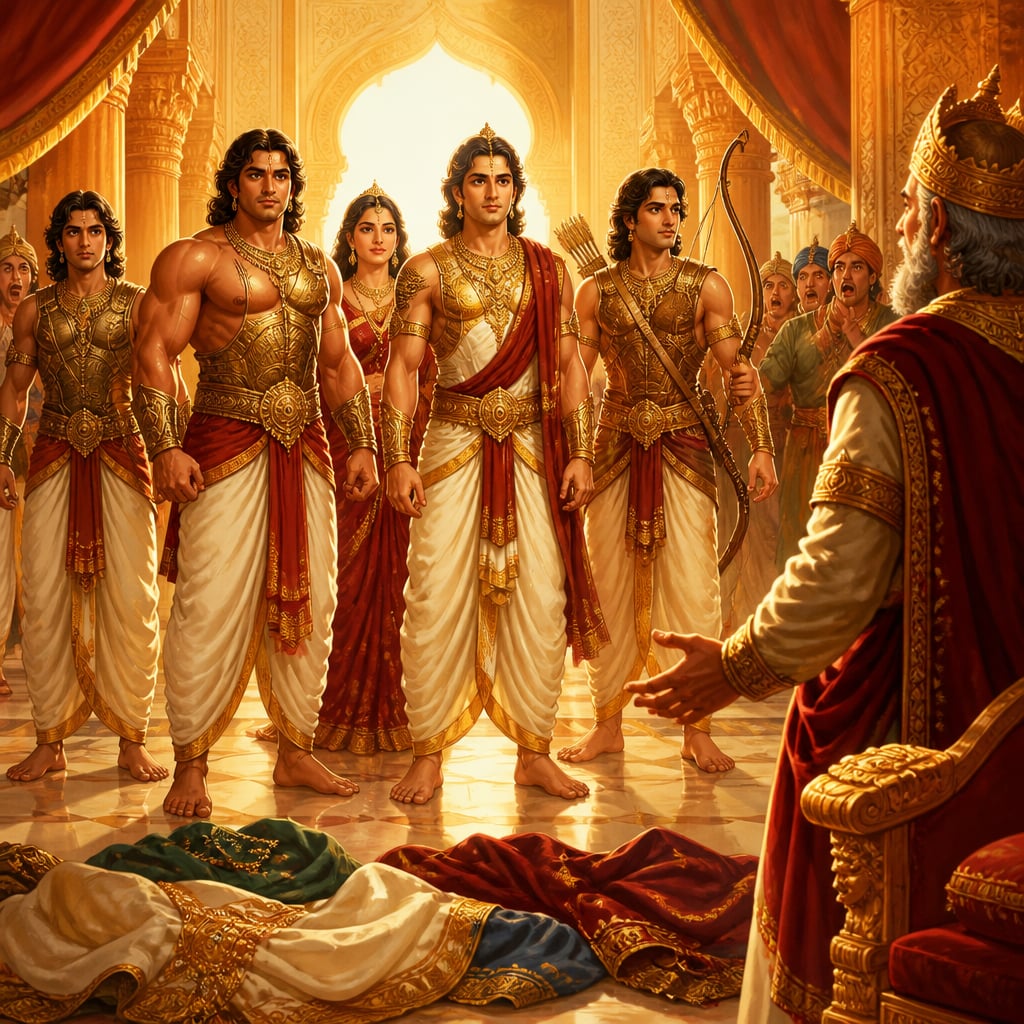
The five Pandavas standing tall in their true warrior attire before the astonished court of King Virata at midmorning, their humble servant garments cast aside at their feet.

The Masks Fall

One by one, the disguises fell away.

Bhima stepped forward, the cook Vallabha, whose strength had bewildered the kitchen staff. "I am Bhima, my lord. Your wrestler. Your cook. And the one who killed Kichaka."

Queen Sudeshna gasped. Her brother's killer had been living in her palace.

Arjuna came next, removing the bangles and silks of Brihannala. "I am Arjuna, my lord. Your daughter's dance teacher. And your kingdom's defender against the Kauravas."

Nakula and Sahadeva revealed themselves, the horse-keeper and cowherd who had made Virata's herds flourish.

And finally, Draupadi, the beautiful maid Sairandhri, who had served Queen Sudeshna with such skill.

"I am Draupadi," she said, "princess of Panchala, wife of these five brothers, and the one whose honor brought death to Kichaka."

Disguise True Identity Service to Matsya
Kanka the Brahmin Yudhishthira Wise counsel to the king
Vallabha the cook Bhima Kitchen excellence, wrestling victories, killed Kichaka
Brihannala the eunuch Arjuna Taught Uttara dance, defeated the Kauravas
Granthika the horse-keeper Nakula Flourishing royal stables
Tantipala the cowherd Sahadeva Prosperous cattle herds
Sairandhri the maid Draupadi Devoted service to the queen

Virata's Response

King Virata stood stunned. For a year, the most famous heroes of the age had been his servants. They had worked in his kitchens, tended his horses, served his wife. And they had saved his kingdom from the Kauravas.

His first emotion was fear. He had treated emperors as servants. He had allowed Kichaka to harass an empress. What if they sought revenge?

But Yudhishthira immediately dispelled that fear.

"Great King, you gave us shelter when we needed it most. You protected us, unknowing though that protection was. We owe you gratitude, not vengeance."

"But Kichaka, " Virata began.

"Kichaka chose his fate," Bhima said flatly. "He attacked a woman under your protection. The only failure was that we could not stop him sooner."

Virata's fear transformed into wonder, then into pride. The Pandavas chose my kingdom. Of all the courts in Bharatavarsha, they had trusted Matsya.

"What do you need?" he asked. "My army? My treasury? Name it."

"An alliance," Yudhishthira said. "War is coming. Duryodhana will never return our kingdom peacefully. We need friends."

"You have one."

The Marriage Proposal

But Virata wanted to offer more than military alliance. He wanted something permanent.

"My daughter Uttara," he said. "She has been taught by Arjuna himself. She admires him... greatly. If Arjuna would accept her as a wife, "

Arjuna raised his hand gently. "Great King, I am honored. But I cannot accept."

"Why not? Is my daughter not worthy?"

"She is more than worthy. But I taught her for a year as her guru. I have seen her as a daughter, as a student. To marry her now would feel... wrong. A teacher should not marry his student."

The court murmured. Some thought Arjuna was refusing insult. Others recognized the principle.

"However," Arjuna continued, "I have a son. Abhimanyu, born to my wife Subhadra, Krishna's sister. He is young, brave, skilled in arms, and he has not been Uttara's teacher. If the princess would accept him, and if you would accept the match, we could bind our families together through their union."

Virata considered. Abhimanyu was Krishna's nephew. Through this marriage, Matsya would be allied not just to the Pandavas but to the Yadavas as well.

"I accept," Virata said. "Let the wedding preparations begin."

Krishna Arrives

Word spread rapidly across Bharatavarsha: the Pandavas had emerged from hiding. They were alive, they were strong, and they were preparing for war.

Krishna and Abhimanyu arriving at Virata's palace

Krishna arrived first, with a procession from Dwaraka. He embraced Arjuna, his closest friend.

"One year as a dance teacher," Krishna said, laughing. "And you come out having defeated the entire Kaurava army. Some would call that overachieving."

"I had good motivation," Arjuna replied. "Duryodhana's army stealing cattle felt... personal."

With Krishna came Abhimanyu, sixteen years old, handsome, eager, trained in arms by both Arjuna and Krishna. He had grown from a boy to a young warrior during his father's exile.

"Father," Abhimanyu said, kneeling. "I've practiced every day. I'm ready."

Arjuna looked at his son and felt a complex mix of pride and sorrow. Ready for what? For war. For battles that might claim his life. This was the world they lived in.

"I know you are," Arjuna said. "And today, you gain a wife."

The Wedding

The wedding of Abhimanyu and Uttara before the sacred fire

The marriage of Abhimanyu and Uttara was celebrated with all the grandeur Matsya could muster, and with contributions from every kingdom now aligning with the Pandavas.

Drupada of Panchala sent gifts and warriors. His enmity with Drona was old and deep; his alliance with the Pandavas was firm.

The Yadavas of Dwaraka came in force, led by Balarama and Krishna themselves.

Shikhandi, Drupada's son born to end Bhishma, came to observe and plan.

And representatives from dozens of smaller kingdoms arrived, some openly allied with the Pandavas, others carefully neutral but watching.

The wedding itself followed all traditional rites. Uttara, barely more than a child herself, circled the sacred fire with Abhimanyu, binding their families together.

As the mantras were chanted and the flames rose, those watching saw not just a wedding but an alliance taking shape. The forces gathering at Matsya would soon march against Hastinapura.

Preparations for War

With the celebrations complete, the talk turned to strategy.

"We must send an embassy to Hastinapura," Yudhishthira said. "Give Duryodhana a chance to return our kingdom peacefully."

"He won't," Bhima growled. "You know he won't."

"Probably not. But we must be seen to offer peace. When war comes, let it be clear who refused accommodation."

Krishna nodded. "Dharma requires the attempt, even if we know it will fail. I will go as your ambassador."

"You? The lord of Dwaraka, going as a messenger?"

"Who better? If Duryodhana refuses even me, his guilt is absolute."

The planning continued. Armies would be gathered. Allies would be summoned. The great war that had been brewing for thirty years was finally about to begin.

The End of Virata Parva

As the Pandavas prepared to leave Matsya, Draupadi paused at the palace gates.

Queen Sudeshna stood there, uncertain.

"My lady, " Sudeshna began. "I mean, Princess, I don't know what to call you now."

"Draupadi will do."

"I... I'm sorry. For my brother. For what he did. For sending you to him."

Draupadi was silent for a long moment. Forgiveness did not come easily. Sudeshna had enabled Kichaka. Had sent her into the trap.

But Sudeshna was also a woman caught between terrible choices, loyalty to a brother, duty to her husband's guest, fear of a powerful man. The world did not make it easy for women to defy the men who controlled them.

"What's done is done," Draupadi said finally. "Your brother faced justice. Let that be the end of it."

She walked out of Matsya's gates, no longer Sairandhri the maid, but Draupadi the empress, the woman whose insult had begun this chain of events, the woman whose honor would soon be avenged on the fields of Kurukshetra.

Looking Forward

The Virata Parva ends with the Pandavas transformed. They had entered Matsya as fugitives, hiding from spies, suppressing their identities, serving those beneath their station. They left as acknowledged heroes, with a new ally, a new family connection, and a clear path toward war.

Thirteen years had passed since the dice game. Twelve in forest exile, one in disguise. The Pandavas had endured everything Duryodhana could devise.

Now it was their turn.

In the next chapter, Krishna's embassy to Hastinapura will offer peace, and be refused. The great war of Kurukshetra begins.

Living traditions

The Virata Parva's conclusion, emergence, alliance, marriage, preparation for war, provides a template that resonates in modern storytelling. The heroes who spent act two hiding emerge in act three to gather allies and prepare for the final confrontation. This narrative structure, refined in the Mahabharata, appears throughout world literature and film.

Reflection

More in Virata Parva

All lessons in Virata Parva · The Mahabharata course