Gupta: Hidden in Plain Sight

Serving King Virata in secret

Months pass as the Pandavas settle into their new lives at Virata's court. A dice-playing Brahmin becomes the king's favorite companion. A cook with impossible strength delights the kitchens. A eunuch teaches dance with warrior's precision. And a hairdresser with royal bearing serves the queen. Living in plain sight, they must suppress every instinct while Duryodhana's spies search every kingdom.

Masters of Disguise

The first weeks were the hardest. Every instinct had to be relearned. Every reaction suppressed. Yudhishthira, accustomed to being addressed as emperor, now bowed to servants who outranked him in Virata's household. Bhima, whose roar once scattered armies, learned to speak softly in the kitchens. Arjuna, who had stood unflinching before gods and demons, learned to flinch at loud noises like a nervous woman.

But the Pandavas were not ordinary people. They had endured twelve years of exile. They had faced demons, challenged the gods, and survived the impossible. Pretending to be servants was hard. It was not impossible.

"Every morning," Yudhishthira would later say, "I woke up and had to remember who I was, not. That forgetting was the first task of each day."

Kanka: The King's Companion

King Virata was a good man but a lonely one. His ministers flattered him. His sons obeyed him. But no one matched him at dice or spoke to him as an equal. When Kanka the Brahmin arrived, dignified, intelligent, with a surprising skill at gambling, the king found something rare: a companion.
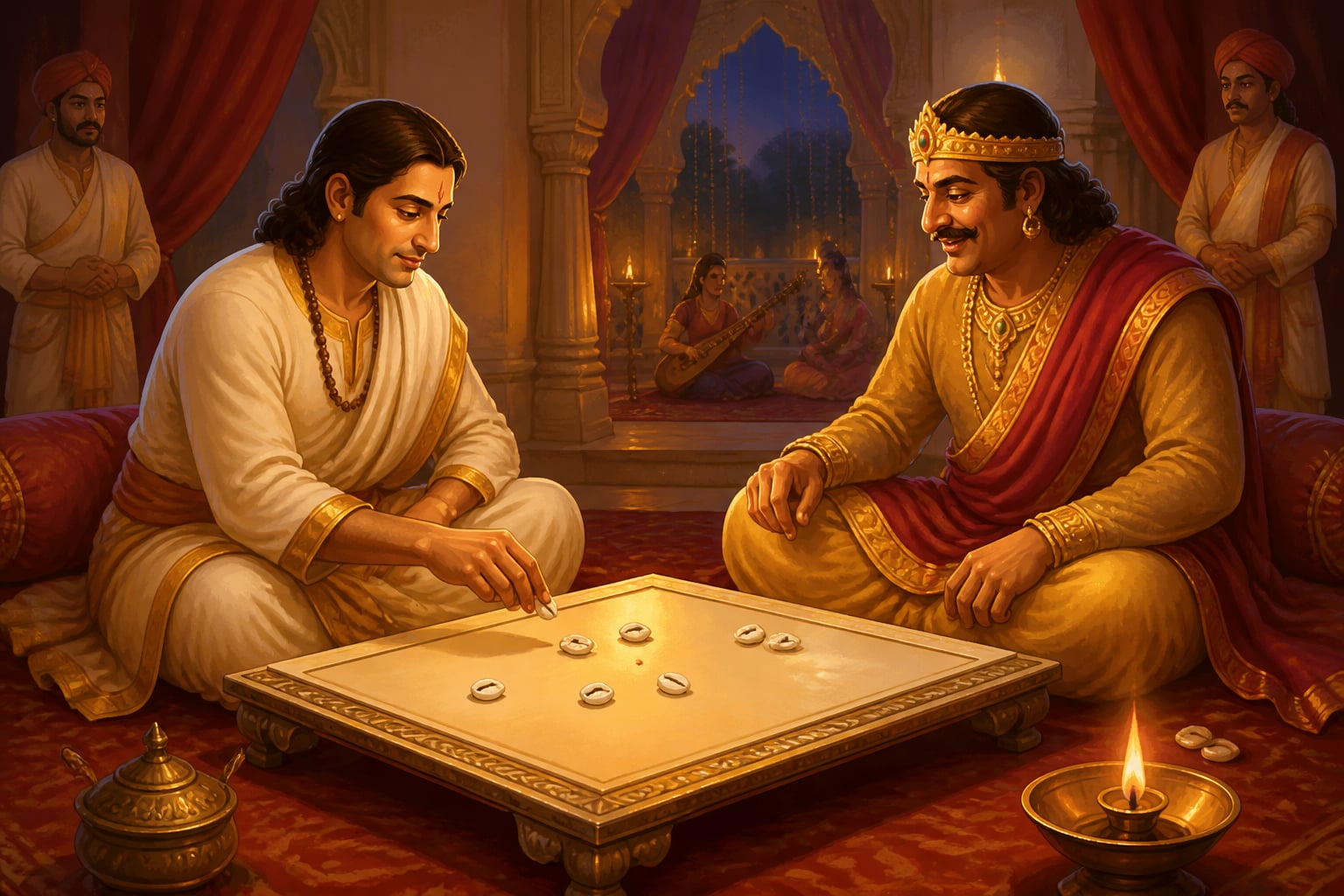
Yudhishthira as Kanka playing dice with King Virata

Every evening, the two would sit over the dice board. Virata played for amusement. "Kanka" played to maintain his cover. The irony was exquisite: the king who had lost everything to dice now used that very skill to stay hidden.

"You play as if you've played for empires," Virata once remarked.

Yudhishthira's heart stopped for a moment. Then he smiled. "I learned from a traveling gambler, my lord. He taught me to never wager more than I can afford to lose."

If only that were true, he thought.

What Yudhishthira gave Virata was more than entertainment. In casual conversation over dice, the disguised emperor offered advice on governance, diplomacy, and strategy. Virata's kingdom began to prosper in small ways. The king never knew his dice-playing Brahmin was the rightful emperor of Hastinapura.

Vallabha: The Cooking Warrior

Bhima found an unexpected peace in the kitchens. The work was honest: grinding spices, kneading dough, preparing feasts. His massive hands, designed to crush skulls, proved equally skilled at crafting delicate sweets.

Bhima's Kitchen Life Hidden Warrior
Kneaded bread Hands that broke Bakasura's spine
Wrestled for entertainment Skills that killed countless rakshasas
Served food humbly Pride that demanded revenge
Obeyed the head cook A prince born to command

The kitchen staff adored him. "Vallabha" was strong, cheerful, and worked harder than anyone. When he wrestled visiting strongmen for the king's entertainment, a common court amusement, he was careful to win impressively but not impossibly. He wanted to seem like a gifted cook who could fight, not a legendary warrior pretending to cook.

Only once did Bhima nearly reveal himself. A visiting merchant spoke casually of "that fool Bhima" who was probably hiding in some cave, crying over his lost kingdom.

The knife in Bhima's hand bent. The kitchen fell silent. Everyone stared.

"Strong hands," Bhima laughed, straightening the blade. "Bent by mistake."

The moment passed. But that night, in his servant's quarters, Bhima's hands shook with rage. One more year, he told himself. One more year and then they will pay.

Bhima disguised as the cook Vallabha kneading great mounds of bread on a stone counter in Virata's bustling palace kitchen at midmorning.

Brihannala: Grace Under Fire

Arjuna's disguise was the most complete, and the most painful. As Brihannala, he wore women's clothing, spoke in a soft voice, and taught dance to the princess Uttara. His warrior's body was draped in silks. His archer's hands demonstrated graceful mudras.

Uttara was young, talented, and curious about her strange new teacher.

"Brihannala," she asked one day, "your movements are so precise. Like a warrior's."

Arjuna's breath caught. Had she seen through him?

"All movement is precision, Princess," he replied carefully. "The dancer and the warrior both seek the same thing, perfect control of the body. I learned this from watching warriors train."

It was not entirely a lie. He had learned dance in Indra's heaven, taught by celestial apsaras while waiting for his year of Urvashi's curse to begin. That curse, to live as a eunuch for one year, now saved the Pandavas. No one suspected the effeminate dance teacher of being the world's greatest archer.

But the disguise cost something. Every day, Arjuna watched young soldiers train in the palace courtyard. Their form was sloppy, their aim poor. He could have made warriors of them in weeks. Instead, he taught teenage girls to move their feet in patterns.

This is the price, he reminded himself. One year of this buys us a kingdom.

Sairandhri: Dangerous Beauty

Draupadi served Queen Sudeshna with skill born of watching servants her entire life. She knew exactly how much pressure to apply while braiding hair, which oils suited which complexion, which stories queens liked to hear.

Sudeshna was pleased. "You are far too skilled to be a mere wandering servant," she said once. "You must have served royalty before."

"I served five gandharvas, my queen," Draupadi replied. "Celestial beings have exacting standards."

The story of her divine husbands served two purposes. It explained her remarkable skills. And it kept men away, most men.

Kichaka first noticing Sairandhri at the queen's chamber

Queen Sudeshna had a brother. His name was Kichaka, and he was the commander of Virata's armies. He was powerful, arrogant, and accustomed to taking what he wanted. From the moment he saw Sairandhri, he wanted her.

"That new maid of yours," he said to his sister. "She is extraordinary."

Sudeshna's face tightened. "She claims to be married to gandharvas who will kill any man who touches her."

Kichaka laughed. "Gandharvas. Convenient protectors who never appear. I think she invented them."

"Brother, leave her alone. She is a good servant."

"I won't force her. I will persuade her. No woman resists me forever."

The shadow was growing. Draupadi felt Kichaka's eyes following her through the palace. She saw the calculating look, the confidence of a man who had never been denied.

She could not fight him. She could not reveal herself. And her "protectors", her five mighty husbands, could not acknowledge her without destroying everything.

The Web of Watchers

In Hastinapura, Duryodhana had not forgotten the terms of exile. Somewhere, the Pandavas were hiding. And if they could be found, they would owe another thirteen years.

His spies fanned across Bharatavarsha. They visited every court, every forest retreat, every town large enough to hide six remarkable people. They asked questions. They listened to gossip. They watched for anything unusual.

"A traveling Brahmin who plays dice with unusual skill," one spy reported from Matsya. "But the king vouches for him."

"A cook who is also a wrestler," noted another. "Strong, but there are strong men everywhere."

"A eunuch dance teacher. Unremarkable."

The reports piled up in Hastinapura. None seemed significant. None screamed "Pandavas hiding here." And so Duryodhana's attention moved elsewhere, to kingdoms that seemed more likely.

The disguise was working. But the year was long, and Kichaka was growing bolder, and Draupadi was running out of ways to refuse him.

Months of Tension

Six months passed. Then eight. Then ten.

The Pandavas had fallen into rhythms. Yudhishthira entertained Virata every evening. Bhima fed the palace and won wrestling matches on special occasions. Arjuna taught Uttara to dance beautifully. The twins tended horses and cattle with expertise that made Virata's herds flourish.

Draupadi braided the queen's hair and avoided Kichaka's increasingly direct advances.

They did not speak to each other. They did not acknowledge each other. When Bhima passed Draupadi in the corridor, his eyes did not linger. When Arjuna saw Yudhishthira at court, he showed no recognition. The separation was complete.

But each night, lying in their separate quarters, they counted the days. Two more months. Then one. Then thirty days. Then twenty.

Freedom was approaching. But Kichaka's patience was ending.

"I have waited long enough," he told Sudeshna. "Tomorrow, send your maid to my quarters. Tell her she is bringing wine. Tell her whatever you must. But send her."

Sudeshna hesitated, then agreed. Kichaka was her brother. And he was not a man who accepted refusal.

Draupadi would walk into a trap. And she would have to face it alone.

What happens when Kichaka makes his move?

Living traditions

The Virata Parva's themes of identity concealment and excellence in adversity resonate in modern contexts. Indian immigrants abroad often cite the Pandavas when discussing their own experiences of navigating new identities while maintaining internal values. Corporate leadership programs reference 'the Virata year' as a metaphor for periods when organizations must operate below the radar while building strength.

Reflection

More in Virata Parva

All lessons in Virata Parva · The Mahabharata course