Ajnatavasa: The Year of Shadows

Pandavas choose their disguises

As their twelve years of forest exile end, the Pandavas face their greatest test yet: surviving one year in disguise without being recognized. Discovery means twelve more years in the wilderness. In a remote forest clearing, five legendary warriors and a queen must shed their identities and become servants, dancers, and stable hands.

The Final Test

Twelve years of exile had forged the Pandavas in ways the Kauravas never anticipated. They had traveled to the heights of heaven, defeated demons, obtained celestial weapons, and gained wisdom from sages. But none of that would matter if they failed this final test.

The thirteenth year of exile carried a cruel condition: the Pandavas must live in disguise, and if recognized by anyone, they would repeat the entire exile, another twelve years in the forest, followed by another year incognito. Duryodhana had crafted this condition precisely because he believed it impossible. How could five of the most famous warriors in all Bharatavarsha simply vanish?

"The world knows our faces," Yudhishthira said grimly. "Every king's court has heard tales of our deeds. Every village knows the story of Draupadi's swayamvara."
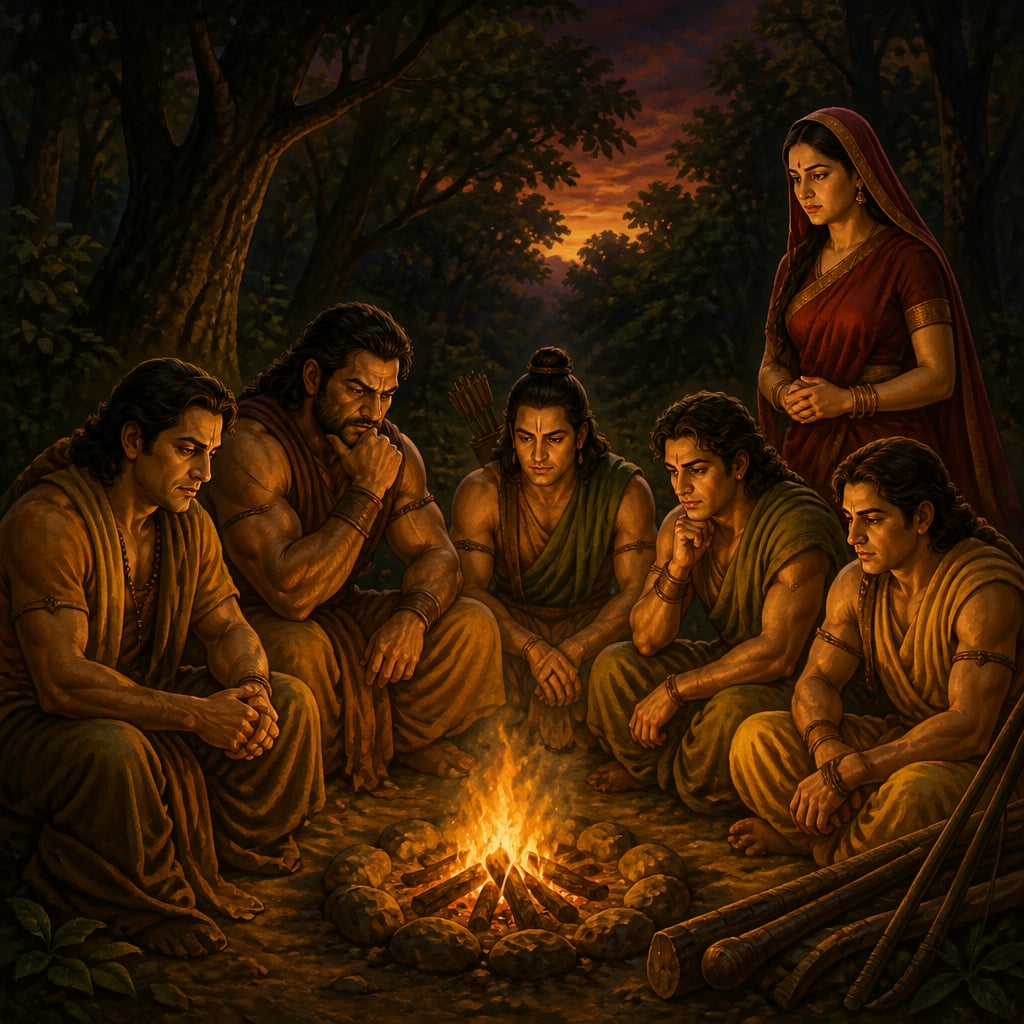
Yudhishthira, Bhima, Arjuna, Nakula and Sahadeva in tense council with Draupadi near Dwaitavana at dusk, a low fire between them and a great Shami tree behind.

Choosing a Haven

The Pandavas gathered in a secluded forest clearing near Dwaitavana, where they had spent much of their exile. Yudhishthira had been contemplating this challenge for months. They needed a kingdom:

Arjuna spoke first. "King Virata of Matsya fits every requirement. His kingdom lies between the Yamuna and the eastern mountains. He is known as righteous but not politically entangled. His court is large enough to absorb strangers."

Bhima nodded slowly. "And his army is strong. If discovered, at least we would have walls to defend."

The choice was made. But choosing a destination was the easy part. The harder question remained: Who would they become?

The Art of Disguise

Yudhishthira, the king whose very name meant "steady in battle," would have to forget everything about command. He chose to become Kanka, a Brahmin skilled in dice, an ironic choice given how gambling had destroyed his kingdom. His knowledge of the game that had ruined him would now serve as his cover.

"I will offer to be the king's companion in games of chance," he explained. "Who would suspect a dice-playing Brahmin of being the emperor who lost everything to dice?"

Bhima faced the greatest physical challenge. His massive frame, arms like tree trunks, a chest broader than most doorways, could not be hidden. Instead, he would exploit it. He would become Vallabha (also called Ballava), a cook and wrestler in Virata's royal kitchen.

"Let them see my strength," Bhima laughed. "They will think me a common strongman. No one imagines a prince kneading dough and wrestling for entertainment."

Arjuna's transformation was the most dramatic. The greatest archer of the age, whose very posture announced a warrior, would become Brihannala, a eunuch who taught music and dance to the palace women. During his year in Indra's heaven, he had been cursed by the apsara Urvashi to live as a eunuch for one year when he rejected her advances. That curse would now become a blessing.

Pandava Disguise Name Role The Irony
Yudhishthira Kanka Dice-playing Brahmin Lost everything to dice
Bhima Vallabha/Ballava Cook and wrestler The mighty warrior serves food
Arjuna Brihannala Eunuch dance teacher The supreme warrior teaches dance
Nakula Granthika Horse keeper Prince becomes stable hand
Sahadeva Tantipala Cowherd Prince tends cattle
Draupadi Sairandhri Lady's maid Queen serves another queen

Nakula, famed for his beauty and his skill with horses, became Granthika, a humble horse keeper. His expertise would serve Virata's stables, but he would be invisible, just another servant.

Sahadeva, the youngest, wise in cattle-lore and astrology, became Tantipala, a cowherd to tend Virata's vast herds.

Draupadi's Dangerous Role

Draupadi's disguise carried the greatest risk. As Sairandhri, a lady's maid, she would serve Queen Sudeshna directly. Her extraordinary beauty, the beauty that had once gathered kings from across the world, could not be hidden. It could only be... explained.

"I will say I am a gandharva's wife," Draupadi decided. "That my divine husbands protect me and will destroy any man who touches me. Fear of celestial wrath may shield me where disguise cannot."

The brothers exchanged troubled glances. They all knew the risk. Draupadi would be in the inner chambers, away from their protection, serving people who might covet her beauty. But there was no better option.

Hiding the Divine Weapons

Pandavas hiding their divine weapons in the Shami tree at midnight

The Pandavas could not carry their weapons into Virata's city. Arjuna's Gandiva bow, Bhima's mace, Yudhishthira's sword, these were famous throughout the land. Anyone who saw them would know.

They traveled to a cremation ground outside the city, where a great Shami tree stood. The tree was enormous and ancient, its branches spreading like a protective canopy.

"We will hide our weapons here," Yudhishthira decided. "Wrap them in cloth and hang them in the highest branches. No one disturbs funeral grounds. No one climbs trees in places of death."

They also hung a corpse nearby, grim but necessary. Any curious passerby would see a body awaiting funeral rites and flee, never looking up.

"If anyone asks about the bundle in the tree," Nakula suggested, "we'll say it contains our dead mother's body, hung according to ancient custom." The lie was distasteful but practical.

Entering the Kingdom

Yudhishthira as Kanka presenting himself at Virata's court

One by one, over several days, the Pandavas entered Virata's capital. They could not arrive together, six remarkable strangers appearing at once would invite questions.

Yudhishthira went first, presenting himself at court as a Brahmin seeking employment. King Virata, impressed by his dignified bearing and sharp mind, quickly invited him to join the royal dice games.

Bhima approached the kitchens, demonstrating his cooking skills and then, when challenged, defeating the palace's strongest wrestler. The kitchen staff marveled at this strange cook who could snap necks as easily as he could knead bread.

Arjuna, in women's garments and speaking softly, offered to teach dance and music to the princess Uttara. His grace, the same grace that guided arrows to their targets, now guided the feet of dancers.

The twins found their places in the stables and cattle herds, their princely knowledge of animals masquerading as common expertise.

And Draupadi, beautiful and alone, entered Queen Sudeshna's service. The queen was suspicious at first, who was this stunning woman with the bearing of royalty? But Draupadi's story of divine husbands, combined with her obvious skill in hairdressing and cosmetics, won her a place.

The Long Deception Begins

As the first day ended and the Pandavas retired to their separate quarters, servants' quarters, stables, kitchens, women's chambers, each knew the same truth: everything depended on their silence.

For one year, five brothers who had grown up together, fought together, suffered together, would live as strangers. They could not acknowledge each other. They could not even exchange meaningful glances. Every day would be a performance. Every moment, a test.

Somewhere in Hastinapura, Duryodhana was already dispatching spies to every corner of Bharatavarsha. He knew the terms of the exile. He knew the Pandavas had to be somewhere. And he intended to find them.

The game of shadows had begun. And this time, the stakes were not a kingdom, but an entire future.

What happens when Draupadi's beauty attracts dangerous attention in Virata's court?

Living traditions

The concept of ajñātavāsa has entered corporate vocabulary in India as a metaphor for strategic patience and organizational stealth. Business leaders reference the Pandavas' ability to suppress ego and adapt to circumstances. The story is taught in IIM leadership courses as an example of long-term strategic thinking over short-term pride.

Reflection

More in Virata Parva

All lessons in Virata Parva · The Mahabharata course