Vanaprastha: Into the Forest

Pandavas begin twelve years exile

Stripped of their kingdom, their wealth, and their dignity, the Pandavas walk out of Hastinapura into twelve years of forest exile. As citizens weep and Draupadi burns with righteous anger, the brothers must transform from princes into ascetics, while never forgetting the wrongs done to them.

The Walk of Shame

The gates of Hastinapura had never seemed so small. Through them walked five princes who had ruled an empire, now dressed in the rough bark garments of forest-dwellers. Behind them came Draupadi, her hair still unbound from when Duhshasana had dragged her, a silent vow that it would remain so until washed in Kaurava blood.

The citizens of Hastinapura lined the streets, weeping openly. Shopkeepers closed their stalls. Women threw flowers from balconies. Children who had grown up hearing tales of Arjuna's archery and Bhima's strength watched their heroes leave like criminals.
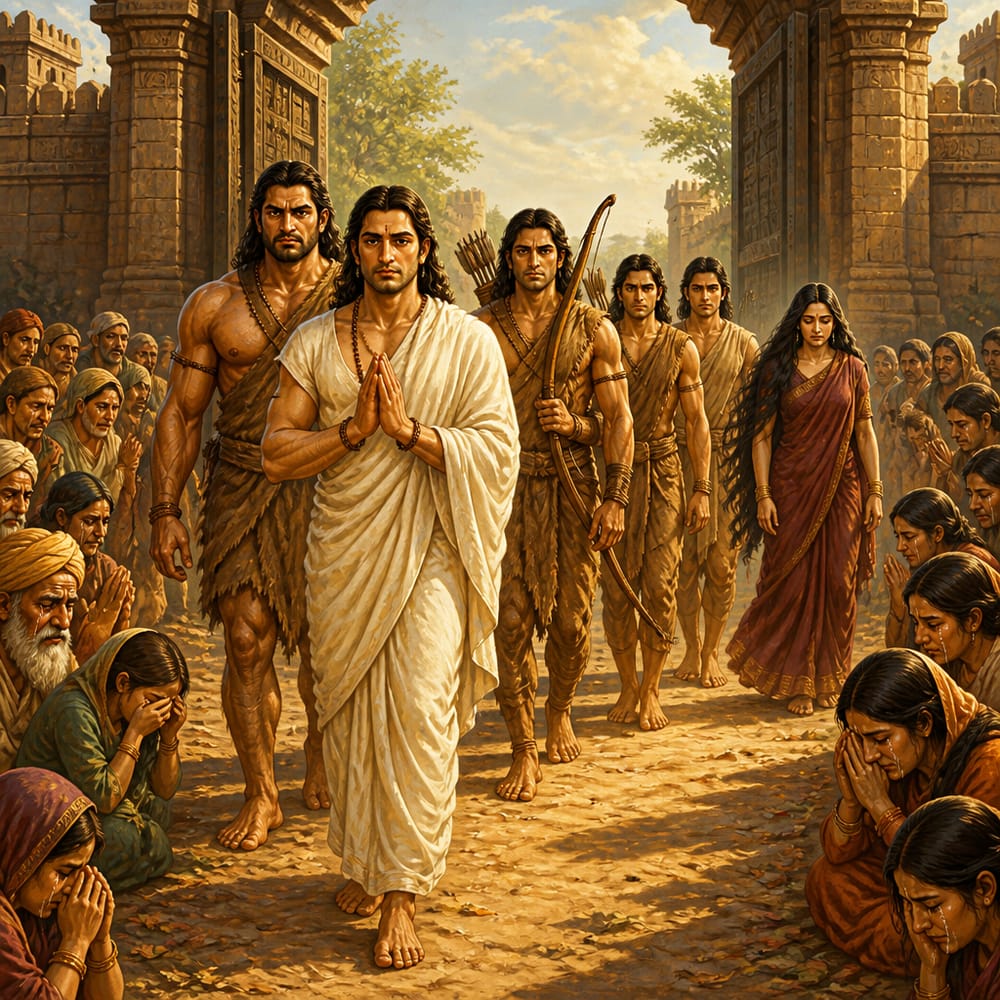
The five Pandavas walk out of Hastinapura in bark cloth as weeping citizens line the road.

"These princes protected us," an old merchant cried. "Now they walk into the wilderness while those who cheated them feast in the palace!"

Yudhishthira walked at the front, his face calm despite everything. He had lost his kingdom, his brothers, himself, and finally his wife, all on the roll of loaded dice. Yet he showed no anger, no resentment. This composure would define him throughout the exile, though whether it represented wisdom or weakness remained a question even his brothers would ask.

The Weeping City

As the Pandavas passed through the city gates, something extraordinary happened. Hundreds of citizens, Brahmins, merchants, soldiers, servants, began following them. They had no plan, no provisions. They simply could not bear to see their beloved princes leave alone.

Vidura, the wise uncle who had warned against the dice game, walked with them for several miles. His eyes were red with tears he could not shed in the palace.

"The wheel of time turns," he told Yudhishthira quietly. "What rises must fall. What falls must rise. Remember this in your darkest hours."

But Yudhishthira gently urged the citizens to return. The forest was no place for city-dwellers. The exile was the Pandavas' burden to bear. Reluctantly, tearfully, the crowd turned back, all except a small group of Brahmins who insisted on accompanying them to perform daily rituals.

Draupadi's Fury

Draupadi confronts Yudhishthira at the first night's campfire

That first night, camped beneath unfamiliar stars, Draupadi finally spoke what she had held inside since the sabha.

"What kind of dharma is this?" she demanded, her voice shaking with rage. "I was dragged by my hair before the assembly. I was called a slave. And my husbands, five great warriors, sat silent!"

Her words struck like arrows. Bhima clenched his fists until his knuckles whitened. He had wanted to burn down the sabha that day. He had wanted to crush Duryodhana's skull.

"I should have killed them all," Bhima growled. "Dharma stopped us. Yudhishthira's dharma. Tell me, brother, what good is dharma that lets a woman be humiliated while her protectors watch?"

Yudhishthira had no answer. The question would haunt all of them for twelve long years.

But Arjuna spoke quietly: "Our time will come. We swore oaths in that sabha, Bhima to drink Duhshasana's blood, I to kill Karna. These oaths bind us to action. But action must wait for the right moment."

The Kamyaka Forest

The Pandavas made their first home in the Kamyaka forest, on the banks of the Saraswati River. It was a sacred place, home to many sages and ascetics who welcomed the exiled princes.

Life changed utterly. These men who had eaten from golden plates now gathered their own food. Princes who had commanded armies now gathered firewood. The transition was hardest for Draupadi, who had managed a palace of thousands and now cooked over an open flame.

Yet the forest offered gifts the palace never could:

The Dharma Question

The greatest challenge of exile was not physical, it was moral. How should the Pandavas live these twelve years?

Draupadi argued for action: gather allies, build an army, strike before the Kauravas grew stronger. Every day in exile was a day Duryodhana consolidated power.

Bhima agreed fiercely. Waiting felt like cowardice. Their enemies feasted while they starved. Where was the justice in patience?

But Yudhishthira held firm to his vow. They had agreed to exile. Breaking that agreement, even an agreement forced through fraud, would make them no better than their enemies. Dharma required keeping one's word, even when the word was given under duress.

"If we break our oath," Yudhishthira said, "we become oath-breakers. Then what will we have left? Our claim to the throne rests on dharma. Abandon dharma, and we have no claim at all."

This tension, between righteous anger and principled patience, would define the entire Vana Parva.

Visitors from Hastinapura

The Pandavas were not entirely cut off from the world. Krishna visited soon after they settled, bringing news and comfort. His presence reminded them that they were not alone, the Yadava alliance remained strong.

"Duryodhana thinks he has won," Krishna told them with a knowing smile. "He does not understand that by wronging Draupadi, he has sealed his own destruction. Time is patient, but time is inevitable."

Other visitors came too. Sage Dhaumya became their priest and guide. Various rishis offered hospitality as the Pandavas later traveled from forest to forest. Even Vidura found ways to send messages of support.

The sage Markandeya arrives at the Pandavas' forest camp

Most touchingly, the sage Markandeya arrived to share stories of others who had endured great suffering, tales that would sustain the Pandavas through their darkest days.

The Transformation Begins

As months passed, the Pandavas began to change. Yudhishthira deepened his study of dharma under the sages. Bhima channeled his rage into protecting the camp from rakshasas and wild beasts. Nakula and Sahadeva tended to their few horses and managed their simple household.

Arjuna grew restless. He was a warrior without a war, a hero without a challenge. The bow that had won Draupadi gathered dust. His skills, he feared, would rust along with it.

It was this restlessness that would soon send him on a journey to the mountains, a quest for divine weapons that would change everything. But that story was yet to come.

The Long Road Ahead

The first days of exile established the pattern for years to come. The Pandavas would face external threats, rakshasas, hostile kings, natural disasters. They would face internal struggles, Draupadi's grief, Bhima's impatience, Yudhishthira's doubts.

But they would also grow. They would hear great stories, of Nala and Damayanti, of Savitri and Satyavan, that mirrored their own struggles. They would gain powerful allies and divine weapons. They would emerge from the forest not just as the same five brothers who entered, but as something more.

For now, though, they were simply exiles. Princes without a palace. Warriors without a war. A family bound together by blood, by marriage, by shared humiliation, and by the unshakeable conviction that one day, they would return.

Living traditions

The Vana Parva's themes of exile, endurance, and transformation resonate in modern Indian culture. Political leaders have invoked the Pandavas' patience during their own periods of political wilderness. The stories within, Nala-Damayanti, Savitri-Satyavan, continue to be adapted in films, TV serials, and literature. The idea of transforming adversity into opportunity has become a staple of Indian motivational discourse.

Reflection

More in Vana Parva

All lessons in Vana Parva · The Mahabharata course