Mrityu Jaya: Savitri's Devotion - Part 2
Savitri outwits Yama
The fateful day arrives. As Satyavan collapses while cutting wood in the forest, Yama himself - the god of death - appears to claim his soul. But Savitri refuses to let her husband go alone. She follows Yama as he carries Satyavan's soul toward his realm, engaging the death god in philosophical dialogue. Impressed by her wisdom, Yama offers her boons - anything except Satyavan's life. Through cleverly worded requests, Savitri secures the restoration of her father-in-law's sight and kingdom, children for her own father, and finally one hundred sons for herself. When Yama realizes his promise means Satyavan must live to father those children, he acknowledges defeat with admiration and restores Satyavan to life. This tale of love conquering death became one of India's most celebrated stories.
Mrityu Jaya: Savitri's Devotion - Part 2
Sage Markandeya continued his tale to the Pandavas, reaching the moment toward which Savitri's entire life had been building.
The Last Days
As the fateful day approached, Savitri undertook a severe fast. For three days before the appointed time, she ate nothing and slept little, spending her hours in prayer and meditation.
Her parents-in-law noticed with concern. "Daughter, why do you observe such harsh austerities? You grow pale and weak."
"It is a vow I have made," Savitri replied simply. "Please do not worry."
Satyavan too was worried. "My love, you have barely eaten for days. Please break your fast."
"I will eat when the vow is complete," she assured him. "Today is the final day."
Into the Forest
On the morning of the appointed day, Satyavan prepared to go into the forest to gather wood and fruits as usual. Savitri asked to accompany him.
"The forest paths are rough," Satyavan said. "And you are weakened from your fast. Stay and rest."
"I cannot bear to be separated from you today," Savitri insisted. Something in her voice made Satyavan agree.
With his parents' blessing, the couple walked together into the forest. Savitri observed everything - the path they took, the trees they passed, the direction of the sun. She memorized every detail, knowing what was coming.
Satyavan found a suitable tree and began cutting wood with his axe. Savitri gathered flowers nearby, never letting him out of her sight.
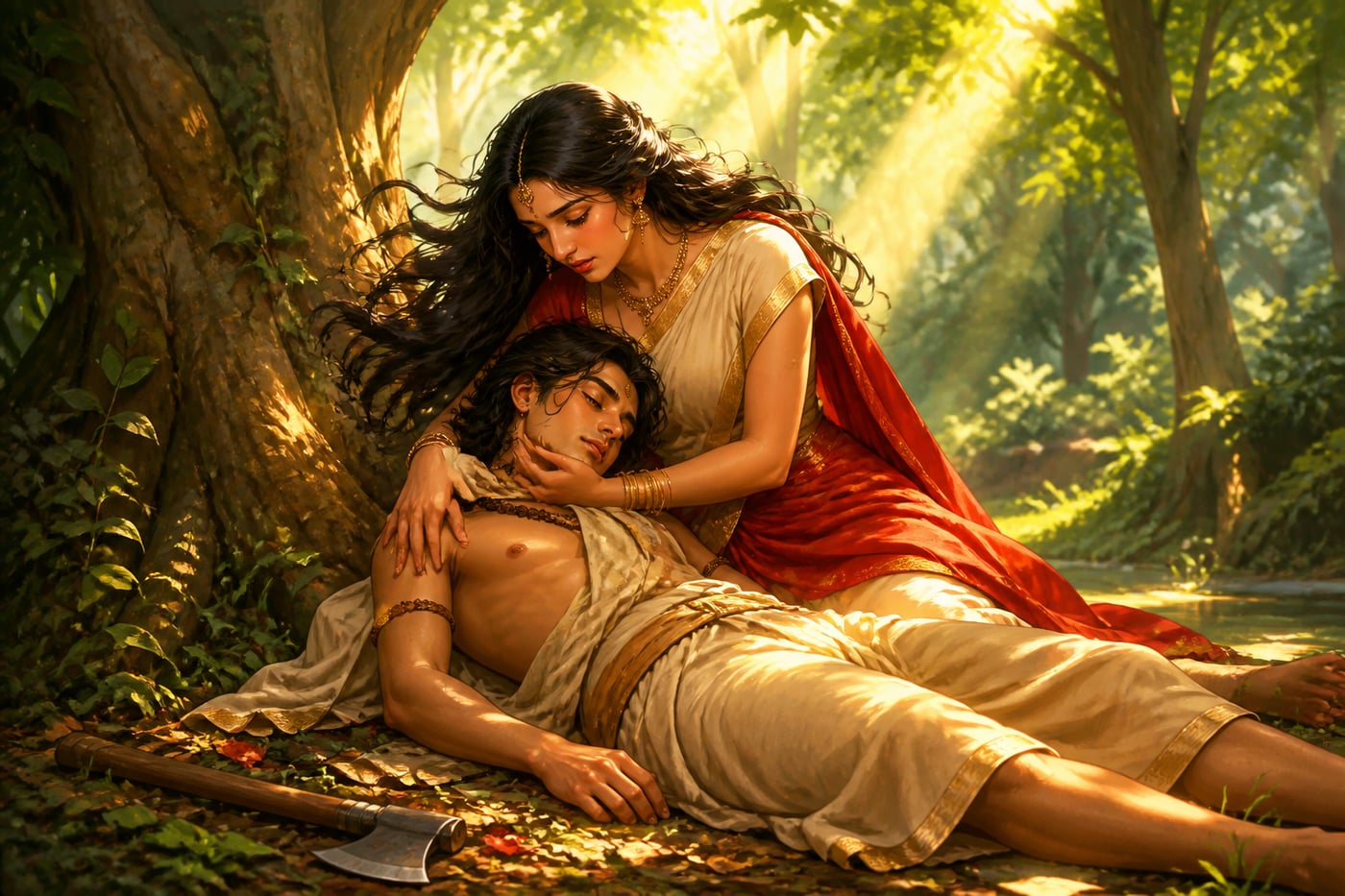
Suddenly, Satyavan stopped. His face contorted with pain. "Savitri, my head... it feels like it's being pierced with needles. I need to rest."
Savitri rushed to him. "Come, lie down. Put your head in my lap."
Satyavan collapsed against her. His breathing grew shallow. His face turned pale. "What is happening to me?" he whispered. "Everything is going dark..."
"Rest," Savitri said softly, stroking his hair. "Just rest."
Within moments, Satyavan's eyes closed. His body went still. The prophecy had been fulfilled.
The Arrival of Yama
As Savitri held her husband's lifeless body, a shadow fell over the clearing. She looked up to see a figure unlike any mortal - dark-skinned and majestic, dressed in blood-red garments, wearing a glittering crown. In his hand he carried a noose.
This was Yama, the god of death himself, the Dharmaraja who judges all souls.
"Who are you, divine one?" Savitri asked, though she already knew. "Why have you come yourself instead of sending your messengers?"
Yama regarded her with something like respect. "I am Yama. Your husband Satyavan was a man of such extraordinary virtue that I could not entrust his soul to lesser beings. I have come personally to escort him to my realm."
With his divine noose, Yama extracted Satyavan's soul from his body - a thumb-sized essence of light - and began walking south, toward his kingdom.
The Following
Savitri gently laid Satyavan's body on the ground and rose to her feet. Then she did what no mortal had ever done - she began following the god of death.
Yama noticed her footsteps behind him. "Return, Savitri. Your duty to your husband is complete. Go back, perform his funeral rites, and live out your days in virtue."
"Where my husband goes, I must follow," Savitri replied. "This is the eternal law for wives. As long as Satyavan's soul travels, I will walk beside it."
"No mortal can walk this path," Yama said. "Turn back. This road leads to a realm where the living cannot enter."
"My feet carry me where my heart leads. And my heart follows my husband."
Yama walked on. Savitri followed.

The First Boon
After traveling a great distance, Yama spoke again. "Your devotion impresses me, Savitri. Few mortals have ever walked this far along death's road. Ask me for any boon except the life of your husband, and I will grant it."
Savitri thought carefully before answering. "My father-in-law Dyumatsena lives in blindness and exile. Grant that his sight may be restored and his kingdom returned to him."
"It shall be so," Yama declared. "Now return to the world of the living."
But Savitri continued walking beside him.
The Second Boon
Yama was puzzled. He had granted her request, yet she still followed. After more distance, he stopped again.
"You are extraordinary, Savitri. Your determination exceeds that of the gods themselves. Ask me for another boon - anything but Satyavan's life."
"My own father, King Ashvapati, has no sons. Grant him one hundred sons to continue his lineage."
"Granted," Yama said. "One hundred sons will be born to your father. Now surely you will return home?"
Savitri kept walking.
The Third Boon
Yama had never encountered such persistence. As they traveled deeper into the twilight realm between life and death, he turned to her once more.
"Woman, your words are sweet, your wisdom profound, and your courage unmatched. I am delighted by your company, though this path is forbidden to you. Ask for a third boon - anything except the life of Satyavan."
Savitri smiled slightly. "Then grant me this, O Dharmaraja - one hundred sons born of Satyavan and myself."
Yama nodded automatically. "So be it. You shall have one hundred sons by Sat..." He stopped mid-sentence.
The god of death, the keeper of dharma, the lord of truth - had been caught by his own words.
Yama's Defeat
How could Savitri have one hundred sons by Satyavan if Satyavan was dead? She was a pativrata, devoted entirely to her husband - she would never marry another. Either Yama would break his word, or he would have to return Satyavan to life.
Yama stood still for a long moment. Then something remarkable happened - the god of death laughed.
"In all the ages since creation, no mortal has ever outwitted me," he said. "You have followed where no living being should walk. You have asked nothing for yourself except what requires your husband's life. Your devotion, your courage, your wisdom - these have conquered death itself."
Yama released the glowing soul from his noose. "Go, Savitri. Take your husband and return to the world. Satyavan will live for four hundred years more, and you will have one hundred sons together. Your father-in-law will regain his kingdom and his sight. Your own father will have the heirs he desires. All that I have promised will come to pass."
"But more than that - know that you have done what was thought impossible. You have defeated Yama. From this day, your story will inspire women for all time."
The Return to Life
Savitri raced back along the path she had traveled, returning to the forest clearing where Satyavan's body lay. As she reached him, color returned to his cheeks. His chest rose and fell. His eyes fluttered open.

"Savitri?" he murmured, confused. "I had the strangest dream. I thought I saw a dark figure with a noose... and you were there, talking to him..."
"Rest now," she said, helping him sit up. "We should return home. Your parents will be worried."
As they walked back to the hermitage, they noticed something strange - messengers arriving at the ashram bearing royal insignia. Inside, a miraculous scene awaited them.
Dyumatsena sat upright, his eyes clear and seeing for the first time in years. "My sight has returned!" he exclaimed. "And these messengers bring word that my enemies have been overthrown. My kingdom awaits my return!"
The Story's Meaning
Sage Markandeya concluded his tale. "So you see, Draupadi, Yudhishthira - what appears to be inevitable can be changed by courage, wisdom, and devotion. Savitri did not simply accept fate. She faced it, followed it, and through her words, transformed it."
Draupadi wiped tears from her eyes. She had found a model for her own situation - not passive acceptance of exile, but active faith that righteousness would eventually triumph.
Yudhishthira spoke thoughtfully. "The god of death himself acknowledged her victory. If even Yama can be persuaded through dharma and devotion, then surely justice will come to us as well."
"That is the meaning of this story," Markandeya agreed. "Death comes to all, but how we face it determines everything. Savitri did not flee from death or deny it. She walked beside it, spoke with it, and ultimately transformed it through the power of her love."
The Pandavas sat in silence as the sun set over the forest. In the stories of Nala and Damayanti, of Savitri and Satyavan, they had found what they needed most - hope that their own impossible situation might yet find resolution.
Living traditions
The Savitri story has become a cultural touchstone for discussions about women's agency and devotion in Indian society. Feminist scholars have rehabilitated Savitri as an active heroine who defeats death through intelligence rather than a passive symbol of wifely submission. The story has been adapted into numerous films, television series, and stage productions. Sri Aurobindo's epic poem 'Savitri' transformed the tale into a spiritual allegory about humanity's struggle against death and ignorance. The phrase 'Savitri of our times' is still used to describe women who show exceptional devotion and courage in difficult circumstances.
- Vat Savitri Vrat Parikrama: The Vat Savitri Vrat culminates in this story being recited as women circle banyan trees, symbolizing Savitri's triumphant return with Satyavan
- Vat Savitri Thread Ceremony: Married women tie sacred threads around banyan trees 108 times while praying for their husbands' longevity, recreating Savitri's bond with life
- Savitri Katha Samapti: The story is recited at the conclusion of the fast, celebrating Savitri's victory over death and the restoration of Satyavan's life
- Vat Savitri Ghat, Varanasi: A sacred ghat on the Ganges where women gather during Vat Savitri to perform rituals associated with the story, especially circumambulating sacred trees.
- Ancient Banyan Trees at Pilgrimage Sites: Old banyan trees at major Hindu pilgrimage sites often become focal points for Vat Savitri worship, with women tying threads and making offerings.
- Yamaraj Temples: Temples dedicated to Yama, the god of death. While primarily associated with funeral rites, they also acknowledge stories like Savitri's where devotion triumphed over death.
Reflection
- How did Savitri's clever wording of her third boon trap Yama into releasing Satyavan?
- Why do you think Yama was pleased rather than angry when he realized he had been outwitted?
- What does this story suggest about the relationship between love and death?