Pativrata: Savitri's Devotion - Part 1

Savitri chooses doomed Satyavan

After hearing the story of Nala and Damayanti, Sage Markandeya shares another tale of extraordinary wifely devotion - the story of Savitri. King Ashvapati of Madra had no children until, through years of dedicated prayer to the Sun goddess Savitri, a radiant daughter was born and named after the deity. When she came of age, Savitri traveled the kingdoms searching for a worthy husband and found Satyavan, son of a blind exiled king living in the forest. Despite the celestial sage Narada's terrible prophecy that Satyavan would die exactly one year from that day, Savitri refused to change her choice. She married Satyavan and went to live with him in the forest, counting down the days to fate's decree while revealing nothing to anyone.

Pativrata: Savitri's Devotion - Part 1

After relating the story of Nala and Damayanti, sage Markandeya turned to address Draupadi directly. "Queen, you have heard of Damayanti's faithfulness through her husband's madness and transformation. Now hear of Savitri, whose devotion conquered death itself."

Yudhishthira and his brothers gathered closer. This was the kind of story they needed - tales of those who faced impossible odds and emerged victorious.

The Prayer for a Child

In the kingdom of Madra ruled a just king named Ashvapati. Though his reign brought prosperity to his people, his own life held one great sorrow - despite eighteen years of marriage, he remained childless. The absence of an heir weighed heavily on the king.

Ashvapati undertook a severe vow. For eighteen years, he performed the Savitri vrata, a difficult observance dedicated to the solar goddess Savitri, consort of Brahma. Each day he offered prayers at dawn and dusk, ate simple food, and maintained strict discipline.
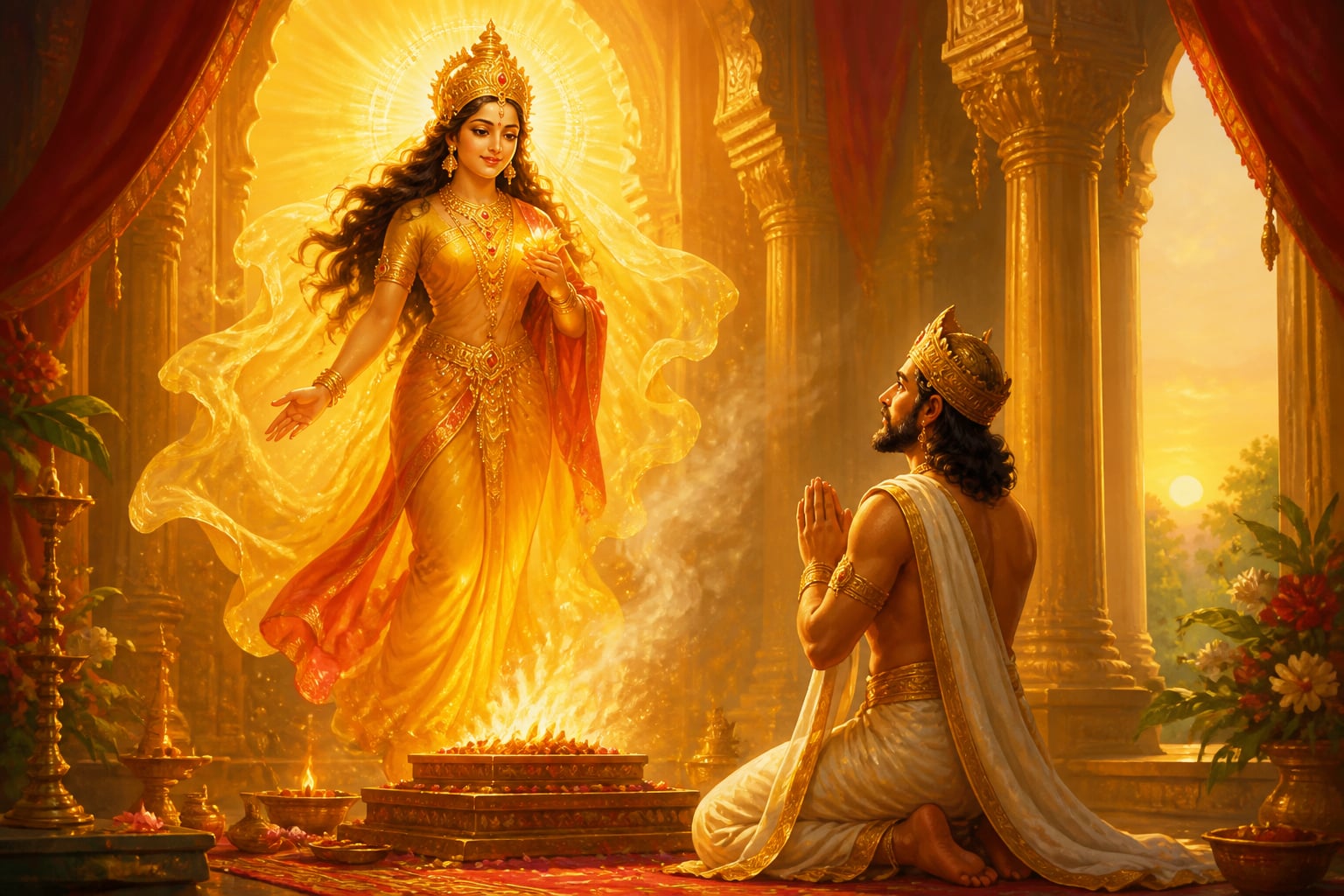
The goddess Savitri appears to King Ashvapati

At the end of these eighteen years, the goddess Savitri appeared before him in a blaze of golden light. "Your devotion has pleased me, O king. Ask what you desire."

"Divine mother, grant me sons to continue my lineage," the king requested.

The goddess smiled. "I have already spoken to Brahma about your wish. You will not have sons, but you will have a daughter of extraordinary radiance and virtue. Do not grieve - she will bring you honor beyond what any son could."

The king accepted this blessing with gratitude. In time, a daughter was born, beautiful as the morning sun. Ashvapati named her Savitri, after the goddess who had granted her.

The Princess Without Equal

As years passed, Savitri grew into a young woman of remarkable beauty and even more remarkable character. Her face glowed with an inner light. Her intelligence impressed the palace scholars, her kindness won the hearts of servants and nobles alike, and her devotion at the temple drew the attention of the priests.

But her very perfection created an unexpected problem. When Savitri reached marriageable age, no suitors came forward. The princes of neighboring kingdoms felt intimidated by her beauty and wisdom, believing themselves unworthy. Some wondered if this radiant princess might be a goddess in disguise.

King Ashvapati grew concerned. "Daughter, you have reached the age when a woman should marry. Yet no princes seek your hand. Tell me - is there anyone in all the kingdoms who has caught your attention?"

Savitri replied calmly, "Father, no one has presented themselves as worthy."

"Then you must search yourself," the king decided. "Take my ministers, chariots, and guards. Travel through all the kingdoms until you find a man worthy to be your husband. One of your virtue should choose her own match."

The Search for a Husband

Savitri embarked on an unusual journey - a princess seeking her own groom rather than waiting for suitors. Her entourage traveled through prosperous kingdoms and humble villages, through sacred forests where sages lived in hermitages.

Months passed. Savitri met princes and warriors, scholars and merchants, but none stirred her heart. Then her path led to a remote forest where she discovered something unexpected.

In a clearing stood a modest hermitage. An elderly blind man sat in meditation while an elderly woman tended a small garden. Despite their simple surroundings, both bore the unmistakable dignity of royalty.

Savitri inquired and learned their story. This was Dyumatsena, once the mighty king of Shalva, who had lost his sight to a mysterious illness. In his blindness, a rival had seized his kingdom. With nowhere else to go, the deposed king had retreated to the forest with his wife and young son, living the life of ascetics.

The Meeting with Satyavan

As Savitri observed the hermitage, a young man emerged from the forest carrying firewood. He moved with the grace of a prince despite his rough forest garments. His face radiated honesty and inner strength.

"Who is that?" Savitri asked her attendant.

"That is Satyavan, son of the blind king. He was born a prince but has known only this forest life since childhood. He gathers wood and forest fruits to support his aged parents."

Savitri watched Satyavan approach his father with the firewood, speaking gently to the old king, helping his mother with small tasks. Here was no pampered prince but a young man who had transformed hardship into grace.

Something shifted in Savitri's heart. After months of searching through palaces and courts, she had found her match in a forest clearing - a prince without a kingdom, a son devoted to his parents, a man whose virtue shone brighter than any crown.

She returned home without speaking to Satyavan, but her decision was made.

Savitri watches Satyavan carry firewood to his blind father at the forest hermitage, her choice settled.

The Fateful Announcement

Back in Madra, Savitri found her father in the assembly hall, attended by the celestial sage Narada who happened to be visiting. This great sage knew the past, present, and future of all beings.

"Father," Savitri announced, "I have made my choice. I will marry Satyavan, son of the blind King Dyumatsena of Shalva."

Ashvapati was troubled. "A noble family, but they live as hermits in the forest. Satyavan has no kingdom, no wealth, no prospects. Surely you could have found a prince with actual power."

Narada delivers the prophecy in the assembly hall

Before Savitri could respond, Narada's face had gone pale. The sage turned to the king with urgency.

"Your majesty, Savitri has chosen one of the most virtuous young men alive. Satyavan is truthful - hence his name - courageous, learned, generous, and devoted to his parents. In character, he rivals the gods themselves."

"Then what concerns you, great sage?" Ashvapati asked.

Narada's voice dropped. "Satyavan has one terrible flaw, through no fault of his own. He is marked for death. Exactly one year from this day, he will die. This is certain and cannot be changed."

The Impossible Choice

Silence fell over the assembly hall. King Ashvapati looked at his daughter with anguish.

"You hear the sage's words, Savitri. Choose another husband. Find a prince who will live to grow old with you, who will give you children and happiness. Do not doom yourself to widowhood before you have even known married life."

Savitri stood unmoved. When she spoke, her voice was steady.

"Father, a choice once made cannot be unmade. Whether Satyavan lives one year or one hundred years, I have given my heart to him. I will marry no other. A daughter of your house does not waver in her decisions like leaves in the wind."

"But child," the king pleaded, "think of what awaits you. One year of marriage, then a lifetime alone. The sage himself confirms the prophecy cannot be averted."

"Death comes to everyone, Father. None of us know our appointed day. Even if I married the healthiest prince, he might die tomorrow in an accident or war. At least with Satyavan, I know what I face. I choose him with full knowledge, not blind hope."

Narada observed this exchange with growing respect. "King Ashvapati, your daughter speaks with wisdom beyond her years. Her resolve is fixed. Perhaps it is best to proceed with what cannot be changed."

The king finally yielded. Preparations began for Savitri's wedding to a man with only one year to live.

The Wedding in the Forest

The royal party traveled to Dyumatsena's forest hermitage. The blind king was overwhelmed when he learned that a princess of Madra wished to marry his son.

"We have nothing to offer," Dyumatsena protested. "We live on roots and fruits. We cannot provide a princess the life she deserves."

"My daughter has chosen your son for his virtue, not his circumstances," Ashvapati replied. "She will live as you live, wear bark garments as you wear them, eat what the forest provides. This is her wish."

The wedding was performed simply in the forest ashram. Savitri exchanged her silk garments for rough cloth. She put aside her jewelry and tied her hair in simple braids. From that day, she served her parents-in-law with the same devotion Satyavan showed them.

The Counting of Days

Savitri told no one about Narada's prophecy - not her new husband, not her parents-in-law. She buried the knowledge in her heart while outwardly radiating peace and contentment.

But she counted each day.

She learned every detail of their forest life - which paths Satyavan walked to gather wood, which trees he favored, what time he left and returned. She observed his habits, memorized his routines.

As months passed, her devotion to Satyavan deepened into a love beyond ordinary bounds. She woke before him each morning to serve his parents. She prepared his simple meals with care. She listened to his dreams of one day restoring his father's kingdom.

Satyavan noticed the intensity in his wife's devotion. "Savitri, you gave up palaces for this humble life. Do you ever regret your choice?"

"Never," she replied. "What are palaces compared to the treasure I have found?"

He did not understand the weight behind her words. He did not know that she was treasuring each day as if it might be their last - because she knew exactly which one would be.

Living traditions

The Savitri story has become synonymous with ideal wifely devotion in Indian culture. It has been adapted into countless films, television series, dance dramas, and theatrical productions. The tale has also sparked modern feminist reinterpretations that highlight Savitri's agency, intelligence, and determination rather than focusing solely on her obedience. Contemporary scholars point out that Savitri makes her own choice, argues successfully against her father, and later defeats Death through her wit - making her a more complex figure than a simple symbol of submission.

Reflection

More in Vana Parva

All lessons in Vana Parva ยท The Mahabharata course