Rishi Katha: Tales of the Sages

Markandeya tells ancient stories

During the forest years, many sages visit the Pandavas and share wisdom through stories. The immortal sage Markandeya, who has witnessed multiple cosmic cycles, becomes a frequent visitor. He tells the Pandavas tales that illuminate dharma in its many forms - the story of Kaushika humbled by a butcher, the tale of a devoted wife whose merit surpassed a meditating sage, and accounts of how righteousness manifests differently in different circumstances. These stories teach that dharma is not found in rituals alone but in how one fulfills their duties with dedication and compassion. The Pandavas learn that their own exile, like all trials, serves a greater purpose.

Rishi Katha: Tales of the Sages

The Pandavas' forest exile was not simply years of hardship - it was also a time of profound learning. Many great sages visited their hermitage, drawn by Yudhishthira's reputation for righteousness. Among these visitors, none was more remarkable than Markandeya.

The Immortal Sage

Markandeya was no ordinary rishi. He had been granted immortality by Lord Shiva himself and had witnessed the creation and dissolution of the universe multiple times. When Yudhishthira expressed amazement at meeting someone who had seen entire cosmic cycles, Markandeya smiled.

"Time moves differently when you have seen it repeat," the ancient sage said. "What seems unique to you - the rise and fall of kingdoms, the struggles between right and wrong - I have witnessed countless times in various forms. Yet each telling is precious. Your story, O Yudhishthira, is as significant as any I have witnessed."

"How can that be?" Yudhishthira asked. "We are mere mortals in exile, while you have seen gods and demons battle for the universe."

"Because dharma is the same whether upheld by a god or a mortal," Markandeya replied. "Let me tell you some stories that may illuminate this truth."
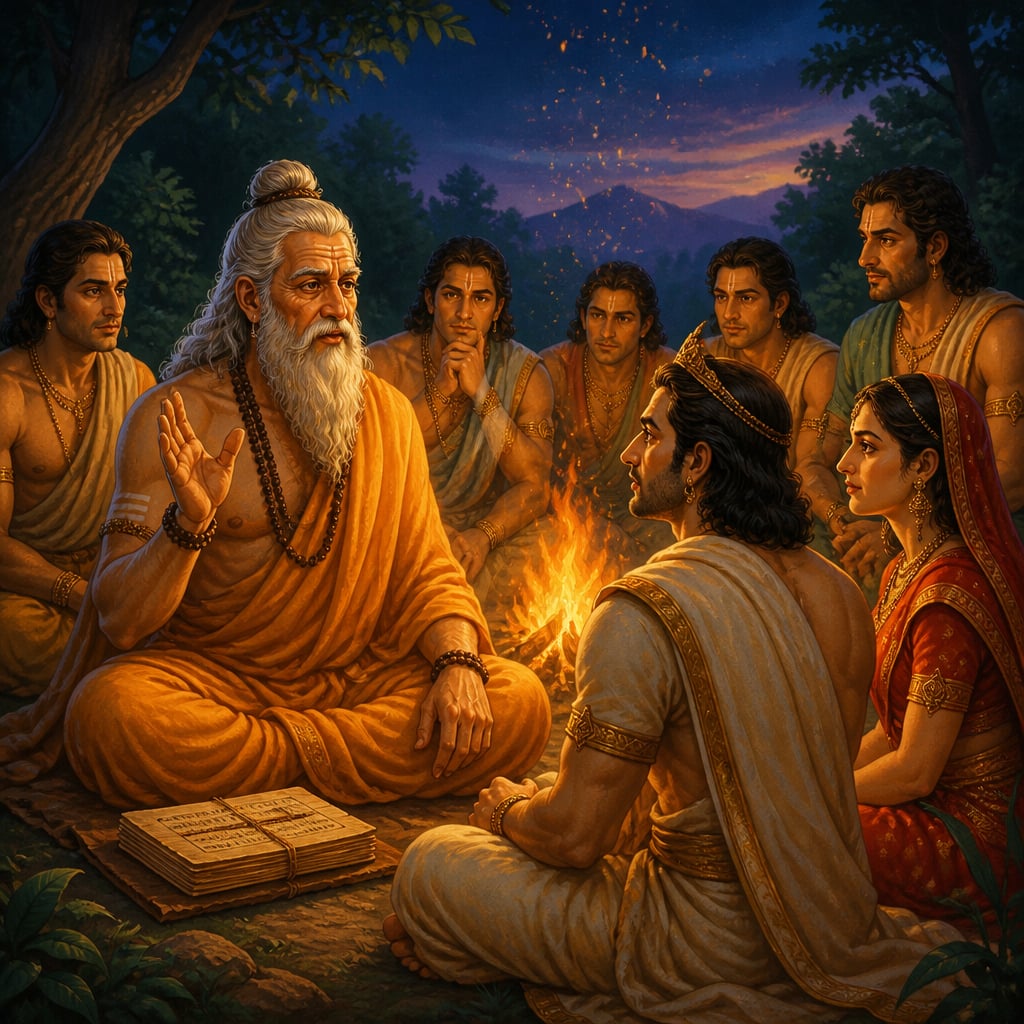
Markandeya sits before the Pandavas' fire at twilight, raising one hand as he begins to tell a story.

The Tale of Kaushika and the Crane

Markandeya began: "There was once a brahmin named Kaushika who was proud of his learning and spiritual practices. He would sit under a tree each day, deep in meditation, convinced that his austerities made him superior to common people.

"One day, as he meditated, a crane perched on a branch above him and accidentally dropped filth on his head. Kaushika looked up in fury, and such was the power of his spiritual practice that the bird fell dead from his angry gaze.

"At first, Kaushika felt proud. 'See my power,' he thought. 'I can kill with a glance.' But then shame crept in. He had killed an innocent creature for a minor accident.

"Later that day, Kaushika went to beg for food at a household as was his custom. The woman of the house asked him to wait while she tended to her husband who had just returned tired from work. Kaushika grew impatient and angry.

"When the woman finally came with food, Kaushika glared at her. 'Do you know who I am? Do you know my powers?'

The humble housewife rebukes the proud brahmin Kaushika

"The woman replied calmly: 'I am not a crane to be burnt by your anger, O brahmin. You may have spiritual powers, but you lack wisdom. If you wish to learn true dharma, go to the city of Mithila and speak with Dharma Vyadha - the righteous butcher.'

"Kaushika was shocked. How did this simple housewife know about the crane? And what could a butcher - whose profession involved killing - teach a brahmin about dharma?"

The Righteous Butcher

Markandeya continued: "Humbled and curious, Kaushika traveled to Mithila. He found Dharma Vyadha in the marketplace, surrounded by meat. The sight disgusted the brahmin, but he remembered the housewife's words.

"The butcher looked up and smiled. 'So the woman in Ujjain sent you. Welcome, brahmin. Let us speak after I finish serving my customers.'

"Again Kaushika was amazed. How did this butcher know?

"When the shop closed, the butcher took Kaushika to his home. There, the brahmin witnessed something remarkable. The butcher served his elderly parents with such tenderness and devotion that it seemed like worship. He washed their feet, fed them the best food, spoke to them with complete respect.

"'This is my dharma,' the butcher explained. 'Every person has duties according to their birth and circumstances. I was born into a family of butchers. I cannot abandon my hereditary profession without causing harm to my dependents. But I can perform my work honestly, without cheating customers, without unnecessary cruelty, while always serving my parents as my primary duty.'

"'But you kill animals!' Kaushika protested.

"'And you killed a crane with your anger,' the butcher replied gently. 'Which is worse - killing to fulfill one's duty to family and society, or killing from pride and irritation? Dharma is not about the nature of your work, but about how you perform it. That housewife who made you wait - she was serving her husband, which is her dharma. Her duty to her husband came before her duty to a begging brahmin. She offended you, but she pleased the gods.'

"Kaushika left Mithila a changed man. He had learned that dharma cannot be measured by caste or profession, but by the sincerity and compassion with which one fulfills their responsibilities."

The Lesson for Yudhishthira

Yudhishthira sat in thoughtful silence after hearing this story. "So dharma is not fixed," he finally said. "What is right for one person may be different for another."

"Exactly," Markandeya replied. "You are troubled because you are a king living in the forest, a Kshatriya who cannot fight, a ruler who cannot rule. But your dharma now is the dharma of exile - to endure, to learn, to prepare for what is to come. The same action - say, killing - might be adharma for a brahmin but dharma for a Kshatriya in battle."

"Then how does one know what is right?" Draupadi asked.

"By examining intention, consequence, and circumstance," Markandeya said. "The butcher kills, but without malice and while serving a social function. The brahmin killed from pride. One maintained dharma, the other violated it - though their actions appeared opposite."

The Story of Shibi and the Dove

King Shibi offers his own flesh on the scales to save the dove

Markandeya shared another tale: "King Shibi was famous for his protection of all who sought refuge with him. One day, a dove flew into his lap, trembling with fear. 'Save me, O king! A hawk pursues me!'

"The hawk landed nearby. 'That dove is my rightful prey. I hunted it fairly. Would you deny me my food?'

"Shibi was caught between two dharmas: his duty to protect one who sought refuge, and the hawk's right to eat. 'I cannot give you this dove,' he said. 'But I will give you flesh equal to its weight from my own body.'

"A scale was brought. The dove was placed on one side. Shibi cut flesh from his own thigh and placed it on the other. But no matter how much flesh he added, the scale did not balance. Finally, Shibi climbed onto the scale himself, offering his entire body.

"At that moment, the dove and hawk revealed themselves as Agni (fire god) and Indra (king of gods), testing Shibi's commitment to dharma. They healed his wounds and blessed him, for he had proven that true dharma sometimes requires sacrifice of self."

The Purpose of Exile

As the days passed and Markandeya shared more stories, a pattern emerged. Each tale illustrated that trials and hardships were not punishments but opportunities - chances to demonstrate virtue, to learn wisdom, to grow stronger.

"Your exile serves multiple purposes," Markandeya told the Pandavas. "It tests your patience and unity as brothers. It gives you time to gather allies and learn new skills. It allows Arjuna to obtain divine weapons. It lets the world see the contrast between your dignified suffering and Duryodhana's ill-gotten luxury."

"But thirteen years is so long," Draupadi said.

"For one who has seen cosmic cycles, thirteen years is a blink," Markandeya replied. "Use this time well. When it ends, you will face decisions more difficult than any you have yet encountered. The wisdom you gain now will guide you then."

The Sage's Departure

Markandeya stayed with the Pandavas for many days, sharing stories that ranged from cosmic visions of creation and destruction to simple tales of ordinary people finding dharma in unexpected places.

When he departed, Yudhishthira felt a profound change within himself. The stories had taught him that exile was not a pause in his life but an essential chapter of it. Every experience, every visitor, every hardship was shaping him for what lay ahead.

"Remember," Markandeya said as he left, "dharma is not always what it appears. The righteous sometimes suffer while the wicked prosper - but only for a time. In the longest view, which I have been privileged to see, dharma always triumphs. Your story will end as it should."

The Pandavas watched the ancient sage disappear into the forest, carrying with them the wisdom of ages.

Living traditions

The tradition of teaching through stories remains powerful in Indian culture and has spread globally through yoga and meditation communities. The Dharma Vyadha narrative has become a touchstone in modern discussions about the relationship between occupation and morality, frequently cited by reformers arguing against caste discrimination. Dr. B.R. Ambedkar and other social reformers referenced such stories to demonstrate that Hindu scriptures themselves contain anti-casteist messages. Markandeya's cosmic perspective continues to offer solace in modern counseling and self-help contexts, reminding people facing setbacks that their troubles are temporary phases in a larger journey. The storytelling format itself has influenced modern Indian theater, literature, and cinema, where nested narratives and philosophical dialogues remain popular storytelling techniques.

Reflection

More in Vana Parva

All lessons in Vana Parva ยท The Mahabharata course