Samudra: Dwaraka Submerges

The ocean claims the city

Arjuna races to Prabhasa upon hearing Daruka's terrible news, only to find the aftermath of annihilation, the Yadava warriors dead, Krishna and Balarama departed from their mortal forms. With Vasudeva dying of grief and the city of Dwaraka promised to the sea, Arjuna performs the funeral rites and organizes the evacuation of sixteen thousand women and children. As the survivors' caravan departs toward Hastinapura, the ocean rises to reclaim the golden city. What the Yadavas built in glory disappears beneath the waves in a single night, completing Gandhari's curse and closing an era.

Arjuna Receives the News

In Hastinapura, Arjuna was the first to see Daruka's chariot approaching. Even from a distance, he could tell something was terribly wrong. The chariot bore no banners. The horses were lathered and exhausted. And Daruka himself, as he stumbled down from the vehicle, looked like a man who had witnessed the end of the world.

Which, in a sense, he had.

"Arjuna..." Daruka could barely speak. His hands shook. His eyes were wild with a grief too large to contain. "You must come. You must come now. Dwaraka... the Yadavas... Krishna himself..."

Arjuna caught him as his legs buckled. "Speak clearly, Daruka. What has happened?"

The story came out in fragments, the pilgrimage, the drinking, the brawl that became a massacre. The eraka grass. The thousands dead. Balarama's withdrawal and departure. And finally, most terribly, the news that Krishna himself had been struck by a hunter's arrow and departed for the heavens.

"He told me to find you," Daruka sobbed. "He said you would know what to do. The survivors, the women, the children, the elders, they wait at Prabhasa. Dwaraka itself will be claimed by the sea. He said you must come quickly."

Arjuna stood frozen. His dearest friend, the one who had guided him through his darkest moments, who had spoken the Gita on the battlefield, who had been his charioteer and confidant and the closest thing he had to a brother outside his own blood, was gone.

For a long moment, he could not breathe. The world seemed to tilt, and he understood for the first time what Balarama must have felt when he said that something had broken inside him.

But Arjuna was a Kshatriya. Grief could wait. There was duty to perform.

"Prepare the chariots," he commanded. "We ride for Prabhasa at once."

The Devastation at Prabhasa
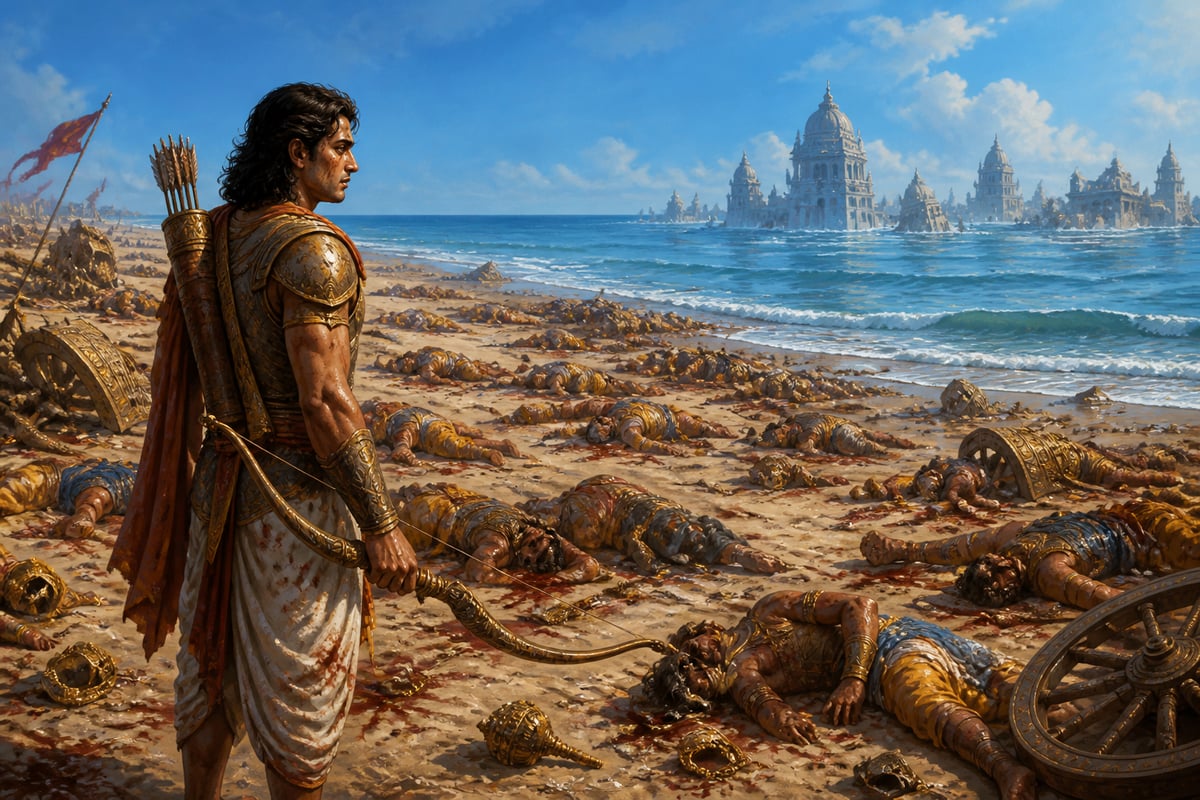
Arjuna alone at Prabhasa among the unburied Yadava dead

The journey to Prabhasa took days of hard riding. When Arjuna arrived, what he found confirmed Daruka's account and exceeded his worst imaginings.

The beach was still marked by the massacre. Despite the survivors' best efforts to cremate the dead, the sheer number of bodies had overwhelmed their capacity. The smell of death lingered. The sand was stained. And everywhere, in the eyes of the widows, in the silence of the orphaned children, in the broken posture of the few old men who remained, was the unmistakable imprint of catastrophe.

What Arjuna Found Details
Dead Thousands of warriors, cremated or awaiting cremation
Survivors Approximately 16,000, mostly women and children
Leadership None, all the clan heads were dead
Resources Adequate for short-term, insufficient for the journey
Morale Devastated, bordering on despair

Arjuna walked among them, and they looked at him with desperate hope. He was the last connection to glory, the final link to the age that was ending. If anyone could save them, surely it was the great archer, Krishna's beloved friend, the hero of Kurukshetra.

But Arjuna did not feel like a hero. He felt old, tired, and utterly unprepared for what lay before him.

Krishna, why did you have to leave now? I need your guidance more than ever.

The answer came as if whispered on the wind: You have everything you need. You learned it long ago. Now apply it.

Vasudeva's Death

Before attending to the survivors, Arjuna went to pay his respects to Krishna's father. Vasudeva, the noble king who had endured so much, from his imprisonment under Kamsa to the liberation of Mathura to the founding of Dwaraka, was dying.

Not from any wound. Not from illness. Simply from grief.

Arjuna found him lying in his tent, attended by the surviving queens, Devaki, Rohini, and others whose sons had perished in the massacre. Vasudeva's eyes were closed, but when Arjuna entered, they opened briefly.

"Arjuna," Vasudeva whispered. "You came."

"I came as quickly as I could, Father. I am sorry... I am sorry I was not here sooner."

"It would not have mattered. This was destined. My son knew it. He let it happen." A tear traced down the old king's weathered cheek. "All my sons are dead, Arjuna. Pradyumna, Samba, all of them. And Krishna, Krishna who was not merely my son but my lord, he too is gone. What is there left to live for?"

"The survivors need protection. Your grandson's widows, your great-grandchildren, "

"I know. That is why I waited for you. Now that you are here, they will be safe." Vasudeva's hand found Arjuna's and gripped it weakly. "Take them to Hastinapura. Yudhishthira will provide for them. And Arjuna, do not grieve too long. Krishna would not want it."

"He loved you more than you know. You were the human soul he trusted most in all the worlds. Do not forget what he taught you."

Those were Vasudeva's last words. His hand relaxed. His breathing ceased. And another pillar of the old age crumbled to dust.

Arjuna sat with the body for a long time, remembering everything, the day he first met Krishna, the exile years when they were inseparable, the war and its aftermath. So many memories, and now the one who shared them most deeply was gone.

But the survivors needed him. He could not indulge his grief.

The Funeral Rites

With the help of the surviving priests and elders, Arjuna performed the funeral rites for Krishna, Balarama, and Vasudeva. The ceremonies were elaborate, these were no ordinary dead but divine incarnations and a royal patriarch.

For Krishna and Balarama, whose bodies had been preserved awaiting Arjuna's arrival:

The fire that consumed Krishna's body, survivors reported, burned with a golden light unlike any natural flame. Some claimed to see the form of Vishnu's eagle, Garuda, descending to carry something away. Others simply wept.

Vasudeva was cremated alongside his sons, and his wives, following the ancient custom, entered the flames with him. Devaki, who had borne Krishna in Kamsa's prison; Rohini, who had raised Balarama; and several other queens chose to accompany their lord in death rather than face a world without him.

Arjuna watched the pyres burn with a heart that felt like stone. He had seen so much death in his life, at Kurukshetra, at the ashrama where his grandfather Bhishma lay dying, at the forest exile where they had lost so many, but this was different. This was the death of an age.

Preparing for Evacuation

Once the funerals were complete, Arjuna turned his attention to the living.

Sixteen thousand women and children needed to be transported safely from Prabhasa to Hastinapura, a journey of many weeks through territory that had once been safe but might no longer be. With the Yadava warriors dead and Krishna's protection withdrawn, robbers and hostile kingdoms might see an opportunity.

Arjuna organized the evacuation with military precision:

Task Approach
Transport Commandeered carts and wagons from Dwaraka
Protection Arjuna himself as primary defender, supported by Daruka and the remaining servants
Provisions Food and water for sixty days of travel
Valuables Krishna's treasures to be carried as portable wealth
Route The safest roads, avoiding known trouble spots

The survivors gathered at the edge of Dwaraka, looking back at the city that had been their home. The golden spires still gleamed in the sunlight. The gardens still bloomed. From a distance, it looked unchanged, as if the massacre had never happened, as if Krishna might still be there waiting for them.

But everyone knew the truth. The city was empty. The glory was departed. And the sea was coming.

Dwaraka's Final Hours

Dwaraka had been built as a refuge, a city Krishna constructed to protect his people from Jarasandha's constant attacks. It was located on an island in the Arabian Sea, accessible only by bridge, defended by the ocean itself.

The city was legendary:

This was what the Yadavas had built with their prosperity. And this was what was about to disappear.

Krishna had warned them: when he departed, the sea would reclaim Dwaraka. No one had quite believed it, how could an entire city simply vanish?, but his words had never been empty.

As Arjuna led the survivors' caravan away from the coast, the first signs appeared. The bridge to the mainland began to crack. The waters around the island churned ominously. The level of the sea began to rise.

"Do not look back," Arjuna commanded. "There is nothing to be done. Keep moving."

But some did look back. And they saw Dwaraka begin to sink.

The Sea Claims Its Due

The submersion of Dwaraka was not gradual. Once it began, it happened with terrifying speed.

First, the outer districts flooded, the markets and merchant quarters that ringed the city's edge. The sea came in waves, each higher than the last, swallowing streets and buildings with hungry abandon.

Then the residential areas went under. The royal palaces, those 900,000 edifices of wealth and beauty, disappeared one by one beneath the dark waters. Gold and jewels meant nothing to the ocean. Glory was irrelevant to the tide.

The temples were last to go. As if paying final respect to the gods, the sea paused briefly at their thresholds before sweeping through. The images of the deities remained serene as the waters rose around them. Then they too were claimed.

By morning, Dwaraka was gone. Where the golden city had stood, there was only water, calm, blue, giving no indication that anything had ever been there.

Dwaraka's golden spires sink beneath cresting waves at dawn as the sea swallows the city.

Some of the survivors who witnessed this fell into despair. Their home, their history, everything they had known, erased as if it had never existed. What was the point of anything if it could all be taken away so completely?

But Arjuna, remembering Krishna's teachings, understood differently.

Nothing that exists is ever truly destroyed. Energy cannot be annihilated, only transformed. Dwaraka is gone as a physical city, but what it represented, the possibility of refuge, the reality of divine protection, the memory of a golden age, these remain. They live in the stories we will tell, the traditions we will keep, the lessons we will pass on.

The caravan moved on. Hastinapura was still many days away.

The Attack of the Abhiras

Abhira bandits attacking the Yadava evacuation caravan

As if the tragedy were not complete, the journey brought one more humiliation.

A tribe of Abhiras, wild forest dwellers who had long resented the Yadavas' power, saw the vulnerable caravan and smelled opportunity. They attacked in force, hoping to plunder the wealth being carried and capture the women.

Arjuna rose to defend the survivors. He reached for his Gandiva bow, the divine weapon that had never failed him in a lifetime of battles, and prepared to unleash the celestial astras that had made him legendary.

But something was wrong.

The Gandiva felt heavy in his hands. His arms trembled. When he attempted to invoke the astras, the mantras he had recited a thousand times, they would not come. His memory failed. His power was gone.

Before After
Gandiva sung in his hands The bow felt like dead wood
Astras came at a word Mantras would not form
Arrows never missed Shots went wide
Inexhaustible energy Fatigue after minutes

Arjuna fought with what he had, ordinary arrows, basic archery, the skill of a trained warrior without divine enhancement. He managed to drive off the worst of the attackers, but not before the Abhiras had seized some of the women and made off with portions of the treasure.

It was a defeat unlike any he had ever experienced. Not because of the material losses, but because of what it revealed: the age of heroes was truly over. The divine favor that had sustained the great warriors through impossible victories had withdrawn. They were mortal now, fully mortal, with all the limitations that implied.

Krishna's departure has taken everything. Even my strength was borrowed from his grace.

Arjuna wept, not for the lost treasure or the captured women, but for the realization that he was no longer the hero he had been. The Arjuna who had fought the entire Kaurava army to a standstill, who had dueled Indra himself, who had been called "Savyasachi" for his ambidextrous mastery, that Arjuna was gone. What remained was an aging man with a heavy bow and fading memories.

Arrival at Hastinapura

Weeks later, the diminished caravan reached Hastinapura. Yudhishthira met them at the gates, his face grave as he surveyed the survivors, far fewer than had departed Dwaraka, far more broken than he had imagined.

"Tell me everything," he said to Arjuna.

Arjuna told him. The pilgrimage. The curse fulfilled. The massacre. Krishna's death. Dwaraka's submersion. The attack on the road. His own failure.

Yudhishthira listened without interruption. When Arjuna finished, the Dharmaraja was silent for a long time.

"Gandhari's curse," he said finally. "It has come to pass, exactly as she spoke it. The Yadavas destroyed as the Kauravas were destroyed. Krishna's clan gone as our enemies' clan is gone."

"It is more than that," Arjuna said. "It is the end of everything. The age is turning. The gods are withdrawing. We are... we are relics now, brother. Remnants of a time that no longer exists."

Yudhishthira nodded slowly. "Then we must decide what to do with the time that remains. These survivors, they are our responsibility now. We must provide for them, integrate them into our kingdom, ensure their children have futures."

The Yadava women and children were given homes in Hastinapura and the surrounding territories. Some of the women remarried into Kuru families. The children were adopted and raised as citizens of the realm. The treasure that had survived became part of the royal treasury, used to rebuild and provide.

The bloodline of the Yadavas, scattered and diluted, would continue, but never again as a distinct nation, never again with their own city and sovereignty. They had been a great people. Now they were refugees, absorbed into another kingdom's story.

Such is the fate of all earthly glory. It rises, it shines, and in the end, it is absorbed back into the larger flow of time.

The Meaning of Submersion

Dwaraka's destruction was not merely punishment, it was completion.

The city had been built by divine power for a divine purpose: to shelter the Yadavas while Krishna walked the earth. When that purpose ended, the city had no reason to exist. Maintaining it would have been like keeping a cocoon after the butterfly has flown, an empty shell, a monument to absence.

The sea that claimed Dwaraka was not an enemy but a teacher. It demonstrated the fundamental truth that the Mahabharata has been teaching from the beginning:

Nothing built by human hands, however glorious, is permanent. Every city falls. Every kingdom ends. Every golden age gives way to darkness. And yet, life continues. New cities are built. New kingdoms arise. New golden ages, in time, emerge.

The Yadavas were gone, but their descendants would spread throughout India. Dwaraka was submerged, but the memory of it would inspire seekers for millennia. Krishna had departed, but his teachings would transform countless lives.

This was the lesson of Mausala Parva: not that endings are tragedies to be avoided, but that they are transitions to be navigated. The curse was fulfilled. The divine play was concluded. And out of the ashes and waters, something new would eventually grow.

But first, there was grief. And first, there was the simple human work of survival, feeding the hungry, sheltering the homeless, comforting the bereaved. The cosmic meanings could wait. The immediate needs could not.

Arjuna understood this. And so he set aside his despair, took up his duties, and began the long work of caring for what remained when glory had departed.

Living traditions

Dwaraka's submersion has become a powerful metaphor in contemporary Indian discourse for climate change and environmental destruction. As rising sea levels threaten coastal cities worldwide, the ancient story of a great civilization swallowed by the ocean takes on new urgency. Environmental activists and spiritual teachers alike reference the Mausala Parva when discussing how human hubris and environmental forces can combine to destroy what seemed permanent. The lesson that 'the sea is coming' resonates differently when oceanographers are predicting exactly that for many modern cities.

Reflection

More in Mausala Parva

All lessons in Mausala Parva · The Mahabharata course