Kula Kshaya: The End of a Dynasty
Yadavas destroy each other
As the sun sets over Prabhasa, the massacre reaches its terrible conclusion. Krishna himself takes up the eraka grass to protect the survivors, slaying those who attack him. When the violence finally ends, the greatest dynasty of the age lies in ruins, thousands dead, the flower of the Yadava nation destroyed in a single afternoon. Krishna sends Daruka to summon Arjuna and prepares for what must come next.
The Scope of Destruction
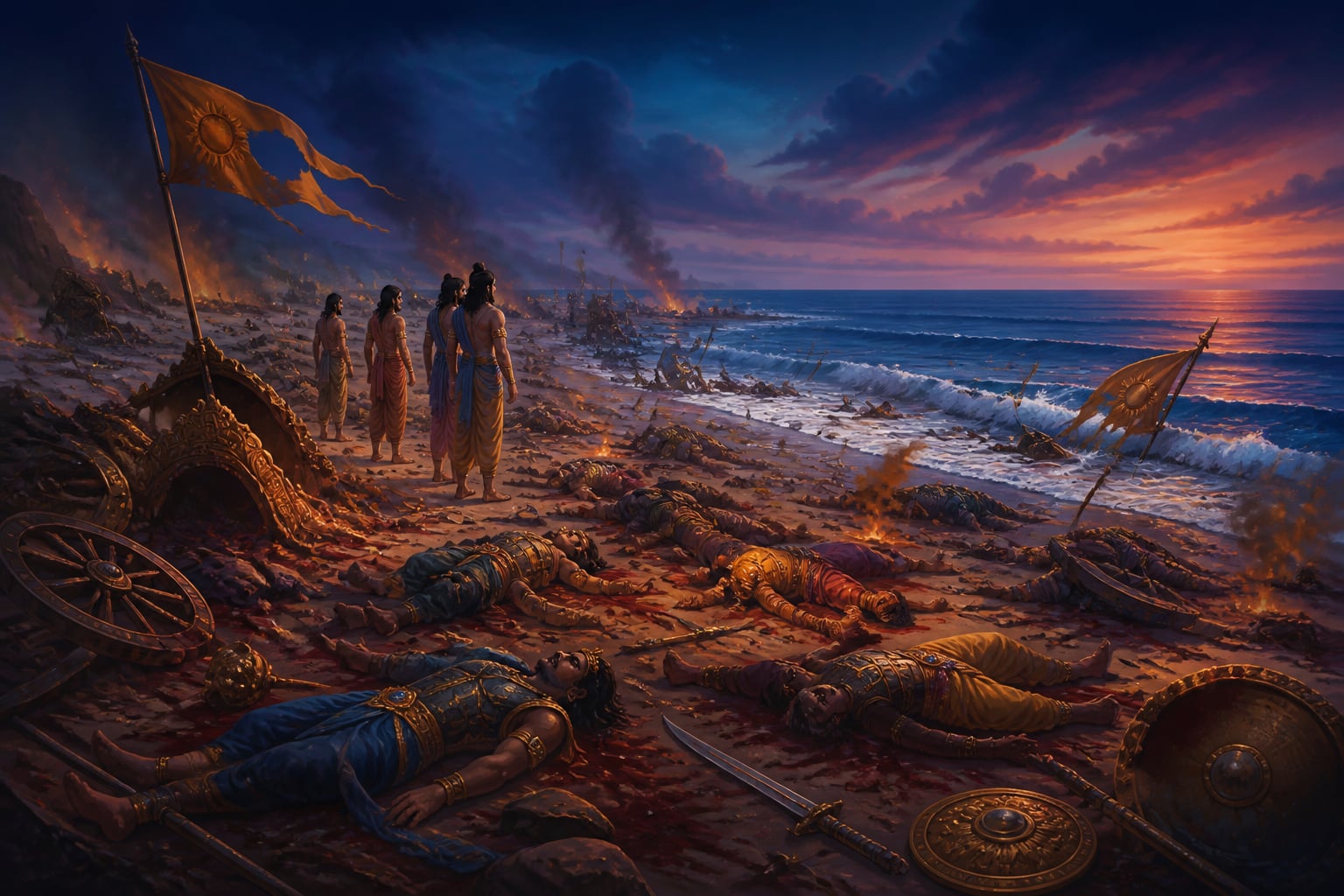
As twilight deepened over Prabhasa, the sounds of battle finally faded, not into peace, but into the silence of exhaustion. There were simply too few left alive to continue killing.
Krishna walked through the carnage, and for the first time in his divine incarnation, something like shock seemed to touch his features. Not because he had not foreseen this, he had known it would come since Gandhari spoke her curse thirty-six years before. But knowing is not the same as witnessing.
The beach was covered with bodies.
Not enemies. Not the faceless warriors of opposing armies. These were his people. His family. His sons and nephews and cousins and friends. They lay tangled together in death, their hands still clutching the eraka grass that had become their weapons and their doom.
| Fallen | Relationship to Krishna | How They Died |
|---|---|---|
| Pradyumna | Son | Defending Satyaki |
| Samba | Son | Killed by cousins |
| Aniruddha | Grandson | Eraka grass |
| Charudeshna | Son | Eraka grass |
| Satyaki | Devoted ally | Mobbed by Bhojas |
| Kritavarma | Ally and rival | First death, by Satyaki |
| Gada | Cousin | Eraka grass |
| Akrura | Elder statesman | Eraka grass |
The list went on and on. Thousands of names. Thousands of stories ending in the same blood-soaked sand.
Krishna Takes Up the Grass
Even as Krishna surveyed the devastation, scattered groups of survivors, maddened by grief and unable to distinguish friend from foe, attacked whatever moved. Some rushed at Krishna himself, their eyes wild, their hands filled with the deadly reeds.
Krishna did not flee. He did not call upon his divine powers to freeze them or transport himself away. Instead, he bent down and gathered a handful of eraka grass.
In his hands, as in everyone else's, the grass became as hard as iron and sharp as any sword. But unlike the others, Krishna wielded it with the calm precision of a warrior who had no illusions about what he was doing.
"Forgive me, my children," he murmured as he struck. "You are beyond reason now. Let this end cleanly."
One by one, he dispatched those who attacked him, not with anger, not with the frenzy that had possessed the others, but with the compassion of a physician ending suffering. Each death was swift, merciful, final.
When the last attacker fell, Krishna stood alone amid the bodies, the bloody grass still in his hands. He looked at it for a long moment, this common reed that had become the instrument of his family's extinction, and then let it fall.

The curse had run its course.
The Survivors
Not everyone had died. The massacre had focused on the warriors, the men who had gathered for the pilgrimage, the fighters who had let their enmities explode. But scattered throughout the camp were survivors:
- Women who had hidden in the tents when the violence began
- Children too young to participate in the drinking
- Servants who had fled into the darkness
- The aged and infirm who could not fight even if they wished to
- Balarama, who had withdrawn from the battle and vanished into the night
And Daruka, Krishna's charioteer, who had remembered his master's instructions and stayed clear of the fighting.
Krishna found Daruka trembling behind an overturned cart, his face pale with shock.
"You survived," Krishna said, with something that might have been relief. "Good. I need you."
"My lord..." Daruka could barely speak. "What happened? I saw them, they were drinking, and then, "
"They were drinking, and then they died. That is all anyone needs to know." Krishna's voice was flat, almost mechanical. "Listen carefully. I need you to go to Hastinapura."
"Now? But the survivors, the women and children, "
"Will be safe until Arjuna comes. Which is why you must go now. Find Arjuna. Tell him what has happened here. Tell him that the Yadava race is destroyed, that Dwaraka will soon be claimed by the sea, and that he must come quickly to lead the survivors to safety."
Daruka stared. "Dwaraka claimed by the sea? My lord, what, "
"Go," Krishna said, not unkindly. "There is no time for explanations. Arjuna will understand when he sees. Go now."
The Weight of Knowing
As Daruka's chariot disappeared into the darkness, Krishna turned back toward the camp. The survivors were beginning to emerge, women crying, children confused, old men hobbling among the dead looking for sons and grandsons.
Krishna moved among them, offering what comfort he could. But his mind was elsewhere.
He had known this would happen. For thirty-six years, he had known. And for thirty-six years, he had carried that knowledge alone, watching his people prosper while the shadow of their destruction grew longer with each passing day.
Was there anything I could have done differently?
He knew the answer, of course. He could have prevented Gandhari's curse by preventing the war, but the war had been necessary, the adharma of the Kauravas too great to be left uncorrected. He could have stopped the young men from mocking the sages, but he had not been present when the prank occurred, and even if he had, preventing that moment would only have delayed the curse to find another entry point.
The curse had not created the Yadavas' destruction. It had merely given shape to forces already present: the arrogance bred by prosperity, the enmities suppressed but never healed, the moral decay that had set in over decades of unchallenged success.
The curse was the match. But my people had been soaking themselves in oil for years.
Accounting for the Dead
As dawn approached, the survivors began the grim work of identifying the dead. It was worse than anyone had imagined.
The Yadava warrior caste, the Vrishnis, Bhojas, Andhakas, Shinis, and all their allied clans, had been virtually exterminated. Not defeated by an enemy army. Not conquered by a foreign power. Destroyed by their own hands, with weapons made of grass.
The death toll included:
- All of Krishna's sons except Pradyumna (who had died earlier) and some minor figures
- Most of the great warriors who had fought at Kurukshetra
- The heads of virtually every major Yadava family
- The bulk of the next generation, the young men who would have led in years to come
What remained was a population of widows, orphans, and the elderly, a people robbed of their future in a single afternoon of madness.
Krishna organized the survivors as best he could. The bodies would need to be cremated, thousands of them, before the journey back to Dwaraka. But even that refuge would not last long.
"The sea is coming for our city," Krishna told the stunned survivors. "We have perhaps days, perhaps weeks. When Arjuna arrives, he will lead you to Hastinapura. The Pandavas will provide refuge."
"And you, my lord?" asked one of the older women, a queen who had lost her husband and all her sons in the massacre.
"I will do what remains to be done," Krishna said. "Do not worry for me."
The Search for Balarama
As the morning wore on, Krishna went looking for his brother.
Balarama had been seen during the early part of the fighting, wielding his great plough and mace against attackers. But at some point, he had withdrawn. Some said he had walked toward the sea. Others said he had gone into the forest. No one knew for certain.
Krishna found him at last on a lonely stretch of beach, far from the massacre site. Balarama sat with his back against a tree, looking out at the waves. His weapons lay beside him, clean, he had not used them in some time.
"Brother," Krishna said, sitting down beside him.
Balarama did not turn. "I couldn't stop it. I tried, at first. But there were too many, and they were... they were not themselves anymore. It was like something else was moving them. Using their hands, their weapons, their rage."
"The curse needed vessels. It found them."
"And you? You knew this would happen. You brought us here knowing."
"I brought us here so it would happen here, and not in Dwaraka where the innocent might suffer more. Here, it was only the warriors. Only those whom the curse had claimed."
Balarama was silent for a long moment. Then: "Our sons are dead, Krishna. Pradyumna. Samba. All of them. Our nephews. Our cousins. Everyone."
"I know."
"And still you sit there, calm as if nothing has happened."
Krishna's voice softened. "I am not calm, brother. I am merely past the point where grief changes anything. We mourn what we cannot save. But we do not abandon what we still can."
"What is there left to save?"
"The survivors. The women and children. They will need guidance when they reach Hastinapura. And there is Dwaraka itself, it must be evacuated before the sea claims it. There is work yet to do, even in the ruins of everything we built."
Balarama looked at his brother at last. His eyes were red, his face aged by grief.
"I don't know if I have the strength for it, Krishna. I feel... I feel as if something has broken inside me. Something that held my soul in my body."
"Then rest, brother. Do what you must. I will handle what remains."
It was permission, or perhaps recognition of what was already happening. Balarama nodded slowly and turned back to the sea.
The Dynasty's End

By evening of the second day, the cremation pyres burned across Prabhasa like a field of fallen stars. The smoke rose to heaven, carrying with it the souls of thousands, warriors who had made the Yadava name a byword for valor across the three worlds.
Krishna watched the fires from a distance, alone with his thoughts.
The dynasty was finished. Not merely weakened, not merely diminished, finished. There would be no recovery. No next generation of Yadava heroes. The surviving women and children would be absorbed into other kingdoms, their bloodline scattered and diluted until the name itself became a memory.
This was what Gandhari had demanded. The complete destruction of Krishna's clan, mirror to the destruction of her own. An eye for an eye, a dynasty for a dynasty, grief answered with grief.
She was right to curse me. I let the war happen. I could have prevented it, I chose not to. And now my people pay the price.
But even as the thought arose, Krishna recognized its limitation. The war had not been a choice made lightly or for personal gain. It had been a correction, an intervention against adharma that had grown too powerful to ignore. Duryodhana's tyranny, the corruption of the Kuru court, the systematic violation of every principle of dharmic rule, these could not have been left to fester.
Sometimes there is no path without cost. Sometimes every choice leads to suffering. And sometimes the best we can do is ensure that the suffering serves a purpose.
The Yadavas' destruction served a purpose. Krishna understood that now with terrible clarity. A dynasty that had begun to rot from within, whose young had lost all reverence, whose elders had lost all authority, such a dynasty could not be allowed to continue. Better a clean end than a slow decay into complete moral collapse.
It was cold comfort. But it was the only comfort available.
Krishna sat through the night, watching the pyres burn down to ash, waiting for whatever would come next.
Living traditions
The Yadava destruction resonates in modern discussions of organizational and civilizational collapse. Business schools study how successful companies suddenly self-destruct through internal conflicts; historians examine how prosperous societies fall to internal discord rather than external enemies. The Mausala Parva's message, that prosperity breeds complacency, complacency breeds arrogance, and arrogance invites destruction, applies across contexts and centuries.
- Pitru Tarpana for Yadavas: Some traditional Brahmin families who claim descent from survivors of the Yadava destruction perform special ancestral offerings (tarpana) for the clan during Pitru Paksha. These rituals acknowledge the tragedy and seek to bring peace to the souls of those who died in the massacre.
- Nageshwar Jyotirlinga: One of the twelve Jyotirlinga temples, located near the region associated with the Yadavas' destruction. The temple offers pilgrims a chance to contemplate both Shiva's eternal presence and the impermanence of even the greatest human dynasties.
- Rukmini Devi Temple: Dedicated to Krishna's chief queen, who survived the massacre (having remained in Dwaraka). The temple preserves the memory of those who lived through the destruction and eventually accompanied the survivors to Hastinapura.
Reflection
- The dynasty's destruction left only widows, orphans, and the elderly. What responsibilities do survivors have toward community remnants? How do cultures and organizations rebuild after catastrophic loss of their core members?
- Balarama confesses to Krishna that 'something has broken inside me.' Have you ever experienced a loss so profound that you felt fundamentally changed, no longer the person you were before? How did you navigate that transition?
- Krishna knew for thirty-six years that his people would destroy themselves, yet he continued to lead them, celebrate with them, and watch them build families and futures that would never come to fruition. Is there wisdom in allowing people to live fully even when you know their time is limited? Or is it a form of deception?