Ashubha: The Omens of Doom
Dark signs appear in Dwaraka
As the thirty-sixth year draws to a close, Dwaraka is plagued by terrifying omens. Sacred fires burn with unnatural colors, animals behave strangely, and the very air seems poisoned with dread. Krishna alone recognizes these signs for what they are: Gandhari's curse reaching its final form. He orders the Yadavas to undertake a pilgrimage to the sacred site of Prabhasa, not knowing that he is leading them to the place of their destruction.
When the World Begins to Unravel
The signs began subtly, so subtly that most dismissed them as coincidence.
A temple priest noticed that the sacred fire, which had burned steadily for generations, now flickered with strange colors, blue and green flames dancing where only orange should appear. He mentioned it to no one, telling himself the wood must be damp.
A merchant's wife found her household vessels had shifted overnight, pots that faced east now faced west, lamps that hung on the left wall had somehow moved to the right. She blamed the servants and said nothing more.
A child ran crying to his mother because the family cow had given birth to a foal. The mother hushed him, certain he had confused their animals with a neighbor's.
But the signs did not stop. They multiplied.
The Unraveling of Order
Dwaraka had always been a city of abundance and harmony. Krishna had built it as a refuge from the tyranny of Kamsa, a place where the Yadavas could prosper in peace. For decades, it had fulfilled that promise, its harbors busy with trade, its streets clean and orderly, its people content.
Now, in the thirty-sixth year after the great war, that order began to crack.
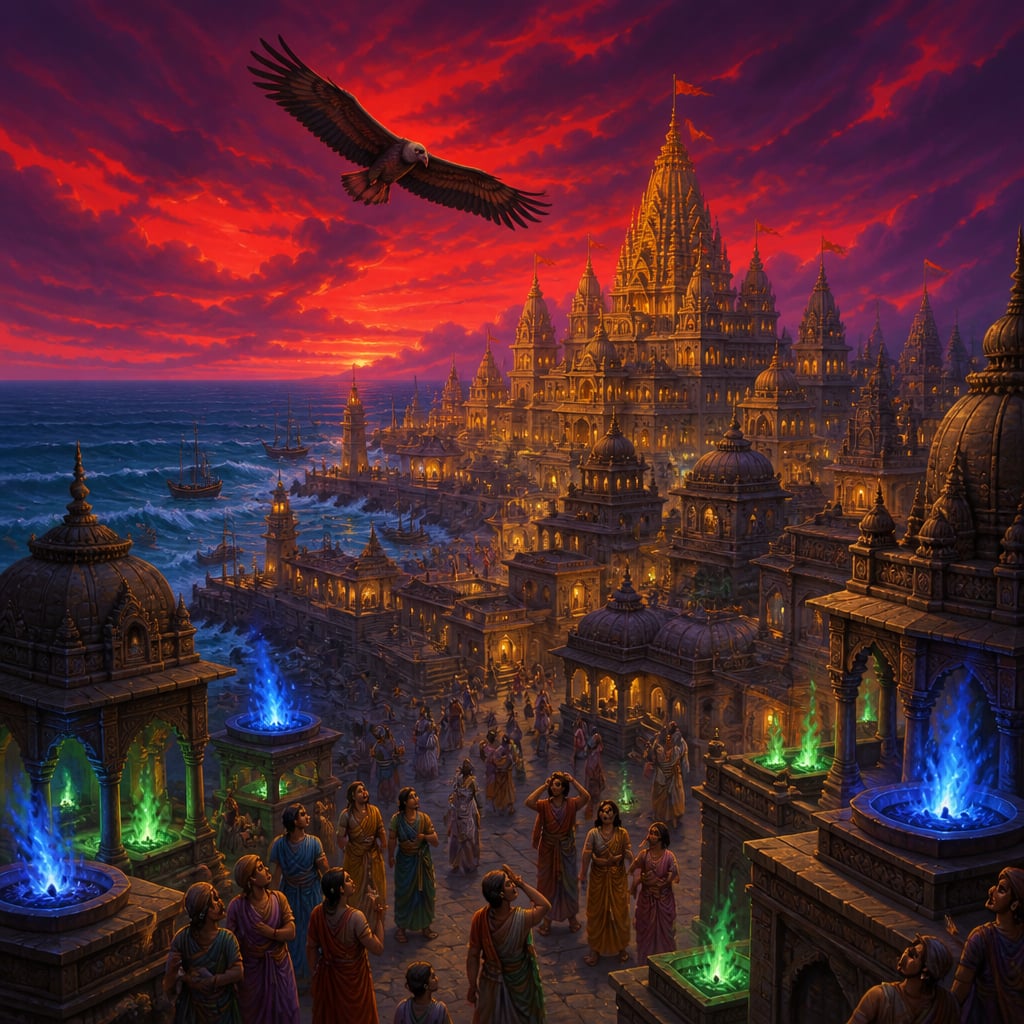
The omens came in waves, each more disturbing than the last:
In the Temples:
- Sacred fires flared without offerings and died despite constant tending
- Idols wept tears that smelled of iron
- Flowers placed at altars withered within hours
- The conch shells, when blown for prayers, produced discordant sounds
In Nature:
- Cows gave birth to donkeys; mares foaled calves
- Birds abandoned their nests and flew in circles until they dropped from exhaustion
- The ocean at Dwaraka's shores churned without wind, its waves running backward
- Fish washed up on beaches in vast numbers, still alive but refusing to return to the water
Among the People:
- Elders forgot the names of their children
- Husbands and wives quarreled over nothing and refused to reconcile
- Previously honest merchants began to cheat openly
- Brahmins muttered curses instead of blessings
| Realm | Normal State | Omen Manifestation |
|---|---|---|
| Sacred | Fires steady, offerings accepted | Fires unpredictable, offerings rejected |
| Natural | Animals predictable, seasons orderly | Unnatural births, reversed tides |
| Social | Harmony, respect for tradition | Discord, breakdown of relationships |
| Moral | Dharma observed, elders honored | Adharma spreads, contempt for virtue |
The Multiplication of Rats

But the most horrifying omen came from below.
Rats, creatures that had always existed in manageable numbers, began to multiply beyond all reason. They poured from drains and cellars in endless waves. They gnawed through granary walls, devoured stored food, chewed the reins of horses and the handles of weapons.
At first, the Yadavas tried to control them through ordinary means: cats, traps, poison. Nothing worked. For every rat killed, ten more seemed to appear.
"These are not rats," whispered the old women. "These are the unborn children of the war dead, come to claim what was denied them."
The rats grew bolder. They attacked sleeping children, swarmed over temples during worship, and once, in an incident that sent shockwaves through the city, they devoured the offerings on the great altar of Vishnu before the priests could stop them.
King Ugrasena ordered mass exterminations. Fires were set, floods released into underground passages, warriors deployed with torches and swords. Still the rats came, as if the earth itself were vomiting them forth.
And always, always, the eraka grass grew thicker on the beaches of Prabhasa.
Krishna Sees What Others Cannot
Krishna observed these omens with the calm of one who has been expecting them.
He alone connected what others saw as random disturbances. The strange fires, the unnatural births, the plague of rats, the breakdown of social harmony, all were symptoms of a single cause. The curse was maturing. The thirty-sixth year was ending. And Gandhari's words, spoken in grief on the fields of Kurukshetra, were taking their final form.
"Your own clan shall destroy itself. The Yadavas will kill each other just as the Kurus and Pandavas have done."
One evening, Balarama found Krishna standing alone on the palace terrace, gazing toward the distant shore where Prabhasa lay.
"Brother," Balarama said, "the people are frightened. They speak of curses and doom. Should we not reassure them?"
Krishna's response was measured, almost gentle:
"What reassurance can I offer that would be true? The omens do not lie. Our time in this place grows short. These signs are not random cruelties of fate, they are warnings, given in mercy, so that those with eyes to see might prepare themselves."
"Prepare for what?"
"For what must come." Krishna paused. "Do you remember, brother, when we were young and fled Mathura to escape Kamsa? We built this city as a refuge. But no refuge is permanent. All things that rise must also fall. The Yadavas have had their age of glory, and now that age is ending."
Balarama was silent for a long moment. Then: "Is there nothing we can do?"
"We can face what comes with dignity. We can ensure that when the end arrives, we meet it as Kshatriyas should, not cowering, not bargaining, but standing upright before the consequences of our deeds."
The Council of Elders
Krishna called a council of the Yadava elders, the heads of the great families, the chiefs of the Vrishnis, Bhojas, Andhakas, and Kukuras. When they had assembled, he spoke plainly.
"You have all seen the omens. You have heard the whispers in the streets. I will not insult you with false comfort. The signs speak truly: a great calamity approaches our people."
Murmurs ran through the assembly. Some had hoped Krishna would explain away the omens; others had feared exactly this confirmation.
"But there is something we can do," Krishna continued. "Not to prevent what fate has decreed, but to purify ourselves before it arrives. I propose that we undertake a pilgrimage, all the great families together, to the sacred tirtha of Prabhasa. There, at the confluence of the sacred rivers, we will perform rituals of purification, make offerings to the gods, and cleanse ourselves of whatever sins have drawn this doom upon us."
| Argument For | Argument Against | Krishna's Resolution |
|---|---|---|
| Purification might avert doom | If doom is fated, why bother? | "We go not to escape fate but to meet it worthily" |
| Unity of the clans at pilgrimage | Tensions between families are high | "Sacred space may heal our divisions" |
| Traditional response to omens | Some want to fight, not pray | "What enemy would you fight? The curse has no body" |
The elders agreed, though not all with equal enthusiasm. Some genuinely hoped the pilgrimage would appease the gods. Others simply wanted to escape Dwaraka's increasingly oppressive atmosphere. A few suspected that Krishna knew more than he was saying, but none dared ask directly.
The decision was announced: in one month's time, the great families of the Yadavas would journey to Prabhasa.
Preparations and Premonitions
The preparations began immediately. Wine and food were gathered in vast quantities, for pilgrimage or festival, the Yadavas never traveled without abundance. Tents were prepared, vehicles readied, priests commissioned to conduct the rituals.
But even as the preparations proceeded, the omens intensified.
Satyaki, the great warrior who had fought alongside Arjuna at Kurukshetra, noticed that his weapons had begun to rust despite careful maintenance. He mentioned it to Kritavarma, who laughed and said his own weapons were fine. An argument followed, the first of many between these two men, whose old enmity from the war years had never fully healed.
Revati, Balarama's wife, dreamed of a great flood washing away a golden city. She woke screaming and would not be consoled.
Rukmini, Krishna's chief queen, found that her jewelry had tarnished overnight, gold that had been pure for decades now streaked with black.
And in the streets, fights broke out with increasing frequency. Yadavas who had been neighbors for generations now quarreled over trivial matters. The younger warriors, drunk and restless, brawled in public. Insults that once would have been laughed off now led to drawn swords.
The social fabric was tearing even before the journey began.
Krishna's Final Instructions

The night before departure, Krishna called his charioteer Daruka to him privately.
"When we reach Prabhasa," Krishna said, "I want you to remain alert. If something... unforeseen... occurs, you are to leave immediately and ride to Hastinapura. Find Arjuna. Tell him everything you have witnessed. He will know what to do."
Daruka was troubled. "My lord, what do you expect to happen?"
Krishna smiled, that mysterious smile that had guided armies and confounded philosophers.
"I expect exactly what must happen. The wheel of time turns, Daruka. We do not stop it; we can only choose whether to be crushed beneath it or to release our grip and let it pass. Go now, and remember what I have told you."
As dawn broke over Dwaraka, the great caravan assembled. Thousands of Yadavas, warriors and priests, women and children, servants and nobles, began the journey to Prabhasa. They traveled with all the pageantry of a festival pilgrimage: bright banners, decorated vehicles, musicians playing, wine flowing freely even on the road.
To an observer, it might have looked like a celebration.
Krishna, riding at the head of the procession with Balarama beside him, knew better. He had seen the eraka grass growing thick on Prabhasa's shores. He had felt the iron arrowhead that destiny had prepared for him. He understood that this pilgrimage would end not in purification but in annihilation.
Yet he led them forward anyway. For some fates are not meant to be escaped, only to be met with open eyes and steady hearts.
Behind them, Dwaraka's golden spires gleamed in the morning light. Many of those who looked back would never see them again.
The journey to destruction had begun.
Living traditions
The omens described in the Mausala Parva continue to resonate in modern discussions about recognizing warning signs. Corporate leaders study how organizations miss signals of impending failure; climate scientists point to accumulating environmental omens; social observers note patterns that precede societal breakdown. The parva's message, that warnings come before destruction, and that heeding them requires breaking through collective denial, remains urgently relevant.
- Tirtha Yatra (Pilgrimage): The practice of undertaking pilgrimage during times of crisis or uncertainty remains central to Hindu tradition. Like the Yadavas journeying to Prabhasa, millions of Hindus today travel to sacred sites seeking purification, guidance, or simply the comfort of sacred space during difficult periods.
- Somnath Temple and Prabhasa Tirtha: The site of the Yadavas' final pilgrimage. The current temple, rebuilt after Mahmud of Ghazni's destruction, stands near the traditional location of the drunken brawl. The Triveni Sangam (confluence) where the Yadavas performed rituals is nearby.
- Bhalka Tirtha: The site where Krishna was struck by the hunter Jara's arrow. A temple marks the spot where the Lord is believed to have left his mortal body. The site connects directly to the Mausala Parva narrative.
Reflection
- The people of Dwaraka saw the omens but told each other 'mā vada', speak not of what you see. Why do communities often maintain silence about signs of impending disaster? Have you ever been part of a group that collectively avoided acknowledging obvious problems?
- The omens began subtly and escalated gradually. At what point do unusual events become patterns that demand attention? How do you distinguish between coincidence and meaningful warning signs in your own life?
- Krishna knew the pilgrimage would lead to destruction, yet he proposed it anyway. Is it ethical to lead people toward an outcome you know will harm them, even if the alternative is equally harmful? What responsibilities come with foreknowledge?