Mada: The Drunken Brawl

Yadavas fight at Prabhasa

At Prabhasa, the pilgrimage meant for purification becomes an occasion for excess. Wine flows freely, loosening tongues that should have stayed silent. When Kritavarma is taunted about his role in the night massacre at the Pandava camp, old enmities explode into violence. Satyaki strikes first, and the curse finds its opening. What begins as a drunken quarrel will end as genocide.

The Sacred Shore

The Yadavas arrived at Prabhasa in the manner of conquerors visiting their estates, with pomp, pageantry, and provisions enough for a month of feasting. The sacred tirtha, where the Sarasvati met the sea, had witnessed countless pilgrimages over the ages. But it had never seen anything like this.

Thousands of Yadavas made camp along the shore. Tents of silk and brocade rose like a temporary city. Cooking fires sent fragrant smoke into the salt air. Musicians played, children ran between the pavilions, and servants unpacked crate after crate of wine, the finest vintages from Dwaraka's legendary cellars.

Krishna watched the preparations with the calm of one who sees beyond the moment. He performed the required rituals, the offerings to the ancestors, the prayers at the tirtha's sacred confluence, the distribution of gifts to Brahmins. Everything correct. Everything proper.

But his heart was not in it. He knew what was coming.

The Feast Begins

The rituals completed, the Yadavas turned to what they did best: celebration.

Wine flowed like water. The warriors who had made Dwaraka the most feared military power in the world now competed to see who could drink the most. Songs were sung, some devotional, then bawdy, then barely coherent. Old stories were told of battles won, of Kamsa overthrown, of how Krishna had lifted Govardhana mountain, of how they had stood with the Pandavas against the Kauravas.

Ah, the Kauravas. That war was never far from memory.

As the evening wore on, the conversations grew louder and less cautious. Wine dissolved the barriers of rank and prudence. Yadavas who normally kept their opinions private now spoke freely, too freely.
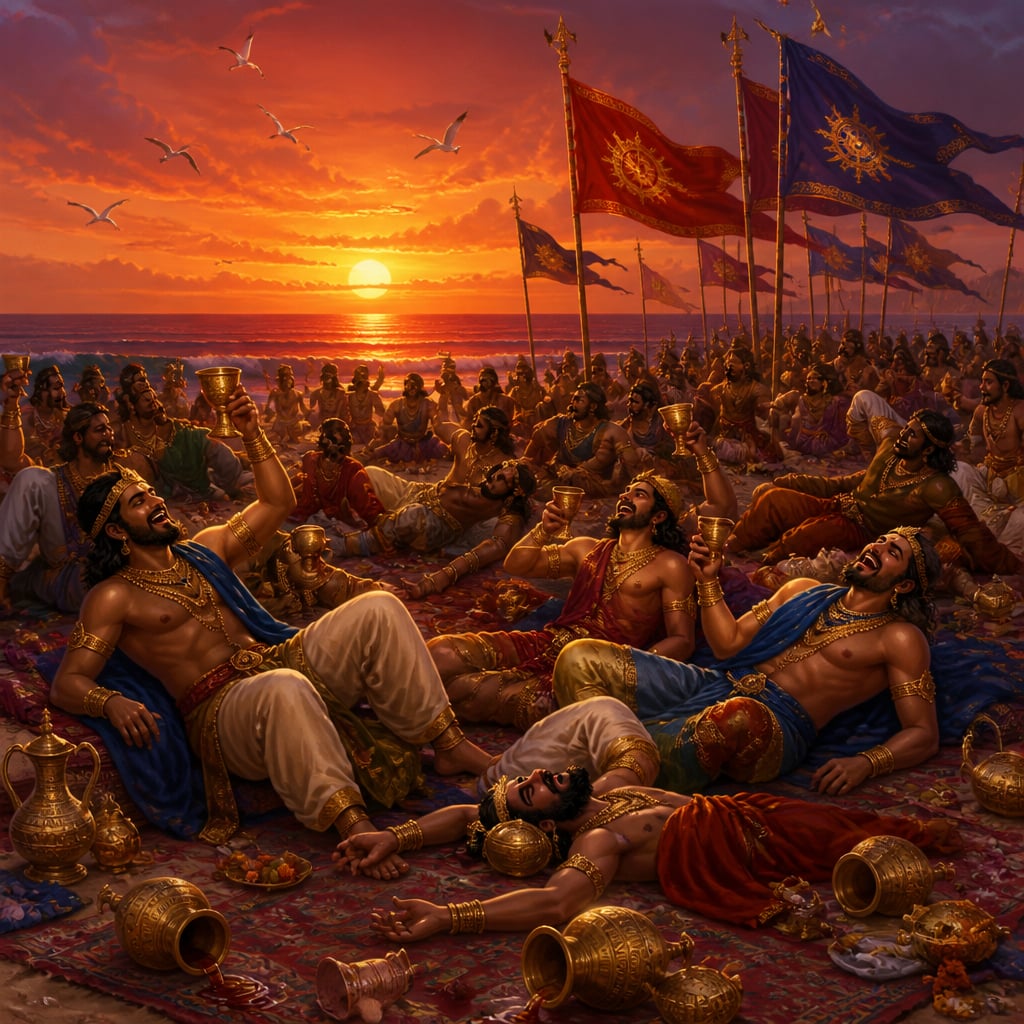
Hundreds of Yadava warriors gathered in drunken feast on the sands of Prabhasa at sunset.

Stage of Drinking Behavior Warning Signs
Early Songs, memories, camaraderie None apparent
Middle Boasting, competition, mild arguments Voices rising
Late Old grievances surfacing, insults Hands near weapons
Final Violence, no restraint Point of no return

The War That Never Ended

Among the heroes present were two whose enmity ran deeper than wine could dissolve: Satyaki and Kritavarma.

Satyaki, Yuyudhana, the Satvata warrior, had been Arjuna's closest companion at Kurukshetra. He had fought with terrible fury, killing hundreds, never wavering in his loyalty to the Pandava cause. He was proud, fierce, and possessed of a memory that never forgave.

Kritavarma, of the Bhoja clan, had fought on the same side during the great war, but his hands were stained with a different kind of blood. On the final night of the war, he had stood guard while Ashwatthama entered the Pandava camp and slaughtered sleeping warriors. The sons of Draupadi, the remnants of the Pandava army, all had died under Ashwatthama's sword while Kritavarma watched and did nothing.

Thirty-six years had passed, but Satyaki had never forgotten. And now, with wine burning in his veins, he saw Kritavarma laughing at some jest, and something snapped.

"Look at him," Satyaki said loudly, his voice cutting through the noise. "Kritavarma the brave! Kritavarma the mighty! Who guards the gates while children are murdered in their sleep!"

The laughter died. Heads turned. Kritavarma's face flushed with sudden rage.

The Accusation

"You dare speak to me of the night raid?" Kritavarma rose, his hand moving toward his sword. "I was following orders. I was loyal to my commander. What of your heroics, Satyaki? Did you not kill Bhurishravas when he sat unarmed in meditation? Did you not cut off his head while he had renounced fighting?"

"He had nearly killed me! Arjuna saved my life!"

"And you repaid that salvation by becoming a butcher of the defenseless!"

The two warriors faced each other, years of suppressed hatred suddenly visible. Around them, the other Yadavas began to take sides, some with Satyaki, some with Kritavarma, many simply eager for the confrontation they had long sensed was coming.

Krishna appeared between them, his presence somehow both calming and commanding.

"Brothers," he said quietly. "This is a sacred place. We came here for purification, not for the reopening of old wounds. Whatever grievances you carry, this is not the time, "

"Stay out of this, Krishna!" Satyaki's voice was thick with wine and rage. "Some of us remember who stood where during the war. Some of us remember who killed children in their beds!"

"And some of us remember who hides behind divine protection!" Kritavarma shouted back. "Who lets others do his killing while he plays the innocent!"

The insult was aimed at Krishna himself. The crowd gasped. Even in drunkenness, this was dangerous ground.

Krishna's face showed no anger, only a deep, terrible sadness.

"So be it," he said softly. "What must happen will happen."

And he stepped aside.

The First Blood

Satyaki striking Kritavarma at the Prabhasa feast

Later, no one could agree on who struck first. Some said Satyaki lunged at Kritavarma with a wine cup. Others said Kritavarma reached for a sword. But all agreed on what happened next.

Satyaki, with a warrior's reflexes that not even wine could fully dull, drew his blade in a single fluid motion and struck Kritavarma across the throat. The Bhoja hero fell, blood fountaining across the sand, dead before he hit the ground.

For one frozen moment, the Yadavas stared in disbelief. Then the Bhojas and Andhakas, Kritavarma's kinsmen, surged forward with a collective roar of fury.

"Murderer! Satvata dog! You'll pay for this!"

They fell upon Satyaki, who fought back with desperate skill. Krishna's son Pradyumna rushed to defend Satyaki, only to be cut down himself, killed by the very people who had sat at table with him moments before.

The curse had found its entry point.

The Grass That Kills

As the violence spread, something strange began to happen.

Weapons broke. Swords shattered against armor. Spears splintered. It was as if the instruments of war themselves refused to function properly. But the Yadavas' rage demanded outlets.

Warriors stumbled onto the beach, where thick clumps of eraka grass grew in the sandy soil. Without thinking, they grabbed handfuls of the sharp-edged reeds, and discovered that in their hands, common grass became deadlier than steel.

The eraka stalks, grown from the iron powder of the cursed pestle, cut through armor as if it were silk. Warriors who had survived Kurukshetra fell to weapons that should have been harmless. The beach turned red with blood.

"The grass!" someone screamed. "It's killing us!"

But by then, it was too late. The Yadavas were lost in a frenzy of mutual slaughter, beyond reason, beyond recognition of friend or foe. Brothers killed brothers. Fathers killed sons. The great houses that had stood united for generations tore each other apart with blades of cursed grass.

Victim Killer How They Fell
Kritavarma Satyaki Sword to throat
Pradyumna Andhakas Protecting Satyaki
Satyaki Unknown mob Overwhelmed by numbers
Aniruddha Fellow Yadavas Eraka grass
Gada Fellow Yadavas Eraka grass
Samba Fellow Yadavas Eraka grass

Krishna's Grief

Krishna watching his clan's self-destruction from a quiet rise

Krishna stood apart from the slaughter, watching his people destroy themselves.

He could have stopped it. Even now, a word from him, a display of divine power, might have frozen the combatants in their tracks. But he did not speak. He did not act. He watched, and in his watching was the weight of cosmic acceptance.

Balarama, his brother, fought beside him for a time, the great plough-wielding warrior dispatching attackers with the ease of long practice. But even Balarama's strength could not turn the tide. There were simply too many, and they were killing each other too quickly.

"Brother!" Balarama shouted over the chaos. "What madness is this? Our own people!"

"Gandhari's curse," Krishna replied, his voice carrying despite its quietness. "The sages' curse. All coming to fruition at once. This was always going to happen, Balarama. We could only choose when and where."

"And you chose here? At a sacred tirtha?"

"Better here than in Dwaraka, where the innocent might suffer. Here, at least, it is only the warriors. Only those whom the curse has claimed."

Balarama stared at his brother, comprehension dawning in his eyes.

"You knew. You knew all along. The pilgrimage, the gathering of the clans, you brought us here to die."

"I brought you here to complete what was destined. There is a difference, brother. A small one, perhaps, but a difference nonetheless."

The Sun Sets on Dwaraka's Glory

As evening fell over Prabhasa, the sounds of battle began to fade, not because the combatants had found peace, but because so few remained alive to fight.

The beach was carpeted with bodies. The great heroes of the Yadava nation, warriors who had made their name invincible, whose valor had never been questioned, lay tangled together in death. The tide lapped at the edges of the carnage, as if the sea itself hesitated to touch such pollution.

Here and there, survivors stumbled through the twilight, many wounded, all dazed. They looked at the destruction around them and could not comprehend what had happened. One moment they had been drinking and singing; the next, they were killing their own kin with fistfuls of grass.

What madness had possessed them?

But it was not madness. It was karma, taking its final shape. It was a mother's curse, spoken in grief, finding its fulfillment. It was a prank against sages, ripening into genocide.

Krishna walked among the dead, touching a face here, closing eyes there. His own sons lay among the fallen, Pradyumna and Samba, the child who had started it all with his foolish mockery. Even in death, Samba's face bore traces of the arrogance that had doomed his people.

"We were warned," Krishna murmured to no one in particular. "The signs were clear. But no one heeds signs who does not wish to see."

He turned to look for Balarama, but his brother had disappeared into the growing darkness.

The massacre at Prabhasa was over. But the dying was not yet complete.

Living traditions

The Prabhasa massacre resonates in contemporary discussions about conflict management, particularly how unresolved grievances can explode when inhibitions are lowered. Corporate trainers cite it when discussing workplace tensions; family counselors reference it when explaining why old resentments resurface at holiday gatherings. The lesson is universal: suppression is not resolution, and triggers are everywhere for the unprepared.

Reflection

More in Mausala Parva

All lessons in Mausala Parva ยท The Mahabharata course