Vaidyanath: The Divine Physician

Shiva as healer and Ravana's extraordinary sacrifice

Understand the concept of Shiva as Vaidyanath - the Divine Physician. Learn the extraordinary story of Ravana's devotion: how he offered his ten heads one by one to please Shiva, and how Shiva appeared as a healer (Vaidya) to restore them.

The Demon Who Moved a God

In the annals of Hindu mythology, no devotee presents a greater paradox than Ravana. The demon king who would later become Rama's nemesis was, in his earlier life, Shiva's most fervent worshipper. The story of how Shiva became Vaidyanath, the Divine Physician, begins not with a saint's gentle prayer, but with a demon's terrifying sacrifice.

Ravana, grandson of the creator-god Brahma and king of the golden city of Lanka, possessed everything: wealth, power, scholarly brilliance, and physical prowess. Yet he yearned for more, he wanted Shiva himself, wanted to take the Lord to Lanka, to possess divine presence as he possessed everything else. This desire would lead him to perform austerities so extreme that they shook the very heavens.

Ten Heads, Ten Offerings

At a sacred site in the forests of what is now Jharkhand, Ravana began his terrible tapas. For years, he meditated, performed yagnas, and chanted Shiva's names. But Shiva remained unmoved. What offering could compel the attention of the Lord who needs nothing?

Ravana found his answer in the ultimate sacrifice, himself.

Using a sword, he severed his own head and offered it into the sacred fire. But Ravana possessed ten heads, a boon from Brahma that symbolized his mastery of the four Vedas and six Shastras. When one head fell, another remained. Day after day, he continued his gruesome offering. Nine heads he sacrificed, the blood of each feeding the flames.

As Ravana raised his sword to sever the tenth and final head, the one whose loss would mean death itself, Shiva appeared.
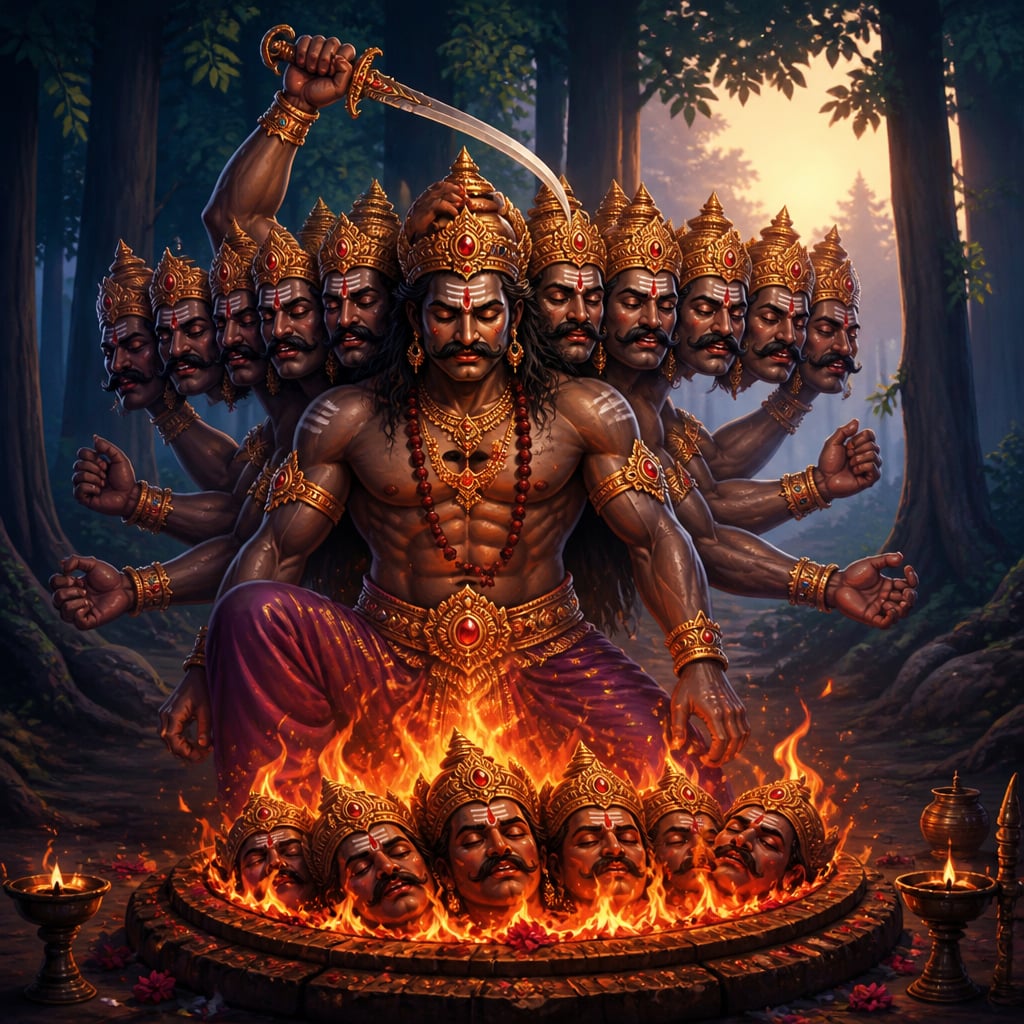
Ravana raising his sword over the tenth head before a tapas fire in the Jharkhand forest

The Healer Emerges

The Lord who had witnessed countless acts of devotion had never seen anything like this. Here was a devotee willing to destroy himself utterly, not for liberation, not for boons, but simply to gain Shiva's attention. The sincerity of this terrible devotion moved even the immovable Mahadeva.

Shiva as Vaidyanath restoring Ravana's heads

Shiva stopped Ravana's hand and did something remarkable: he healed the demon. One by one, he restored the nine severed heads, making Ravana whole again. In this moment, Shiva revealed himself as Vaidya, the physician, the healer, and thus became known as Vaidyanath, the Lord of Physicians.

The name carries profound meaning. "Vaidya" derives from "vid" (to know), connecting healing to knowledge. A true physician doesn't merely treat symptoms but understands the root cause of suffering. Vaidyanath is Shiva as the ultimate healer, one who can restore not just bodies but souls, not just health but wholeness.

The Paradox of Healing

This mythology presents a troubling question: Why would Shiva reward such violent devotion from a being who would later commit great adharma? The answer lies in understanding what the story actually teaches.

Shiva's healing of Ravana is not an endorsement of his future actions. It is a demonstration of a profound truth: divine grace responds to intensity of devotion, not to the devotee's moral record. The rain falls on both the garden and the wasteland. The sun illuminates both temple and tavern. Divine healing is not a moral judgment but a response to genuine surrender.

Ravana's tragedy is that he sought to possess Shiva rather than transform through Shiva. He was healed physically but remained spiritually ill, his ego intact, his desires unextinguished. The ultimate healing Vaidyanath offers is liberation from the very self that seeks to possess, but Ravana refused this deeper cure.

Shiva Tattva: Healing as Dissolution

Ash-smeared Shiva in a cremation ground teaching dissolution

The Vaidyanath teaching reveals a distinctive aspect of Shiva's nature: healing through dissolution. Where other healing traditions focus on restoration and strengthening, Shaiva philosophy understands that true healing often requires the destruction of what seems essential.

Ravana's heads represented his accumulated knowledge, his intellectual pride, his multiple competencies. By offering them, he symbolically surrendered these identities. Shiva's healing didn't simply restore what was lost, it transformed the meaning of what remained.

This is the paradox at the heart of Vaidyanath worship: the Divine Physician heals by taking away. He removes the diseased attachment, the inflamed ego, the infected desire. What feels like loss is actually cure. What seems like death is actually the beginning of true life.

The ash-smeared Lord who dwells in cremation grounds knows something about healing that modern medicine has forgotten: sometimes the only way to heal is to let something die. The patient who clings to their sickness, who identifies with their wound, who builds their identity around their suffering, this patient cannot be healed until they surrender what has become precious: the illness itself.

The Multiple Claimants

The power of the Vaidyanath legend is so great that multiple sites claim to be the original location where Ravana performed his sacrifice. The primary claimant is Baidyanath Dham in Deoghar, Jharkhand, one of India's most visited pilgrimage sites. But Vaijnath in Parli, Maharashtra and Baijnath in Kangra, Himachal Pradesh also stake ancient claims.

This multiplicity is itself instructive. The healing power of Vaidyanath cannot be contained in a single location because the need for healing is universal. Every place where sincere devotees have sought Shiva's healing presence has become, in some sense, a Vaidyanath shrine. The geographical debates, which we will explore in later lessons, ultimately point to a deeper truth: Vaidyanath is wherever suffering meets surrender.

For now, what matters is the teaching: Shiva heals. He heals the demon as readily as the saint, the villain as thoroughly as the hero. His healing is not reward but response, the natural outcome when intense devotion meets infinite compassion.

Key figures

Vaidyanath

Shiva in his aspect as the Divine Physician and Lord of Healing

Ravana

King of Lanka; Brahma's grandson; the demon devotee whose sacrifice led to Shiva's manifestation as Vaidyanath

Shakti (Sati's heart)

The divine feminine energy; at Vaidyanath, represented through the Shakti Peetha where Sati's heart is said to have fallen

Historical context

Ancient (Puranic period, codified c. 300-1000 CE)

The Vaidyanath legend emerges from a period when Shaivism was becoming a major devotional movement. The story of Ravana's devotion served to demonstrate that Shiva's grace transcends moral categories, even demons could be devoted, even villains could be healed. This inclusive theology helped Shaivism appeal across social boundaries.

The Vaidyanath teaching offers a distinctive approach to healing: sometimes transformation requires destruction, and divine grace responds to devotional intensity rather than moral perfection. In an age of therapeutic spirituality, this challenges comfortable assumptions. True healing may demand surrender of what we think we need.

Living traditions

The Vaidyanath tradition continues to influence Indian healthcare philosophy. Many Ayurvedic practitioners begin their day with Vaidyanath prayers, acknowledging that true healing comes from beyond human skill. Modern integrative medicine's recognition that healing involves mind, body, and spirit echoes what the Vaidyanath tradition has taught for millennia.

Reflection

More in Vaidyanatha Vivada: The Healer and The Debates

All lessons in Vaidyanatha Vivada: The Healer and The Debates ยท The Twelve Jyotirlingas course