Nageshwar Vivada: The Location Debate
Dwarka, Aundha Nagnath, and Jageshwar - three claimants to one jyotirlinga
The Nageshwar Jyotirlinga faces a three-way dispute remarkably similar to Vaidyanath's. Explore Dwarka (Gujarat), Aundha Nagnath (Maharashtra), and Jageshwar (Uttarakhand). Discover how the 'lost forest' of Darukavana and textual variations created this geographical puzzle.
The Lost Forest
If you search for the Nageshwar Jyotirlinga, your map will show a temple near Dwarka in Gujarat. This is the site most pilgrims visit, included in standard twelve-jyotirlinga circuits. But scholarly tradition and two other ancient temples raise a question that cannot be easily resolved: Where was the original Nageshwar?
The mystery centers on a single Sanskrit word: Darukavana. The texts say Nageshwar manifested in the "forest of Daruka" (or "Dāruka"). But no such forest exists today by that name. The original location has been lost to time, leaving multiple sites to claim the title based on different interpretations of where Darukavana might have been.
This lesson explores all three claimants, Nageshwar near Dwarka, Aundha Nagnath in Maharashtra, and Jageshwar in Uttarakhand, each with its own textual, archaeological, and devotional evidence.
The Darukavana Legend
Before examining the claimants, let's understand the mythology they share.
In ancient times, a demon named Daruka terrorized the earth. With his wife Daruki, he had obtained a boon from Parvati that made him nearly invincible. He and his followers established a stronghold in a forest that came to bear his name, Darukavana.
A devoted couple, Supriya (a merchant's wife) and her husband, were captured by Daruka's forces and held prisoner in this forest. Despite her captivity, Supriya continued her daily Shiva worship, creating a linga from earth and offering prayers. When Daruka discovered this defiance, he moved to kill her.
At that moment, Shiva himself emerged from the makeshift linga, destroying Daruka and liberating the devotees. Because he emerged to protect his worshippers from the serpent-like demon, Shiva became known as Nageshwara, Lord of Serpents, or Lord who conquered the Naga/serpent demon.
The question is: where did this happen?
Nageshwar, Gujarat: The Popular Choice
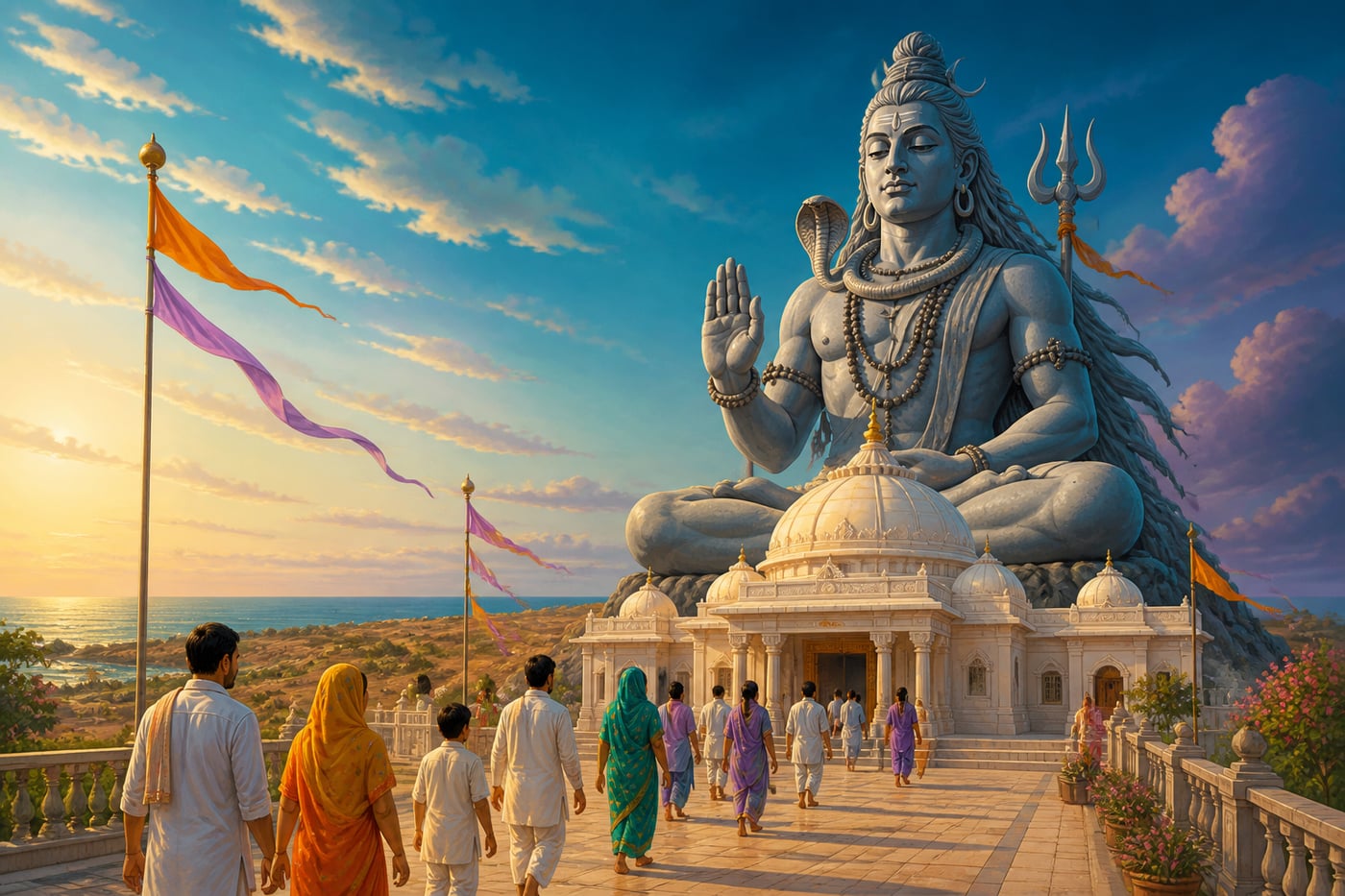
On the road between Dwarka and the Bet Dwarka island, approximately 15 kilometers from the sacred city of Krishna, stands the Nageshwar Temple. This is the site most Hindus recognize as the Nageshwar Jyotirlinga.
The Arguments For:
Proximity to Dwarka: Some manuscript variations read "Dwarakavane" instead of "Darukavane", "in the forest of Dwarka" rather than "in the forest of Daruka." If this reading is original, the Gujarat location fits perfectly.
Popular Recognition: Millions of pilgrims visit Nageshwar as part of the Dwarka pilgrimage circuit. This democratic validation carries weight in Hindu tradition.
Temple Development: The site features a massive 25-meter Shiva statue (one of the tallest in India) and well-developed facilities, reflecting its status as a major pilgrimage destination.
The Arguments Against:
Recent Prominence: The current temple structures date primarily to the 20th century, with significant development in recent decades. Critics suggest the site's prominence is modern rather than ancient.
No "Forest": The Dwarka region is arid, with little evidence of ever having been forested. The "Darukavana" would have been a dense forest, did one exist here?
Textual Questions: The "Dwarakavane" reading may be a later scribal error or deliberate change to support Gujarat's claim.
Aundha Nagnath, Maharashtra: The Forest Claim
In the Hingoli district of Maharashtra stands one of the oldest temples in the region, Aundha Nagnath. Local tradition claims this temple is 3,000 years old, and it presents a compelling case for Nageshwar authenticity.
The Arguments For:
The Original Darukavana: The region around Aundha was historically forested. Ancient texts describe the Vidarbha and Marathwada regions as dense forests in earlier ages. This geography matches the "Darukavana" description better than arid Gujarat.
Archaeological Age: The temple shows architectural features dating to the 6th-7th century CE, with possible earlier foundations. This antiquity exceeds documented history at the Dwarka site.
Maharashtra Recognition: The Maharashtra government includes Aundha Nagnath in its five-jyotirlinga circuit, giving it official state recognition.
The Unique Linga: The linga at Aundha is partially underground, with only its top visible, a characteristic often associated with ancient, naturally-occurring lingas rather than installed ones.
The Arguments Against:
Less Popular: Aundha Nagnath sees far fewer pilgrims than Dwarka's Nageshwar, and popular recognition matters in Hindu tradition.
Regional Claim: Critics suggest Maharashtra promotes Aundha as a jyotirlinga for regional pride rather than historical accuracy.
Jageshwar, Uttarakhand: The Himalayan Option

In the deodar forests of Kumaon, at an elevation of 1,870 meters, sits one of the most atmospheric temple complexes in India: Jageshwar. Over 100 temples, some dating to the 7th century CE, cluster along a stream beneath ancient trees.
The Arguments For:
The Name: "Jageshwar" is etymologically related to "Nageshwar", both mean "Lord of Serpents" (jāga = serpent in some dialects). The preservation of the serpent-lord name suggests original connection.
The Forest Setting: Unlike Dwarka, Jageshwar actually sits in a forest, dense deodar woods that could plausibly be described as "Darukavana." The setting matches the mythology.
Archaeological Depth: The Jageshwar complex contains temples from the 7th-14th centuries CE, demonstrating continuous worship across many centuries.
The Naga Tradition: The Kumaon region has strong serpent-worship traditions predating Hindu influence. A Nageshwar temple here would represent synthesis with indigenous Naga cults.
The Arguments Against:
Least Textual Support: No manuscript tradition explicitly names Jageshwar as Nageshwar. The claim rests primarily on the name similarity and forest setting.
Distance from Standard Routes: Jageshwar's remote Himalayan location made it less accessible to pan-Indian pilgrimage circuits, limiting its recognition.
The Textual Confusion
The core of the dispute lies in a single syllable: Da-ru-ka versus Dwa-ra-ka.
In Sanskrit manuscripts, the difference between 'd' and 'dw' can be ambiguous depending on the script and the scribe's handwriting. Over centuries of copying, "Darukavane" could become "Dwarakavane" or vice versa. Which was original?
Textual scholars offer no consensus:
Some argue "Darukavana" is original because it connects to the demon Daruka's story, providing narrative coherence.
Others argue "Dwarakavana" is original because Dwarka is a major tirtha where jyotirlinga manifestation would be expected.
Still others suggest both readings are ancient, reflecting regional traditions that developed independently.
The honest answer: we don't know. The original reading cannot be recovered with certainty.
The Pattern Emerges
By now, a pattern should be clear. Nageshwar, like Vaidyanath, faces a three-way dispute with no definitive resolution. Both disputes share common features:
Textual ambiguity: Ancient manuscripts contain variations that support different locations.
Lost geography: Place names (Chidabhoomi, Darukavana) no longer map to current locations.
Multiple valid traditions: Each claimant has genuine antiquity, living devotion, and regional recognition.
No central authority: No institution exists to definitively adjudicate jyotirlinga authenticity.
This pattern suggests that such disputes are structural features of Hindu sacred geography, not aberrations to be resolved. The tradition expects and accommodates them.
Shiva Tattva: Protection of Devotees
All three Nageshwar claimants share the same teaching: Shiva emerges to protect his devotees. Supriya, imprisoned by demons, continued her worship despite mortal danger, and Shiva came.

This Shiva Tattva is practical: genuine devotion receives divine protection, regardless of circumstances. The devotee need not be in a temple, need not have proper materials, need not be free. Supriya made a linga from prison-floor earth and worshipped. Shiva responded.
The teaching challenges comfortable religion. It says that devotion practiced under difficulty, in hospitals, in prisons, in hostile environments, may be more powerful than devotion practiced in comfort. Shiva became Nageshwar not in a gold-plated temple but in a demon's dungeon.
For the Pilgrim Today
If seeking the "official" Nageshwar: Dwarka's Nageshwar is most widely recognized. Its proximity to Krishna's city makes it easy to include in Gujarat pilgrimage. The massive Shiva statue and modern facilities make for a comfortable visit.
If seeking antiquity and forest atmosphere: Aundha Nagnath offers something the Gujarat site cannot, a genuine sense of age and the feeling of worship continuing from deep antiquity. The partially-buried linga creates a distinctive darshan experience.
If seeking natural beauty and temple complexity: Jageshwar in the Kumaon hills offers the most atmospheric setting, ancient deodar forests, mountain streams, and over 100 temples. Whether or not it's "the" Nageshwar, it's an extraordinary sacred site.
The integrative approach: Visit all three. Each offers a different flavor of Nageshwar worship. Gujarat's modern pilgrimage energy, Maharashtra's ancient earthiness, Uttarakhand's forest mysticism, together they reveal different faces of the Lord who protects his devotees from serpent-demons.
Key figures
Nageshwar
Shiva in his aspect as Lord of Serpents and Protector of Devotees; the deity worshipped at all three claimant temples
Daruka
The demon whose forest stronghold became the site of Nageshwar's manifestation; Shiva's opponent in the Nageshwar legend
Supriya
The merchant's wife who maintained Shiva worship while imprisoned by Daruka; her devotion triggered Nageshwar's manifestation
Historical context
Multiple periods (documented from 7th century CE onwards; mythological origins in Tretā Yuga)
The three Nageshwar claimants emerged in different regional contexts: Gujarat's maritime and trading culture shaped Dwarka's Nageshwar; Maharashtra's Deccan heritage shaped Aundha; Uttarakhand's mountain Shaivism shaped Jageshwar. Each site reflects its region's distinctive approach to Shiva worship.
The Nageshwar debate demonstrates that jyotirlinga geography is alive, contested, and productive of multiple valid traditions. Rather than viewing this as a problem, we can see it as demonstrating Shiva's presence at multiple sites, his devotees' regional creativity, and the Hindu tradition's capacity to hold multiple truths simultaneously.
Living traditions
The three Nageshwar sites demonstrate different aspects of Hindu pilgrimage in the modern era. Dwarka's Nageshwar shows how sites can develop rapidly with modern infrastructure and tourism; Aundha Nagnath preserves ancient atmosphere despite lower visitor numbers; Jageshwar maintains the forest setting that may have been original to all Nageshwar sites. Together, they represent the diversity and resilience of Hindu sacred geography.
- Nageshwar Abhisheka for Snake-bite Protection: Devotees perform special abhisheka (ritual bathing of the linga) seeking Nageshwar's protection from snakebites and serpent-related dangers. This is particularly popular in rural areas where snakebite is a genuine hazard.
- Nag Panchami at Nageshwar Sites: The festival of Nag Panchami (worship of serpents, in Shravan month) is celebrated with special intensity at all Nageshwar temples. Live snakes may be worshipped, milk is offered, and devotees seek the blessing of serpent deities.
- Jageshwar Monsoon Pilgrimage: The monsoon season brings special pilgrims to Jageshwar, when the deodar forest is lush, streams are full, and the atmosphere most closely resembles the mythological 'Darukavana.' This seasonal pilgrimage emphasizes the forest setting.
- Nageshwar Jyotirlinga Temple, Dwarka: The most visited Nageshwar site, featuring a massive 25-meter Shiva statue and modern pilgrimage facilities. Part of the Dwarka-Bet Dwarka pilgrimage circuit.
- Aundha Nagnath Temple: Ancient temple claiming 3000-year history, with partially underground linga. Part of Maharashtra's five-jyotirlinga circuit. Less visited but more atmospheric than Dwarka.
- Jageshwar Temple Complex: Over 100 temples in a stunning deodar forest setting at 1,870 meters elevation. The only Nageshwar claimant actually situated in a forest. Archaeological treasure and spiritual retreat.
Reflection
- Supriya maintained her worship in a demon's prison using only earth from the floor. Most of us have far more resources but may practice less consistently. What does her example reveal about the relationship between external circumstances and inner devotion? What's your excuse?
- The Nageshwar dispute, like the Vaidyanath dispute, seems unlikely to ever be resolved. Both have lasted centuries with no resolution in sight. What does it mean that Hindu tradition has functioned perfectly well without resolving them? What would be lost if someone did definitively resolve them?
- Daruka had obtained divine protection through worship of Parvati, he was, in his own way, a devotee. Yet Shiva destroyed him. What distinguishes devotion that protects from devotion that is destroyed? Can you think of examples where 'religious' people or practices were themselves the oppressors?