Anya Davedara: The Other Claimants

Parli and Baijnath - competing traditions, shared devotion

Deoghar is not alone in claiming the Vaidyanath title. Explore the ancient temples at Parli (Maharashtra) and Baijnath (Himachal Pradesh), each with compelling textual and traditional evidence. Learn why these 'disputes' ultimately enrich rather than diminish the tradition.

When Many Claim the Same Name

In the previous lessons, we visited Baidyanath Dham in Deoghar as if it were the undisputed Vaidyanath Jyotirlinga. For most pilgrims, it is. But scholarship and regional tradition tell a more complex story.

Two other ancient temples claim the title with equal conviction: Vaijnath in Parli, Maharashtra, and Baijnath in Kangra district, Himachal Pradesh. Each has textual evidence, archaeological depth, and living devotional traditions. Each considers itself the authentic site of Shiva's manifestation as the Divine Physician.

Rather than declare a winner, which would be both presumptuous and spiritually beside the point, this lesson explores all three claimants. The disputes themselves teach us something important about how Hindu tradition works: not through papal decree or council vote, but through the organic growth of regional devotion around shared symbols.

The Textual Puzzle
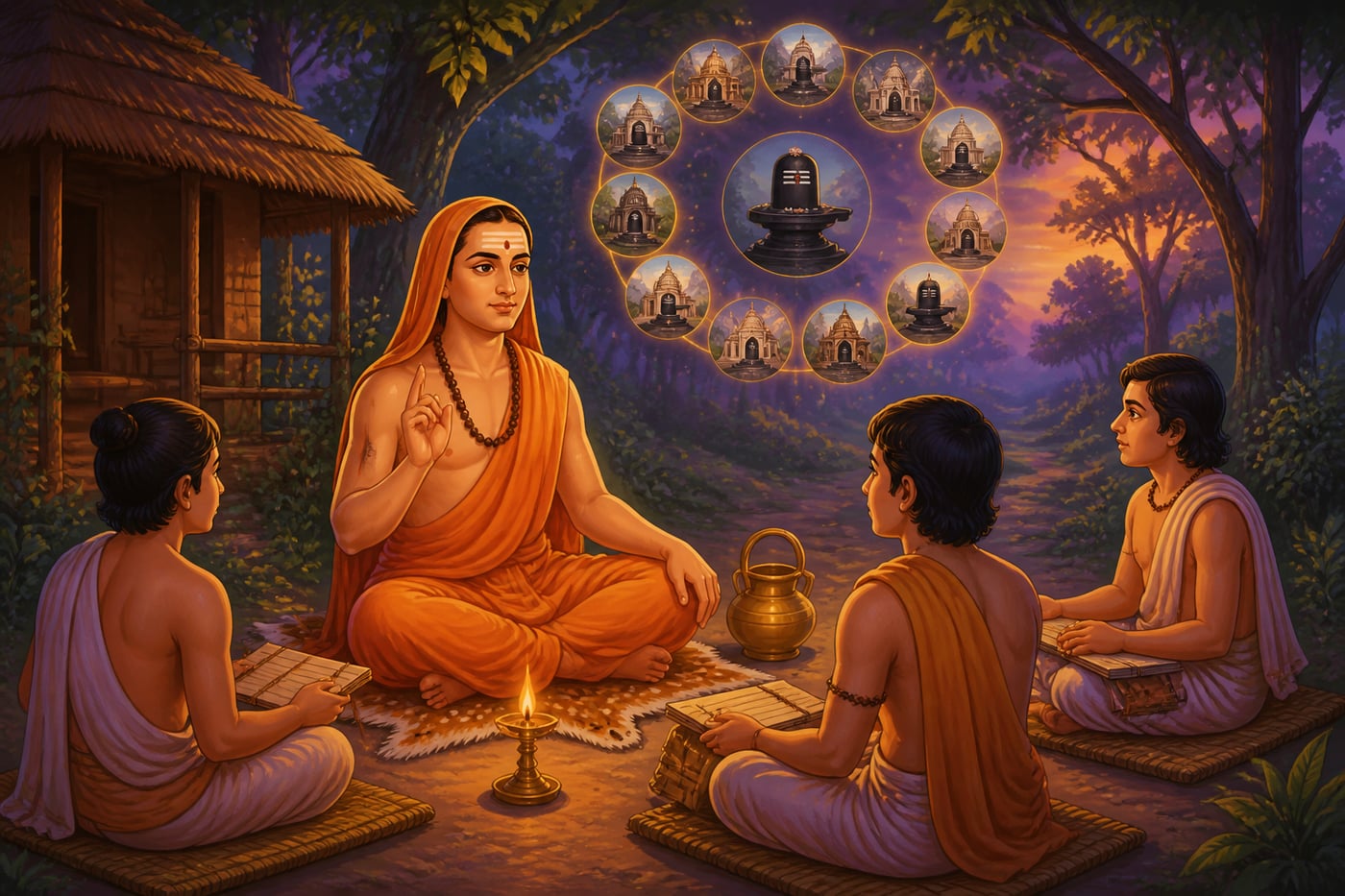
Adi Shankaracharya composing the Dwadasha Jyotirlinga Stotra

The primary source for the twelve jyotirlingas is the Dwadasha Jyotirlinga Stotra, traditionally attributed to Adi Shankaracharya. The verse describing Vaidyanath reads:

"Pūrvottare prajvalikā-nidhāne..."

But which "northeast" (pūrvottara)? From where? The subcontinent's center? A specific region? The ambiguity has enabled multiple interpretations.

More problematically, different manuscript traditions of the stotra contain variations. Some read "परल्यां वैद्यनाथं च" (Parlyāṃ Vaidyanāthaṃ ca), "Vaidyanath at Parli", explicitly naming the Maharashtra site. Others omit this geographical specification. Textual scholars debate which represents the original.

The Shiva Purana refers to the jyotirlinga appearing in "Chidabhoomi," which Deoghar claims matches its ancient name. But the same text uses forest names (Darukavana) and regional descriptions that other sites also claim.

This is the reality of ancient Sanskrit textual transmission: manuscripts copied over centuries in different regions develop variations. No single "original" can be definitively established. The tradition has always been plural.

Vaijnath: Parli's Claim

In the Beed district of Maharashtra stands Vaijnath Temple at Parli, often called Parli Vaijnath. The temple sits on a small hill, its shikhara visible across the surrounding farmland. This site claims to be the original Vaidyanath based on several arguments:

The Textual Argument: Manuscripts that include "Parlyāṃ" explicitly name this location. If Adi Shankaracharya did compose the stotra (and this is debated), he traveled through Maharashtra, making a reference to this region plausible.

The Ravana Connection: Local tradition holds that this is where Ravana's penance occurred. The temple complex includes a stone said to mark where Ravana performed his tapas. The surrounding landscape, somewhat isolated, conducive to severe austerity, fits the mythological requirements.

Archaeological Depth: The current temple dates to the 12th-13th century CE, built during the Yadava dynasty period. But inscriptions and archaeological evidence suggest worship at this site extends back much earlier, possibly to the 6th century CE or before.

The Linga Characteristics: The Vaijnath linga is described as swayambhu (self-manifested), naturally emerging from the earth rather than being installed by human hands, a characteristic claimed by all genuine jyotirlingas.

Parli Vaijnath Temple in Maharashtra with a priest performing abhishekam on the swayambhu Shiva linga

The Maharashtra government officially recognizes Parli Vaijnath as a jyotirlinga, and it's included in the state's pilgrimage circuit alongside Trimbakeshwar, Bhimashankar, Grishneshwar, and Aundha Nagnath.

Baijnath: The Himalayan Claim

Baijnath Temple in the Kangra Valley under Himalayan peaks

In the Kangra Valley of Himachal Pradesh, surrounded by snow-capped peaks and pine forests, stands Baijnath Temple. This site's claim is based on different evidence:

The Name Argument: "Baijnath" is linguistically identical to "Vaidyanath", both derive from "Vaidya" (physician) + "Nath" (Lord). The phonetic evolution from Vaidyanath to Baijnath follows standard patterns of Hindi/Pahari linguistic development.

The Ancient Tradition: The current temple was built in 1204 CE by two merchants, Ahuka and Manyuka, but inscriptions indicate they were building over an existing sacred site. Local tradition claims Shiva worship here extends to time immemorial, literally, "since the beginning."

The Nagara Style: Baijnath Temple is one of the finest examples of North Indian Nagara temple architecture, featuring intricate stone carvings that place it among medieval India's architectural treasures. The artistic investment suggests this was not a minor shrine but a site of major religious significance.

The Pahari Tradition: In the religious geography of the Himachal-Uttarakhand region, Baijnath holds special status. The temple is associated with both Shiva and the goddess (as Parvati), reflecting the mountain region's distinctive Shakta-Shaiva synthesis.

Notably, Baijnath's claim has less textual support than either Deoghar or Parli, no manuscript tradition explicitly names this location. But the argument from continuous tradition is powerful: the name itself, preserved over millennia, testifies to the site's Vaidyanath identity.

Why Multiple Claimants?

How did three different temples come to claim the same jyotirlinga? Several factors contribute:

The Nature of Oral Tradition: Before printing standardized texts, sacred geography was transmitted orally, with regional variations developing naturally. A pilgrimage tradition centered in Maharashtra would know Parli; one centered in the Gangetic plain would know Deoghar; one in the Himalayas would know Baijnath.

The Politics of Sacred Geography: Royal patronage shaped temple importance. When a king patronized a temple and declared it a jyotirlinga, that declaration carried weight within his kingdom. Different dynasties promoted different sites.

The Theological Possibility: From a Shaiva philosophical perspective, there's nothing preventing Shiva from manifesting at multiple locations simultaneously. The jyotirlingas are not historical artifacts with single origins but living presences of divine consciousness. Why should that consciousness be limited to one spot?

The Pilgrimage Economics: Major pilgrimage sites bring economic benefits to their regions. The motivation to claim jyotirlinga status has never been purely spiritual, though this doesn't mean the spiritual significance is false, only that multiple factors interact.

The Resolution That Isn't

Scholars have proposed various resolutions: Deoghar is "most authentic" based on the Chidabhoomi reference; Parli has stronger textual support through the "Parlyāṃ" manuscripts; Baijnath represents an independent Himalayan tradition deserving separate recognition.

But these attempts at resolution miss the point. Hindu tradition has never operated through centralized authority declaring single truths. It operates through paramparā, transmission from teacher to student, parent to child, region to region. In this model, multiple traditions can coexist, each valid within its context.

The Vaidyanath "dispute" is not a problem to be solved but a feature of how living traditions work. The devotee in Maharashtra goes to Parli; the devotee in Jharkhand goes to Deoghar; the devotee in Himachal goes to Baijnath. Each receives Vaidyanath's darshan. Each is blessed. The blessing doesn't diminish because another temple makes the same claim.

Shiva Tattva: The Omnipresent Healer

The multiple Vaidyanath claims point to a distinctive Shiva Tattva: Shiva is not located in space. The jyotirlinga mythology begins with Brahma and Vishnu's failure to find Shiva's top or bottom, because the pillar of light extended infinitely. The teaching is clear: Shiva cannot be bounded.

If Shiva cannot be bounded, why should Vaidyanath be limited to a single temple? The Divine Physician's healing presence extends wherever devotees seek it with sincere hearts. Deoghar, Parli, and Baijnath are not competitors but manifestations, different access points to the same infinite reality.

This is challenging for minds trained in exclusivist logic (either/or). Hindu theology often operates in inclusivist logic (both/and). Both Deoghar AND Parli AND Baijnath can be genuine Vaidyanath jyotirlingas because Vaidyanath himself is not subject to the limitations that would make this contradiction.

For the Pilgrim

What does this mean practically for someone planning pilgrimage?

If seeking "the" Vaidyanath: Deoghar is most popular and most widely recognized. The Shravan Mela makes it an extraordinary experience. Most pilgrim circuits treat Deoghar as the official site.

If in Maharashtra: Parli Vaijnath is included in the state's jyotirlinga circuit. Visiting it alongside Trimbakeshwar, Bhimashankar, Grishneshwar, and Aundha Nagnath creates a powerful regional pilgrimage.

If in the Himalayas: Baijnath Temple is a gem of medieval architecture in a stunning mountain setting. Whether or not it's "the" Vaidyanath, it's an ancient and powerful Shiva site worth visiting.

The sophisticated approach: Visit all three. Recognize that each offers a distinct flavor of Vaidyanath darshan. The debates among scholars need not constrain the pilgrim's journey. Shiva is present wherever sincere devotion meets ancient tradition.

Key figures

Adi Shankaracharya

8th-century philosopher-saint traditionally credited with composing the Dwadasha Jyotirlinga Stotra

Ahuka and Manyuka

12th-century merchant brothers who rebuilt Baijnath Temple in its current form (1204 CE)

Yadava Dynasty

Medieval dynasty (12th-14th century CE) that ruled the Deccan and patronized Vaijnath Temple at Parli

Historical context

Multiple periods (6th century CE onwards for all three sites)

The three Vaidyanath temples emerged in different political and cultural contexts. Baijnath reflects the Himalayan Shaiva-Shakta synthesis; Parli reflects Deccan Shaivism under Yadava patronage; Deoghar reflects the Gangetic pilgrimage tradition. Each site absorbed regional influences while maintaining connection to the shared Vaidyanath mythology.

In an age of centralization and standardization, the Vaidyanath tradition offers an alternative model: unity through shared devotion rather than imposed uniformity. The three temples disagree about which is 'original' but agree completely on who Vaidyanath is and what he offers. Essence unifies; particulars diversify.

Living traditions

The three Vaidyanath claimants represent different models of sacred authority. Deoghar demonstrates the power of popular recognition, millions of pilgrims vote with their feet. Parli shows regional authority, state recognition within its domain. Baijnath illustrates traditional continuity, the name and practice maintained across centuries. Each model has validity; together they demonstrate that Hindu tradition is not monolithic but pluralistic.

Reflection

More in Vaidyanatha Vivada: The Healer and The Debates

All lessons in Vaidyanatha Vivada: The Healer and The Debates · The Twelve Jyotirlingas course