Deoghar: Heart of Sati
Baidyanath Dham - jyotirlinga and Shakti Peetha
Visit Baidyanath Dham in Deoghar, Jharkhand - the most popular Vaidyanath claimant. Explore the ancient name 'Chidabhoomi', why it's also a Shakti Peetha (where Sati's heart fell), and the famous Shravan Mela when millions walk barefoot carrying Ganga water.
Where Gods Make Their Home
In the ancient forests of Jharkhand, where the Santhal and Mundari peoples have worshipped nature spirits since time immemorial, stands one of India's most powerful pilgrimage sites. The town is called Deoghar, literally "the abode of gods" (deva-griha). At its heart lies Baidyanath Dham, the temple complex that most Hindus recognize as the true Vaidyanath Jyotirlinga.
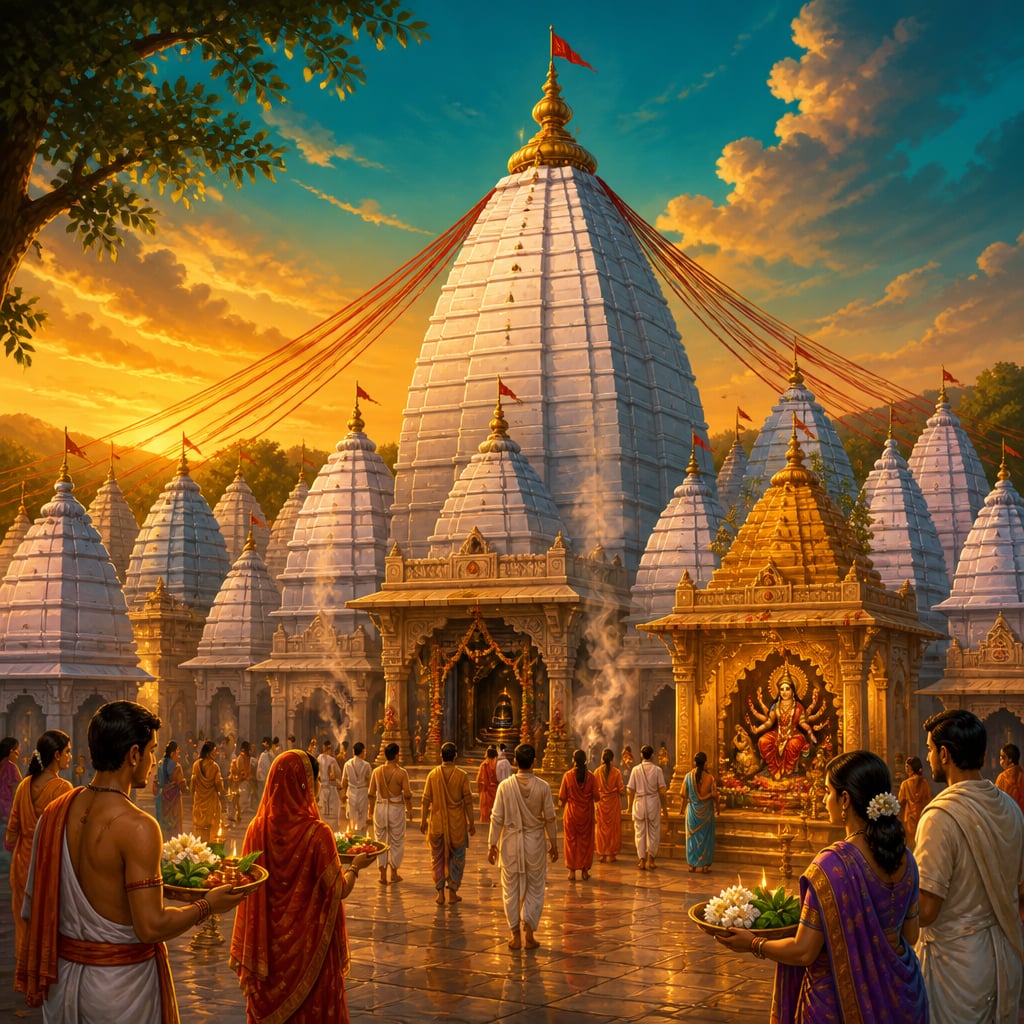
But Deoghar holds a secret that makes it rare among the twelve jyotirlingas: this is also one of the 51 Shakti Peethas, where a part of the goddess Sati's body fell to earth. Here, it was her heart. In only a few places do the masculine and feminine divine principles, Shiva and Shakti, consciousness and energy, unite so completely. This dual identity shapes everything about the temple's traditions, its power, and its millions of devotees.
The Ancient Name: Chidabhoomi
The oldest texts refer to this place not as Deoghar but as Chidabhoomi, the land of consciousness (cit = consciousness, bhūmi = land). This name reveals the philosophical understanding of what Vaidyanath represents here.
"Chit" or "Cit" is the Sanskrit term for pure awareness, the unchanging consciousness that witnesses all experience. In Shaiva philosophy, Shiva is Chit itself: not a being who has consciousness, but consciousness itself. The land where Shiva manifested as the Divine Physician is therefore the land of consciousness, the place where pure awareness touches the earth.
This etymology supports Deoghar's claim to be the original Vaidyanath. The Shiva Purana describes the jyotirlinga appearing in "Chidabhoomi," and Deoghar's ancient name matches this description precisely. While other claimants have their own textual evidence, this geographical correspondence is central to Deoghar's authority.
Heart of the Goddess
The story of the Shakti Peethas begins with tragedy. Sati, Shiva's first wife and daughter of the creator Daksha, immolated herself when her father insulted Shiva. Grief-stricken, Shiva picked up her burning body and began his terrible Tandava, the dance of destruction that threatened to unmake the cosmos.

To save creation, Vishnu used his Sudarshana Chakra to cut Sati's body into pieces, which fell across the Indian subcontinent. Where each piece landed, a Shakti Peetha arose. At Deoghar, Sati's heart fell to earth.
The symbolism is profound. The heart is the seat of love, the center of emotional being. That Sati's heart landed where Shiva manifested as healer suggests an intrinsic connection between healing and love. Vaidyanath heals not through cold clinical intervention but through the heart's power, the same heart that Sati offered in her ultimate sacrifice.
At Baidyanath Dham, the goddess is worshipped as Jai Durga in a separate temple adjacent to the main shrine. Pilgrims must visit both, the jyotirlinga of Shiva and the Shakti Peetha of the goddess, for their pilgrimage to be complete. One without the other is half a journey.
The Temple Complex
Baidyanath Dham is not a single temple but a complex of 22 temples, each with its own deity and significance. The main temple houses the Vaidyanath linga, a naturally occurring stone that rises about five inches above the floor, constantly bathed in water and offerings.
The temple's architecture reflects waves of reconstruction over millennia. The current structure dates primarily to the 18th century, rebuilt by the kings of the Gidhaur estate after earlier structures were damaged. But excavations reveal temple remains going back at least to the 7th century CE, and devotional activity at the site is certainly older still.
Unique to this temple: the linga shows a crack. Local tradition holds that this mark was made when Ravana, in his eagerness to carry the linga to Lanka, put it down with too much force. It's a reminder that even the Divine Physician bears marks of devotional intensity, scars that don't diminish but rather deepen the sacred.
The Shravan Mela: River of Faith

Every year during the Hindu month of Shravan (July-August), Baidyanath Dham becomes the destination for one of the world's largest religious gatherings. An estimated 7-10 million pilgrims participate in the Shravan Mela, walking barefoot from Sultanganj on the Ganges, a distance of over 100 kilometers, carrying sacred Ganga water to offer to Vaidyanath.
These pilgrims, called Kanwariyas, carry the water in decorated pots suspended from bamboo poles across their shoulders. Many walk the entire distance in a single day, driven by vows and devotion. The route transforms into an orange river of faith, with pilgrims chanting "Bol Bam!" (Speak Lord!) as they walk.
The tradition connects the two holiest elements of Hindu geography: Ganga, the river goddess, and Shiva, the supreme ascetic. By personally carrying Ganga water to bathe the Vaidyanath linga, devotees create a living bridge between these sacred forces. The physical hardship, the blisters, the exhaustion, the August heat, becomes itself a form of tapas, generating spiritual merit through willing sacrifice.
Shiva Tattva: Unity of Opposites
Baidyanath Dham teaches a distinctive Shiva Tattva: the unity of apparent opposites. Here, Shiva (masculine, consciousness, stillness) and Shakti (feminine, energy, movement) are not separate but inseparable. The jyotirlinga and the Shakti Peetha together form a complete sacred geography.
This extends to the paradox we explored in the previous lesson: the demon Ravana is worshipped here alongside Shiva. During Shravan Mela, a special puja honors Ravana's devotion. The temple refuses the comfortable division of sacred history into heroes and villains, recognizing that the same devotion that made Ravana a great worshipper was inseparable from the pride that made him a villain.
The teaching is radical: wholeness includes shadow. Healing integrates rather than amputates. The Divine Physician at Chidabhoomi, the land of consciousness, offers awareness that embraces rather than excludes, that heals by making whole rather than by cutting away.
The Tribal Connection
Before Brahmanical Hinduism reached this region, the Santhal and other Adivasi communities worshipped at this site. Some scholars suggest that Vaidyanath worship here represents a synthesis: Shiva's tradition merging with indigenous healing practices and nature reverence.
Even today, tribal priests (called Ghatwals) hold hereditary rights in certain temple rituals. This isn't mere accommodation but recognition that the sacred power of this place predates and exceeds any single tradition. The land itself is holy; the traditions have arranged themselves around that holiness.
This gives Baidyanath Dham a flavor distinct from temples established purely through Brahmanical tradition. The forest feeling persists. The sense of ancient, primal sanctity remains. When millions of Kanwariyas walk through the August heat, they're following paths that Adivasi healers walked millennia before them.
Visiting Baidyanath Dham
The temple opens at 4:00 AM with the Mangala Aarti and remains active until 9:30 PM. The most powerful darshan times are during the four daily aartis, when the atmosphere of collective devotion is most intense.
During Shravan Mela (July-August), expect massive crowds but also an extraordinary atmosphere of devotion. Outside this period, the temple is more accessible but still draws thousands daily. The winter months (October-February) offer the most comfortable weather for pilgrimage.
The temple complex requires removing shoes before entry. Photography is restricted in the inner sanctum. Offerings of water, milk, bilva leaves, and flowers can be purchased at shops outside the temple.
Key figures
Sati
Shiva's first wife; the goddess whose self-immolation and subsequent dismemberment created the Shakti Peethas
Jai Durga
The form of the goddess worshipped at Baidyanath Dham's Shakti Peetha; manifestation of Sati's heart
Ghatwal (Tribal priests)
Hereditary tribal priests who hold traditional rights in certain Baidyanath Dham rituals
Historical context
Ancient to present (documented from c. 7th century CE, with likely earlier origins)
Baidyanath Dham's location in the Santhal Parganas region reflects the complex religious history of eastern India. This area was home to Adivasi communities whose nature worship and healing practices predated Brahmanical Hinduism. The synthesis visible at Baidyanath, Shaiva tradition merging with tribal practices, Ghatwal priests maintaining hereditary roles, represents a pattern common across India but particularly visible here.
Baidyanath Dham exemplifies how sacred sites accumulate meaning across millennia. From tribal healing site to Puranic legend to living pilgrimage center, the place has continuously absorbed and synthesized religious currents. The Shravan Mela demonstrates that such ancient traditions remain vibrantly alive, millions still walk barefoot carrying sacred water, just as their ancestors did.
Living traditions
Baidyanath Dham demonstrates how ancient pilgrimage traditions adapt to modernity while retaining their essential character. The Shravan Mela now features medical camps, lost-and-found services, and organized traffic management, but the barefoot walk, the kanwar on shoulder, and the 'Bol Bam!' chants remain unchanged. The site has become a symbol of Bihar and Jharkhand's cultural identity, featuring in literature, film, and political discourse.
- Kanwar Yatra: Pilgrims walk barefoot from Sultanganj (on the Ganges) to Baidyanath Dham carrying sacred Ganga water in decorated pots suspended from bamboo poles. Many complete the 100+ kilometer journey in a single day, fueled by devotion and continuous chanting.
- Dual Darshan: Pilgrims visit both the Vaidyanath Jyotirlinga and the Jai Durga Shakti Peetha, recognizing that one without the other is incomplete. The goddess temple is visited either before or after the main shrine, never skipped.
- Jal Dhara: Continuous abhisheka (bathing) of the Vaidyanath linga with water and milk. During peak pilgrimage, this becomes a never-ending stream as each devotee pours their offering.
- Baidyanath Dham Main Temple: The central shrine housing the Vaidyanath Jyotirlinga. A naturally occurring linga about 5 inches tall, constantly bathed in offerings. The crack in the linga is considered sacred, attributed to Ravana's handling.
- Jai Durga Temple (Shakti Peetha): The Shakti Peetha where Sati's heart is said to have fallen. Adjacent to the main Vaidyanath shrine. Pilgrimage is considered incomplete without visiting both temples.
- Sultanganj: Starting point for the Kanwar Yatra. Pilgrims collect Ganga water here before beginning their barefoot journey to Baidyanath Dham. The ghat and the small Shiva temple here are significant pilgrimage sites in their own right.
Reflection
- Sati's heart fell at Deoghar, making it a place where love and healing intersect. In your own experience, how are healing and love connected? Can true healing happen without love, whether love from others, self-love, or connection to something greater?
- Millions of Kanwariyas endure significant physical hardship, walking 100+ kilometers barefoot, to offer Ganga water to Vaidyanath. Some might dismiss this as superstition, while others see it as profound devotion. What is the value of difficult pilgrimage? Does the hardship add something essential, or is it merely tradition?
- The Ghatwals (tribal priests) remind us that sacred places often predate the traditions that claim them. What does it mean for land itself to be holy, independent of any religion's claims? Do sacred places make religions, or do religions make sacred places?