Yoga Nidrā: The Practice Sleep Apps Are Selling

Traditional yogic sleep vs. modern sleep hacking, what's lost and what remains

Yoga Nidrā, psychic sleep, conscious dreaming, is a Tantric practice for pratyāhāra (sense withdrawal) and saṃskāra purification. Explore how modern sleep apps have extracted its relaxation techniques while losing its transformative depth. Contrasts Āyurvedic sleep wisdom with modern sleep hacking.

Yoga Nidrā: The Practice Sleep Apps Are Selling

The sleep industry is worth over $70 billion. Apps like Calm and Headspace offer 'sleep stories', soothing narratives designed to lull users into slumber. Sleep trackers monitor your REM cycles. Blue light glasses promise better rest. Melatonin supplements line pharmacy shelves.
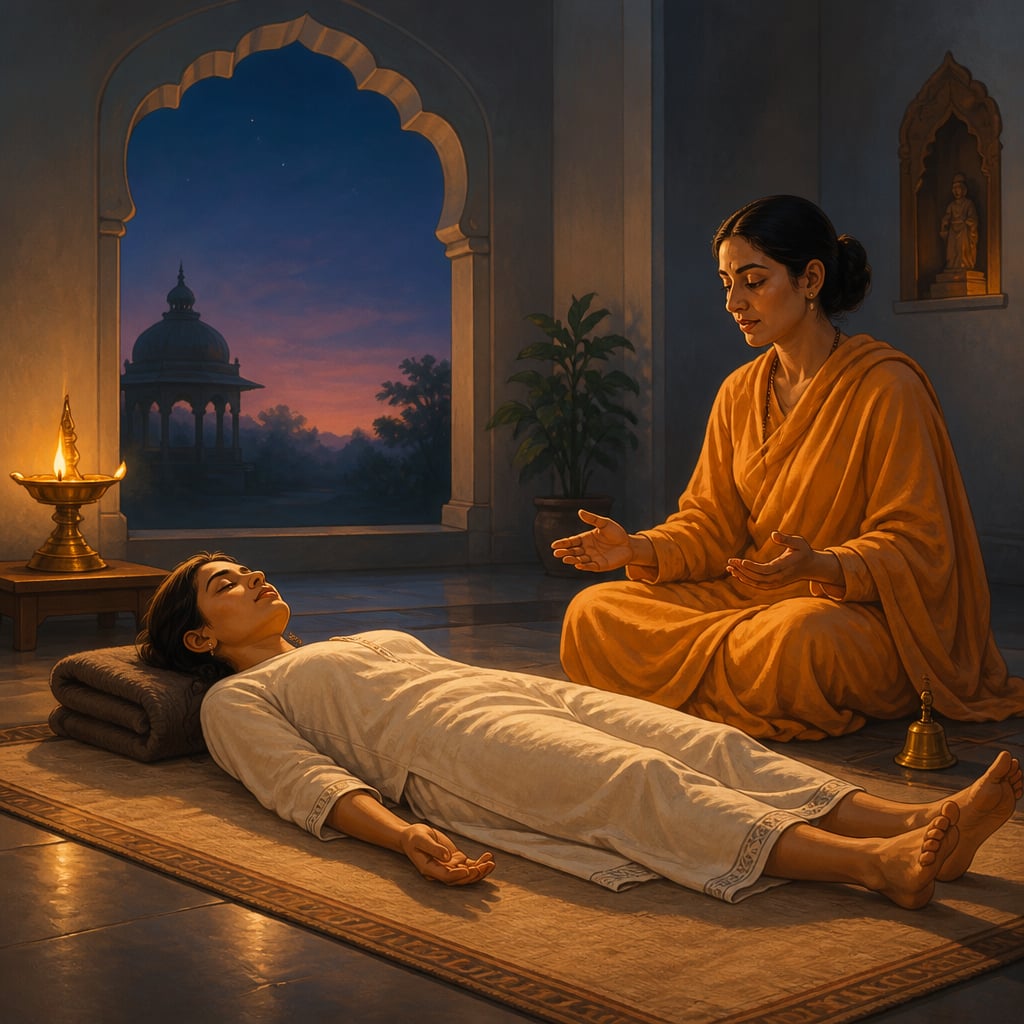
A Yoga Nidra session in a softly lit ashram hall at dusk

Meanwhile, an ancient practice offers something these solutions never touch: conscious navigation of the threshold between waking and sleeping, where the deepest work of psychological transformation occurs.

Yoga Nidrā, literally 'yogic sleep', is not about falling asleep faster or optimizing your sleep architecture. It's about accessing a state of consciousness that is neither fully awake nor fully asleep, where the seeds of suffering (saṃskāras) can be identified and released.

What Yoga Nidrā Actually Is

Yoga Nidrā emerges from Tantric traditions and is systematically presented in texts like the Yoga Taraṅgiṇī and various Tantric manuals. It represents a sophisticated technology for exploring consciousness at its most subtle levels.

The State: Yoga Nidrā induces a hypnagogic state, the threshold between waking and sleeping. In this state, the analytical mind quiets while awareness remains present. Brain wave studies show practitioners enter theta and delta states while maintaining consciousness, something ordinary sleep cannot achieve.

The Purpose: Traditional Yoga Nidrā has three primary aims:

  1. Pratyāhāra (sense withdrawal), the fifth limb of Aṣṭāṅga Yoga, systematically withdrawing attention from external senses
  2. Saṃskāra Śuddhi (impression purification), accessing and releasing deep mental impressions that drive habitual patterns
  3. Preparation for Dhyāna, creating the inner conditions for genuine meditation to arise

The Method: Classical Yoga Nidrā follows a structured sequence:

  1. Śavasāna (corpse pose), complete physical stillness
  2. Saṅkalpa (resolve), planting a positive intention in the receptive mind
  3. Rotation of consciousness, systematic awareness through body parts
  4. Breath awareness, subtle attention to prāṇa
  5. Feeling pairs, experiencing opposites (hot/cold, heavy/light) to develop witnessing capacity
  6. Visualization, guided imagery accessing symbolic and archetypal dimensions
  7. Saṅkalpa repetition, reinforcing the resolve
  8. Return, gradual externalization of awareness

The Tantric Dimension

Yoga Nidrā's deepest roots lie in Tantric practice, particularly the Vijñāna Bhairava Tantra's techniques for accessing non-ordinary states. The 112 dhāraṇās (concentration practices) in this text include several that work with the threshold states Yoga Nidrā explores.

One technique describes awareness at the moment of falling asleep: 'At the point of sleep, when sleep has not yet come and external awareness has gone, at this point Being is revealed.' This is the precise territory Yoga Nidrā systematically explores.

The Tantric understanding recognizes that ordinary sleep is a missed opportunity. Each night, consciousness passes through profound states that could, with proper training, become doorways to liberation. Most people traverse these states unconsciously, gaining physical rest but missing the spiritual potential.

Āyurvedic Sleep Wisdom

Traditional Āyurvedic sleep preparation at dusk

Classical Āyurveda treats sleep (nidrā) as one of the three pillars of health (trayopastambha), alongside food (āhāra) and sexual conduct (brahmacharya). This framework predates modern sleep science by millennia.

Doṣa-Specific Sleep Needs:

Timing: Āyurveda emphasizes sleeping during kapha time (6 PM - 10 PM onset) and rising during vāta time (2 AM - 6 AM completion). The modern recommendation to maintain consistent sleep schedules echoes this ancient understanding.

Quality over Quantity: Classical texts distinguish between sattvic sleep (refreshing, moderate) and tamasic sleep (excessive, dulling). The goal is not maximum sleep but appropriate sleep for one's constitution and life stage.

What Sleep Apps Extract

A modern person using a sleep app at bedtime

Modern sleep applications have borrowed several elements from Yoga Nidrā:

Body Scan Relaxation: The rotation of consciousness through body parts has become the 'body scan' in apps, a progressive relaxation technique.

Guided Imagery: Visualization sequences have become 'sleep stories', narratives designed to occupy the thinking mind while the body relaxes.

Breath Attention: Focusing on breath as a bridge to sleep appears in most sleep app protocols.

Intention Setting: Some apps include 'setting an intention', a simplified version of saṅkalpa.

What Gets Lost

The Pratyāhāra Gateway: Traditional Yoga Nidrā is a systematic training in pratyāhāra, the fifth limb of yoga, the withdrawal of senses from their objects. This is preparation for meditation (dhyāna), not an end in itself. Modern sleep apps use relaxation techniques to induce ordinary sleep, missing the opportunity to develop the capacity for conscious sense withdrawal that Yoga Nidrā cultivates.

Saṃskāra Purification: Perhaps the greatest loss is the transformative dimension. Traditional Yoga Nidrā accesses the threshold state specifically because saṃskāras (deep impressions) become visible and workable there. The hypnagogic state is a window into the unconscious where patterns normally hidden can be observed and released.

Modern sleep apps aim at unconsciousness, the very state traditional Yoga Nidrā works to illuminate. They help you fall asleep; they don't help you wake up (in the spiritual sense).

The Saṅkalpa Tradition: A saṅkalpa is not a 'positive affirmation' or casual intention. It's a resolution formed in the deepest part of consciousness, planted when the mind is most receptive, and allowed to germinate without conscious interference. The practice requires guidance in formulating an appropriate saṅkalpa and understanding how it works. Simplified as 'set an intention,' the technology becomes wishful thinking.

The Witnessing Development: The pairs of opposites (hot/cold, heavy/light, pleasure/pain) in traditional Yoga Nidrā aren't arbitrary relaxation techniques. They develop sākṣī bhāva, the witnessing capacity that observes experience without identification. This is preparation for the equanimity required in deeper meditation.

The Teacher Relationship: Traditional Yoga Nidrā is transmitted from teacher to student, with guidance tailored to the individual's needs, stage, and capacity. The practice can access deep psychological material that requires skilled support to integrate. Mass-market apps offer the same generic content to everyone, with no capacity to respond to what emerges.

The Sleep Hacking Phenomenon

Modern sleep optimization represents a different paradigm entirely:

Sleep Trackers: Devices monitor sleep stages, heart rate variability, and movement. The data can be useful but easily becomes another source of anxiety, people develop 'orthosomnia,' insomnia caused by worry about their sleep metrics.

Blue Light Blocking: Glasses and screen filters reduce blue light exposure before bed. This addresses a real problem (screen light disrupting melatonin) but treats the symptom (screen use at night) rather than the cause (inability to disconnect from stimulation).

Sleep Supplements: Melatonin, magnesium, valerian, CBD, the supplement market offers chemical solutions to what is often a lifestyle and consciousness problem.

Environmental Optimization: Cooling mattresses, blackout curtains, white noise machines. These can help but miss the inner dimension entirely.

The Deeper Issue

The sleep industry treats sleep as a problem to be solved through external optimization. Āyurveda and Yoga treat sleep as one dimension of overall life balance.

Poor sleep is often a symptom, of unprocessed emotions, inappropriate lifestyle, disconnection from natural rhythms, excessive mental stimulation. Addressing these root causes naturally improves sleep. Addressing only the symptom through sleep hacking leaves the underlying imbalance untouched.

Moreover, the traditional framework asks: what is sleep for? Mere physical recovery? Or an opportunity for psychological integration, spiritual development, and consciousness exploration?

Yoga Nidrā answers: sleep can be much more than unconscious recovery. The threshold states the body naturally moves through each night can become, with practice, portals for profound transformation.

Reclaiming the Practice

How might one approach Yoga Nidrā in its fuller dimension?

Learn from Qualified Sources: Seek instruction from teachers trained in traditional Yoga Nidrā, not just modern adaptations. The Bihar School of Yoga's systematization by Swami Satyananda is respected; Swami Rama's Himalayan tradition offers another approach.

Understand the Context: Yoga Nidrā is part of a comprehensive system. It works best when combined with appropriate āsana, prāṇāyāma, and ethical living. Extracted from this context, it becomes mere relaxation.

Work with Saṅkalpa: Learn to formulate and work with a proper saṅkalpa, not a wish but a resolve that aligns with your deepest nature and highest potential.

Recognize the Goal: The aim is not better sleep but expanded consciousness. Yoga Nidrā develops the capacity to remain aware while the body and ordinary mind rest. This is preparation for the ultimate state, samādhi, conscious absorption that transcends the waking-dreaming-sleeping cycle entirely.

The sleep apps will help you fall asleep. Traditional Yoga Nidrā offers to help you wake up.

Before reaching for sleep supplements or apps, examine the three pillars: Is your food appropriate for your constitution and eaten at proper times? Is your daily activity balanced with adequate rest? Is your mental-emotional life in reasonable order? Establish a consistent sleep time during kapha hours (before 10 PM). Avoid screens in the hour before bed, not because of blue light alone but because of mental stimulation. If sleep difficulties persist, they're pointing to imbalances worth investigating, not just symptoms to suppress.

Practice Yoga Nidrā not as a sleep aid but as saṃskāra work. During the visualization phase, notice what images arise, they often reveal active saṃskāras. Don't analyze or engage; simply witness. The witnessing itself, maintained in this receptive state, begins to loosen the pattern's grip. Over time, you'll notice that reactions previously felt as 'automatic' become more spacious, you see them arising and have choice about whether to follow them. This is the beginning of psychological freedom.

Key figures

Swami Satyananda Saraswati

Swami Rama of the Himalayas

Michael Acton Smith

Case studies

The Sleep Story Phenomenon: From Yoga Nidrā to Calm

In 2016, Calm introduced 'Sleep Stories' - bedtime stories for adults narrated by soothing voices. The feature became enormously popular, with celebrities like Matthew McConaughey and Stephen Fry lending their voices. Calm grew to over 100 million downloads, with Sleep Stories becoming its signature offering. The app was valued at $2 billion by 2019. Sleep Stories borrow several elements from Yoga Nidrā's structure: **Progressive Relaxation**: Stories often begin with body awareness, guiding listeners to notice physical sensations - a simplified rotation of consciousness. **Soothing Narrative**: The visualization component of Yoga Nidrā becomes the story itself - something to occupy the thinking mind. **Designed for Unconsciousness**: Stories are intentionally slow-paced and somewhat boring, designed so listeners fall asleep before the ending. What's different: **Goal**: Sleep Stories aim to produce ordinary sleep. Traditional Yoga Nidrā aims to maintain awareness through the sleep transition. **No Saṅkalpa**: There's no intention-setting, no working with resolve. The practice is purely passive. **No Opposites Work**: The development of witnessing capacity through pairs of opposites is absent. **No Transformation**: Sleep Stories don't access saṃskāras or work with psychological material. They help you escape consciousness rather than expand it.

The Yoga Sutras (3.1-3) describe the progression from dharana (concentration) to dhyana (meditation) to samadhi (absorption) as a deepening of the same practice. The Mandukya Upanishad maps consciousness states to brainwave patterns that modern neuroscience is now confirming through EEG studies of experienced meditators.

Sleep Stories have helped millions fall asleep more easily, and this is genuinely valuable given widespread sleep difficulties. But they represent a fundamental inversion of Yoga Nidrā's purpose. Traditional practice used the sleep transition as an opportunity for consciousness development; Sleep Stories use relaxation techniques to produce unconsciousness faster. Both reduce stress; only one develops the capacity to remain aware through changing states of consciousness. The commercial success of Sleep Stories shows massive demand for relief from insomnia and anxiety. The spiritual potential of that threshold state, however, remains largely unexplored.

Commercial adaptation tends to extract technique while losing transformative purpose The same techniques can serve opposite goals - consciousness expansion or consciousness suppression Mass demand for sleep help indicates widespread lifestyle imbalance Traditional practices aimed at waking up; modern adaptations often aim at switching off

Calm's Sleep Stories have over 100 million downloads, using techniques derived from yoga nidra to help people fall unconscious faster. The original practice was designed to expand awareness, not suppress it. This inversion is the clearest example of how market demand can flip a practice's purpose entirely.

A 2020 study in Nature Neuroscience found that experienced meditators showed 25% greater cortical thickness in the prefrontal cortex and 15% more gray matter in the hippocampus compared to age-matched controls.

Historical context

Tantric Period to Modern Systematization (8th century CE - 20th century CE)

Living traditions

Reflection

More in Dhyāna: From Liberation to Stress Relief

All lessons in Dhyāna: From Liberation to Stress Relief · Indian Wellness Traditions: Modern Connections course