Mantra Japa: The Practice Behind Transcendental Meditation
How ancient mantra repetition became Maharishi's trademarked technique
Mantra japa, the practice of sacred sound repetition, is millennia old, with three distinct modes: spoken (vaikharī), whispered (upāṃśu), and mental (mānasika). When Maharishi Mahesh Yogi brought it West as Transcendental Meditation, he created a global brand with celebrity endorsements, 'secret' mantras, and premium pricing. Explores what this remarkable marketing achievement preserved and transformed.
The $2,500 Secret
In cities around the world, people pay between $1,000 and $2,500 to receive a personal mantra. The ceremony is held in private, with flowers and fruit offered at a small altar bearing a portrait of Guru Dev. The teacher speaks the mantra softly; the student repeats it. They are instructed never to share their mantra with anyone, it is personal, chosen specifically for them.
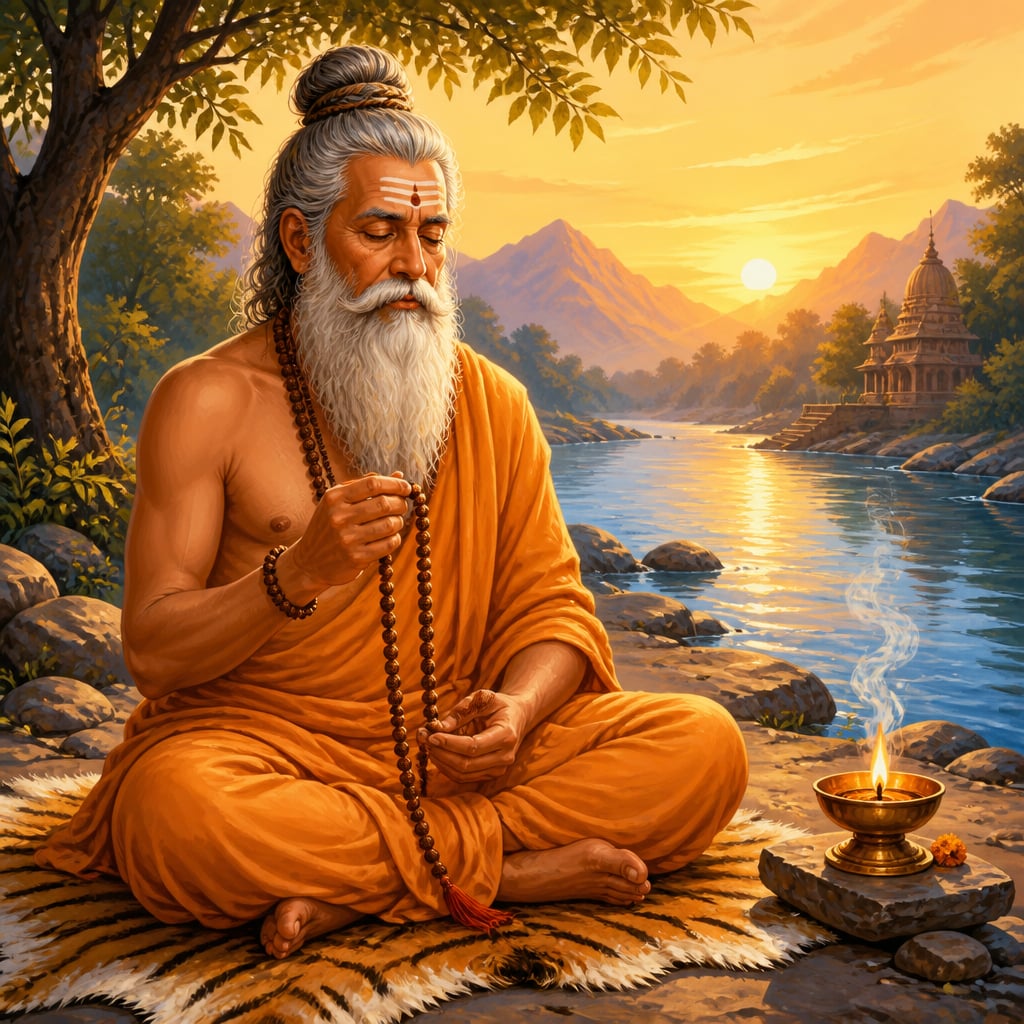
What most initiates don't know is that their 'personal' mantra likely comes from a list of about sixteen mantras, assigned based on age and gender. The mantras themselves, 'aing,' 'shrīng,' 'hrīm' and variations, are bīja (seed) mantras that have been used in Indian traditions for millennia. The practice they're learning is mānasika japa, mental repetition, described in texts dating back thousands of years.
This is Transcendental Meditation, one of the most successful spiritual movements of the 20th century. At its peak, TM initiated hundreds of thousands annually. The Beatles went to India to study with Maharishi. David Lynch founded a foundation to bring TM to schools. The practice has been researched in hundreds of studies.
TM is genuine meditation. It works. But the presentation obscures something: the technique is ancient, available in any Indian temple, taught for free by countless teachers. What Maharishi brought West wasn't a new discovery, it was an ancient practice, brilliantly marketed.
Mantra: Sacred Sound
To understand what TM adapted, we need to understand mantra.
Mantra (मन्त्र) means something like 'instrument of thought' or 'that which protects the mind.' In Indian traditions, mantras are not merely words, they are sacred sounds believed to carry inherent power. The sound itself transforms consciousness, regardless of whether the practitioner understands its meaning.
This belief in the power of sound goes back to the Vedas. The Vedic rishis didn't compose hymns, they 'heard' them (śruti means 'that which is heard'). Sound was considered the subtle essence of reality, and certain sounds could affect both the practitioner and the cosmos.
Mantras range from single syllables (bīja mantras like 'Oṃ' or 'Hrīṃ') to complex verses with explicit meaning. Some are devotional, invoking specific deities. Others are technical, used in specific practices. Some are general; others are personal, received in initiation (dīkṣā).
The Three Modes of Japa
Japa (जप) is the practice of mantra repetition. Traditional texts describe three modes, progressing from gross to subtle:
Vaikharī Japa (वैखरी) - Spoken repetition, audible to others. The practitioner recites the mantra out loud, using physical voice. This is the most accessible form, engaging the body through speech. It's often used in group chanting, temple rituals, and initial stages of practice.
Upāṃśu Japa (उपांशु) - Whispered repetition, barely audible. The lips move, but the sound is soft, heard only by the practitioner. This intermediate stage begins to internalize the practice while maintaining some physical engagement.
Mānasika Japa (मानसिक) - Mental repetition, completely silent. The mantra is repeated only in the mind, with no physical movement or sound. This is considered the most powerful form, the subtlest engagement with sound, approaching the source of the mantra itself.
The progression is significant. Vaikharī grounds the practice in the body. Upāṃśu bridges outer and inner. Mānasika works at the level of mind itself. Traditional teaching often progresses through all three; TM teaches only the third, jumping directly to mental repetition.
Maharishi's Genius: The Making of TM
Maharishi Mahesh Yogi (1918-2008) was born Mahesh Prasad Varma in central India. He studied physics, then became a disciple of Swami Brahmananda Saraswati, known as Guru Dev, who was Shankaracharya of Jyotir Math, one of the four senior positions in the Advaita Vedānta tradition.
After Guru Dev's death in 1953, Maharishi began teaching. He called his method 'Transcendental Deep Meditation,' later shortened to 'Transcendental Meditation.' In 1959, he began his first world tour.
His genius was packaging. Where other teachers taught mantra as part of a comprehensive spiritual path, Maharishi extracted the technique and presented it as a standalone practice with measurable benefits. No belief required. No lifestyle changes. Twenty minutes twice daily, and you'd reduce stress, increase creativity, and develop consciousness.
This was radical simplification. Traditional mantra practice was embedded in ethical frameworks (yama, niyama), philosophical study, devotion to a deity or guru, and often vegetarianism, brahmacharya (celibacy or sexual discipline), and other observances. Maharishi stripped away everything except the technique itself.
The result was accessible and effective, but also decontextualized. You could practice TM while eating meat, drinking alcohol, and engaging in any occupation. The mantra became a mental technology divorced from its spiritual ecosystem.
The Celebrity Strategy

Maharishi understood something that spiritual teachers before him had not: celebrity endorsement. When the Beatles visited him in India in 1968, the resulting media coverage introduced TM to millions who would never have sought out an Indian guru.
The Beatles eventually left, with John Lennon writing the acidic 'Sexy Sadie' about the experience. But the exposure had worked. TM became the meditation of the counterculture, then of the mainstream. Beach Boys, Mia Farrow, and later David Lynch, Ellen DeGeneres, and Oprah Winfrey, the celebrity thread continued for decades.
This wasn't accidental. Maharishi cultivated celebrities, understanding that their endorsement reached audiences no amount of traditional teaching could. The ashram in Rishikesh where the Beatles stayed became famous precisely because they stayed there.
The strategy worked. TM became, for many Westerners, synonymous with meditation itself. When people said 'I meditate,' they often meant they practiced TM. The brand achieved dominance that traditional teachers couldn't match.
The Business Model
TM's business model was unprecedented in spiritual teaching. Traditional gurus accepted donations (dakṣiṇā) but didn't set prices. Many teachings were transmitted freely, with the expectation that advanced students would support teachers voluntarily.
Maharishi monetized. TM initiation has always carried a fee, currently $1,500 for adults in the US, with reduced rates for students and those in need. The organization offers 'advanced techniques' for additional fees. The complete course of TM-Sidhi practices, including the claimed ability to develop 'yogic flying,' costs thousands more.
The justification offered is that the fee ensures commitment and supports the organization's activities, including free courses for veterans, at-risk youth, and others through the David Lynch Foundation. The organization has built schools, universities, and retreat centers.
Critics note that the core technique, mānasika japa with bīja mantras, is available for free throughout India and in countless meditation centers worldwide. What TM charges for is the brand, the standardized instruction, the community, and the research validation.
Defenders argue that the fee makes the teaching available in ways that donation-based models don't, you know the cost, you pay it, and you're done. No ambiguity about what's expected.
The 'Secret' Mantras

The most controversial element of TM is the claim that mantras are secret and personal. Initiates are instructed never to share their mantra, told that doing so would diminish its power.
Investigations by former TM teachers and journalists have revealed that TM uses a limited set of bīja mantras (seed syllables) assigned by age group:
For women:
- Age 0-11: Eng
- Age 12-17: Em
- Age 18-29: Aing
- Age 30-39: Aima
- Age 40-49: Shrīng
- Age 50+: Shrīm
For men (similar pattern with slight variations)
These mantras are derived from tantric tradition. They're not secret in any traditional sense, they appear in published texts and are taught openly by many teachers. The 'secrecy' is a TM invention, creating a sense of specialness and preventing comparison.
Is this deceptive? The organization would say the mantras are 'confidential' for pedagogical reasons, sharing can create doubt or confusion. Critics would say it obscures the generic nature of what's being taught.
What's undeniable: the same mantras, or close variants, have been used in Indian traditions for millennia. The innovation isn't the mantras but the packaging.
What TM Preserved
Despite valid criticisms, TM preserved something essential: the technique works.
Mānasika japa produces measurable effects. Research on TM, though some has methodological issues, consistently shows reduced stress, lower blood pressure, decreased anxiety. The practice genuinely changes physiology.
TM also preserved the emphasis on effortlessness. Traditional mānasika japa is not concentration but allowing, you introduce the mantra gently and let it repeat itself, following its natural tendency to become subtler. TM instructs this correctly: no effort, no forcing, just easy repetition.
And TM created a container that millions found accessible. The standardized instruction, the clear time commitment (20 minutes twice daily), the community of practitioners, these elements helped people establish and maintain practice.
What Got Lost
But significant dimensions disappeared.
The devotional element. Traditional mantra practice often involves relationship with a deity. The mantra 'Oṃ Namaḥ Śivāya' isn't just sound, it's connection with Śiva. Bīja mantras like 'Hrīṃ' are associated with specific goddesses. TM strips this away, presenting mantras as mere vibrations without devotional meaning.
The dīkṣā relationship. Traditional mantra transmission happens in dīkṣā (initiation), establishing a spiritual relationship between guru and disciple. This relationship involves guidance, accountability, and ongoing teaching. TM's initiation is a transaction: pay, receive mantra, practice. The ongoing relationship is optional.
The progressive path. Traditional practice often progresses through vaikharī, upāṃśu, and mānasika, developing the capacity for subtler practice. TM jumps straight to mānasika, which may be appropriate for some but misses the grounding that outer practice provides.
The ethical framework. In traditional contexts, mantra practice supports and is supported by ethical living. TM requires no ethical commitment, you can practice while engaged in any activity, any occupation, any lifestyle. This makes TM accessible but also disconnected from transformation beyond stress reduction.
The Three Japa Modes as Practice
If you want to explore mantra practice beyond TM, consider working with all three modes:
Start with vaikharī (spoken). Choose a mantra, 'Oṃ' is universal, and recite it audibly. Feel the sound in your body. Notice how vocal repetition engages physically. Practice for 5-10 minutes.
Progress to upāṃśu (whispered). Same mantra, now barely audible. Lips move, but sound is soft. Notice the shift, still physical, but more internal. The vibration becomes subtler.
Develop mānasika (mental). Stop moving lips. Repeat the mantra only mentally. Let it become subtler and subtler. Don't force; allow. When the mantra fades, gently reintroduce it.
This progression grounds the practice before it becomes purely mental. Many practitioners find that starting with vaikharī creates a stability that makes mānasika more effective.
Practicing with Awareness
If you practice TM, you're practicing a genuine technique with ancient roots. Know this context:
Your mantra isn't secret. It's a bīja from tantric tradition, used for millennia. This doesn't diminish its effectiveness, but understanding its origins connects you to lineage.
Consider adding outer practice. Even if your primary practice is mānasika, occasional vaikharī or upāṃśu can ground and refresh the practice.
Explore the devotional dimension. Bīja mantras traditionally connect to specific deities. Research the associations: 'Hrīṃ' with Goddess traditions, 'Oṃ' with cosmic consciousness. You needn't believe in gods to explore these dimensions.
Integrate with life. Traditional japa wasn't isolated from ethics and lifestyle. Consider whether your meditation practice might be supported by attention to how you live.
If you're considering TM but hesitant about the cost, know that the same practice is available from many teachers. Search for 'mānasika japa' or 'bīja mantra meditation.' You may find excellent instruction for free or by donation.
The Marketing Achievement
Maharishi accomplished something remarkable: he took an ancient practice from temple courtyards and made it a global brand practiced by millions. He proved that Indian meditation could appeal to Western seekers when properly packaged. He pioneered research-based validation. He understood celebrity, media, and branding before these became standard spiritual industry tools.
The achievement came with costs. The practice was decontextualized, the traditions obscured, the devotional dimension removed. What remained was effective but partial, a technique without a path, a mantra without a cosmos.
This is neither entirely good nor entirely bad. Millions have benefited from TM who would never have found their way to traditional teachers. The stress reduction is real. The practice is genuine.
But the fuller practice, vaikharī through mānasika, embedded in ethical commitment and devotional relationship, remains available for those who want it. Maharishi brought a gift from India. The gift came from somewhere, and that somewhere offers more than any brand can contain.
The Sound Behind the Sound
In the Nāda Yoga tradition, practitioners listen for the inner sound, the subtle vibration that underlies all manifestation. Mantra practice is one doorway to this dimension. The repeated sound becomes progressively subtler until it reveals the sound behind the sound, the vibration of consciousness itself.
This is what mantra practice ultimately points toward. Not stress reduction, though that happens. Not celebrity endorsement, though that spreads the teaching. But the recognition that at the subtlest level of awareness, there is a vibration that is the source of all sound, all thought, all experience.
TM can point toward this. Traditional japa can point toward this. Any sincere mantra practice can point toward this. The technique is a doorway; the destination is beyond technique.
Maharishi built a brand. The tradition built a path. Both can serve. Neither is the goal.
If you practice mantra meditation, whether TM or another form, experiment with all three modes. Start your session with a few minutes of spoken repetition. Notice how the sound grounds you, engages the body. Transition to whispered repetition, feeling the practice internalize. Then move to silent mental repetition, building on the foundation you've created.
If you practice mantra meditation, consider enriching it with traditional context. Research the meaning of your mantra, even bīja mantras have associations and meanings. Learn about the tradition from which your practice comes. Consider whether ethical commitments might support your meditation. You needn't become Hindu, but understanding enriches practice.
Key figures
Maharishi Mahesh Yogi
Founder of Transcendental Meditation and the Spiritual Regeneration Movement. Brought mantra-based meditation to millions in the West through unprecedented marketing and celebrity endorsement.
Founded TM organization (1958); trained thousands of TM teachers; established Maharishi International University (now Maharishi University of Management); created the TM-Sidhi program; initiated research program that has produced hundreds of studies; brought meditation to Beatles, Beach Boys, and countless celebrities who spread awareness further.
Swami Brahmananda Saraswati (Guru Dev)
Shankaracharya of Jyotir Math (1941-1953), one of the highest positions in the Advaita Vedānta tradition. Maharishi's guru, whose portrait appears in TM initiation ceremonies.
Revived the Jyotir Math; trained Maharishi and other disciples; his name and image continue to provide traditional authority for TM practice; represents the Advaita Vedānta tradition within which TM positions itself.
David Lynch
Filmmaker (Twin Peaks, Mulholland Drive) and TM practitioner since 1973. Founded the David Lynch Foundation to bring TM to schools, veterans, and at-risk populations.
Founded David Lynch Foundation; advocates publicly for TM; funded research and programs bringing TM to underserved populations; written and spoken extensively about his practice; kept TM prominent in cultural conversation through continued celebrity engagement.
Case studies
Maharishi's Marketing Genius: How TM Became a Global Brand
In 1968, the Beatles traveled to Rishikesh to study with Maharishi Mahesh Yogi. The resulting media coverage introduced Transcendental Meditation to millions. Photos of John, Paul, George, and Ringo sitting cross-legged with an Indian guru appeared in newspapers worldwide. This wasn't accidental. Maharishi had already been cultivating celebrity connections. The Beach Boys had studied with him. He understood that celebrity endorsement reached audiences that traditional spiritual teaching never could. The Beatles eventually left, disillusioned. George Harrison later said Maharishi was 'trying to get money' from them. John Lennon wrote 'Sexy Sadie,' originally titled 'Maharishi,' expressing his disappointment. But the exposure had worked. TM became internationally famous. The marketing continued after Rishikesh. Maharishi positioned TM not as religion but as science. The organization funded research studies - hundreds eventually - creating empirical validation that secular institutions could accept. TM entered schools, hospitals, corporations. The pricing strategy was equally innovative. Traditional spiritual teaching operated on donation. You gave what you could; the teacher accepted. Maharishi set fixed prices: you knew what TM cost, you paid it, you received initiation. No ambiguity, no relationship complexity. The transaction was clean. The 'secret mantra' element added perceived value. Your mantra was special, chosen for you, not to be shared. This created exclusivity around what were actually standard bīja mantras assignable by age group. Was this deceptive? The organization would say it was skillful communication - meeting people where they were, making ancient wisdom accessible. Critics would say it obscured origins and commodified sacred practice. What's undeniable: the marketing worked. By some estimates, over five million people have learned TM. No traditional guru reached a fraction of that number. The technique was transmitted. The question is what else was - or wasn't - transmitted along with it.
The Mandukya Upanishad describes four states of consciousness: waking, dreaming, deep sleep, and turiya (transcendent awareness). Meditation in the classical tradition aims at turiya, a state beyond the mind's categories. Reducing this to stress relief is like using a telescope only as a paperweight.
The TM marketing template has been replicated throughout the wellness industry. Celebrity endorsement, scientific studies, subscription pricing - all derive from Maharishi's innovations. Understanding TM's history helps evaluate the many meditation brands that followed.
Maharishi demonstrated that spiritual practice could be marketed like any product. Celebrity endorsement, scientific validation, premium pricing, proprietary secrets - these tools had never been applied to meditation before. The result was unprecedented reach but also unprecedented controversy about whether commodified spirituality serves seekers or exploits them.
Only 4% of meditation product buyers cite spiritual growth as their motivation, compared to 68% citing stress relief. This inversion of purpose from liberation to optimization defines the modern meditation market and explains why most users plateau quickly. The ceiling for stress relief is much lower than the ceiling for contemplative development.
The global wellness industry reached $5.6 trillion in 2023, with meditation and mindfulness products representing $2.2 billion. A 2023 consumer survey found 68% of meditation product buyers cited stress relief, while only 4% cited spiritual growth.
Historical context
Ancient Practice to 20th Century Movement (Vedic times to present)
Living traditions
TM remains one of the largest meditation organizations globally, with centers in most major cities and ongoing teacher training. The David Lynch Foundation has expanded TM's reach into schools, veteran programs, and underserved communities. Research on TM continues, though with ongoing debates about methodology and interpretation. The organization has survived Maharishi's 2008 death under continued leadership. Meanwhile, mānasika japa continues to be taught in countless other contexts, temple pūjās, traditional yoga schools, other meditation organizations, maintaining the practice's availability outside any single brand.
- Maharishi University of Management: Founded by Maharishi in 1973 (as Maharishi International University), this accredited university integrates TM practice into all academic programs. The campus includes the Golden Domes where group meditation takes place, manifestation of Maharishi's vision of consciousness-based education.
- Jyotir Math, Uttarakhand: One of the four seats established by Śaṅkarācārya, this is where Guru Dev served as Shankaracharya. The lineage from which TM claims descent maintains traditional Advaita Vedānta teaching. Visiting provides connection to the traditional roots that TM's global brand can obscure.
Reflection
- If you practice mantra meditation, do you know the meaning and associations of your mantra? How might learning this context change your relationship to the practice?
- TM charges significant fees for what are essentially traditional bīja mantras available for free throughout India. Is this reasonable compensation for instruction and organization, or problematic commodification of sacred practice? Can you hold both views simultaneously?
- TM strips mantra from devotional context, the mantras are presented as pure vibration, not connection to deity. Does this make the practice more universal (accessible to anyone regardless of belief) or does it lose something essential (the relational dimension of traditional practice)?