The Hardy Connection: East Meets West
The legendary collaboration between Ramanujan and G.H. Hardy
Trace the remarkable intellectual partnership between Srinivasa Ramanujan and G.H. Hardy, from the nine page letter that arrived in Cambridge in January 1913 through five years of collaboration that reshaped twentieth century number theory.
The Hardy Connection: East Meets West
On the morning of 16 January 1913, a nine page letter written in careful if slightly nonstandard English arrived at Trinity College, Cambridge, addressed to the mathematician Godfrey Harold Hardy. The letter was from a twenty five year old clerk in the Port Trust office in Madras named Srinivasa Ramanujan, who introduced himself as a man with no university education, no formal mathematical training beyond high school, and a modest salary of twenty pounds a year. Attached to the letter were roughly 120 mathematical results, stated as bald assertions without proof, ranging from the elementary to the staggeringly deep. Hardy read the letter over breakfast. He was, at that point, the leading pure mathematician in England and one of the two or three most rigorous analytic number theorists in the world. His first reaction, he later admitted, was that the letter must be a hoax. His second reaction, after an afternoon reviewing the claims with his longtime collaborator John Edensor Littlewood in Trinity's rooms, was that nobody could possibly have made up a letter like this, because nobody with enough mathematical sense to fabricate half of these results would have bothered to fabricate the other half. The letter was real. Its author was real. And in late afternoon of 16 January 1913, the history of twentieth century mathematics quietly pivoted.
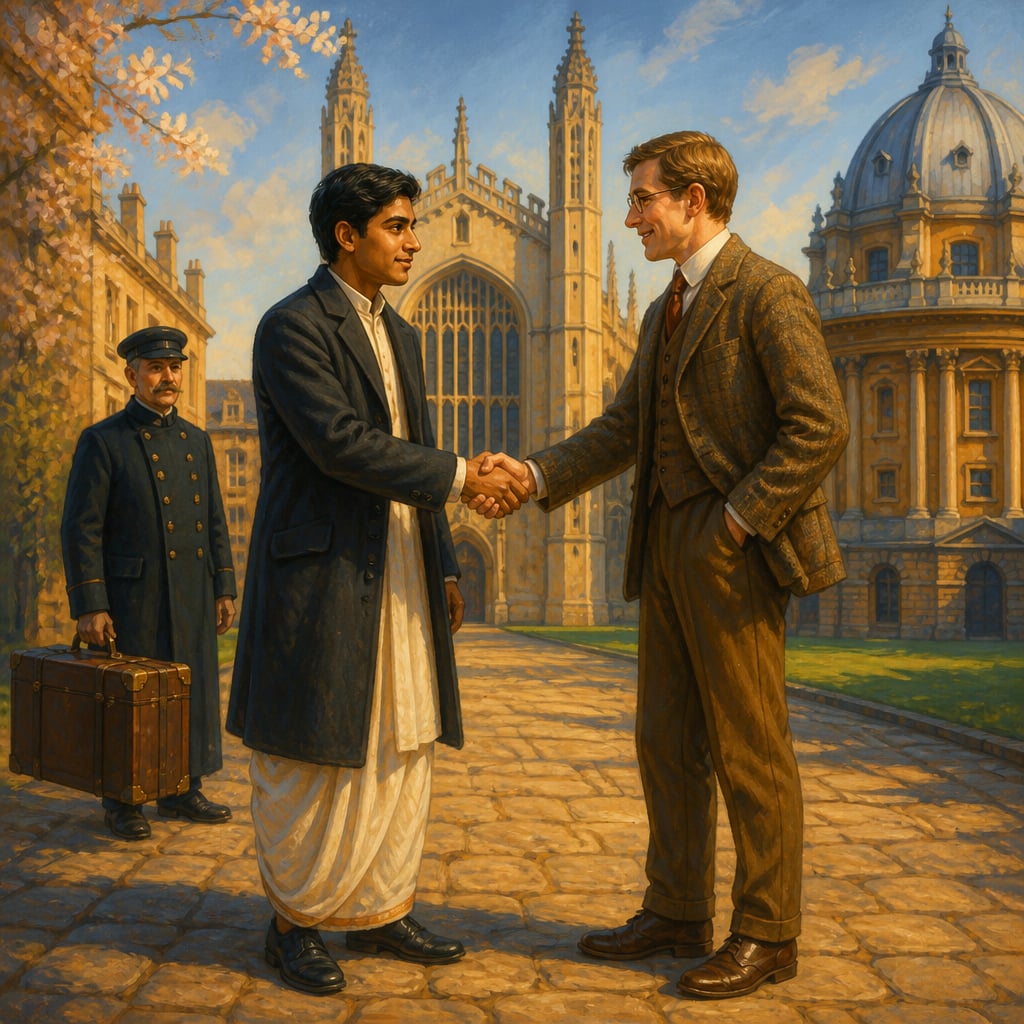
A Clerk in Madras Writes to Cambridge
The letter had not been a first attempt. Ramanujan had written to M.J.M. Hill and to H.F. Baker and to E.W. Hobson, three other eminent British mathematicians of the period, and had been ignored or dismissed. He was running out of people to try. The letter to Hardy was both a scientific announcement and a personal plea. Its opening paragraph described the writer's circumstances in plain terms, declared that he had after much work achieved several results unlikely to be known in Europe, and asked, with as much dignity as a twenty five year old with no connections could muster, that the recipient give the attached work a fair reading. The attached results included identities in continued fractions, new asymptotic formulas, definite integrals that even Hardy could not evaluate on sight, and a handful of theorems in the analytic theory of numbers that were, as Hardy later put it in his famous essay on Ramanujan, of a kind one would not even have dared to conjecture unless one already had some sense of their being true.
Hardy's Verdict

Hardy read the letter. Littlewood read the letter. The two mathematicians, whose collaboration had already produced some of the most penetrating work of early twentieth century analytic number theory, sat together that afternoon and went through the theorems one by one. Some they already knew. Some were wrong in detail but suggestive. Some were previously published results that Ramanujan had rediscovered independently, which, given his isolation from the current European literature, was itself a remarkable feat. And some, Hardy and Littlewood realized, were entirely new, correct beyond any doubt once you saw them, and completely mysterious in origin. Hardy wrote to Ramanujan the same day with careful, detailed questions about the most surprising results. Within weeks he had concluded that the author was one of the finest mathematical minds he had ever encountered, and that the only rational course of action was to bring him to Cambridge. The effort to do this would occupy the next fifteen months of Hardy's life, complicated by the distance, by wartime travel restrictions, and above all by the orthodox religious scruples that made the sea voyage itself a serious crisis for Ramanujan and his family.
The Orthodox Problem
Ramanujan was a devout Iyengar Brahmin of the Vaishnava Sri Vaishnavite tradition, the family deity was Namagiri Thayar of the Namakkal temple, and the orthodox rules of his community strictly forbade a sea voyage. To cross the kala pani, the black water, was to risk ritual pollution severe enough to break caste. Ramanujan's mother, Komalatammal, was implacably opposed to her son making the journey. The matter was resolved, according to the family tradition that was later recorded by his biographers, through a dream in which Namagiri herself appeared to the mother and commanded her to let her son go. With this divine authorization, and with the patient mediation of E.H. Neville, the Trinity mathematician who had traveled to Madras to help persuade Ramanujan to come, the voyage was arranged. Ramanujan sailed on the SS Nevasa on 17 March 1914 and arrived in England in April, three months before the outbreak of the First World War.
Five Years at Trinity

The collaboration that followed lasted almost exactly five years, from April 1914 until Ramanujan's return to India in February 1919. In those five years, Ramanujan and Hardy wrote together or separately roughly thirty papers that contained results Hardy would later describe as among the most beautiful and unexpected of twentieth century mathematics. The pattern of the collaboration was unusual. Ramanujan would produce a theorem, often announcing it in a single compressed sentence of the kind he had learned to write from his childhood study of Carr's Synopsis of Pure Mathematics, and the result would be correct. Hardy's job, as he himself described it, was to supply the proofs that Ramanujan's intuitive methods had left out, to check the results against the established literature, and to persuade Ramanujan that certain widely known theorems were actually known and did not need to be rediscovered. The complementarity was nearly perfect. Ramanujan saw where a formula must be true. Hardy showed why it was true. Between them, the two men produced the partition function asymptotics, the theory of highly composite numbers, the first modern applications of the circle method in analytic number theory, and a body of identities in continued fractions, modular forms, and elliptic functions whose depth was only gradually understood over the decades that followed.
A New Paramparā
Hardy was an atheist. Ramanujan was a Brahmin who attributed his theorems to the direct revelation of Namagiri Thayar. Hardy demanded rigorous proof. Ramanujan relied on a combination of computation, pattern, and what he unselfconsciously called inspiration. Hardy was a product of Trinity and the English public school tradition. Ramanujan was a self taught mathematician from a poor south Indian family with no contact with the mainstream European mathematical literature. By any reasonable measure the two men should not have been able to work together at all. That they did, and that their collaboration produced results that no other pairing in the history of mathematics could have produced, is one of the great lessons of twentieth century intellectual history. The east met the west at Trinity College in April 1914, and what passed between them was not a one way transmission. It was a paramparā in the classical Indian sense, a teacher student relationship in which each man was in different ways the teacher and the student of the other, and in which the flow of influence went in both directions. Hardy taught Ramanujan modern analytic proof. Ramanujan taught Hardy the existence of a mathematical world whose inhabitants could be discovered by methods the European tradition had not yet learned to use, and the shape of that discovery still runs through the analytic number theory of the century that followed.
The Pairing Now
A century after the breakfast at Trinity, the partnership Hardy and Ramanujan started is still being unpacked. Ken Ono and his students have spent two decades working through identities the two men only sketched. Manjul Bhargava, who won the Fields Medal in 2014, has named Ramanujan among the mathematicians who shaped his sense of what number theory could be. The Ramanujan Machine, an AI project launched at the Technion in 2019, generates new continued fraction conjectures in the style Ramanujan used and waits for human mathematicians to prove them. The pairing of an English analyst's rigour with an Indian autodidact's sight has become a template, not just a story.
The nine-page letter that Hardy nearly set aside in his rooms at Trinity is still being read. The breakfast that began this paramparā has not yet ended.
Key figures
Srinivasa Ramanujan
22 December 1887 to 26 April 1920, Erode and Kumbakonam (Tamil Nadu) and Trinity College, Cambridge
Godfrey Harold Hardy
7 February 1877 to 1 December 1947, Trinity College Cambridge and Oxford
John Edensor Littlewood
9 June 1885 to 6 September 1977, Trinity College, Cambridge
Case studies
16 January 1913: A Letter Arrives at Trinity
On the morning of 16 January 1913, the post delivered to G.H. Hardy's rooms at Trinity College, Cambridge, a nine page letter written in careful handwriting by a twenty five year old clerk in the Port Trust office in Madras. The letter introduced the writer as Srinivasa Ramanujan, described his lack of formal training, and asked Hardy to look at the attached theorems, roughly 120 of them, stated as bald assertions without proof. Hardy read the letter over breakfast. His first reaction was suspicion, on the grounds that the letter looked like the kind of grand claim that amateurs often send to eminent professionals. His second reaction, after he had looked at a few of the identities and realized he could not evaluate them on sight, was closer to bewilderment. He took the letter to his regular collaborator, John Edensor Littlewood, and the two mathematicians sat together that afternoon in Hardy's rooms and went through the 120 claims one by one. Some were known. Some were wrong. Some were previously published results that the writer had rediscovered independently, a striking achievement on its own given his apparent isolation. And some were entirely new, correct as far as Hardy and Littlewood could tell, and of a depth that no amateur could possibly have produced by guesswork. The two men reached the same verdict. The letter was real. The writer was a mathematician of the first rank. Something must be done, and quickly.
The letter is a textbook example of Gita 4.34 in action. Ramanujan, the junior approaching the senior, opens with praṇipāta, humble approach, stating his circumstances plainly and asking with dignity for the recipient's attention. The attached theorems are paripraśna, thorough questioning, the detailed technical content by which the senior mathematician is invited to engage with the junior's actual work. The willingness to travel to Cambridge, to be taught, to serve in the disciplined atmosphere of a Trinity College fellowship, is sevā, service. The three elements map onto the Gita verse with almost uncomfortable precision. And Hardy, the recipient, responds exactly as the verse predicts the jñānī, the one who knows, will respond. He gives the knowledge. He replies to the letter. He goes to extraordinary lengths to bring the writer to the place where the knowledge can be transmitted. The entire scene, read through the Gita verse, is a classical upadeśa encounter in the most unexpected modern setting imaginable, a Cambridge common room in January 1913.
Within a month, Hardy had written back to Ramanujan with detailed technical questions. Within six months, Hardy was actively arranging for Ramanujan to come to Cambridge. Within fourteen months, with the assistance of E.H. Neville, who traveled to Madras personally to help persuade Ramanujan and his family, the voyage had been arranged. Ramanujan arrived at Trinity in April 1914. The five year collaboration that followed produced, among many other results, the partition function asymptotic formula, the theory of highly composite numbers, the circle method in analytic number theory, and the mock theta function letters of 1920, some of the most beautiful and unexpected results in twentieth century mathematics. All of it can be traced back to a single letter delivered on the morning of 16 January 1913, read over breakfast, and taken seriously by a mathematician who could easily have thrown it away.
The most important act of scientific discovery is sometimes not the discovery itself but the decision to take an unexpected letter seriously. Hardy did not invent any of the 120 theorems in Ramanujan's letter. He only recognized that they were real. That act of recognition, repeated in a thousand variations, is what a functioning scientific community actually consists of. The cost of taking the letter seriously was an afternoon of Hardy's time. The cost of not taking it seriously would have been the loss of one of the great mathematical partnerships of the twentieth century.
Ramanujan's first letter to Hardy, dated 16 January 1913, contained approximately 120 mathematical results stated without proof. Of these, roughly a third were already known, roughly a third were incorrect in some detail but suggestive, and roughly a third were new to mathematics and correct. The new results alone would have been enough to secure a major reputation for their author.
Trinity 1918: The Partition Function and the Birth of the Circle Method
By 1918, Ramanujan had been at Trinity College for four years. The war was in its final phase, his health was already seriously declining, and he and Hardy were in the middle of their most ambitious joint project. The problem was the asymptotic behavior of p(n), the partition function, which counts the number of ways a positive integer can be written as a sum of positive integers. The partition function grows very rapidly. p(1) equals 1, p(2) equals 2, p(10) equals 42, p(100) equals roughly 190 million. No exact formula was known, and all previous attempts to give even a good asymptotic estimate had failed. Hardy and Ramanujan approached the problem using a method that was new to both of them, treating the generating function for p(n) as a function on the complex plane and extracting asymptotic information by careful integration along a circular contour. The technique required all of Hardy's analytic training and all of Ramanujan's pattern seeking intuition, and it produced an asymptotic formula of startling accuracy. For n equal to 200, the formula predicted the partition count to within a handful of units out of a total of roughly four trillion. The paper, published in the Proceedings of the London Mathematical Society in 1918, founded what is now called the Hardy Ramanujan circle method and became one of the defining tools of twentieth century analytic number theory.
This is jñāna and vijñāna working together in a single piece of mathematics, exactly as Gita 7.2 promises. Ramanujan's role was the direct intuitive grasp of the structure. He could see, without being able to fully explain why, that the partition generating function had the specific kind of behavior on certain arcs of the unit circle that the method would need. Hardy's role was the disciplined analytic apparatus. He supplied the contour integration, the careful estimates, the rigorous bounds. Neither piece alone would have produced the result. The jñāna without the vijñāna would have been a beautiful conjecture with no proof. The vijñāna without the jñāna would have been a set of tools with nothing to prove. Together they produced the asymptotic formula, and together they founded a method that is still the dominant approach to a large class of problems in analytic number theory a century later. The collaboration is, in the Gita's exact vocabulary, jñānaṃ savijñānam, knowledge together with its discriminative understanding, in the purest modern scientific form.
The Hardy Ramanujan asymptotic formula for p(n) was refined by Hans Rademacher in 1937 into an exact convergent series, a result that modern number theorists regard as one of the most elegant in the discipline. The circle method introduced in the 1918 paper became, through the work of I.M. Vinogradov and his Soviet school in the 1930s and 1940s and of Selberg and Bombieri and the British school later in the century, the primary tool for an entire class of problems including Waring's problem, the Goldbach conjecture, and the distribution of primes in arithmetic progressions. As of 2026, every current textbook on analytic number theory devotes at least one chapter to the Hardy Ramanujan circle method, and every working analytic number theorist uses it routinely. The founding paper is Ramanujan and Hardy, 1918, and the direct line from that paper to current research is unbroken.
A collaboration works best when the two partners bring fundamentally different modes of thought to the same problem. Ramanujan and Hardy were not similar mathematicians who happened to work together. They were opposites in almost every respect, and the opposition was the engine of the partnership. The deepest creative work often requires a pairing of jñāna and vijñāna, of the person who sees the answer and the person who can prove it, and the pairing works precisely because neither one could have done the other's job.
The Hardy Ramanujan asymptotic formula for p(n), published in 1918, predicts the partition function with an error that grows far more slowly than the function itself. For n equal to 200, the exact value of p(200) is 3972999029388, and the Hardy Ramanujan formula produces this to a relative accuracy of better than one part in 100000, which for an asymptotic formula on a function growing as fast as p(n) is an extraordinary level of precision.
Namakkal 1913: A Mother's Dream and a Voyage Across the Black Water
In late 1913, after Hardy had decided to bring Ramanujan to Cambridge, the single largest obstacle was not money, nor distance, nor the logistics of wartime travel. It was the religious taboo on the sea voyage itself. Ramanujan was an orthodox Iyengar Brahmin of the Srivaishnava Vaishnava tradition, and his community held firmly to the rule that crossing the kala pani, the black water of the ocean, meant the loss of caste. His mother, Komalatammal, was implacably opposed to the journey on exactly these grounds. She had raised her son in strict observance, she was the spiritual center of the household, and without her blessing no voyage was possible. E.H. Neville, a young Trinity fellow sent by Hardy to Madras in late 1913 specifically to resolve this crisis, spent weeks in the family home, discussing the matter with the mother, the father, and the young mathematician himself. The conversations went nowhere until, according to the family tradition later recorded by Ramanujan's biographers, Komalatammal experienced a dream one night in which Namagiri Thayar, the family deity at the Namakkal temple, appeared to her and explicitly authorized her son's journey. The mother woke, went to her son, and told him she had seen Namagiri, and that he had her permission to go. Within weeks the travel arrangements were complete. Ramanujan sailed from Madras on the SS Nevasa on 17 March 1914 and arrived in England in April, three months before the outbreak of the First World War.
The kalapani crisis was not a minor obstacle that rationalism swept aside. It was a genuine religious crisis that was resolved by religious means, specifically by the direct intervention of a family goddess communicated through a dream. The modern European framing of Ramanujan's story often treats the religious elements as colorful background to a primarily mathematical story. The family's own framing is nearly the opposite. The voyage happened because Namagiri said it could happen, and the mathematics that followed is, in Ramanujan's own consistent testimony throughout his life, the continuation of that same divine permission. He prayed to Namagiri before and after the composition of his theorems. He attributed the arrival of the formulas to her grace. He said, explicitly, that an equation had no meaning unless it expressed a thought of God. The Hardy collaboration, from the family's point of view, was not an escape from this religious framework. It was an extension of it into a new setting, and the presiding deity of the entire enterprise was the goddess of the Namakkal hill.
Komalatammal's blessing was given on the strength of the dream. The voyage proceeded. Ramanujan spent five years at Trinity College, produced the great body of work that now bears his name, was elected a Fellow of the Royal Society in 1918, and was elected a Fellow of Trinity College in 1918, becoming the first Indian mathematician to receive either honor. His health, always fragile, was severely damaged by the wartime food shortages and the strict vegetarian diet he maintained in a Cambridge that had neither the ingredients nor the understanding to support it. He returned to India in February 1919 and died in April 1920 at the age of thirty two. His body was cremated in the orthodox Hindu manner, at the family home in Kumbakonam, and his ashes were returned to the sacred waters of the Cauvery. The orthodox framework within which he had lived was preserved at every stage, and the five year Cambridge interlude, improbable as it was, proved compatible with it. The dream of Namagiri Thayar was, in the end, correct.
The deepest cross cultural scientific collaborations do not require either party to abandon their own framework. They require both parties to work within their own frameworks at once and to find the points where the two frameworks can meet. Ramanujan did not become less of a Brahmin at Trinity. Hardy did not become less of an atheist in the presence of Ramanujan. The collaboration worked because both men brought their full selves to it, and because the meeting point between them was the mathematics itself, which admitted both the Gita's jñāna and the Trinity tradition's vijñāna as equal citizens.
Ramanujan sailed from Madras on the SS Nevasa on 17 March 1914 and arrived in London on 14 April 1914. The voyage, forbidden by the orthodox rules of his caste community, was authorized by his mother on the strength of a dream in which the family deity Namagiri Thayar of Namakkal appeared to her and commanded her to let her son go.
Historical context
The late Edwardian and early Georgian period in Britain and the late British Raj in Madras Presidency, the immediate prewar, wartime, and early postwar years from 1913 to 1920, a period of simultaneous global catastrophe and extraordinary concentrated intellectual productivity at Trinity College, Cambridge.
The Madras Presidency of 1913 was a sprawling British colonial province covering most of south India, administered from the Fort St George complex in Madras city and governed by a combination of British officials and a network of Indian clerical and professional staff. The Iyengar Brahmin community to which Ramanujan belonged was one of several orthodox Srivaishnava Vaishnava communities in the Tamil country, concentrated in the towns around Srirangam, Kumbakonam, and Tirupati, and deeply committed to the ritual, dietary, and theological framework of the Vadagalai and Tengalai subtraditions of Ramanuja's eleventh century Visistadvaita school. Mathematics was cultivated in these communities as a scholarly pursuit with roots in the classical Indian tradition, but the formal academic channels for advanced mathematical work were limited. The Indian Mathematical Society had been founded only in 1907, and the principal Indian mathematical figures of Ramanujan's youth, including V. Ramaswamy Aiyer, P.V. Seshu Iyer, and S. Narayana Iyer, were devoted amateurs and school teachers rather than research mathematicians in the European sense. Ramanujan's path from this environment to Trinity College was therefore extraordinary at every step, and it required the active intervention of a network of Indian supporters in Madras as well as of British mathematicians in Cambridge.
The Hardy Ramanujan collaboration is the clearest modern case of what happens when the Indian mathematical tradition, with its centuries of commitment to jñāna and to the direct apprehension of mathematical identities, meets the modern European analytic tradition, with its commitment to vijñāna and to rigorous proof. Neither tradition is complete on its own. Ramanujan alone would have left a notebook full of correct but unproved identities that the world would have slowly puzzled over for decades. Hardy alone would have written a series of elegant papers in the established European tradition that would have been highly respected and rapidly forgotten. Together they produced work that neither could have produced without the other, and in doing so they made visible the possibility of a modern mathematics that honors both modes of knowing. This lesson is not only about the specific historical collaboration. It is about the general principle that the deepest creative work almost always requires the pairing of different kinds of intelligence across different traditions, and that the meeting point is where the real discovery happens.
Living traditions
The Hardy Ramanujan collaboration remains one of the most actively cited episodes in the modern history of mathematics. The circle method founded in the 1918 partition function paper is used today in current research in analytic number theory, additive combinatorics, and the Langlands program. Ramanujan's mock theta functions, described in his last letter to Hardy in 1920 and for decades mysterious, were finally placed in their proper context by Ken Ono, Sander Zwegers, and others in the early twenty first century, where they turned out to be harmonic Maass forms and to play a central role in string theory, black hole entropy computations, and the theory of automorphic forms. The SASTRA Ramanujan Prize, awarded annually since 2005 to mathematicians under thirty two working in areas influenced by Ramanujan, is now one of the most prestigious awards in mathematics. National Mathematics Day in India, the film The Man Who Knew Infinity released in 2015 based on Robert Kanigel's biography, and the permanent exhibits at the Ramanujan Institute for Advanced Study in Mathematics at the University of Madras all keep the story in public memory. The collaboration with Hardy at Trinity College from 1914 to 1919 continues to be the central reference point in the global understanding of twentieth century Indian mathematics, and the restoration of Ramanujan to his full place in the Indian scientific paramparā, from Aryabhata through Madhava to the modern era, is one of the quiet intellectual successes of the last generation of Indian scholarship.
- National Mathematics Day, 22 December: The Government of India declared 22 December, Ramanujan's birthday, as National Mathematics Day by a formal proclamation in 2012, on the occasion of his 125th birth anniversary. The day is marked every year with public lectures, school programs, exhibitions, and mathematical olympiad events across India. The central government, state governments, and most Indian universities host events on the day. The Ramanujan Mathematical Society, the Indian Mathematical Society, and the Indian Institute of Science all contribute to the annual programming. For school students, the day is increasingly a primary encounter with the life and work of Ramanujan, and through him with the entire heritage of Indian mathematics from Aryabhata through Madhava to the modern era. The simple annual observance is one of the most direct ways in which the Hardy Ramanujan collaboration, and the larger story it represents, is brought into the lives of the next generation of Indian students.
- Ramanujan Memorial at the Sarangapani Sannidhi Street Home, Kumbakonam: The small house at number 18 Sarangapani Sannidhi Street in Kumbakonam, Tamil Nadu, where Ramanujan grew up and where he did much of his early mathematical work, has been preserved and opened to the public as a memorial. The house is maintained by the Ramanujan Mathematical Society and the SASTRA Deemed University, which also hosts the annual SASTRA Ramanujan Prize, one of the most prestigious awards in mathematics given to young mathematicians under the age of thirty two, the age at which Ramanujan himself died. The memorial includes the room in which Ramanujan is said to have done his earliest work, the simple wooden pial on which he sat, and a small museum of photographs, letters, and documents tracing his life from Kumbakonam to Cambridge and back. Visitors to the memorial can stand on the exact spot where the foundational insights of twentieth century analytic number theory first took form in a teenage mathematician's mind, and can experience directly the deep simplicity of the physical environment in which those insights arose.
- Namakkal Narasimha Swamy Temple: The Home of Namagiri Thayar: The Narasimha Swamy Temple at Namakkal is one of the ancient Pallava period rock cut temples of the Tamil country, dating in its original form to the eighth century CE, and it houses the form of Lakshmi known as Namagiri Thayar who was the family deity of the Ramanujan household. The temple sits on a low hill, the Namagiri Hill, and the sanctum of the main shrine is carved directly into the rock. The separate sannidhi of Namagiri Thayar is the specific place where Ramanujan's mother Komalatammal worshipped and where the family tradition holds that the goddess appeared to her in the dream that authorized Ramanujan's journey to England. For a pilgrim of the history of mathematics, Namakkal is the theological center of the Hardy Ramanujan collaboration, the place from which, in the family's own framing, the entire Cambridge interlude was permitted and empowered.
- Trinity College, Cambridge: The Scene of the Collaboration: Trinity College in Cambridge is where Ramanujan lived and worked from April 1914 to February 1919, and where the entire body of the Hardy Ramanujan collaborative work was produced. The great court of Trinity, the wren library, the chapel, and the staircase to the rooms that Ramanujan occupied during most of his time in Cambridge all survive essentially unchanged from the period of his residence. The library holds a substantial collection of his original manuscripts, including his lost notebook, which was rediscovered in the Wren Library archives by George Andrews in 1976. A visit to Trinity today still gives direct physical access to the rooms, libraries, and courts in which the work of 1913 to 1919 was actually done, and the college continues to hold events on 22 December each year in recognition of its most famous Indian fellow.
Reflection
- The Bhagavad Gita distinguishes jñāna, direct intuitive knowing, from vijñāna, disciplined articulated understanding, and insists that both are necessary for complete knowledge. The Ramanujan Hardy collaboration embodies this distinction in its purest modern form. In your own work, which of the two modes is dominant? What does the other look like when you encounter it in a collaborator or a teacher, and what do you gain when the two are brought together on the same problem?
- Hardy spent fifteen months of his life arranging for a twenty five year old clerk in Madras to come to Cambridge, simply because he recognized the mathematical quality of a letter that arrived in his breakfast post. What is the smallest cost you would willingly pay to take seriously a letter, a message, or a conversation from a stranger who claimed to know something worth your attention?
- Think of one area of your work in which you rely on intuition that you cannot fully explain. Now think of one area of your work in which you rely on rigor that sometimes feels slow or labored. If you had a collaborator who was the exact opposite of you on both axes, what would you most want to ask them, and what would you most want to teach them?