Kumbakonam to Cambridge: The Making of a Genius

The improbable arc of Srinivasa Ramanujan, from a Tamil temple town to Trinity College

How a self-taught clerk from Kumbakonam, educated almost entirely from a bad nineteenth-century British cram book, wrote a letter in 1913 that reached G. H. Hardy at Cambridge and changed modern mathematics. This lesson walks the journey from a boy with a borrowed trigonometry book to the voyage made possible by a village goddess's permission received in a mother's dream.

Kumbakonam to Cambridge: The Making of a Genius

Imagine the envelope. It is nine sheets of cheap Indian notepaper, sealed in Madras on 16 January 1913, addressed to Mr. G. H. Hardy, Trinity College, Cambridge. Inside are more than a hundred theorems written out in a careful but untrained hand. The sender is twenty-five years old. He earns twenty pounds per year as an accounts clerk at the Madras Port Trust. He has no university degree, has failed his college examinations twice, and has no formal training in the mathematics of the last three hundred years. His name is Srinivasa Ramanujan.
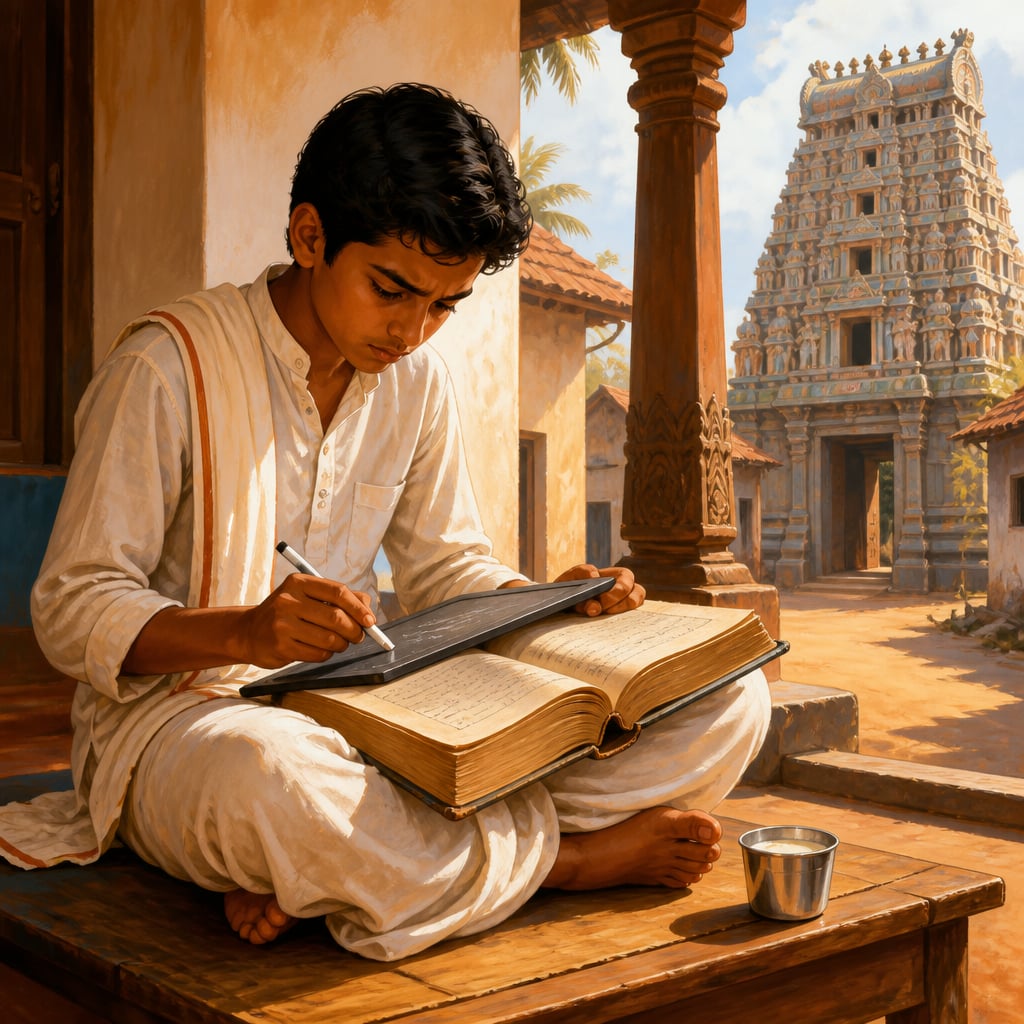
Young Ramanujan with Carr's Synopsis

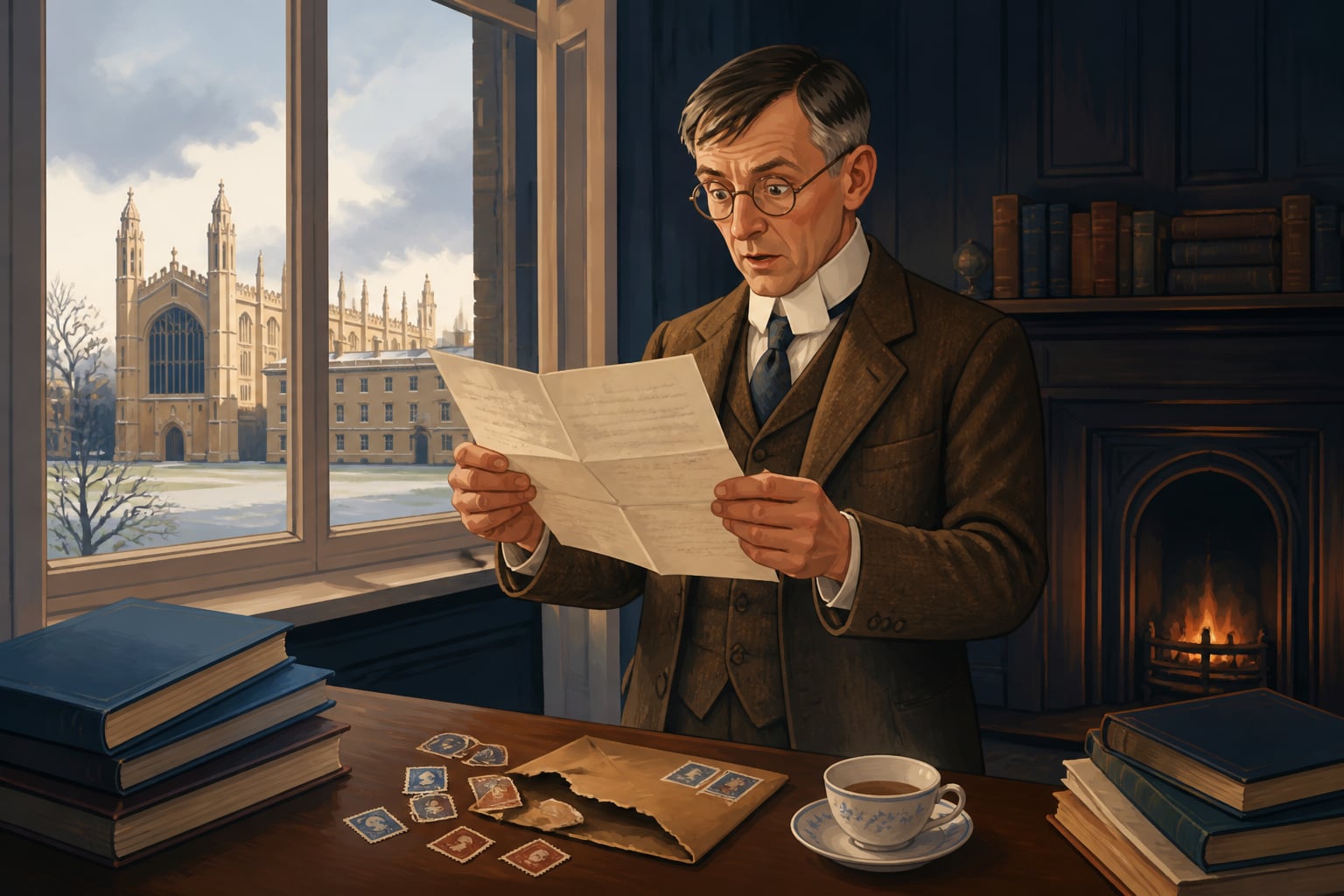
Hardy reading the nine-page letter at Trinity

Hardy, who at the time was widely regarded as the finest pure mathematician in England, received the letter, glanced through it, and almost threw it away. The formulas were so strange and so bold that his first reaction was to suspect a hoax, or a crank, or a lazy copyist working from a book of published results. But something about the letter would not let him rest. That evening he showed it to J. E. Littlewood, his frequent collaborator, and the two men sat up past midnight trying to prove or disprove the claims. By the early hours they had reached a conclusion that Hardy would later write into the history of mathematics. The theorems had to be true, because, as he put it, no one could have the imagination to invent them. The unknown clerk in Madras was the real thing.

This is the story of how he got from one place to the other.

A Boy in Kumbakonam

Srinivasa Ramanujan was born on 22 December 1887 in Erode, Tamil Nadu, and grew up in the temple town of Kumbakonam, where his father worked as a clerk in a sari shop. The family was Iyengar Brahmin, Śrīvaiṣṇava by tradition, and poor. They lived in a small house on Sarangapani Sannidhi Street, next to the great Sārangapāṇi temple whose gopuram Ramanujan could see from his doorstep every morning. His mother, Komalatammal, was the unshakable center of the household. She sang devotional songs in the temple, managed the family's religious life, and raised her son on a steady diet of Vaiṣṇava piety and stubborn conviction that he was meant for something large.

Ramanujan's early schooling was unremarkable for its form and remarkable for its results. He sat the Madras Presidency primary examination in November 1897 and stood first in the district. By the time he was eleven he was teaching senior students arithmetic problems they could not solve on their own. By thirteen he had borrowed a copy of S. L. Loney's Trigonometry from an older friend and was working out problems on the blank sides of its pages. By fifteen he had been handed, by a friend of the family, the book that would define the rest of his life.

The Strange Education

The book was George Shoobridge Carr's A Synopsis of Elementary Results in Pure and Applied Mathematics, published in London between 1880 and 1886. It was not, by any contemporary account, a good textbook. It was a two-volume list of roughly five thousand theorems, briefly stated, mostly without proof, arranged in the style of a cram manual for students preparing for the Cambridge Mathematical Tripos of thirty years earlier. Anyone receiving a modern mathematical education in 1903 would have dismissed Carr as a curiosity of the previous century. Ramanujan received him as the entirety of his mathematical curriculum.

And then he did what a serious student of a list of unproved theorems has to do. He began working out the proofs himself. For each claim in Carr, he sat with a slate and a stub of chalk, derived the result from whatever he already knew, and moved on to the next. When his work filled the slate he erased it with his elbow and kept going, because paper was expensive. He did this for roughly five years. By the end, he had not only reconstructed Carr's five thousand theorems; he had extended many of them, generalized others, and produced three thick notebooks of his own results. The notebooks are still preserved at the University of Madras and have been published in facsimile editions by the Tata Institute of Fundamental Research. Each page is a window into a mind that taught itself calculus, number theory, infinite series, continued fractions, and hypergeometric functions almost entirely without an interlocutor.

What the wrong textbook did for Ramanujan was paradoxical. Because Carr gave no proofs, Ramanujan had to invent his own, which meant his command of each result ran far deeper than a cram-book student's would have. Because Carr was thirty years out of date, Ramanujan worked through a slightly older version of mathematics in idiosyncratic, self-taught ways that let him see patterns a modern curriculum would have smoothed over. The book that made him a mathematician would have stopped almost anyone else. He drew strength from the fact that no one was there to tell him his results had already been proved by someone else a century earlier, because most of them had not.

The Lost Years

The formal educational system did not reciprocate Ramanujan's devotion. He won a scholarship to the Government Arts College in Kumbakonam in 1904 and lost it the following year when he failed every subject except mathematics, because he had stopped attending any class that was not mathematics. He won a second scholarship to Pachaiyappa's College in Madras in 1906 and lost that one too for the same reason. His family tried to steady him with marriage in 1909, to a ten-year-old bride named Janaki Ammal. It did not stop the notebooks. Between 1905 and 1912, Ramanujan was essentially unemployed. He tutored occasionally, wrote occasionally to mathematicians in Madras, suffered repeated periods of illness, and always, always filled notebooks. He was repeatedly rejected for clerical positions because he had no degree to list on the application.

The break came through Indian patrons who saw what the scholarship committees had missed. V. Ramaswamy Iyer, a tax collector who had founded the Indian Mathematical Society, gave Ramanujan a letter of introduction. R. Ramachandra Rao, the collector of Nellore, listened to his explanations of magic squares and elliptic integrals and quietly underwrote him with a stipend of twenty-five rupees per month for a year. In early 1912, Sir Francis Spring, chairman of the Madras Port Trust, offered him a clerk's position at thirty rupees per month. His immediate supervisor, Sir S. Narayana Iyer, was himself an accomplished mathematician and had been Ramanujan's silent supporter for years. For the first time, Ramanujan had a steady wage, quiet evenings after office hours, and a listener who could follow what he was saying.

The Letter and the Crossing

The letter to Hardy was not the first letter Ramanujan had sent to England. He had already written to H. F. Baker and E. W. Hobson, two senior Cambridge mathematicians, and had been ignored by both. Hardy was the third attempt. The letter was composed in collaboration with Narayana Iyer and the circle of Indian encouragers who had come to believe that Ramanujan's work had to be seen by someone in the imperial center. Together they selected which of his thousands of results to include, because Ramanujan's own instinct was to send everything. Hardy replied within weeks, asking for proofs and inviting him to Cambridge.

Komalatammal praying at the Namakkal hilltop temple

Ramanujan refused. Orthodox Tamil Brahmins of his caste could not cross the ocean on pain of losing ritual purity and their place in the community on return. Hardy wrote again, adjusting the terms, offering to cover every expense, pleading the cause. Ramanujan refused again. The crisis was resolved, in the end, by his mother. Komalatammal had a dream, she reported to the family, in which the goddess Namagiri of Namakkal stood by her son on a platform surrounded by Europeans and gave her explicit consent for the voyage. With the goddess's permission conveyed through his mother's dream, Ramanujan agreed to go. He sailed from Madras on 17 March 1914 aboard the S. S. Nevasa, arrived at Cambridge on 14 April, and began the five years of work that would make him, before his death at thirty-two in 1920, a fellow of Trinity College, a fellow of the Royal Society, and one of the most celebrated mathematicians of the twentieth century.

Why the Story Matters

The next six lessons of this chapter will unfold the mathematics: Namagiri's gift, the Hardy partnership, the partition formula, mock theta functions, the Lost Notebook, and the legacy that now runs through string theory, combinatorics, and modular forms. But the foundation is this journey. A boy in a Tamil temple town taught himself mathematics from a bad textbook. He spent seven years unemployed filling notebooks no one would read. He reached Cambridge only because a letter reached the third mathematician he tried and only because his mother dreamed of a village goddess giving her consent. Everything that comes after is a consequence of that one improbable arc. The chapter is called Ramanujan-Pratibhā, Ramanujan's genius, and the word pratibhā in Sanskrit names a flash of insight that comes unbidden. The story of how he got from Kumbakonam to Cambridge is the story of how one such flash, held inside one stubborn and devoted mind, finally found a listener.

Key figures

Srinivasa Ramanujan

22 December 1887 to 26 April 1920, Erode, Kumbakonam, Madras, Cambridge, and Kumbakonam again

G. H. Hardy

7 February 1877 to 1 December 1947, Cranleigh, Cambridge, and Oxford

Komalatammal

c. 1868 to 19 May 1931, Kumbakonam and Madras

Case studies

Carr's Synopsis: The Wrong Textbook That Made a Mathematician

In 1903, a friend of the Ramanujan family handed the fifteen-year-old Srinivasa a borrowed copy of George Shoobridge Carr's A Synopsis of Elementary Results in Pure and Applied Mathematics, published in London in 1886. Carr was a mathematics tutor in London who had assembled, over many years of coaching students for the Cambridge Mathematical Tripos, a two-volume list of roughly five thousand theorems from arithmetic, algebra, trigonometry, calculus, and classical analysis. The theorems were presented one after another in dense numbered paragraphs with minimal commentary. Most were stated without proof. Many were given without any hint as to why they were true or how they had been derived. The book was not well regarded in English academic circles. It was considered a cram manual, useful for stuffing a student's head with memorizable facts before an examination but nothing more. The Cambridge mathematicians of the 1880s had already moved well past the material Carr collected, and by 1903 the Synopsis was effectively a curiosity of the previous generation. This was the book that became Ramanujan's mathematical education. He had no other systematic textbook. He did not attend a university-level mathematics course in any regular way. He did not have a tutor. He had Carr, a slate, a piece of chalk, and roughly five years. He worked through the five thousand theorems one at a time, deriving each proof from whatever he had already mastered, erasing the slate with his elbow when it filled up, and moving on. By the end he had produced three manuscript notebooks containing not only reconstructions of Carr's results but thousands of his own new theorems, many of them in areas that Carr had barely touched.

The Indian tradition has a word for what Ramanujan was doing during those five years: svādhyāya, self-study. It is one of the five classical niyamas listed by Patañjali in the Yoga Sūtras, alongside purity, contentment, austerity, and surrender to the divine. Svādhyāya is not a lesser substitute for instruction by a teacher. It is a traditional observance in its own right, a discipline the practitioner takes up as a commitment, and it carries its own lineage of sanctity going back to the daily scriptural recitation of the Vedic householder. When Ramanujan sat with Carr's Synopsis and derived the proofs himself, he was not improvising because no better option was available. He was practicing an observance two thousand years old, and he was doing it in a religious framework that understood self-study as a legitimate source of knowledge rather than as a consolation prize for those denied a classroom. The wrongness of the textbook was, in the classical Indian framework, almost an asset. A textbook that handed him proofs would have let him pass over each result without understanding why it had to be true. Carr, by omitting proofs, forced him to own every claim. The book that would have defeated a lesser student became the book that made him.

Ramanujan's three manuscript Notebooks, compiled primarily between 1903 and 1914 while he worked through and extended Carr, contain an estimated 3,900 original results. A significant fraction of them were unknown to professional mathematics at the time, and many have required the tools of twentieth and twenty-first century mathematics to be fully understood. Bruce Berndt of the University of Illinois spent more than thirty years, from 1977 onward, editing and annotating the Notebooks in a five-volume Springer edition, and even that definitive work leaves some of Ramanujan's claims open. The badly chosen textbook produced, in the end, a body of work that is still generating new mathematics more than a hundred years later.

A sufficiently committed student can be educated by the wrong textbook. The constraint becomes a form of discipline. What destroys most people in that situation is the absence of external validation, not the absence of proofs. Ramanujan survived the absence of validation because his tradition had already named and honored the practice he was engaged in. If your work is svādhyāya, you do not need a teacher's permission to begin.

Carr's Synopsis contained roughly 5,000 theorems. Ramanujan's three Notebooks, compiled largely in response to it, contain roughly 3,900 original results. Bruce Berndt's annotated edition of the Notebooks runs to five volumes and more than 2,000 pages, and even it is not considered complete.

The Hardy Letter and the Two Unanswered Envelopes

Before Ramanujan's famous letter of 16 January 1913 reached G. H. Hardy at Trinity College, Cambridge, two very similar letters had already been sent to other Cambridge mathematicians. In 1912, Ramanujan had written to H. F. Baker, a distinguished professor of mathematics at St John's College, enclosing a selection of his results and asking for guidance. Baker had not replied. Later that same year, Ramanujan had written to E. W. Hobson, the Sadleirian Professor of Pure Mathematics at Christ's College, enclosing a similar selection and making the same request. Hobson had not replied either. These were the two most senior British mathematicians to whom a brilliant unknown Indian could plausibly write, and both had silently returned the envelopes to the unread pile. Ramanujan and his Indian encouragers, in particular Narayana Iyer and V. Ramaswamy Iyer of the Indian Mathematical Society, discussed what to do next. They settled on Hardy, whose reputation for unusual generosity of mind they had heard about through the small community of Indian mathematicians who read English journals. On 16 January 1913, Ramanujan sealed nine sheets of notepaper containing roughly 120 theorems into a fresh envelope and mailed it to Hardy at Trinity. Hardy received it a few days later. His first reaction was to suspect a hoax or a copyist, and he nearly dismissed it the way Baker and Hobson had. But the results looked original, and they were too strange to be invented by a crank. He showed the letter to Littlewood that evening. By the early hours of the following morning the two men had agreed that the theorems had to be real, and Hardy's reply, inviting Ramanujan to Cambridge, went out a few days later.

The Indian tradition has always understood that teaching is a two-sided relationship, not a one-sided broadcast. The adhikāra, the fitness to receive, is not only on the student's side; it is also on the teacher's. A teacher who cannot recognize a gifted student when one appears is as fundamentally incompetent as a student who cannot follow a lesson. Baker and Hobson were not bad mathematicians. They were simply failing the adhikāra test of the senior. When the letter arrived, they did not have the receptive capacity to see what was in it, and so it passed them. Hardy passed the test, just barely. His first instinct was also to dismiss the letter. But he was willing to be overruled by the mathematics itself, and willing to stay up all night with Littlewood to check whether the strange formulas could actually be true. The difference between Hardy and his two predecessors is not that Hardy was smarter. It is that he was, at the relevant moment, more willing to be surprised. In the Indian frame, this is a property of the teacher's character, not of his intellect, and it is precisely the quality the classical tradition names as the mark of a worthy guru. A teacher who cannot be surprised by a student's insight cannot transmit knowledge, because the transmission requires the teacher to let the student teach him something in return.

Hardy's reply of early February 1913 initiated the correspondence that would bring Ramanujan to Cambridge in April 1914. The partnership that followed produced the Hardy-Ramanujan asymptotic formula for the partition function, multiple joint papers on analytic number theory, and Ramanujan's election to the Royal Society in 1918 at the age of thirty. None of this would have happened if any of the three letters had been opened by someone willing to see what was in them, and all of it depended on the third letter being opened by someone who was. Baker and Hobson are now remembered in the history of mathematics primarily for having not replied.

If the right person does not answer, send the letter to the next person. The system is not merit-based from the recipient's side. The envelope that gets opened is the one that reaches a reader who is willing to be surprised. Keep sending the letter until you find that reader, and do not assume the first two silences mean the work is unworthy.

Ramanujan mailed at least three letters to Cambridge mathematicians between 1912 and January 1913. Two (to Baker and Hobson) went unanswered. The third (to Hardy, dated 16 January 1913) was answered within weeks and led to Ramanujan's arrival at Cambridge fifteen months later. The margin between mathematical obscurity and the Royal Society was the single decision of the third recipient to take the envelope seriously.

The Lost Kumbakonam Years: Seven Years Unemployable

Between 1905 and early 1912, Ramanujan was, by every external measure, a failure. He had lost his scholarship at the Government Arts College in Kumbakonam in 1905 after failing every subject except mathematics, because he had stopped attending any class that was not mathematics. He had lost a second scholarship, at Pachaiyappa's College in Madras, in 1906 for exactly the same reason. He had no degree, which in the British educational system of colonial India meant he had no future as a clerk, a teacher, or even a railway inspector. Between these two academic failures and the end of 1911, he was essentially unemployed. He tutored occasionally, wrote letters to mathematicians in Madras asking for recognition, and received almost none. His family, in desperation, arranged a marriage in 1909 to Janaki Ammal, a ten-year-old girl from a nearby village, on the traditional theory that the responsibility of a wife would steady him into some practical line of work. It did not. He continued to fill notebooks with theorems that nobody was reading. He suffered recurrent illnesses, including a serious bout of illness in 1909 that required surgery his family could barely afford. He was repeatedly turned down for clerical positions because he could produce no degree and could not answer the non-mathematical parts of the interview. During this entire period, he was producing the mathematical results that would later be called the early Notebooks, including large parts of what would eventually constitute his letters to Hardy. The most productive mathematical mind of his generation was, for seven consecutive years, unhirable.

The classical Sanskrit word for this kind of sustained, ignored, self-imposed discipline is tapas, which literally means heat, and which names the long quiet labor by which the seeker is transformed through continuous concentrated effort. Tapas is not suffering chosen for its own sake. It is the sustained application of heat to a task until the task yields. The tradition understands that tapas is often invisible to the outside world and that its fruits often arrive in a single moment of recognition after years of being ignored. The seven years Ramanujan spent in Kumbakonam and Madras between 1905 and 1912 were tapas in this precise sense. He was not being unproductive. He was being productive in a way the system around him had no apparatus to measure, and the system's failure to measure it was an external fact, not an internal one. When the Port Trust job arrived in 1912, followed by the Hardy letter in 1913 and Cambridge in 1914, these were not sudden lucky breaks. They were the fruits of tapas. They arrived because seven years of heat had made the person who would receive them, and the world finally happened to notice. The lesson the Indian tradition draws from this is that the heat has to be applied first, and the noticing comes later, and there is no way to arrange it in the other order.

The seven years of tapas produced, in concrete terms, the early manuscript Notebooks that Ramanujan carried with him to Cambridge and that Hardy would later describe as the most remarkable mathematical discovery he had ever made. Had Ramanujan been successful by the standards of the British Indian educational system (had he passed his English examinations, gotten a degree, and become a schoolmaster), he would almost certainly not have produced the same body of work. The same fate that looked like failure from the outside was, inside the notebooks, the thing that was making his mathematics possible. This is the part of the story that is most often misunderstood in modern retellings, which tend to treat his poverty and anonymity as obstacles that he overcame. They were not obstacles. They were the conditions in which his work took shape.

A period of being unhirable, ignored, and productive all at once is not automatically a failure. It may be the tapas phase of the work that cannot be produced any other way. The tradition has a word for it because the tradition has seen it before. If you are in such a phase, the question is not whether you are wasting your time but whether the notebooks are filling up. If the notebooks are filling up, the heat is doing its work.

The seven years from 1905 to early 1912 produced an estimated two of Ramanujan's three manuscript Notebooks. During the same period, his total formal employment amounted to a handful of short tutoring arrangements and a few temporary clerical stints, none lasting more than a few months.

Historical context

Late colonial India and the transition to the twentieth century (1887 to 1920)

The southern Indian world into which Ramanujan was born was shaped by the Madras Presidency's mix of Tamil Brahmin scholarly tradition, British colonial education, and the emerging Indian national movement. The Brahmin households of Kumbakonam maintained Sanskrit learning, Vedic recitation, and temple-centered religious life as the core of daily existence, while also sending their sons through British-model colleges to qualify for clerical and administrative positions in the colonial economy. Ramanujan's family was part of this community. His father worked as a cloth-shop clerk. His mother sang in the Sārangapāṇi temple. He attended the Town High School in Kumbakonam and studied English-medium mathematics from Loney and Hall and Knight before encountering Carr. The Indian Mathematical Society, founded in 1907 by V. Ramaswamy Iyer, was the small institutional structure that finally gave Ramanujan his first printed platform. The Society's journal published his first papers and connected him to the network of Indian patrons, including Ramachandra Rao and Sir Francis Spring, who kept him alive financially during his most precarious years.

The arc from Kumbakonam to Cambridge is the story of how Indian mathematical tradition, which had developed independently from Āryabhaṭa through the Kerala School to the nineteenth century, finally re-entered the international mainstream in a single dramatic moment of individual contact. The letter of 16 January 1913 is the most consequential single piece of correspondence in the modern history of Indian mathematics. It is also an object lesson in how much the reception of talent depends on accidents of attention. Two Cambridge mathematicians before Hardy had the chance to be the discoverer of Ramanujan. They missed it because they did not open their envelopes carefully enough. The third did, and the subsequent history of twentieth-century number theory, combinatorics, and modular forms is the result.

Living traditions

Ramanujan's legacy in twenty-first century mathematics is unusual for the sheer breadth of what his Notebooks have made possible. Bruce Berndt's five-volume edition of the three early Notebooks, completed over more than three decades, has opened lines of research in q-series, elliptic functions, and modular forms that are still being extended. The Lost Notebook, rediscovered by George Andrews at Trinity College in 1976, has driven much of the theory of mock theta functions, a subject completed in modern form only in 2002 by Sander Zwegers and carried further in the last two decades by Ken Ono, Kathrin Bringmann, and their collaborators. Ramanujan's work connects directly to modern physics through the Rogers-Ramanujan identities, which turn up in statistical mechanics, and through modular forms, which are central to string theory. The SASTRA Ramanujan Prize, the Ramanujan Mathematical Society, the Ramanujan Institute for Advanced Study in Mathematics, and the Abdus Salam International Centre for Theoretical Physics's Ramanujan Lectures all testify to the ongoing mathematical fertility of his results. His life has also become a cultural reference point outside mathematics, most famously through Robert Kanigel's biography The Man Who Knew Infinity (1991) and the 2015 film of the same name. More than a century after his death, Ramanujan is not a closed chapter. He is still actively generating mathematics, through the long delayed cashing-out of claims he wrote down in cheap Indian notebooks in the years his formal education was officially judging him a failure.

Reflection

More in Ramanujan-Pratibha: The Genius Who Knew Infinity

All lessons in Ramanujan-Pratibha: The Genius Who Knew Infinity · Indian Mathematics: Ancient Genius, Modern Foundations course