Namagiri's Gift: Mathematics as Divine Revelation

How Ramanujan experienced mathematics as a spiritual vision

Discover Ramanujan's deep devotional connection to mathematics. He believed his formulas were gifts from Namagiri Thayar, the family goddess at the Namakkal temple, and that an equation had no meaning unless it expressed a thought of God.

Namagiri's Gift: Mathematics as Divine Revelation

In a rented room at 7 Trinity Street in Cambridge in the spring of 1914, a twenty six year old Tamil Brahmin mathematician sat at a small wooden desk by the window. He was writing equations in a school notebook in the same meticulous hand he had used as a clerk at the Madras Port Trust two years earlier. When his English colleagues asked him where his formulas came from, he would sometimes pause, put down his pen, and say, with complete calm and no sense of metaphor, that the goddess Namagiri had come to him in a dream and shown him a scroll on which the formulas were written. He meant it literally. The formulas were real. The dream was real. The goddess was real. And the British mathematician across the table from him, G.H. Hardy, who was one of the most rigorous thinkers in modern Europe and a committed atheist, would spend the rest of his life unable to fully reconcile what he had heard. Ramanujan's name for the source of his mathematics was Namagiri, and everything in this lesson starts from the simple, historically documented fact that he said so himself, often, clearly, and without embarrassment.
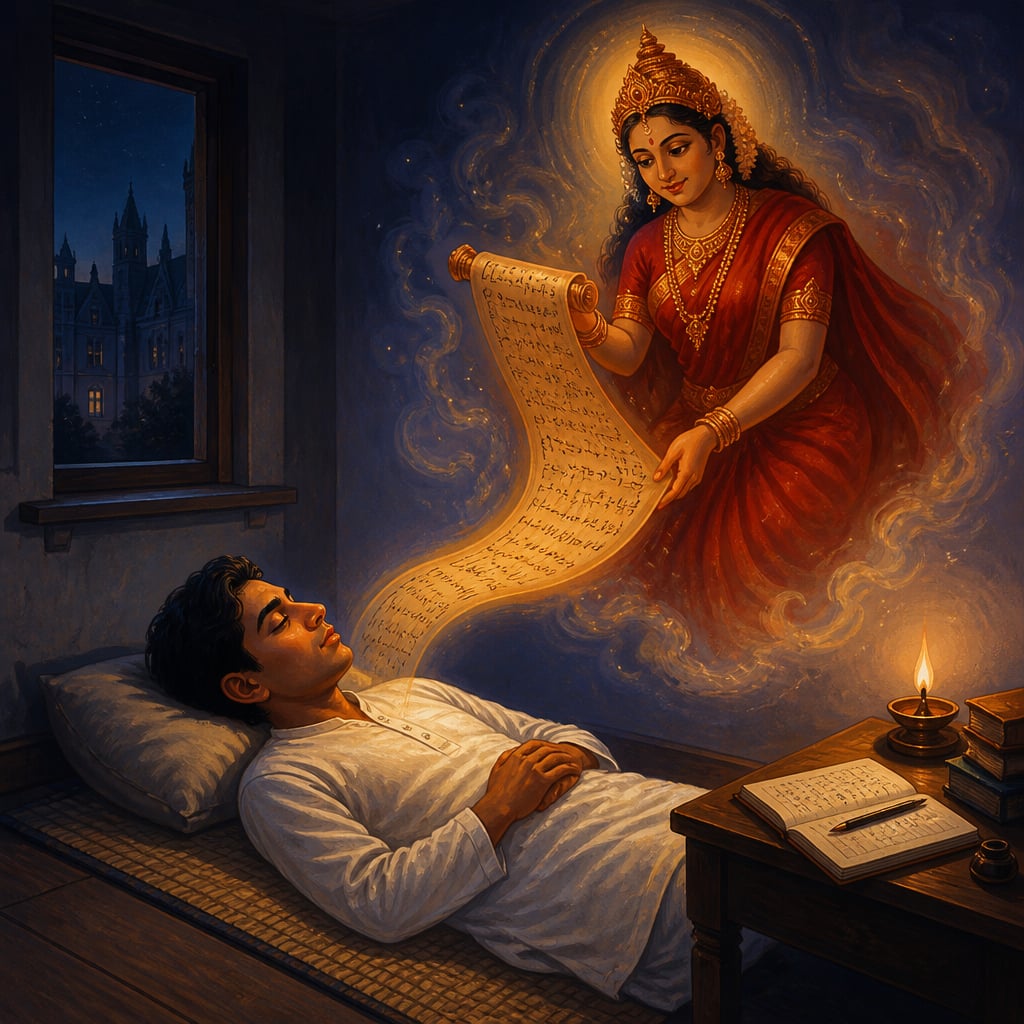
Namagiri Thayar dream vision

Who Is Namagiri Thayar?

Pilgrims ascending the Namakkal hilltop temple at dawn

Namagiri Thayar is a form of the goddess Lakshmi, the consort of Lord Narasimha, worshipped at the hilltop temple at Namakkal in western Tamil Nadu. The temple sits on a rocky outcrop in the middle of the town, and the sanctum is carved directly into the stone. Namakkal is one of the most important Vaishnava pilgrimage sites in south India, and Namagiri Thayar is the kuladevata, the family deity, of a number of Tamil Brahmin lineages in the region. The family of Srinivasa Ramanujan was one of them. His mother Komalatammal, a devout and traditionally learned woman, had prayed to Namagiri for a son and had received him, as she understood it, through the grace of the goddess. Ramanujan was named Srinivasa after his father and, by one family tradition, also after the same Srinivasa form of Vishnu whose consort Lakshmi presides at Namakkal. From his childhood he accompanied his mother on pilgrimages to the Namakkal temple, and the goddess was not an abstract symbol for him but a living presence woven through the ordinary fabric of his home life.

The Scrolls in the Dream

The most famous testimony comes from Ramanujan himself. He told several people, in several different contexts, that his formulas came to him in dreams. Sometimes he described a scroll unfurling before him with equations written on it in a clear hand. Sometimes he described a drop of blood on the tongue, a red spot in the dream from which the mathematics flowed. Sometimes he described the presence of Namagiri herself, or of the goddess's consort Narasimha, from whose tongue, he once said, the formulas came. He never treated this as a metaphor. When he reproduced the formulas on paper the next morning, they were exactly what he had seen in the dream, down to the individual notations. Hardy's colleague J.E. Littlewood, who knew Ramanujan well, wrote in his memoir that 'every positive integer was one of Ramanujan's personal friends' and that the source of his intuition was, in the Indian mathematician's own explicit framing, devotional. The other Cambridge Trinity Fellows found this bewildering. Ramanujan found it ordinary. For him it was the same source from which his mother drew her bhajans and from which the Brahmin tradition he had grown up in drew everything that mattered. The goddess provided, the mathematician received, and the mathematics on the page was the record of that reception.

The Famous Quotation

Ramanujan's best known single line on the subject was spoken to Hardy and is preserved in several forms in Hardy's own recollections. It is usually rendered: 'An equation for me has no meaning unless it expresses a thought of God.' The line is worth reading slowly. It does not say that all equations are divine. It does not say that equations are useful because they please God. It says that for Ramanujan, personally, an equation without a divine thought behind it was meaningless, the way a poem without an idea behind it is meaningless. His criterion of mathematical significance was not beauty, or utility, or elegance in the Greek sense. It was whether the equation expressed something of the nature of reality as he understood that reality, which was devotional to its core. This is not a religious embellishment on top of otherwise secular work. It is the single most accurate statement Ramanujan ever made about his own method. He was not doing mathematics the way Hardy was doing mathematics. He was doing a form of darshana, of devotional seeing, in which the formulas were the visible side of a reality whose invisible side had a name and a form and a temple at Namakkal.

The Passage to England

The most striking single piece of evidence for the depth of Ramanujan's belief is the story of how he came to England at all. In early 1914, Hardy and his colleagues at Trinity College Cambridge had arranged for Ramanujan to come to England so that he could work in direct collaboration with them. The one obstacle was religious. In the orthodox Tamil Brahmin tradition of the time, crossing the kala pani, the black water, was a serious violation of caste rules. A Brahmin who sailed to a foreign land would be excommunicated from his jati and could return only after elaborate purification rituals. Ramanujan's mother Komalatammal, who had raised her son inside this tradition and was the person most invested in preserving it, initially forbade him to go. She was the final authority on the matter, and the Cambridge arrangement was at a standstill. Then, according to the family account preserved in the biographies by Robert Kanigel and others, Komalatammal had a dream. In the dream she saw Ramanujan seated in a great hall of Europeans, and Namagiri stood behind her son, one hand on his shoulder, and told her not to stand in the way. She woke, gathered the household, and reversed her decision the same morning. Ramanujan sailed from Madras to London in March 1914. The voyage was permitted by the goddess before it was permitted by the mother. Whether you read this story as religious history, as family psychology, as the narrative a grieving mother later constructed to explain her consent, or as literal revelation, the historical point is the same. Ramanujan's entry into Cambridge, and therefore his entire contribution to world mathematics from that point onward, passed through a dream of Namagiri. It is impossible to tell the story of the Hardy Ramanujan collaboration without telling this story first.

Hardy, the Atheist, and the Indian Who Could Not Be Explained

Hardy walking the Cambridge Backs at sunset

G.H. Hardy was one of the most rigorously secular intellectuals in early twentieth century Britain. He regarded religious belief with a cheerful and unembarrassed contempt, and he wrote in his Mathematician's Apology that if he was remembered for anything it would be as the man who discovered Ramanujan, and that the discovery was a pure piece of mathematical luck with no divine assistance required. But Hardy was also honest. He acknowledged, repeatedly, that he did not understand where Ramanujan's intuition actually came from, and that the Indian mathematician's own account, the account involving Namagiri and the scrolls and the dreams, was one he could not either accept or dismiss. In Hardy's memoir of Ramanujan, written in 1940 twenty years after his younger colleague's death, there is a striking admission. Hardy writes that the formulas Ramanujan produced were so unlike anything in the European tradition that a secular explanation of them would require the existence of a mathematician more gifted than anyone the West had ever known, and that Ramanujan's own explanation, which Hardy could not believe, was at least self consistent. The atheist recognized that the devotional framing fit the data better than any secular framing available to him, and he was too honest to pretend otherwise.

What the Lesson Does Not Claim

This lesson is not an argument that mathematics is religious, or that all mathematical intuition comes from divine sources, or that Ramanujan's results can be derived by prayer. It is a much simpler claim. Ramanujan himself believed that his formulas were gifts from Namagiri, he said so repeatedly and on the record, and any honest account of his mathematics has to include this fact rather than quietly edit it out. The editing is the problem. For the better part of a century after his death, Western biographies of Ramanujan tended to treat the Namagiri framing as an exotic embellishment, a charming piece of local color to be mentioned once and then left behind on the way to the 'real' mathematics. That treatment misses the point. The devotional framing was not an ornament on the work. It was the soil in which the work grew, and Ramanujan himself identified it as such every time he was asked. Restoring it to its proper place is not an act of religious advocacy. It is an act of biographical honesty, and it is the correction this lesson asks the reader to make.

Modern Echoes

A hundred years on, the formulas Ramanujan said came from Namagiri are still doing new work. In 2002, Sander Zwegers at Utrecht finally cracked the structure of the mock theta functions Ramanujan had named on his deathbed. In 2012, the string theorist Atish Dabholkar and his collaborators showed that the same functions count quantum states of certain black holes. Ken Ono at the University of Virginia, who has spent his career inside Ramanujan's notebooks, has called the experience of watching dream-given formulas describe twenty-first century physics the spookiest thing in his mathematical life. The devotional source Ramanujan named is not a footnote modern scholars have outgrown. It is the framing under which work that is still ahead of us was first set down.

Back at the small wooden desk by the window at 7 Trinity Street, the Tamil Brahmin in the rented Cambridge room kept his pencil moving. The goddess he named has not been edited out of the work. The work is still arriving.

Key figures

Srinivasa Ramanujan

1887 to 1920, Erode and Kumbakonam in Tamil Nadu, Madras, and Cambridge

Komalatammal

c. 1865 to 1931, Tamil Nadu

Godfrey Harold Hardy

1877 to 1947, England

Case studies

The Namakkal Hill: Where a Mother Prayed and a Mathematician Was Born

In a small town called Namakkal in western Tamil Nadu, a rocky outcrop rises abruptly from the flat plain. On the top of the rock is a small natural cave, and inside the cave is the sanctum of a temple that has been continuously active for more than a thousand years. The presiding deity of the cave shrine is Narasimha Swamy, the lion headed incarnation of Viṣṇu, and his consort is Namagiri Thayar, a form of Lakṣmī who is regarded as the kuladevatā, the family goddess, of a number of Tamil Brahmin lineages in the region. In the late 1880s, a young Brahmin woman named Komalatammal made the pilgrimage to Namakkal with her husband Kuppuswamy. She had married into a family whose own kuladevatā was Namagiri, and she was asking the goddess for a son. By the family account she received a vision or a sign during the pilgrimage, and her son Srinivasa Ramanujan was born in Erode on 22 December 1887 as the answer to her prayer. Throughout his childhood in Kumbakonam, Komalatammal continued her visits to Namakkal and continued to frame her son's unusual gifts, his precocious mathematical ability, his quiet devotion, his long hours of solitary calculation, as expressions of the goddess's ongoing gift. By the time Ramanujan was an adult and producing original mathematics, his own identification of Namagiri as the source of his formulas was not a late religious gloss on secular work. It was the continuation of the same relationship his mother had opened on the rock at Namakkal twenty years earlier.

This is the kuladevatā relationship working as Tamil Brahmin tradition understands it. The goddess is inherited through the family line, she is petitioned for major life events, she is thanked when the petitions are answered, and the child who is born in response to the petition grows up understanding himself as a gift from the goddess rather than as an accidental individual. This is not a vague religious atmosphere. It is a specific, named, and traceable lineage of devotion that shapes every major choice in the life of the person who belongs to it. For Ramanujan, the Namagiri connection was the primary fact of his psychological and spiritual identity. It was older than his mathematics. It was older than his self conception as an adult. It was, in the literal family narrative, older than his own existence. When he said his formulas came from Namagiri, he was saying that the same source from which he himself came was now producing the equations through him. Both statements were equally literal from inside the devotional framework.

The Namakkal temple continues to be one of the most visited pilgrimage sites in Tamil Nadu, and among its most devoted visitors are mathematics students, teachers, and professional mathematicians from across India and increasingly from around the world. A small plaque near the temple entrance commemorates Ramanujan's family connection, and a number of Tamil Brahmin families continue to name Namagiri as their kuladevatā in the same continuous tradition in which Komalatammal prayed more than a century ago. The link between the temple and Ramanujan's mathematics is now an active part of the cultural and scientific identity of the region. It is also a reminder to the wider world that Ramanujan's devotional life was not an exotic personal eccentricity but the continuation of a living tradition in which millions of people still participate.

The most important thing a tradition can do for its members is to be ready when they arrive. Namagiri was available to Komalatammal because her family had been worshipping the goddess for generations. Namagiri was available to Ramanujan because his mother had taught him to approach her from infancy. The gift of the goddess was not a surprise intervention. It was a relationship that had been quietly prepared, generation by generation, long before the mathematician was born. When a tradition is kept alive with care, it becomes the channel through which grace reaches the next person in the line.

The Namakkal Narasimha Swamy temple is estimated to be over 1,500 years old and has been continuously active as a Śrīvaiṣṇava pilgrimage site throughout that period. Ramanujan's family connection to Namagiri Thayar as kuladevatā goes back at least three generations before his birth in 1887.

Trinity College Cambridge, 1914 to 1919: The Atheist Who Could Not Explain His Friend

Between March 1914 and March 1919, Srinivasa Ramanujan lived in rooms near Trinity College Cambridge and collaborated almost daily with Godfrey Harold Hardy. Hardy was the most rigorous pure mathematician in Britain, a founder of the modern Cambridge school of analysis, and a man whose atheism was not casual but ideological. He wrote in A Mathematician's Apology that religion was a historical curiosity with no bearing on scientific work. When he received Ramanujan's first letter in January 1913, he recognized within hours that the young Indian clerk who had sent it was a mathematical genius of the first rank. When Ramanujan arrived in Cambridge the following year, Hardy had to adjust to the fact that the genius in question was also a strict orthodox Śrīvaiṣṇava Brahmin who attributed every one of his formulas to a goddess whose temple was in Tamil Nadu. The two men worked together for five years. Hardy never accepted the devotional framing. Ramanujan never abandoned it. The tension between them was not polite avoidance but a real, ongoing intellectual puzzle for Hardy, who could not understand where the formulas actually came from and who was too honest to pretend that his own atheism provided a satisfactory answer. In his 1940 memoir Ramanujan: Twelve Lectures, written twenty years after his younger colleague's death, Hardy devotes several pages to this question and leaves it unresolved. He acknowledges that Ramanujan's own account fits the observable facts, that Ramanujan was constitutionally incapable of producing a dishonest report about his own experience, and that no secular theory of genius in Hardy's own tradition quite explains the specific character of Ramanujan's output. The memoir is one of the most honest documents a skeptic has ever written about a mystic.

Hardy and Ramanujan are, for this lesson, the two ends of a conversation between rationalism and bhakti that has been going on for centuries and shows no signs of being resolved. Hardy was a kind and decent man who loved Ramanujan personally and championed his work tirelessly. His atheism was not a failure of empathy. It was a genuine philosophical position that he held honestly, and he never pretended to understand what he did not understand. Ramanujan for his part never tried to convert Hardy and never softened his own framing to make it more palatable. He simply stated what he experienced and left Hardy to do with it what he could. The result is that the written record of their collaboration contains, side by side, the most rigorous secular analysis of Ramanujan's mathematics (Hardy's lectures and papers) and the most straightforward devotional account of its source (Ramanujan's own reported statements). Both are true from inside their respective traditions, and neither reduces to the other. Hardy's honesty, his willingness to say that the mystic's account fits the data better than his own, is the most valuable non devotional testimony we have. It is also a model of how a rationalist can engage with a devotional tradition without either condescension or surrender.

The Hardy Ramanujan collaboration produced a body of work, most famously the Hardy Ramanujan circle method for the partition function, that remains foundational in analytic number theory more than a century later. Hardy arranged Ramanujan's election as a Fellow of the Royal Society in 1918 and as a Fellow of Trinity College Cambridge the same year, at the age of thirty. Ramanujan returned to India in 1919 in declining health and died in 1920 at the age of thirty two. Hardy continued to champion and interpret Ramanujan's work for the rest of his own life and wrote the Twelve Lectures in 1936 specifically to preserve the full picture of Ramanujan's achievement for posterity. The memoir is still in print and still read. Its most striking passages are the ones where Hardy, the devout atheist, admits that he cannot explain his friend by the tools of his own worldview and that the devotional account must be taken seriously on its own terms even by a skeptic.

The highest form of intellectual honesty is the willingness to say that you do not understand something when your own framework cannot explain it. Hardy could have written Ramanujan into a purely secular narrative of genius and most of his colleagues would never have noticed. He chose instead to leave the devotional explanation intact in his memoir, even though he could not accept it, because it was what Ramanujan actually believed and what actually fit the observable facts. This is a discipline more demanding than either belief or disbelief. It is the discipline of letting the witness speak in his own voice, even when the voice says something your own tradition finds impossible.

G.H. Hardy and Srinivasa Ramanujan collaborated from March 1914 until Ramanujan's departure for India in March 1919, producing approximately twenty joint papers. Hardy's 1940 memoir Ramanujan: Twelve Lectures remains the single most cited source on Ramanujan's life, method, and devotional framing in the English language, and it is the primary source for the quotation that an equation had no meaning for Ramanujan unless it expressed a thought of God.

Neuroscience in the Twenty First Century: How to Read Ramanujan Without Reducing Him

In the early twenty first century, the study of creativity, insight, and the hypnagogic state (the drifting consciousness between sleep and waking) has become a serious subfield of cognitive neuroscience. Researchers have documented that many of the most famous moments of scientific insight in history occurred in dream or half dream conditions. August Kekulé saw the benzene ring as a snake biting its own tail in a reverie in 1865. Dmitri Mendeleev saw the periodic table in a dream in 1869. Otto Loewi saw the experiment that would prove the chemical basis of nerve impulses in a dream on Easter 1921 and had to go back to bed and dream it again to remember it. Nikola Tesla saw the alternating current motor in a walking vision in Budapest in 1882. In each case the inventor reported receiving the idea in a form that felt given rather than constructed. Modern neuroscience now has a partial vocabulary for describing what happens in these states. The default mode network of the brain becomes more active, divergent associative pathways open that are normally suppressed during goal directed thinking, and the prefrontal cortex relaxes its executive filter just enough to allow unexpected combinations to surface. This is not a complete account of creative insight, and no researcher would claim it is, but it is a real body of empirical work. When the same framework is applied to Ramanujan's reports of formulas arriving in dreams, the reports become less alien. They join a large class of documented historical cases of insight arriving in hypnagogic or dream states. What the neuroscience does not do, and cannot do, is adjudicate the devotional framing. It can describe the mental conditions under which the formulas surfaced. It cannot tell us whether Namagiri was present in those conditions or not. That question lies outside the scope of any imaging technology. It is a question for theology and personal experience, not for brain science.

The modern neuroscience framing and the traditional devotional framing are not rival explanations of the same data. They are two different kinds of explanation operating at two different levels. The neuroscience tells us about the hardware. The devotional account tells us about the encounter. A devotee of Namagiri would say that the goddess uses the brain's hypnagogic state as the natural channel through which her gifts arrive, and that this is no different from saying that a violinist uses the violin as the natural channel through which her music arrives. The channel is not the source, and the fact that the channel can be described in modern scientific terms does not eliminate the source. Ramanujan himself would have had no difficulty with this reading. The Bhagavad Gītā verses quoted earlier in the lesson already say that the Lord, abiding in the heart, gives buddhiyoga through the devotee's own understanding. The goddess working through the hypnagogic state is buddhiyoga working through the device that makes it possible. The modern science adds detail to the how. It does not contradict the traditional claim about the who.

The contemporary conversation about Ramanujan is increasingly able to hold both framings at once. Modern biographies by Robert Kanigel and Ken Ono include the devotional material without flinching or explaining it away. Modern papers in mathematics history, notably those of Bruce Berndt, who has devoted his career to proving the theorems in Ramanujan's notebooks, treat the Namagiri framing as a historical fact rather than as an embarrassment. Neuroscience of creativity research takes seriously the hypnagogic origin of many famous insights without claiming to have fully explained them. The lesson for the general reader is that the old dichotomy, either the mathematician was a secular genius whose religious talk was window dressing, or the mathematician was a mystic whose science was a miraculous exception, has been dissolved by more careful thinking on both sides. Ramanujan was both. He was a world class mathematician and a devout Śrīvaiṣṇava. The two are not in tension in his own testimony, and they need not be in tension in ours.

When two explanations of the same phenomenon come from different traditions, the first instinct is to ask which one is right. The more useful instinct is to ask which level each explanation is operating on. Neuroscience and bhakti are not competing for the same slot. They are describing different aspects of the same event. The hardware and the encounter. The device and the caller. The brain state and the goddess. Holding both at once is the discipline of a mature mind, and Ramanujan's life is one of the best places in history to practice it.

A 2015 meta analysis of creative insight in the default mode network, published in the journal Consciousness and Cognition, cited historical hypnagogic discovery cases including Kekulé, Loewi, and Ramanujan. Modern neuroscience increasingly treats dream state mathematical insight as a documented phenomenon, though it makes no claim about the ultimate source of the insights themselves.

Historical context

The last years of British colonial India and the early decades of the twentieth century, bridging the traditional Tamil Brahmin world of Kumbakonam and Namakkal with the early modern British university system at Cambridge

Ramanujan's formative years were spent entirely inside the traditional Tamil Brahmin world of the Cauvery delta and the Kongu region of Tamil Nadu. His home in Kumbakonam was a traditional agraharam house, a Brahmin street home with a small inner courtyard, a tulsi plant, a daily ritual schedule, and frequent pūjā. Sanskrit hymns were chanted every morning and evening. The day was punctuated by the offerings to the household deities, the family idol of Narasimha, and the recitation of the Sahasranāma. His mother Komalatammal was fluent in Tamil devotional literature and knew by heart many of the verses of the Āḻvār poets. Pilgrimages to Namakkal, Srirangam, Thanjavur, and other Śrīvaiṣṇava shrines were regular family events. In this environment, the distinction between mathematical work and devotional work would have been almost unintelligible. Both were forms of attention given to the same underlying reality. The compartmentalization that a modern Western observer instinctively applies to the two categories did not exist in Ramanujan's world, and his reports of receiving formulas from Namagiri are not a blending of categories but a statement made from inside a single integrated worldview in which no such blending was needed. The colonial English language education Ramanujan received at Kumbakonam's Town High School introduced him to Western mathematical forms but did not displace this underlying devotional framework. He went to Cambridge as a Śrīvaiṣṇava Brahmin who happened also to be a world class mathematician, and he returned to India in 1919 as the same person, unchanged in his religious identity even though transformed in his mathematical reach.

This lesson refuses to sanitize Ramanujan into a secular genius whose religious talk was a charming eccentricity. It insists that Ramanujan himself identified the source of his mathematics as Namagiri Thayar, that he did so repeatedly and consistently throughout his life, that his mother Komalatammal received a direct revelation permitting his voyage to Cambridge, and that even G.H. Hardy, the committed atheist, was honest enough in his 1940 memoir to admit that he could not explain the Indian mathematician's intuition by secular means and that the devotional account fit the facts better than any alternative available to him. Taking this seriously does not require the reader to share Ramanujan's devotional framework. It requires only the biographical honesty to let the testimony stand in his own words. The alternative, treating the Namagiri framing as an exotic ornament to be mentioned once and set aside, has been the Western default for more than a century, and it has systematically distorted the historical picture of one of the greatest mathematicians in world history. This lesson is the small act of correction that restores Ramanujan to his own story.

Living traditions

Ramanujan's devotional framing of mathematics has, over the past thirty years, moved from the margins of his biographical story to the center. Robert Kanigel's 1991 biography The Man Who Knew Infinity took the Namagiri material seriously and did not explain it away. The 2015 film adaptation of the same book, starring Dev Patel as Ramanujan and Jeremy Irons as Hardy, gave the devotional elements a full and respectful treatment in a way no earlier mainstream portrayal had done. Bruce Berndt and his collaborators at the University of Illinois have spent more than four decades systematically proving the theorems in Ramanujan's notebooks, and their published volumes explicitly credit the Śrīvaiṣṇava context as part of the historical record. Ken Ono, one of the leading modern number theorists, has written and lectured publicly on his own personal debt to Ramanujan's religiously framed insights, and has organized several international conferences on the continuing relevance of Ramanujan's work in contemporary mathematics. In India, SASTRA University runs the Srinivasa Ramanujan Centre in Kumbakonam and awards the annual SASTRA Ramanujan Prize to outstanding young mathematicians. National Mathematics Day on 22 December is observed across India every year. In the twenty first century, taking Ramanujan at his word about Namagiri is not a fringe view. It is the scholarly mainstream, carried forward by some of the most rigorous mathematicians and biographers in the world. The devotional and the mathematical sides of his life are now treated, in the best writing on him, as a single integrated whole. That is the restoration this lesson has been working toward, and it is nearly complete.

Reflection

More in Ramanujan-Pratibha: The Genius Who Knew Infinity

All lessons in Ramanujan-Pratibha: The Genius Who Knew Infinity · Indian Mathematics: Ancient Genius, Modern Foundations course