Ramanujan's Living Legacy: From String Theory to AI
How a hundred-year-old genius continues to transform modern science
Discover how Ramanujan's work continues to impact modern physics (black holes, string theory), computing, and even artificial intelligence.
Ramanujan's Living Legacy: From String Theory to AI
Srinivasa Ramanujan died in Kumbakonam on 26 April 1920 at the age of thirty-two. He had been ill for years. He had written, in pencil, on whatever paper he could find, until almost the end. The last letter he sent to G.H. Hardy in Cambridge, dated 12 January 1920, contained a list of seventeen new functions which he called 'mock theta functions'. He gave examples, hinted at properties, and offered no proofs. He died fourteen weeks later. For the next eighty years, mathematicians had no idea what these functions actually were.
In 2002, a young Dutch mathematician named Sander Zwegers, working on his doctoral thesis at Utrecht, finally cracked the structure of the mock theta functions. They turned out to be the missing pieces of a deep theory connecting modular forms, harmonic Maass forms, and quantum field theory. Ten years later, in 2012, the string theorists Atish Dabholkar, Sameer Murthy, and Don Zagier showed that exactly these functions are the precise mathematical objects needed to count quantum states of certain black holes. A piece of mathematics scribbled by a dying man in a small town in Tamil Nadu had turned out to encode information about the interior of black holes. Ramanujan had been a hundred years ahead of physics.
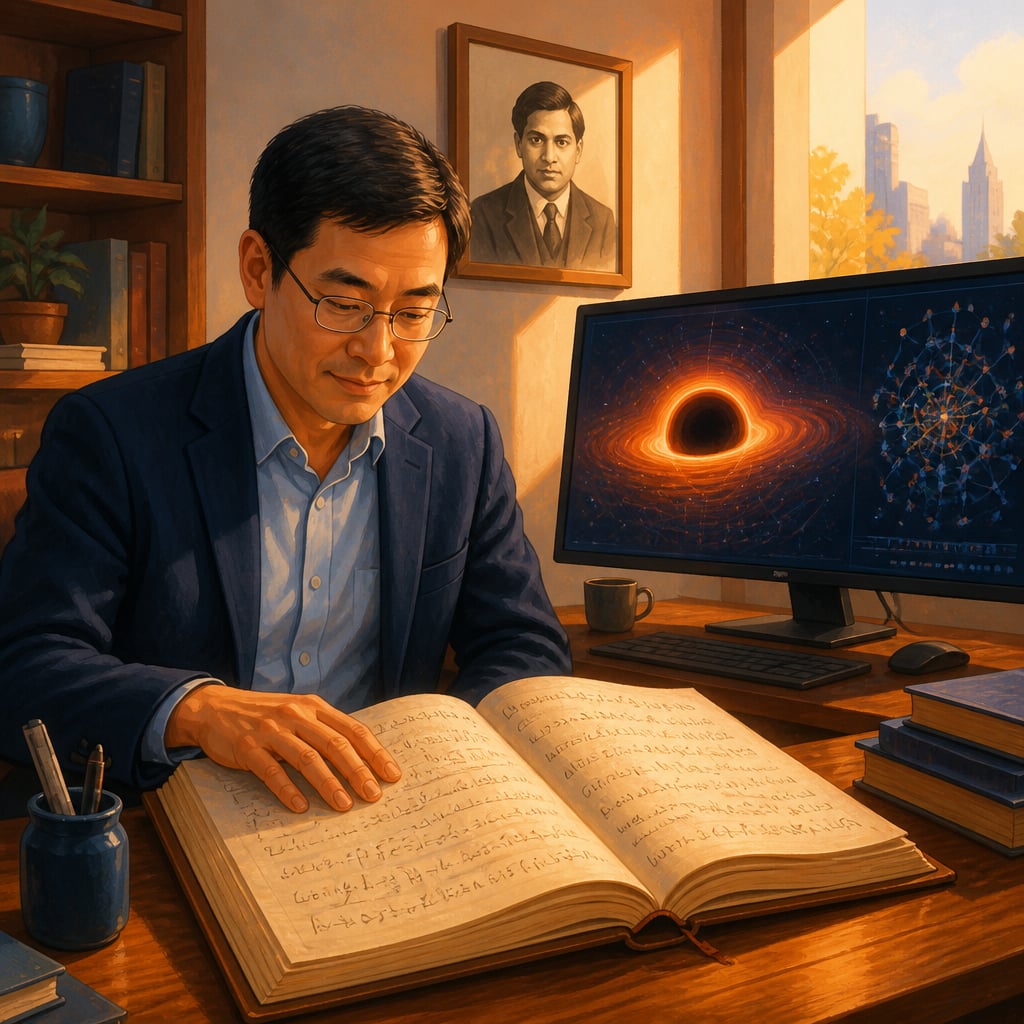
This is not an isolated incident. It is the pattern of his entire posthumous life. Wherever modern mathematics or physics has gone deep into a hard problem, it has tended to find Ramanujan's notebooks waiting for it.
The Notebooks That Keep Producing
Ramanujan filled three large notebooks with results during his years in India before going to Cambridge. He left a fourth, written during his final illness, which was lost for half a century until George Andrews of Pennsylvania State University rediscovered it in a box at the Trinity College library in 1976. The four notebooks together contain roughly four thousand identities, formulas, and conjectures, almost none with proofs. The proofs of these results have been an active research project for more than a century. As of 2026, every major identity in the notebooks has been proved, but the deeper structures they belong to are still being uncovered. The notebooks are not a closed book of historical curiosities. They are an active research frontier.
This is the unusual feature of Ramanujan's mathematics. Most great mathematicians produce results that are absorbed into the standard literature within a generation, after which their work becomes historical. Ramanujan's results have a strange property: they tend to be early sightings of structures that later mathematics develops independently and only afterward recognizes as Ramanujan-shaped. He was working on the answers before anyone else had asked the questions.
The Reach of the Work
Consider the breadth of fields where Ramanujan's ideas have become foundational.
In theoretical physics, mock theta functions and modular forms are now central to string theory, conformal field theory, and the counting of black hole microstates. The Dabholkar-Murthy-Zagier connection is not the only example. The Monstrous Moonshine conjecture, which links the Monster group of finite group theory to modular forms, has Ramanujan's tau function woven into its structure. Edward Witten and others have built quantum field theories whose partition functions are essentially Ramanujan series.
In computational mathematics, the world records for computing the digits of pi are all held by variants of an algorithm published by the Chudnovsky brothers in 1988, derived directly from a Ramanujan series of 1914. As of 2024, the Chudnovsky algorithm has been used to compute pi to over one hundred and five trillion digits. Every billion-digit calculation of pi in the modern world traces back to a single notebook entry from a clerk in Madras.
In computer science, Ramanujan graphs (a class of optimally efficient networks named for the deep connection to the Ramanujan tau function) are now standard tools. They are used in error-correcting codes, in randomized algorithms, in derandomization, in network routing, and in post-quantum cryptography. A pure-mathematics object from a 1916 paper became infrastructure for the modern internet.
In number theory, the Bhargava cube, the work of the 2014 Fields Medalist Manjul Bhargava on the composition of binary quadratic forms, traces a clear lineage from Gauss through Ramanujan into the present. Bhargava has spoken openly about the influence Ramanujan's work had on his own choice of problems.

And in artificial intelligence, the most striking development is the Ramanujan Machine. In 2021, a team of researchers at the Technion in Israel published a paper in Nature describing a system that automatically generates Ramanujan-style conjectures, relating constants like pi and e to continued fractions. The machine has produced previously unknown identities, several of which have since been proved by humans. Ramanujan is the only mathematician whose name is now used for an AI conjecture generator.
Why His Mathematics Is Different
There is a question that haunts everyone who studies Ramanujan: how did he do it? Hardy himself confessed that he could not really answer. Ramanujan worked, by his own account, by communing with the goddess Namagiri of Namakkal, who appeared to him in dreams and revealed scrolls of equations. He wrote down what he saw. He attributed nothing to himself. 'An equation for me has no meaning,' he is reported to have said, 'unless it expresses a thought of God.'
This is, by the standards of a modern Western philosophy of science, an embarrassing way to talk about mathematics. But the standards of modern Western philosophy of science also failed to predict mock theta functions, the Ramanujan tau function, or the Chudnovsky algorithm. Whatever Ramanujan was doing, it worked. He produced more correct, deep, fertile mathematical results in his short life than almost anyone before or since.
One way to read his life is as the modern reappearance of an older Indian intellectual disposition. The Aryabhatas, Brahmaguptas, and Madhavas of the classical tradition treated mathematics as a sacred discipline rooted in observation, ritual, and direct insight. Ramanujan, working in colonial Madras with no formal training and the family deity of his ancestors as his stated source, was not an aberration. He was a continuation. The Indian mathematical paramparā that began with Lagadha's Vedanga Jyotisha and ran through Aryabhata, Brahmagupta, Bhaskara, and Madhava had one more burst of brilliance left. Ramanujan was its twentieth-century manifestation.
What the Living Legacy Tells Us

The Indian mathematical tradition has been a continuous tradition for over three thousand years, from Lagadha's earliest astronomical reckonings to the Yuktibhasa's calculus proofs to the Ramanujan Machine's AI-generated conjectures. The thread does not break in 1947 with Indian independence. It does not break in 1857 with the colonial dismantling of indigenous education. It does not break in 1920 with Ramanujan's death. As long as Indian children are taught that this tradition is theirs, the thread will continue to be carried forward.
The most surprising thing about Ramanujan is not how much he produced. It is how much of what he produced is still ahead of us. The notebooks contain identities whose deeper meaning has not yet been understood. The mock theta functions are now connected to black holes, but no one knows what other physical structures they describe. The continued fraction conjectures of the Ramanujan Machine are still being proved one by one. Every year a new paper appears connecting some Ramanujan formula to some modern field that did not exist when the formula was written.
Back in the small house in Kumbakonam where Ramanujan finished the last letter on 12 January 1920, the pencil stopped fourteen weeks later. The sheets he had written on cheap paper, dying, with no library and no collaborators, are the same sheets that now seed string theory, AI conjecture engines, and unfinished chapters of twenty-first century physics. He did not see any of it. He sent it forward.
This is what a living mathematical tradition looks like. Not a museum of finished results, but a stream of insights that keep arriving from the past faster than the present can absorb them. The course you have just completed is, in a way, a description of how that stream began, how it ran, and where it is still flowing. The next chapter belongs to whoever picks up a pencil and continues the work.
Key figures
Ken Ono
born 1968, United States
Atish Dabholkar
born 1963, India
Manjul Bhargava
born 1974, Canada and India
Case studies
Black Hole Entropy from a Deathbed Letter
On 12 January 1920, fourteen weeks before his death, Srinivasa Ramanujan wrote his last letter to G.H. Hardy from Kumbakonam. The letter introduced seventeen new functions which he called 'mock theta functions'. He gave examples, listed transformation properties, and offered no proofs. He hinted that they were related to ordinary theta functions but were not themselves modular. He died before he could explain further. For more than eighty years, mathematicians treated the mock theta functions as a beautiful but isolated curiosity. They could verify the identities Ramanujan had written down but could not place them in any larger theory. In 2002, the Dutch mathematician Sander Zwegers, in his Utrecht doctoral thesis, finally identified them as 'holomorphic parts of harmonic Maass forms', placing them inside a broader theory of modular objects. Ten years later, in 2012, Atish Dabholkar, Sameer Murthy, and Don Zagier published a paper showing that exactly these functions are the mathematical objects that count quantum microstates of certain black holes in string theory. A piece of mathematics scribbled by a dying man in a small town in Tamil Nadu turned out to encode information about the interior of black holes.
From within the Indian intellectual tradition, the story is not paradoxical but expected. Ramanujan attributed his insights to direct sākṣātkāra, the immediate seeing of mathematical truth. His framing, that an equation has no meaning unless it expresses a thought of God, treats discovery as a glimpse of a structure that already exists rather than as the construction of something new. In a worldview where mathematical reality is not invented but seen, it is not strange that a result seen in 1920 should turn out, a century later, to describe physics nobody had yet imagined. The seeing was always of the same underlying object. The labels we attach (mock theta, harmonic Maass, black hole microstate) are the labels of our own slowly catching up. Ramanujan was not a hundred years ahead of physics. He was simply looking in the same direction physics would eventually look.
The 2012 Dabholkar-Murthy-Zagier paper has become a touchstone in both mathematical physics and the history of modern science. Mock theta functions and the broader theory of mock modular forms are now active research areas with applications in string theory, conformal field theory, and the geometry of moduli spaces. Sander Zwegers, the doctoral student who first cracked the structure in 2002, is now a professor at Cologne. The story is regularly cited in popular accounts of how mathematics anticipates physics. The mock theta functions of Ramanujan's deathbed letter have become one of the clearest historical examples of a result that was right but unrecognized for nearly a century, until the rest of mathematics caught up with the place from which it had been written.
The deepest results sometimes arrive in their final form long before the scientific context that can interpret them. Recognizing such results requires patience, humility, and the willingness to preserve and transmit work whose value is not yet apparent. The mock theta functions survived because Hardy preserved Ramanujan's last letter, because the Trinity College library kept the lost notebook, and because mathematicians for eight decades continued to study identities they could not yet explain. The future of any discipline depends on its willingness to safeguard the work of those who saw further than their contemporaries could follow.
Ramanujan introduced the seventeen mock theta functions in a letter dated 12 January 1920. The 2012 Dabholkar-Murthy-Zagier paper appeared exactly 92 years later in the journal Communications in Mathematical Physics. The connection had taken almost a century to be understood.
The Chudnovsky Algorithm: Trillions of Digits of Pi from One Notebook Entry
In 1914, Ramanujan published a paper containing several rapidly converging series for one over pi. One particular series, involving factorials, square roots, and a magic constant of 1103, converges so fast that each new term adds roughly eight more correct digits of pi. For seventy years the series was admired as elegant but impractical. Then, in 1988, the Ukrainian-American mathematician brothers David and Gregory Chudnovsky, working in their cluttered apartment in Manhattan with a homemade supercomputer they had built themselves, published a refined version of Ramanujan's series. Their formula adds approximately fourteen correct digits of pi per term and is the basis for every modern record-breaking computation of pi. As of 2024, the Chudnovsky algorithm has been used to compute pi to over one hundred and five trillion digits. Every billion-digit calculation of pi in the modern world traces back, through one or two refinements, to a single notebook entry by a clerk in colonial Madras.
Ramanujan's pi series is a continuation of a much older Indian fascination with computing pi. Mādhava of Saṅgamagrāma, around 1370 CE, gave the first known infinite series for pi (the Mādhava-Gregory series). Ramanujan, working in 1914, gave a series that converges hundreds of times faster than Mādhava's. The continuity is direct. The Indian mathematical tradition has been computing pi for fifteen hundred years, getting better at it with each generation, and Ramanujan is the modern peak of that lineage. The Chudnovsky brothers' contribution is to convert his series into machine-executable form for an era when supercomputers could exploit its convergence rate. They have repeatedly acknowledged the Ramanujan origin of their work.
The Chudnovsky algorithm holds every world record for the computation of pi from the 1990s through 2024. The most recent record, set by Solidigm and the StorageReview team in 2024, computed pi to over 105 trillion digits using the Chudnovsky formula on enterprise SSDs. The mathematics is the same Ramanujan series of 1914, with the constant 1103 unchanged. The algorithm appears in every reference text on computational mathematics and is a standard test for new high-precision arithmetic libraries. Its use continues to grow. Ramanujan's single notebook entry has, in the long run, become one of the most computationally productive results in the history of mathematics.
A formula that looks impractical in one technological era can become the central tool of another. Mathematical truth is not bound to the computational resources of the time when it is discovered. This is one of the strongest arguments for valuing pure mathematics on its own terms: its applications often emerge from technological developments that the original mathematician could not have anticipated. Ramanujan never saw a computer. His series now runs on machines whose operations per second are measured in trillions. The lesson is to invest in the mathematics now, in the trust that the technology will eventually catch up.
Ramanujan's 1914 series for 1/π adds approximately 8 correct digits per term. The Chudnovsky brothers' 1988 refinement adds approximately 14 digits per term. The 2024 world record using the Chudnovsky algorithm computed π to 105 trillion digits.
Ramanujan Graphs as Modern Computing Infrastructure
In 1916, Ramanujan published a paper introducing what is now called the Ramanujan tau function, a mysterious sequence of integers arising from the coefficients of a particular modular form. The function had no obvious applications at the time. In 1988, the mathematicians Alexander Lubotzky, Ralph Phillips, and Peter Sarnak (working independently in Israel and the United States) published a construction of a class of optimally efficient networks using deep properties of the Ramanujan tau function and the Ramanujan-Petersson conjecture. They named the new objects 'Ramanujan graphs' in his honor. A Ramanujan graph is a network with the maximum possible 'spectral gap' for its size, which translates into the most efficient possible information flow. They are now standard tools in computer science, with applications in error-correcting codes, randomized algorithms, derandomization, network routing, and post-quantum cryptography. A pure-mathematics object from a 1916 paper became infrastructure for the modern internet.
The pattern repeats. Ramanujan publishes a result in pure number theory, motivated entirely by aesthetic and theological concerns. Seven decades later, the result becomes the basis of practical engineering tools that did not exist in his lifetime. The Indian tradition has a phrase for this: arthasiddhi, the unintended fulfillment of purpose, where work undertaken for one reason turns out to serve a completely different one. Ramanujan undertook his mathematics as a continuation of his religious life. The fact that it became a building block of computer networks is, in the language of Indian thought, an unintended grace, a phala that nobody asked for and that arrived anyway. The modern computer scientist who uses a Ramanujan graph is participating, without knowing it, in a chain that began in a small shrine in Kumbakonam.
The Lubotzky-Phillips-Sarnak construction of 1988 has become a foundational result in spectral graph theory. The textbook 'Ramanujan Graphs' by Lubotzky and others is a standard reference. Modern variants have been used in the design of error-correcting codes, expander codes, randomness extractors, and post-quantum cryptographic schemes. The Ramanujan tau function continues to play a role in adjacent areas of theoretical computer science. The naming has done what naming usually does: it has carried Ramanujan's reputation into a discipline he never knew existed and made his name a daily reference for engineers who have probably never read the 1916 paper.
Naming matters. By naming a class of computer-science objects after Ramanujan, the mathematicians of 1988 ensured that every researcher in spectral graph theory and post-quantum cryptography would encounter his name in their daily work. The naming is not mere homage. It is a structural acknowledgment of where the underlying ideas come from. When you build on someone else's work, name it after them. The naming itself is part of the mathematics, because the names we use shape the lineages we recognize.
Ramanujan introduced the tau function in his 1916 paper 'On certain arithmetical functions'. The Lubotzky-Phillips-Sarnak Ramanujan graphs were constructed in 1988, exactly 72 years later. The objects are now standard tools in computer science, post-quantum cryptography, and theoretical communication theory.
The Ramanujan Machine: AI as Mathematical Apprentice
In 2021, a research team at the Technion in Israel led by Ido Kaminer published a paper in the journal Nature describing a computer system they called the Ramanujan Machine. The system uses pattern-matching and search algorithms to automatically generate Ramanujan-style conjectures: continued-fraction representations of fundamental constants like pi, e, and Catalan's constant. The machine has produced previously unknown identities, several of which have since been proved by humans. The naming was deliberate. Ramanujan's notebooks contain hundreds of identities that look like patterns generated rather than derived, and his characteristic mathematical instinct (recognizing deep relations between constants and elementary functions) is exactly the kind of intuition the team set out to mechanize. He is the only mathematician whose name is used for an AI conjecture generator.
There is something theologically interesting about this. Ramanujan attributed his insights to a goddess. A modern AI system named for him is producing, by automated search, the kind of conjectures he produced by what he called divine revelation. From within the Indian tradition, this is not a contradiction. The Upaniṣads describe knowledge as something seen, not constructed. Whether the seer is a human mind in deep meditation or a computer running an exhaustive search, what is being seen is the same underlying mathematical reality. The faculty differs. The object does not. The Ramanujan Machine is, in this view, a new kind of organ for sākṣātkāra, the direct presentation of mathematical truth, with its own characteristic strengths and blindnesses.
The Ramanujan Machine project has produced dozens of new conjectures since its launch, several of which have been proved by independent mathematicians and added to the literature on continued fractions. The project is open: anyone can run the search software and contribute computer time. The 2021 Nature paper drew widespread attention from both the mathematics and machine-learning communities and has been cited in discussions of AI-augmented science. Whether the machine will eventually produce a result of the depth and beauty of one of Ramanujan's own identities is an open question. What is no longer in doubt is that Ramanujan has become a permanent reference point in the ongoing conversation about how mathematical discovery actually happens, and whether machines can participate in it.
An individual mathematician's intuition can become a model for the next generation of automated systems. Ramanujan's particular gift, the rapid recognition of deep numerical patterns, turned out to be the most natural template for the first generation of AI conjecture generators. Other styles of mathematical thinking will inspire other systems. The lesson is that the great mathematicians of the past are not behind us. They are templates for the kinds of cognition we are still trying to understand and reproduce. Studying their notebooks is, increasingly, also a form of computer science.
The Ramanujan Machine paper was published in Nature on 4 February 2021. As of 2026, the system has produced dozens of new conjectures relating π, e, and Catalan's constant to continued fractions, several of which have been proved by independent mathematicians.
Historical context
The Posthumous Life of Ramanujan (1920 to 2026 CE)
Independent India has progressively reclaimed Ramanujan as a national figure of the first rank. The Indian government declared his birth anniversary, 22 December, as National Mathematics Day in 2012, on the centenary of his recognition by Hardy. SASTRA University at Kumbakonam acquired and restored his ancestral house as a museum and instituted the SASTRA Ramanujan Prize, awarded annually to a mathematician under 32 working in areas influenced by his work. Indian school curricula now mention Ramanujan alongside Aryabhata, Bhaskara, and Madhava as part of a continuous mathematical heritage. The 2015 film The Man Who Knew Infinity introduced his story to a global audience and was widely shown in Indian cities. The cultural reclamation is not yet complete but is firmly in motion.
The continuity of the Indian mathematical tradition is not an academic claim. It is a living thread that runs from Lagadha through Aryabhata, Brahmagupta, Bhaskara, and Madhava to Ramanujan and from Ramanujan into every laptop running the Chudnovsky algorithm, every cryptographic protocol using a Ramanujan graph, and every black hole physics paper computing microstate entropy. Studying this continuity is not nostalgia. It is the recognition that a culture which produced one such thread can, with the right cultivation, produce another. The next Ramanujan is presumably alive somewhere in India today, possibly under-resourced, possibly unrecognized. The question for our generation is whether we will notice in time.
Living traditions
Ramanujan's legacy is not confined to history books. It is encoded in software libraries computing pi to trillions of digits, in cryptographic protocols built on Ramanujan graphs, in string theory papers calculating black hole entropy with mock theta functions, in Manjul Bhargava's Fields Medal-winning work on quadratic forms, in the AI conjectures of the Ramanujan Machine, in the SASTRA Ramanujan Prize awarded each year to a young mathematician under 32, in the National Mathematics Day celebrated each year on 22 December, in the 2015 feature film that brought his story to global audiences, and in the daily teaching of mathematics in Indian schools where his name now stands beside Aryabhata, Brahmagupta, Bhaskara, and Madhava as part of an unbroken three-thousand-year tradition. The thread that began with Lagadha's earliest astronomical reckonings has not ended. It runs through Ramanujan and into every place where mathematical work is being done with patience, devotion, and the willingness to see further than one's contemporaries can yet follow.
- Ramanujan's House and Museum, Kumbakonam: The small ancestral house in which Srinivasa Ramanujan grew up and to which he returned in his final illness. The house has been restored and is maintained as a museum by SASTRA University. It contains photographs, facsimiles of his notebooks, and the simple rooms in which he worked. The street outside is named for him. A short walk leads to the Sarangapani temple where the Ramanujan family worshipped daily and where a young Ramanujan would have recited the Vishnu Sahasranama countless times. To stand in the room where the mathematics happened is the most direct experience of his life available.
- Namagiri Thayar Temple, Namakkal: The temple of Lakshmi Narasimha at Namakkal, where the goddess Namagiri Thayar is the consort of the man-lion form of Vishnu. Namagiri was Ramanujan's family deity and, by his own account, the source of his mathematical visions. He believed that she appeared to him in dreams and revealed equations on scrolls. The temple is one of the most important Vaishnava sites in western Tamil Nadu and the most direct pilgrimage destination for anyone moved by Ramanujan's story. The man-lion image at the inner sanctum is carved into the rock face of a hill.
- Trinity College, Cambridge: The Cambridge college where Ramanujan was elected a Fellow in 1918, the first Indian to receive the honor. He arrived in Cambridge in 1914 and worked with G.H. Hardy and J.E. Littlewood until his health broke down in 1918. The Wren Library at Trinity holds part of his correspondence with Hardy and the box in which George Andrews rediscovered the Lost Notebook in 1976. The college and the surrounding mathematical institutions of the University of Cambridge remain pilgrimage sites for any mathematician interested in Ramanujan's English years.
Reflection
- Where in your own life have you produced something whose value was not understood until much later, by you or by others? What kept you working on it during the period when its meaning was unclear?
- If mathematical truths are seen rather than invented, where are they seen from, and who is doing the seeing?
- A culture that produced Lagadha, Aryabhata, Brahmagupta, Bhaskara, Madhava, and Ramanujan in continuous succession over more than three thousand years has clearly been doing something right. What conditions make a tradition like this possible, and what would it take to make a similar tradition possible again in the next three thousand years?