Varahamihira's Five: Synthesizing World Astronomy
How a 6th-century scholar at Ujjain laid five rival astronomies side by side and built the first comparative science
In 575 CE Varahamihira wrote the Panchasiddhantika, a line-by-line comparison of five competing astronomical systems including Greek and Roman ones, ranked by accuracy and synthesized into a single working tradition. This lesson shows why that book is one of the earliest surviving works of comparative science anywhere in the world.
Five Skies on One Desk
In the middle of the sixth century CE, in the astronomical observatory on the banks of the Kṣiprā river at Ujjain, the court mathematician Varāhamihira sat down with five astronomical treatises laid out in front of him. Each gave a different length for the year. Each gave different periods for the planets. Each gave different rules for predicting eclipses. One, the Paitāmaha, was attributed to the ancient grandfather Brahmā. One, the Vāsiṣṭha, to the sage of that name. One, the Romaka, had come to India by sea from Alexandria and the eastern Roman empire and was spoken of at Ujjain in a technical vocabulary half-Sanskrit and half-Greek. One, the Pauliśa, carried the name of a teacher the later Persian scholar al-Bīrūnī would identify with the Alexandrian astronomer Paul. The fifth, the Sūrya, was a fresh Indian recension of older material that would later become canonical. Five rival systems. Five different skies. A working astronomer in a temple town could not use all five. He had to choose, or he had to reconcile.
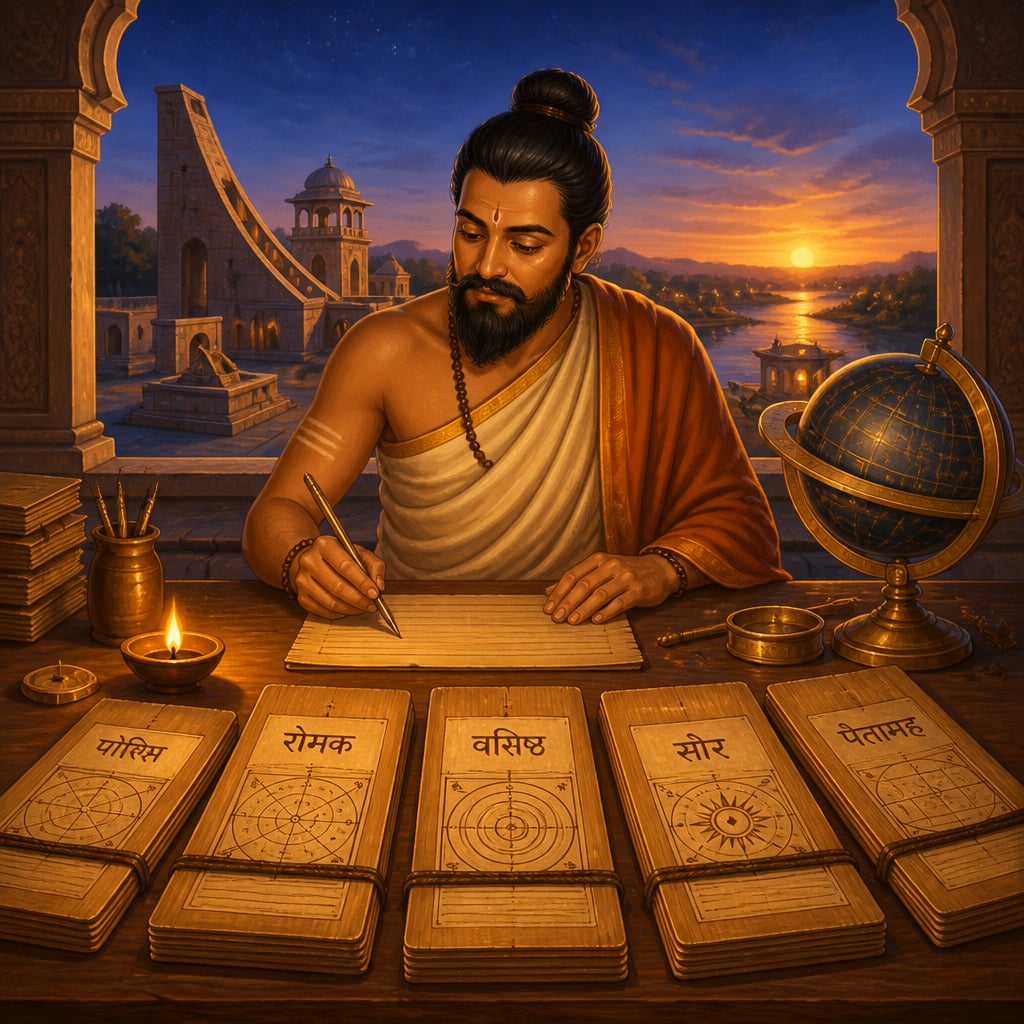
Varāhamihira did the hardest thing. He laid the five side by side, ranked them against observation, and wrote a synthesis. The resulting work, the Pañcasiddhāntikā, the Treatise on the Five Siddhāntas, is one of the earliest surviving works of comparative science anywhere in the world, and it is the single reason Indian astronomy after his time was more accurate than any of its individual sources.
Who He Was
Varāhamihira lived from roughly 505 to 587 CE, most of his working life spent at Ujjain, the astronomical and mathematical capital of classical India. Tradition places him as one of the Navaratnas, the nine jewels, at the court of a king called Vikramāditya. The historicity of the title is debated, but the mathematical record is not. Varāhamihira produced three major works that any serious student of Indian science still has to read. The Pañcasiddhāntikā on mathematical astronomy. The Bṛhat Saṃhitā, an encyclopedia of natural science, civil engineering, meteorology, gem-craft, and astronomy-adjacent topics. And the Bṛhajjātaka, the canonical Indian text on horoscopy. The first is our subject here.
The Five Siddhāntas
By the mid sixth century, Indian mathematical astronomy was not a single tradition. It was at least five competing schools, each with its own parameter values for the length of the year, the periods of the planets, the diameters of the sun and moon, and the rules for predicting eclipses. Varāhamihira named them.
First, the Paitāmaha Siddhānta, the old tradition, attributed to the ancient grandfather Brahmā himself. It preserved pre-classical values and was the least precise of the five.
Second, the Vāsiṣṭha Siddhānta, attributed to the sage Vasiṣṭha, a slightly later refinement working from improved observations.

Third, the Romaka Siddhānta, the Roman treatise. Roma here means the eastern Roman empire, and the text carried astronomical parameters that had entered India through sea trade between the western Indian coast and Alexandria. Its year length of 365 days, 5 hours, 55 minutes, 12 seconds is, to a decimal place, the tropical year used by Hellenistic Greek astronomers.
Fourth, the Pauliśa Siddhānta, attributed to a teacher named Pauliśa. Al-Bīrūnī in the eleventh century identified him with the Alexandrian astronomer Paul, and whether that identification is exactly right or not, the parameters in this system line up closely with late Greek practice.
Fifth, the Sūrya Siddhānta, an early recension of the treatise that would later be canonized as the foundation of medieval Indian astronomy. It was the most accurate of the five and became the backbone of Varāhamihira's synthesis.
The extraordinary thing about this list is the list itself. Varāhamihira did not hide the foreign sources. He named Romaka and Pauliśa openly, gave their parameters, and treated them as serious schools worth studying. In the Bṛhat Saṃhitā he went further. He wrote that the Yavanas, the Greeks, though considered foreigners by ritual reckoning, had mastered this science and should be honored like sages, and that a Brahmin who combined their knowledge with his own lineage was the more worthy for it. Yavana in Sanskrit means 'Ionian', and the statement is the strongest surviving declaration in classical Sanskrit literature that foreign knowledge is to be judged on its merits and not on the purity of its source.
What He Did With Them
Varāhamihira's work was not a passive compilation. He ranked the five systems. He declared the Sūrya Siddhānta the most accurate, the Romaka and Pauliśa next, the Vāsiṣṭha after that, and the Paitāmaha the least. He then used the Sūrya as his base and cross-checked it against the others, adopting corrections from the Romaka where the Greek tradition was sharper and improvements from the Pauliśa where its methods for rising-time calculations proved superior. The result was not a sixth parameter set added to the five. It was a working synthesis of the best available values, explicitly documented so that later astronomers could see exactly what had been kept, what had been replaced, and why.
Along the way he did original work of his own. He refined the sine table, using a radius of 120 units and computing jyā values at intervals of 3°45′, a sharper grid than Āryabhaṭa's earlier table. He stated that the moon is illuminated by reflected sunlight, and he gave one of the earliest surviving Indian discussions of the distances of the sun and moon computed from parallax. He calculated the length of the year to within about a minute of the modern value and defended a method for predicting eclipses that later Indian astronomers adopted wholesale.
Why It Matters
The Pañcasiddhāntikā matters for two reasons beyond its specific contents.
First, it is one of the earliest works in world history that does what we now call comparative science. Lay the rival theories next to each other. Identify their differences. Test each against observation. Rank them. Synthesize. Varāhamihira did this in 575 CE, a thousand years before Tycho Brahe and Johannes Kepler would do something similar in Europe.

Second, it shows that classical Indian astronomy was not a closed system defending its own purity. It was a cosmopolitan discipline willing to cite Yavana and Roman sources, name them, and integrate them. Ujjain in the sixth century was, in modern terms, an open-source project with a clear maintainer. The maintainer was Varāhamihira, and the commit log he left behind is the Pañcasiddhāntikā.
When the Indian tradition went on to build its more famous later siddhāntas, from Brahmagupta's Brāhmasphuṭasiddhānta in 628 CE through Bhāskara II's Siddhānta-śiromaṇi in 1150 CE, it did so on a foundation Varāhamihira had already prepared. He had shown that there is more than one acceptable way to measure the sky, and that intellectual honesty about that plurality is a precondition for getting the answer right.
Key figures
Varāhamihira
c. 505 to 587 CE, Ujjain and the Avanti region of western India
Pauliśa (Paulus the Yavana)
Pre-sixth century CE, most likely late Hellenistic Alexandria
Utpala Bhaṭṭa
Tenth century CE, Kashmir
Case studies
Romaka and Pauliśa: The Sea Route from Alexandria to Ujjain
Between roughly the first and fifth centuries CE, the western coast of India was the eastern terminus of an intense maritime trade with the Mediterranean world. The Periplus of the Erythraean Sea, a Greek shipping manual from the first century CE, describes Roman ships arriving at Muziris and Barygaza carrying wine, glass, and coral, and leaving with pepper, silk, and gemstones. What the manual does not mention, but what Varāhamihira's Pañcasiddhāntikā preserves, is that the same ships carried astronomical knowledge. The parameters of the Romaka Siddhānta (a year of 365 days 5 hours 55 minutes 12 seconds) and the Pauliśa Siddhānta (rising-time methods and numerical tables) closely match late Hellenistic Greek practice documented in Ptolemy and his predecessors. Some time between the second and fifth centuries, a Greek-language astronomical text, probably in a form ultimately traceable to Alexandria, was translated or paraphrased into Sanskrit and took its place alongside indigenous works in the library of an Indian astronomer. By Varāhamihira's generation it had been absorbed into the working curriculum at Ujjain, and he had enough fluency in it to judge its accuracy against the Sūrya Siddhānta and incorporate its better values.
The Pañcasiddhāntikā is the surviving downstream evidence of a transmission event that the written record otherwise almost entirely loses. Nobody preserved the name of the Sanskrit translator who first rendered a Hellenistic manual into Indian technical vocabulary. Nobody preserved the name of the ship that carried the scroll. What survives is the embedded parameter values and the borrowed vocabulary, horā from Greek hōra, kendra from Greek kentron, lipta from Greek lepton. Varāhamihira handled this inheritance with open eyes. He named the Romaka and Pauliśa siddhāntas as two of the five authorities and he explicitly honoured the Yavanas as masters of the science. The Indian intellectual tradition did not treat borrowed knowledge as a threat to purity. It treated borrowed knowledge the way a working scientist treats a better instrument.
The Hellenistic parameters that entered Indian astronomy through the Romaka and Pauliśa channels became part of the mathematical substrate that Āryabhaṭa, Brahmagupta, and Bhāskara II would build on. The sine-based trigonometry that Indian mathematicians developed into the Mādhava series in the fourteenth century had one root in this sixth-century synthesis. The transmission was also bidirectional. Indian methods travelled back along the same trade routes and reached the Islamic world, and from there Europe, in the ninth century. Varāhamihira's willingness to acknowledge the Yavanas as sources is what makes the upstream half of that round trip visible to historians today.
A mature intellectual tradition is one that can import a better method without treating the act of import as a defeat. Ujjain in the sixth century had this maturity. The Pañcasiddhāntikā is the documentary record of it. When Varāhamihira named the Romaka and Pauliśa alongside the Paitāmaha and Vāsiṣṭha, he was setting a standard for how to be cosmopolitan in technical matters, and the standard is one we are still trying to meet.
The Romaka Siddhānta's value for the length of the tropical year, preserved in Pañcasiddhāntikā 1.15, is 365 days 5 hours 55 minutes 12 seconds. The modern value is about 365 days 5 hours 48 minutes 45 seconds. The Romaka figure is therefore accurate to within roughly 7 minutes, better than many values current in sixth-century Europe.
Al-Bīrūnī's Debt: India's Synthesizer Becomes the Model for a Muslim Scholar
In 1017 CE the Central Asian scholar Abū Rayhān al-Bīrūnī, then in the entourage of Sultan Maḥmūd of Ghazni, travelled to India. Over the next thirteen years he learned Sanskrit, collected manuscripts, interviewed pandits, and produced a book called Taḥqīq mā li-l-Hind, usually translated as the Kitāb al-Hind, the Book of India. The book is the most sophisticated comparative study of Indian science written by a non-Indian before the modern period. Its method is explicit. Al-Bīrūnī places Indian positions on astronomy, cosmology, and mathematics next to Greek and Islamic positions, describes each accurately from its own internal perspective, notes where they agree and where they differ, and then judges. The book he cites more often than any other Indian source is the Pañcasiddhāntikā, and the scholar he treats with the most visible respect is Varāhamihira. Al-Bīrūnī explicitly records that the Pauliśa Siddhānta in Varāhamihira's book is the work of 'Paulus the Greek of Alexandria', the identification that modern scholarship still discusses. He also quotes the Bṛhat Saṃhitā 2.15 verse on honouring the Yavanas and uses it to justify his own reciprocal honouring of the Indian sages.
Al-Bīrūnī's Kitāb al-Hind is the rarest kind of document: a work in which the method of one civilization is consciously modelled on the method of another. Varāhamihira's Pañcasiddhāntikā had shown how to handle five rival astronomical schools without favouritism. Al-Bīrūnī applied the same method to Indian science as a whole, with Islamic and Greek science as his comparison classes. Where Varāhamihira wrote that the Yavanas should be honoured like ṛṣis, al-Bīrūnī wrote that the Indians are 'excellent in accounts, calculations, and the exact sciences', and that any honest scholar must study them on their own terms. The intellectual lineage from sixth-century Ujjain to eleventh-century Ghazni is direct, and al-Bīrūnī was explicit about it. He had learned from Varāhamihira not only specific parameter values, but the discipline of taking a rival tradition seriously.
Al-Bīrūnī's work became the bridge through which much of Indian astronomical knowledge, including the values that Varāhamihira had preserved, reached the wider Islamic world and from there Christian Europe. The Pañcasiddhāntikā itself was never translated in its entirety into Arabic, but its parameters and its methods were summarized and paraphrased by al-Bīrūnī and by later astronomers in his tradition. The Ujjain synthesis, written in Sanskrit in 575 CE, is present inside Latin astronomical handbooks of the thirteenth century in the form of values whose origin was no longer remembered but whose numerical substance was intact.
A method of scholarship can travel further than the specific facts it proves. Varāhamihira's specific parameters eventually became obsolete. His method of comparing rival systems without prejudice did not. Four and a half centuries after the Pañcasiddhāntikā was written, al-Bīrūnī picked up the method and applied it again to a new set of rival traditions. The technique of the honest comparativist was Varāhamihira's most durable export.
Al-Bīrūnī's Kitāb al-Hind, completed around 1030 CE, cites Varāhamihira more than any other Indian mathematical author and quotes directly from at least three of his works: the Pañcasiddhāntikā, the Bṛhat Saṃhitā, and the Bṛhajjātaka. Edward Sachau's 1888 English translation remains the standard reference for following the citations.
JPL Ephemerides: A Global Pañcasiddhāntikā Running in Real Time
Every spacecraft NASA launches, every radio telescope that tracks a distant pulsar, and every ground-based observatory doing precision astrometry uses a single canonical set of planetary positions called the JPL Planetary and Lunar Ephemerides, maintained by the Solar System Dynamics Group at the Jet Propulsion Laboratory. The current production version, DE441, is a huge numerical integration spanning more than thirteen thousand years, fitted to observational data from dozens of independent sources. These sources include classical optical telescopes in the United States, Europe, Russia, and Japan, radar ranging to Mercury, Venus, and Mars from facilities in California and Puerto Rico, laser ranging to reflectors on the Moon placed by the Apollo and Luna missions, Doppler tracking of spacecraft at every planet, and radio interferometry at multiple frequencies. Each source has its own coordinate conventions, its own error model, and its own strengths and weaknesses. The JPL team does not average them naively. They rank the sources by quality for each epoch and each object, weight the observations accordingly, identify and discard outliers, and publish a single integrated ephemeris with explicit documentation of what was kept and what was adjusted.
This is the Pañcasiddhāntikā scaled up to the whole planet and executed in real time. Varāhamihira had five sources. The JPL team has dozens. Varāhamihira wrote in Sanskrit verse and published once in a lifetime. The JPL team writes in FORTRAN and publishes updated releases every few years. The underlying method is the same. Lay the rival measurements side by side. Judge each on its technical merits. Rank them. Integrate them. Document what you did. Varāhamihira's ranking of the Sūrya Siddhānta as the most accurate and his willingness to take corrections from the Romaka and Pauliśa where they were sharper is, in every important respect, the same act as the JPL team's decision to weight a Mars rover's Doppler tracks more heavily than ground-based optical data for certain epochs. The discipline of the comparative ephemeris is the discipline Varāhamihira founded.
The JPL ephemerides are the working foundation of modern planetary science. Every Mars landing, every comet intercept, every gravitational-wave electromagnetic counterpart search relies on them. The International Astronomical Union's Standards of Fundamental Astronomy software, the IERS Conventions, and the coordinate systems used by deep space navigation all trace back through the ephemerides to the observational synthesis that produces them. The Pañcasiddhāntikā was the earliest surviving example of this kind of synthesis. Fifteen centuries later, the same method is running continuously on racks of computers at JPL and is the reason a spacecraft can arrive at Jupiter within a few kilometres of its planned orbit.
The deepest lesson of Varāhamihira is that knowledge of the sky is a collective, cumulative, comparative discipline. No single observatory, no single school, no single tradition gets it right on its own. The best available answer at any time is the one that honestly integrates the best available measurements from wherever they happen to come. This is as true in the twenty-first century as it was in the sixth. The Pañcasiddhāntikā is the ancestor of the modern ephemeris, and the modern ephemeris is the Pañcasiddhāntikā's descendant.
The JPL DE441 ephemeris, released in 2020, covers the interval from roughly 13,200 BCE to 17,191 CE and is fitted to observations from more than a dozen major data classes including lunar laser ranging, planetary radar, Cassini spacecraft tracking, and Very Long Baseline Interferometry. It is, in Varāhamihira's terms, a modern pañca-siddhānta with the 'pañca' replaced by several dozen.
Historical context
The Ujjain Synthesis and the Second Wave of Indian Classical Astronomy (c. 500 to 600 CE)
Sixth-century Ujjain was the astronomical capital of the Indian subcontinent. It sat on the prime meridian of Indian geography, its tropic was used as the reference for solar declination, and its observatory tradition had been continuous since at least the time of the Śakas in the first century BCE. Varāhamihira worked in an intellectual environment that was cosmopolitan by necessity. Trade routes from the western coast brought Hellenistic and Roman ideas. Overland routes from the northwest brought Sāsānian and Central Asian influences. Southern sea routes connected to Southeast Asia. The court of the Avanti region, whether under the Aulikaras, the later Guptas, or a local Vikramāditya tradition, supported scholarship across all of these channels. This is why the Pañcasiddhāntikā could be written at Ujjain and nowhere else. The raw materials for the synthesis were all on one desk.
The Pañcasiddhāntikā is the earliest surviving work of comparative astronomy in the world. Before Varāhamihira, astronomers in India, China, Greece, and the Islamic world generally defended a single system. After Varāhamihira, at least in the Indian tradition, defending a single system without comparing it to its rivals was no longer acceptable scholarship. This shift, from orthodoxy to comparison, is one of the preconditions for science as we now practise it, and Varāhamihira made it six centuries before Alhazen and a thousand years before Galileo.
Living traditions
Varāhamihira's direct textual legacy lives on in the Pañcasiddhāntikā manuscripts preserved in collections at Pune, Varanasi, Thanjavur, and Trivandrum, and in critical editions published from Copenhagen, Delhi, and Madras during the last century. His comparative method lives on in every modern astronomical ephemeris, every standards body that reconciles observations from multiple sources, and every piece of software that has to merge upstream contributions from independent authors. The specific verse Bṛhat Saṃhitā 2.15, honouring foreign masters of a science, is quoted in Indian policy debates on scientific openness to this day. And the word jyā, which he refined in his sine table, has travelled through Arabic into Latin into every modern European language as 'sine', so that every scientific calculator on earth carries a distant memory of the Ujjain tradition Varāhamihira was trying to improve.
- Jantar Mantar, Ujjain: Ujjain was Varāhamihira's working city and the astronomical capital of classical India for more than a thousand years. The eighteenth-century Jantar Mantar observatory built by Maharaja Jai Singh II preserves Ujjain's continuous identity as a place where the sky has been watched and measured. The prime meridian of Indian geography once ran through Ujjain, and its tropic is still used as a reference in Indian astronomical tradition. Walking between the observatory and the Mahākāleshwar Jyotirlinga temple gives a feel for how scientific and ritual practice were integrated in the city of Varāhamihira.
- Kapittha (Kayatha) near Ujjain: Local tradition identifies Kapittha, in the modern village of Kayatha about twenty kilometres east of Ujjain, as Varāhamihira's birthplace. The archaeological site at Kayatha has Chalcolithic and early historic layers and has been excavated by the Deccan College team. There is a small memorial to Varāhamihira and the surrounding countryside preserves the agrarian landscape of the Avanti region his texts describe.
Reflection
- Think of a decision in your own work where several different sources, colleagues, frameworks, books, models, have given you conflicting advice. Have you truly laid them side by side the way Varāhamihira did with his five siddhāntas, or have you quietly defaulted to the one you already trust?
- Varāhamihira called the Yavanas foreigners by ritual reckoning and sages by their science. Does your tradition, whatever it is, allow you to hold those two judgements at once about the same people?
- Is comparison a form of humility or a form of ambition? Varāhamihira compared because he wanted a more accurate result, not because he wanted to seem balanced. Which of those motives drives the comparisons you make?