Eclipse Prediction: Mathematics Serving Dharma
How ritual requirements drove accurate eclipse calculation
Learn how the need to predict eclipses for ritual purposes drove increasingly sophisticated mathematical methods.
The Grandmother's Minute
Picture a child, call her Lakshmi, in a Telugu village on a summer morning, woken at four in the morning. Her grandmother is already awake. Today there is a grahaṇa, an eclipse, and the family will bathe in the river at the exact moment of first contact, chant the Āditya Hṛdayam through totality, and break their fast at the instant the sun is fully released. For any of this to have meaning, someone has to know, to the minute, when the eclipse begins, how long it lasts, and when it ends.
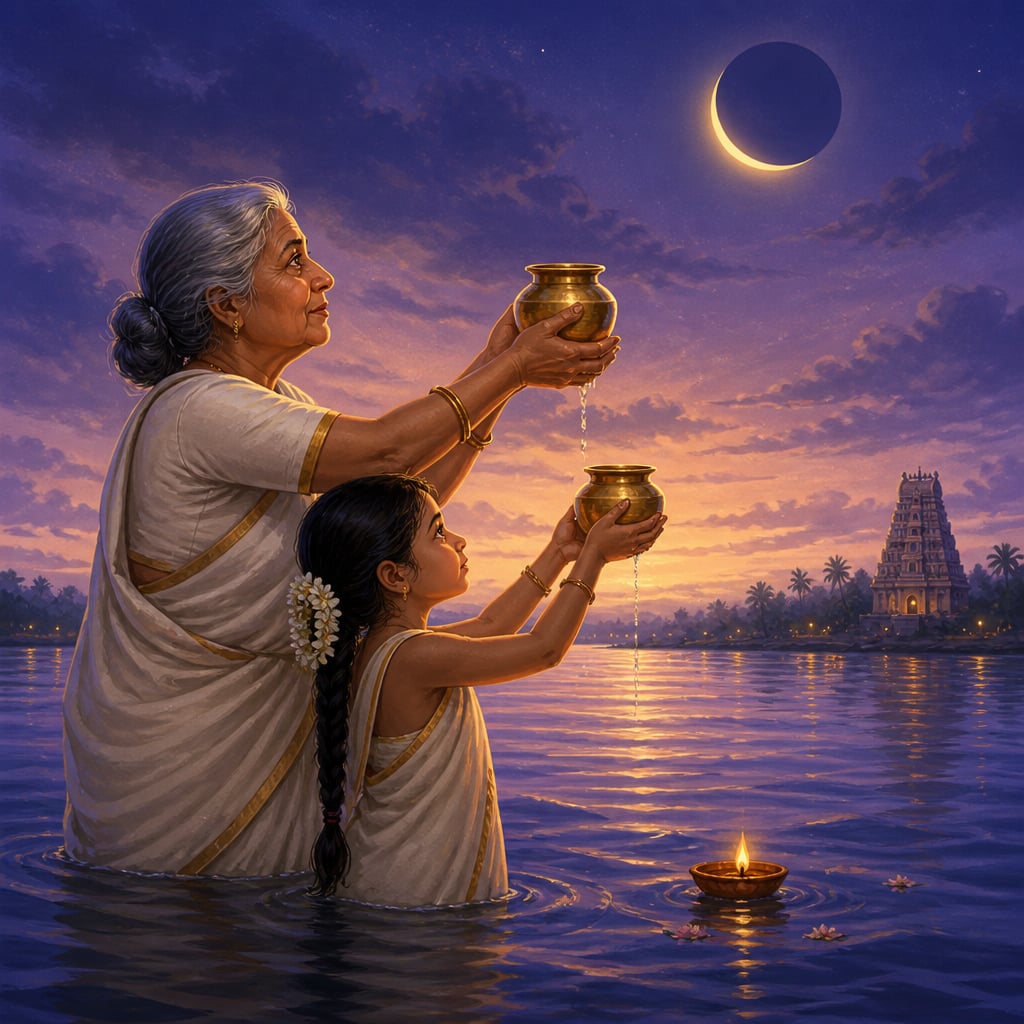
That someone is the author of the family's pañcāṅga, the local astronomical almanac. Behind the pañcāṅga stands fifteen hundred years of Indian mathematics. The timings printed in the grandmother's booklet are computed using algorithms that Āryabhaṭa wrote in 499 CE, refined by Varāhamihira and Brahmagupta, perfected by Bhāskara II, and corrected by Parameśvara and the Kerala school. They arise from a single radical decision. If dharma demanded that rituals be timed to the minute, then the mathematics would be good enough to deliver.
This is the thesis of the lesson. In India, astronomy became rigorous not despite religion but because of it. Dharma needed numbers. Numbers required geometry. Geometry demanded trigonometry. And trigonometry, pressed against the problem of predicting a shadow, forced Indian mathematicians to build tools the rest of the world would not have for another thousand years.
Why the Priests Needed the Mathematicians
Classical dharma śāstra treats an eclipse as a liminal moment of extreme ritual power. The texts prescribe a dense cluster of observances. Grahaṇa-snāna, bathing in a river at the moment of first contact. Cessation of cooking and eating. Recitation of specific mantras, especially the Gāyatrī, the Āditya Hṛdayam, and the Mahāmṛtyuñjaya. Charitable giving, dāna, at the moment of release. Śrāddha offerings to ancestors, believed to carry a hundred-fold merit when performed during totality.
Every one of these practices requires knowing, to the minute, when the eclipse starts, when totality begins, and when the shadow leaves. A priest who called the family to bathe before first contact, or who released them from silence after the shadow had already gone, was dishonoring dharma itself. The Sūryasiddhānta, the oldest surviving complete treatise of Indian mathematical astronomy, opens its eclipse chapter with the assumption that its calculations will be used to time exactly these rites.
The result is one of the most productive marriages of ritual and rigor in any civilization. Where Ptolemaic Greek astronomy computed eclipses mostly for philosophical curiosity, and Chinese astronomers computed them mostly for dynastic legitimacy, Indian astronomers computed them because a grandmother in every village needed the minute.
Āryabhaṭa's Revolution: Shadow, Not Serpent
The older Vedic and Puranic texts mythologize eclipses as the work of Rāhu and Ketu, demons who swallow the sun and moon. The Rigveda, more than three thousand years ago, already has a verse describing how the Asura Svarbhānu pierced the sun with darkness until the sage Atri restored its light. This is the world's oldest literary reference to an eclipse.

Āryabhaṭa, writing at Kusumapura near modern Patna in 499 CE, breaks decisively with the myth. In the Gola chapter of the Āryabhaṭīya, verse 37, he states plainly that the moon obscures the sun by passing in front of it, and the earth's great shadow obscures the moon. That is the entire mechanism. The demons are a story. The shadow is a calculation.
This single decision reshapes Indian astronomy. Once an eclipse is a shadow, prediction becomes a problem of geometry. You need the positions of the sun, moon, and earth. You need the inclinations of the orbital planes. You need the radii of the shadow cone at the moon's distance. Āryabhaṭa supplies all of this in verse, with the arithmetic and trigonometric machinery he had already developed for his sine tables.
Brahmagupta, writing a century later in the Brāhmasphuṭasiddhānta of 628 CE, publicly criticizes Āryabhaṭa for violating scripture. Yet Brahmagupta's own eclipse chapter, when you read the computation itself, uses Āryabhaṭa's shadow model. The orthodox language honors Rāhu. The working mathematics quietly builds on Āryabhaṭa. This is a pattern that repeats across Indian scientific history. The ritual vocabulary is preserved, the mechanism is quietly corrected.
The Five Elements of Eclipse Calculation
By the time of Bhāskara II in the twelfth century, the Indian eclipse algorithm has settled into five standard steps. In the Siddhānta Śiromaṇi, he lays them out with textbook clarity.
First, compute the true longitudes of the sun and moon at the predicted conjunction or opposition, using the mean motion corrected by manda (the equation of center) and śīghra (the synodic correction).
Second, compute the lunar parallax, both in longitude (lambana) and latitude (nati), because the eclipse is seen from a point on the earth's surface, not from its centre. This is the step that lets an almanac give locally correct timings for a village in Karnataka and another village in Assam.
Third, test whether the corrected moon actually enters the solar disk, or the earth's shadow cone actually catches the moon. If not, no eclipse is visible from here.
Fourth, compute the magnitude, the first contact (sparśa), the greatest obscuration (madhya), and the release (mokṣa), using the relative velocities of the two bodies across the sky.
Fifth, render the eclipse as a diagram so the priest can see at a glance the shape, orientation, and duration.
Every one of these steps is trigonometric. Every one depends on Āryabhaṭa's sine tables, Brahmagupta's interpolation formulas, and the iterative convergence methods that the Kerala school would later perfect. The ritual requirement drives the mathematical machinery. Remove the ritual urgency and the mathematics has no reason to be this careful.
Correction by Observation

The Kerala astronomers of the fourteenth and fifteenth centuries took a further step. Parameśvara, over a career spanning fifty-five years, systematically observed every visible eclipse against the predictions of the inherited Āryabhaṭan model. He recorded small but real discrepancies and published a corrected system which he named Dṛggaṇita, calculation matched to sight. This is the first formal observational reform of a major astronomical tradition anywhere in the world.
Dṛggaṇita is why a modern pañcāṅga, produced today in Thiruvananthapuram or Pune or Varanasi, can still deliver eclipse timings that match NASA's ephemerides within seconds. The dharma demanded the number. The number demanded observation. The observation refined the model. And the refined model is still running.
What This Means
Eclipse prediction is the purest example of what Jyotiṣa-gaṇita actually is. It is the mathematics of the sky, grown up in the discipline of the temple. It is not astronomy walled off from religion, and it is not religion indifferent to evidence. It is dharma and gaṇita braided together so tightly that the pañcāṅga in a grandmother's trunk is the visible surface of a thousand years of rigorous computation. When she tells the child to step into the river at 5:47 a.m., she is acting on a number that Āryabhaṭa wrote down, Bhāskara corrected, Parameśvara calibrated, and a modern almanacist printed. The river is old. The ritual is old. The mathematics is as careful as anything in the ancient world. And the three still belong to each other.
Key figures
Āryabhaṭa
476 to 550 CE, Kusumapura (modern Patna), Gupta era
Bhāskara II (Bhāskarācārya)
1114 to 1185 CE, Vijjalavīḍa (near Bijapur, Karnataka) and Ujjain
Parameśvara of Vaṭaśśeri
c. 1360 to 1455 CE, Vaṭaśśeri (modern Alathiyur, Kerala)
Case studies
Āryabhaṭa Demythologizes Eclipses (499 CE)
In 499 CE, a 23-year-old astronomer at Kusumapura (Pāṭaliputra) named Āryabhaṭa finishes a short Sanskrit treatise of 121 verses. In the last section, the Golapāda or chapter on the sphere, verse 37 states that the moon obscures the sun and the earth's shadow obscures the moon. Four words in Sanskrit, one mechanism, zero demons. The statement directly contradicts the Puranic teaching that eclipses are the work of Rāhu, the decapitated demon who periodically swallows the luminaries in revenge for the gods' theft of amṛta. Āryabhaṭa does not flinch. He goes on to show how, once you accept the shadow mechanism, you can compute the time, duration, and magnitude of an eclipse from the known motions of the sun and moon. The mathematics works. The predictions are verifiable. The demons are not needed for the algorithm.
A century later, Brahmagupta of Bhillamāla, writing the Brāhmasphuṭasiddhānta in 628 CE, publicly denounces Āryabhaṭa for this verse. In the chapter on the tantraparīkṣā (examination of systems), Brahmagupta calls Āryabhaṭa a liar for contradicting scripture. And yet, when Brahmagupta himself reaches the eclipse chapter, the actual computational algorithm he uses is Āryabhaṭa's. He keeps the demons in the ritual vocabulary, because the tradition around grahaṇa-snāna and eclipse-dāna will not tolerate their removal, and he keeps the shadow geometry in the computation, because the shadow geometry is what actually predicts the eclipse. This is the enduring settlement Indian astronomy reaches with orthodoxy. The old language is preserved. The new mechanism is quietly used.
Āryabhaṭa's shadow model did not overturn the Rāhu tradition. It sat beneath it, doing the actual work. Every major Indian astronomer from Brahmagupta (628 CE) through Bhāskara II (1150 CE) to Parameśvara (1431 CE) and Nīlakaṇṭha (1500 CE) uses Āryabhaṭa's geometric mechanism for eclipse prediction. The Rāhu of the ritual almanac and the shadow of the computational almanac are the same eclipse, seen through two vocabularies. When the 2009 total solar eclipse crossed India, a village priest in Kurukshetra who called out the timings to the gathered crowd was reading numbers that descended directly from the single half-verse Āryabhaṭa wrote fifteen hundred years earlier, even as he invoked Rāhu by name.
A society can keep its oldest vocabulary and still upgrade its deepest mechanism. Āryabhaṭa did not force his culture to choose between the demon and the shadow. He quietly demonstrated that the shadow was the better predictor, and let the tradition decide how much of the older language it wanted to keep. Fifteen centuries later, most of the language is still there, and so is all of the mathematics. When you are proposing a change that feels like it contradicts tradition, consider whether the two can cohabit. The hardest part of reform is often not the new idea. It is letting the old language survive alongside it.
Āryabhaṭa's shadow explanation of eclipses in 499 CE predates the equivalent Greek statement (in Ptolemy's Almagest) by only three centuries, but predates any published European acceptance of the shadow mechanism as the working basis of calendrical almanacs by more than a thousand years. In the Islamic world, al-Battānī (858 to 929 CE) uses the same shadow geometry, inherited through Sanskrit intermediaries.
Bhāskara II Stakes His Reputation on a Live Prediction
In 1150 CE, Bhāskara II, head of the Ujjain astronomical observatory, completes the Siddhānta Śiromaṇi. The work is not a theoretical treatise. It is a working manual for court astronomers who are expected to tell the king, and the king's priests, exactly when the next eclipse will occur, how long it will last, and what fraction of the disk will be obscured. The reputation of the jyotiṣī, and often his post, depend on getting the numbers right. Bhāskara writes out the algorithm in five stages with a textbook clarity that no Indian astronomer before him had achieved. True longitudes first. Then parallax. Then the visibility test. Then the contact and release timings. Then the graphical diagram. Every step is a trigonometric calculation. Every number is checked against the previous night's observations. The manual is not written for abstract correctness. It is written so that on the day of the eclipse, the prediction printed in the palace almanac will match the shadow that actually falls on the moon.
Bhāskara II was operating inside a dharmic economy. Temples commissioned his calculations to time śrāddha offerings and grahaṇa-snāna. Royal courts commissioned them because the legitimacy of a king's rule was partly measured by his astronomer's accuracy. A predicted eclipse that failed to arrive, or arrived at the wrong time, was not just an academic embarrassment. It was a sign that the kingdom's jyotiṣa tradition had drifted from truth, and by implication, that its dharma had too. This gave Bhāskara's work a built-in feedback loop that abstract mathematics rarely has. Every one of his predictions was tested, in public, against the sky. His Karaṇa Kutūhala (1183 CE), a condensed computational manual written thirty years later, compressed the five-stage algorithm into forms simple enough that a working court astronomer could produce eclipse timings in a single afternoon, without needing to retrace the full theoretical derivation.
Siddhānta Śiromaṇi and Karaṇa Kutūhala together set the computational standard for Indian astronomy for the next four hundred years. Court astronomers across the Deccan, the Gangetic plain, Rajasthan, and Gujarat learned their eclipse algorithms from Bhāskara's five stages. Translations into Persian by Faizi at the court of Akbar in the sixteenth century carried the method into the Mughal imperial almanacs. When Jai Singh II of Amber built his Jantar Mantar observatories in the eighteenth century, the instruments were designed in part to verify and refine the parameters that Bhāskara had left for them. The algorithm outlived its author by seven hundred years, partly because it was mathematically correct, and partly because the ritual economy demanded that it keep being checked.
Work that is tested against reality gets better. Work that is not, drifts. Bhāskara II wrote inside a system that tested every prediction against an eclipse that either happened or did not, in front of a crowd, at a specific time. The mathematics could not afford to be approximate. If you want your own work to stay sharp, ask yourself what part of it is actually being checked against an outside reality, and what part of it is only being checked by people who trust you. The feedback loop is not a luxury. It is the thing that keeps the algorithm from rotting.
Bhāskara II's Siddhānta Śiromaṇi ran as the standard Indian court-astronomy manual for approximately 400 years, from 1150 to roughly 1550 CE, before being substantially updated by the Kerala school's Dṛggaṇita corrections. Over that period, the five-stage eclipse algorithm produced predictions that were typically accurate to within 10 to 20 minutes for solar eclipses, limited mostly by inherited parameter values rather than by the algorithm itself.
Pañcāṅga Versus NASA on the 2009 Total Solar Eclipse
On 22 July 2009, the longest total solar eclipse of the twenty-first century swept across India. The path of totality entered the country near Surat, passed through Indore, Bhopal, Varanasi, and Patna, and exited the subcontinent near the India-Bangladesh border. Totality lasted up to 6 minutes and 39 seconds in the deepest part of the track. NASA's Goddard Space Flight Center, using the DE405 planetary ephemeris and modern numerical integration, published first-contact, mid-eclipse, and last-contact times to the second for every major Indian city. At the same moment, the Nirnaya Sindhu and Vakya pañcāṅga traditions, both of which descend from the Siddhānta Śiromaṇi through the Kerala Dṛggaṇita lineage, printed their own predictions in cheap booklets distributed at temples across the country. Grandmothers in villages from Maharashtra to Odisha consulted these booklets. They woke their families in the pre-dawn dark and told them when to step into the river.
The pañcāṅga predictions and NASA's predictions agreed, in most cities, to within a few seconds. This is not because the pañcāṅga tradition secretly uses NASA data. It uses a chain of corrections that starts with Āryabhaṭa in 499 CE, passes through Bhāskara II in 1150 CE, is refined by Parameśvara's fifty-five-year observational journal in the 1400s, is updated again by Nīlakaṇṭha Somayājī in 1500 CE, and continues through a succession of named almanac makers down to the present. Each generation of pañcāṅga maker has compared inherited predictions against observed eclipses and adjusted the parameters when the two disagreed. That unbroken feedback loop is why a ritual instrument designed for a village priest can still deliver timings that match the best modern computational astronomy.
On 22 July 2009, millions of Indians timed their eclipse rituals by pañcāṅga predictions that were correct to within the accuracy that ritual practice requires, usually within a few seconds of NASA's published times. For the villages that observed totality, the booklet in the grandmother's hands and the published ephemeris at the Goddard Space Flight Center were, for all practical purposes, the same prediction rendered in two different languages. This is not a coincidence. It is the endpoint of fifteen hundred years of continuous work on a problem that began when a 23-year-old at Pāṭaliputra decided to replace a demon with a shadow.
A tradition that tests itself against reality for long enough converges with any other tradition that does the same, no matter how different their vocabularies are. The pañcāṅga speaks of Rāhu and śrāddha and sparśa-kāla. NASA speaks of saros cycles and JPL ephemerides and Besselian elements. They are describing the same sky. The vocabulary does not matter. What matters is the feedback loop. If your tradition is honest about its predictions and willing to correct them when they fail, you will arrive at the truth, and so will anyone else who does the same, and you will find each other there.
Independent comparisons between Indian drik-siddhānta pañcāṅga predictions and NASA's published timings for the 22 July 2009 total solar eclipse showed typical agreement within 2 to 10 seconds for first and last contact at major Indian cities. The residual differences are dominated by the choice of geodetic reference point within the city, not by errors in the underlying algorithm.
Historical context
Classical to Medieval Indian Mathematical Astronomy (5th to 16th century CE)
The classical period of Indian mathematical astronomy coincided with a dense network of institutional patronage. Gupta-era Kusumapura supported Āryabhaṭa. Bhillamāla under the Gurjara-Pratīhāras supported Brahmagupta. Ujjain, already the prime meridian of Indian astronomy since antiquity, supported Bhāskara II as head of its observatory. In Kerala, temple villages like Vaṭaśśeri and Saṅgamagrāma supported an unbroken lineage of astronomer-mathematicians from Mādhava in the 1340s through Parameśvara, Nīlakaṇṭha, Jyeṣṭhadeva, and Śaṅkara Vāriyar into the seventeenth century. Every one of these centres combined ritual astronomy (producing almanacs for local temples) with theoretical astronomy (refining the parameters and the algorithms). The two feedback loops were never separated.
The eclipse story is the cleanest example of how ritual necessity produced mathematical rigour. A culture that did not care about timing its rituals to the minute had no reason to develop trigonometric prediction to the precision that Indian astronomers achieved. A culture that cared about dharma but dismissed mathematics could not have delivered the timings that dharma required. The marriage of the two is why a modern pañcāṅga can still match NASA, and why the Kerala school went on to develop calculus two hundred years before Newton. The rigour began with a demand from the temple.
Living traditions
The algorithm that Āryabhaṭa founded, Bhāskara II codified, and Parameśvara corrected is still running. Every major Indian pañcāṅga, whether produced in Pune, Varanasi, Thiruvananthapuram, or Guwahati, computes eclipse timings using methods that descend unbroken from the classical siddhāntas. For eclipses visible from the subcontinent, the pañcāṅga timings typically agree with NASA's JPL ephemerides to within a few seconds. Modern computing has added numerical precision and planetary perturbation theory on top of the classical framework, but the conceptual backbone, the shadow geometry, the five-stage algorithm, and the commitment to correcting the model when observation disagrees, is the same one a Gupta-era astronomer would recognize. A child who times her grahaṇa-snāna by a printed almanac today is acting on the unbroken transmission of a mathematical tradition fifteen centuries old.
- Jantar Mantar, Jaipur: The largest and best-preserved of the five observatories built by Mahārājā Sawai Jai Singh II between 1724 and 1738. The instruments were designed to produce eclipse predictions and planetary tables more accurate than those available from any manuscript tradition of the time. The Samrāṭ Yantra, a 27-metre sundial, measures time to an accuracy of two seconds. Standing in front of these instruments, one can physically trace the geometric logic that Bhāskara II put into verses and Parameśvara corrected against the sky.
- Ujjain Observatory (Vedh Shala): Ujjain has been the symbolic prime meridian of Indian astronomy since antiquity. The Mahākāla temple and the associated Vedh Shala observatory mark the city as the traditional reference point from which longitudes were reckoned in the Sūryasiddhānta and the Siddhānta Śiromaṇi. The current observatory preserves instruments installed by Jai Singh II and is still used to publish an official pañcāṅga. A pilgrimage for anyone who wants to stand at the place that served as the zero-longitude of Indian eclipse calculation for fifteen centuries.
Reflection
- In your own life, where has a non-negotiable deadline, a ritual or a commitment you could not move, forced you to become more precise and more careful than you would otherwise have been?
- What does it mean that ritual and rigour reinforced each other in Indian astronomy, rather than opposing each other as they are usually framed in the modern story of science?
- When Āryabhaṭa replaced the demon Rāhu with the earth's shadow, the old language did not die. The pañcāṅga still names Rāhu even today. What is gained, and what is lost, when a culture keeps two vocabularies, a poetic one and a mechanical one, for the same phenomenon?