Panchanga: The Living Mathematical Calendar
How ancient mathematics continues to guide daily Hindu life
Explore how the Panchanga calendar system embodies centuries of astronomical mathematics in daily religious and cultural practice.
Five Lines on a Wedding Card
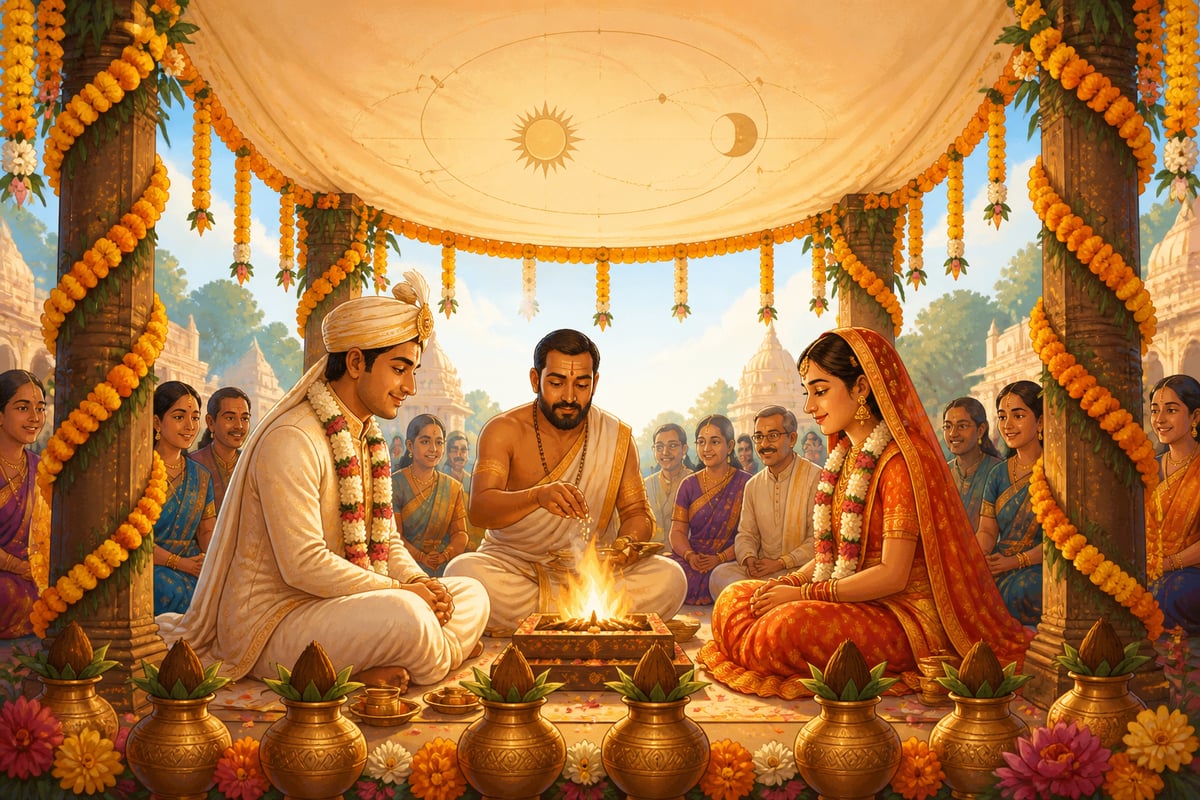
A Hindu wedding card printed in Hyderabad in 2026 still does what an inscription at Halebidu did in 1140 CE. Picture the priest who set the muhurta, sitting in a small office in Banjara Hills with a spiral-bound pañcāṅga on his desk and a smartphone app open beside it, reading off five numbers to the bride's father. The tithi, the vara, the nakṣatra, the yoga, and the karaṇa of the auspicious moment. He calls them to the minute. The printer sets them in Telugu type the following week. Behind those five small lines of text sit fifteen hundred years of continuously practiced astronomical mathematics.
The panchanga, literally 'the five limbs', is the only ancient mathematical system in the world that has never gone out of daily use. The Babylonian zodiac is a museum piece. The Mayan long count is a tourist attraction. The Egyptian decan calendar is a footnote in textbooks. The panchanga is on your phone, in your grandmother's drawer, and on the desk of the priest who set the muhurta for your cousin's wedding next month. It is the mathematics of Aryabhata and Brahmagupta as a living utility.
This lesson is about how five mathematical quantities, each defined by a clean astronomical formula, became the operating system of Hindu life.
The Five Limbs
A panchanga is not a calendar in the European sense. A European calendar gives you a date. A panchanga gives you five numbers that describe the state of the heavens at a given instant. They are:
Tithi, the lunar day, defined as the time during which the moon moves twelve degrees ahead of the sun in longitude. There are thirty tithis in a synodic month. Because the moon's motion is irregular, a tithi is not a fixed length of clock time. It can stretch from about nineteen hours to twenty-six hours.
Vara, the weekday. The seven-day week with its planetary names, Ravivara for Sunday, Somavara for Monday, Mangalavara for Tuesday, was already standard in India by the early centuries of the common era. The Yavanajataka of the second century CE references it, and the Surya Siddhanta treats it as routine.
Nakshatra, the lunar mansion. The ecliptic is divided into twenty-seven equal arcs of thirteen degrees and twenty minutes each. The nakshatra at any moment is the arc the moon currently occupies. The system is older than the classical period, named in the Rigveda, the Taittiriya Samhita, and the Vedanga Jyotisha of Lagadha.
Yoga, an angular quantity defined as the sum of the longitudes of the sun and the moon, divided into twenty-seven equal segments of thirteen degrees and twenty minutes. Each segment has a name and traditional meaning. Yoga has no obvious physical referent in the sky. It is a pure mathematical construction designed to give priests and astronomers a usable property of the sun-and-moon system.
Karana, half a tithi. There are eleven karanas in total, of which seven repeat in a moving cycle and four are fixed. A tithi has two karanas, one for each half. This is the most arithmetic of the five limbs and the easiest to derive once tithi is known.
Notice the structure. Tithi tracks the moon relative to the sun. Vara tracks the day. Nakshatra tracks the moon relative to the fixed stars. Yoga tracks a derived combination of solar and lunar longitudes. Karana tracks the halves of tithi. Five quantities, five different mathematical relationships, designed so that any moment in time can be located precisely along several independent astronomical axes at once.
Mathematics as Daily Use
The remarkable fact is what these quantities are used for. They are not used by professional astronomers. They are used by everyone.
A muhurta for a wedding requires the right combination of tithi, vara, and nakshatra. Computing it requires solving a small system of inequalities over astronomical functions. A traditional priest setting the muhurta is doing applied trigonometry without calling it that. The mantra is in Sanskrit, but the underlying calculation is the same one Bhaskara II would recognize from his Karanakutuhala of 1183 CE.
A new mother in a traditional household will be told that her child's nakshatra at birth determines the first syllable of its name. The lookup table for which syllable belongs to which nakshatra appears in classical texts and is still printed in the back of every almanac sold at a temple bookstall.

A farmer in coastal Andhra Pradesh will sow paddy on a tithi and nakshatra considered auspicious for sowing, an inheritance from agronomic practice that is itself an inheritance from astronomical practice. A trader in Surat may still time the opening of new account books to the muhurta on Akshaya Tritiya, a tithi-defined festival recomputed every year.
These uses are not symbolic. They depend on the calculation being correct. If your panchanga says Pradosham begins at 5:47 PM and the actual conjunction of trayodashi tithi with sunset is at 6:12 PM, your worship is at the wrong time. Accuracy is therefore a matter of constant maintenance, and that maintenance has been performed continuously for nearly two millennia.
What Is Actually Computed
The Surya Siddhanta, in its surviving form from around the fourth or fifth century CE, gives the algorithms. The motions of the sun, moon, and planets are computed from epicyclic models with corrections for inequalities of motion. The user does not need to know these. The user opens an almanac and reads off five numbers for the day.
What the panchanga-maker computes, behind the page, is roughly this. First, the longitude of the sun for the moment of local sunrise, calculated to fractions of a degree. Second, the longitude of the moon for the same instant, computed with greater complexity because the moon's motion is harder to model. Third, the difference between these two longitudes, divided by twelve degrees, giving the tithi. Fourth, the sum of these two longitudes, divided by thirteen degrees and twenty minutes, giving the yoga. Fifth, the moon's longitude alone, divided by thirteen degrees and twenty minutes, giving the nakshatra. Sixth, the weekday, derived from the count of civil days since a known epoch. Seventh, the karana, derived from tithi.
This is the same calculation Aryabhata describes in the Aryabhatiya in 499 CE. The arithmetic has been refined, the constants improved, and the modern Drik tradition substitutes telescope-corrected values for the older siddhantic ones, but the structure is unchanged. A sixth-century manuscript and a twenty-first-century smartphone app are running the same algorithm.
Why It Survives
The panchanga survived because it was useful. It tied astronomical mathematics to the rhythm of agricultural, religious, and personal life. A calendar that tells you only the date can be replaced by any other calendar. A calendar that tells you when to fast, when to plant, when to marry, when to begin a new venture, and when to perform shraddha for your ancestors becomes hard to replace, because each replacement would require a separate decision about each function.
The other ancient calendars failed at this binding. The Egyptian civil year drifted from religious observance within a few centuries. The Roman calendar required imperial reform. The Mayan long count fell with its civilization. The panchanga has been printed continuously, in some form, since printing reached India. Before that, it was copied by hand. Before that, it was memorized by those who needed it.
What you hold in your hand when you open a panchanga app on your phone is not a quaint survival. It is a piece of working mathematical infrastructure that has been in continuous service since the time of Aryabhata. The mathematics is older than every European nation. The use is daily. The accuracy is checked every morning by the position of the actual moon in the actual sky.
Key figures
Lagadha
c. 1400 to 1200 BCE, exact dates uncertain
Bhāskara II (Bhāskarācārya)
1114 to 1185 CE, Bijapur and Ujjain
Nirmala Chandra Lahiri
1906 to 1980, Bengal
Case studies
Drik and Vākya: Two Mathematical Schools, One Living Calendar
In Tamil Nadu and Kerala, two distinct mathematical traditions for computing the panchanga have coexisted for more than a thousand years. The Vākya school, attributed to the legendary Vararuci, encodes the motions of the sun, moon, and planets as memorizable Sanskrit verses (vākyas) that produce the required positions through pure arithmetic, without trigonometric tables. A trained Vākya panchanga-maker can produce a usable almanac entirely from memory and a counting board. The Drik school, by contrast, computes positions directly from observed astronomical data, with corrections applied for the actual sky as seen through telescopes and ephemerides. Both schools publish almanacs every year. Both are consulted by traditional priests. They occasionally disagree on the exact starting time of a tithi by a few minutes, and when this happens, the disagreement is debated by panchanga-makers in print and now in WhatsApp groups.
The persistence of two parallel mathematical schools is unique among living calendar traditions. The Vākya method preserves an algorithmic style designed for portability and memorization, the same constraints that shaped the original siddhantic tradition. The Drik method preserves the principle that mathematics must answer to observation, the same principle Āryabhaṭa championed when he asserted that the earth rotates rather than the sky. The fact that both still exist, that neither has eliminated the other, reflects an Indian intellectual habit of holding multiple methods in reserve as long as each is internally rigorous and useful in its own domain.
The Vākya school survives most prominently in the temple panchanga tradition of Kerala, where the Karkitaka and Chingam masa transitions are still computed by Vākya methods at major temples. The Drik tradition dominates the published almanacs of Tamil Nadu, the Lahiri-aligned Drik Panchang software now used worldwide, and the calendar of the Government of India. When the two disagree on a festival date, communities choose based on local custom, and both choices are considered valid. No central authority has ever been allowed to standardize one method out of existence. The mathematical pluralism is part of the tradition.
A mathematical tradition can sustain multiple legitimate algorithms for the same problem, and may be stronger for it. The discipline of choosing between them, rather than the false comfort of a single official answer, is what keeps the underlying mathematics alive. Where modern scientific cultures often prize a single canonical method, the panchanga tradition prizes informed disagreement, and has done so without losing either rigor or unity for over a thousand years.
The Vākya tradition, rooted in the verses attributed to Vararuci (c. 4th century CE), and the Drik tradition, rooted in observation-aligned siddhantic refinement, have coexisted in South India for at least 1,500 years. Both still produce printed annual almanacs in 2026.
The Astronomical Trigger of the Kumbh Mela
The Kumbh Mela, the largest periodic gathering of human beings on the planet, is not scheduled by date. It is scheduled by astronomy. Every twelve years a Pūrṇa Kumbh occurs at one of four sites: Prayagraj, Haridwar, Ujjain, and Nashik. The trigger for each is a specific configuration of the sun, the moon, and Jupiter. At Prayagraj, the festival opens when Jupiter enters Vṛṣabha (Taurus) and the sun and moon are in Makara (Capricorn) at the new moon. At Haridwar, when Jupiter is in Kumbha (Aquarius) and the sun is in Mēṣa (Aries). The exact dates of the major bathing days, the śāhī snān, are derived from a panchanga calculation performed by a committee of pandits months in advance. In 2025, the Mahā Kumbh at Prayagraj saw an estimated 660 million people across forty-five days, all moving on dates set by these astronomical conditions.
The Kumbh dates are the most consequential application of the panchanga in modern India. They are not symbolic. A bathing date that is mathematically wrong is religiously void. The committee that fixes the dates, drawn from the akhāṛas and traditional Sanskrit institutions, is performing a calculation that has been performed continuously since the Surya Siddhanta era. The same algorithm that an Aryabhata-trained astronomer would have used in the sixth century is what governs the movement of more people than the population of any country in Africa today. The civil and railway authorities receive these dates as fixed inputs and plan around them. The panchanga is the upstream system.
The 2025 Mahā Kumbh at Prayagraj generated logistics and transit operations for hundreds of millions on dates determined entirely by panchanga astronomy. Indian Railways added thousands of special trains aligned to the bathing dates. Hospitals, security forces, and sanitation systems planned around tithis. The Government of India treats the panchanga calculation as the authoritative source of these dates and never overrides it. The mathematics of Lagadha and Āryabhaṭa is therefore quietly directing the largest organized movement of people on earth, every twelve years, without interruption since records exist.
When mathematical astronomy is bound to the rhythm of life rather than to the rhythm of academic publication, it survives every political and technological change. The panchanga shows what happens when the people who use a science also depend on it. The Kumbh Mela is not a survival of an old practice. It is the periodic verification that an old practice is still working at planetary scale.
The 2025 Mahā Kumbh at Prayagraj drew an estimated 660 million pilgrims over forty-five days, all governed by tithi and grahacāra calculations performed by traditional panchanga committees and unchanged in structure since the fifth century CE.
The Diwali 2024 Tithi Debate
In late October 2024, panchanga-makers across India faced a familiar but consequential question. The amāvāsyā tithi of Kārtika, the new moon that marks Diwali, began on the afternoon of October 31 and continued past sunrise into November 1. According to one traditional rule (pradoṣa-vyāpinī amāvāsyā), Lakṣmī Pūjā should be performed when amāvāsyā is present at evening twilight. According to another rule (udayatithi), the tithi present at sunrise governs the day. October 31 satisfied the first rule. November 1 satisfied the second in some regions. Within India, panchanga-makers in different traditions and different states arrived at different recommendations. National newspapers carried explainers. Sanskrit pandits debated on television. Major temples in Varanasi, Mathura, and Ayodhya issued public statements. The Government of India's gazetted holiday, set by the Calendar Reform Committee's rules, fell on November 1 in some states and October 31 in others.
The debate was not about astronomy. The astronomical computation of the tithi was identical for everyone. The disagreement was about which of several legitimate scriptural rules for tithi-vyāpti, the overlap of a tithi with a particular part of a solar day, applied to Lakṣmī Pūjā specifically. This is a feature of the panchanga, not a bug. The tradition allows multiple legitimate rules and trusts local communities and learned pandits to apply them with discernment. The mathematics is fixed. The interpretation is alive. This is what it means for a calendar to be both rigorous and human at the same time.
Most of North India observed Diwali on November 1, 2024. Much of South and West India observed it on October 31. Both observances were religiously valid by their respective panchanga traditions. The debate produced articles, calendars, and public commentary that, taken together, amounted to a national crash course in tithi mathematics. Millions of Indians for whom the panchanga is normally a quiet background utility were suddenly drawn into discussions about angular longitudes, vyāpti rules, and the difference between sūryodaya and pradoṣa. The episode demonstrated that the mathematics of the panchanga is not only living but capable of mobilizing public attention at moments when its calculations matter most.
A living mathematical tradition will sometimes produce ambiguous results, and the way the tradition handles those ambiguities is a measure of its health. The 2024 Diwali debate was not a failure of the panchanga. It was an advertisement of how the system works. Multiple legitimate rules, applied by knowledgeable practitioners, can yield different answers, and the tradition trusts the user to choose with awareness rather than imposing a single official line. Every modern technical field that relies on calculation should ask whether it is mature enough to handle disagreement this gracefully.
Hindu communities in India observed Diwali 2024 on two different dates, October 31 and November 1, depending on which tithi-vyāpti rule their local panchanga tradition applied. Both dates were astronomically correct and religiously valid.
Historical context
From the Vedānga Jyotiṣa to the Lahiri Ephemeris (c. 1400 BCE to 2026 CE)
The panchanga has been produced continuously, in some manuscript or printed form, since at least the early centuries CE. Major regional traditions developed in Bengal, Maharashtra, Tamil Nadu, Kerala, Karnataka, Andhra Pradesh, Odisha, and the Hindi heartland, each preserving its own variant constants and conventions while sharing the same underlying siddhantic mathematics. From the 1830s onward, lithographic and then offset printing made annual almanacs cheaply available across India. By the 2000s, digital panchangas had reached every smartphone, and traditional pandits and software engineers were both contributing to the same evolving mathematical artifact.
No other ancient mathematical system has been used continuously by ordinary people from its inception to the present. The panchanga is the proof that mathematics can survive the fall of empires, the rise of new religions, the displacement of languages, and the transition from manuscript to print to digital, as long as it remains useful at the kitchen table. Studying it is therefore studying what mathematical longevity actually looks like.
Living traditions
The panchanga is now a piece of digital infrastructure. Drik Panchang, mPanchang, Hindu Calendar, and dozens of regional apps deliver tithi, nakshatra, yoga, karaṇa, and muhurta to tens of millions of users every day, with the calculations running on the same algorithms that Bhāskara II laid out in the Karaṇakutūhala. The Government of India's National Calendar, adopted in 1957 on the recommendations of the Saha committee, integrates the panchanga structure with Gregorian dates and is used on every gazette notification and All India Radio broadcast. The Lahiri ayanāṃśa, a single mathematical correction defined by N.C. Lahiri in the 1950s, is now the global standard for sidereal astronomical calculation in the Indian tradition. From wedding cards to railway timetables for the Kumbh Mela, the panchanga is the only ancient mathematical artifact that has survived to become contemporary infrastructure.
- Jantar Mantar, Jaipur: The largest of the five astronomical observatories built by Sawai Jai Singh II between 1724 and 1734. The instruments are masonry rather than brass, designed for high-precision measurement of solar declination, planetary positions, and time of day. Jai Singh built the observatory specifically because the panchanga constants of his era had drifted from observation, and he wanted to update them. The Samrāṭ Yantra, a sundial nearly twenty-seven metres tall, is still accurate to within two seconds. Walking among these instruments is the most direct experience available of the kind of practical astronomy that produced the panchanga.
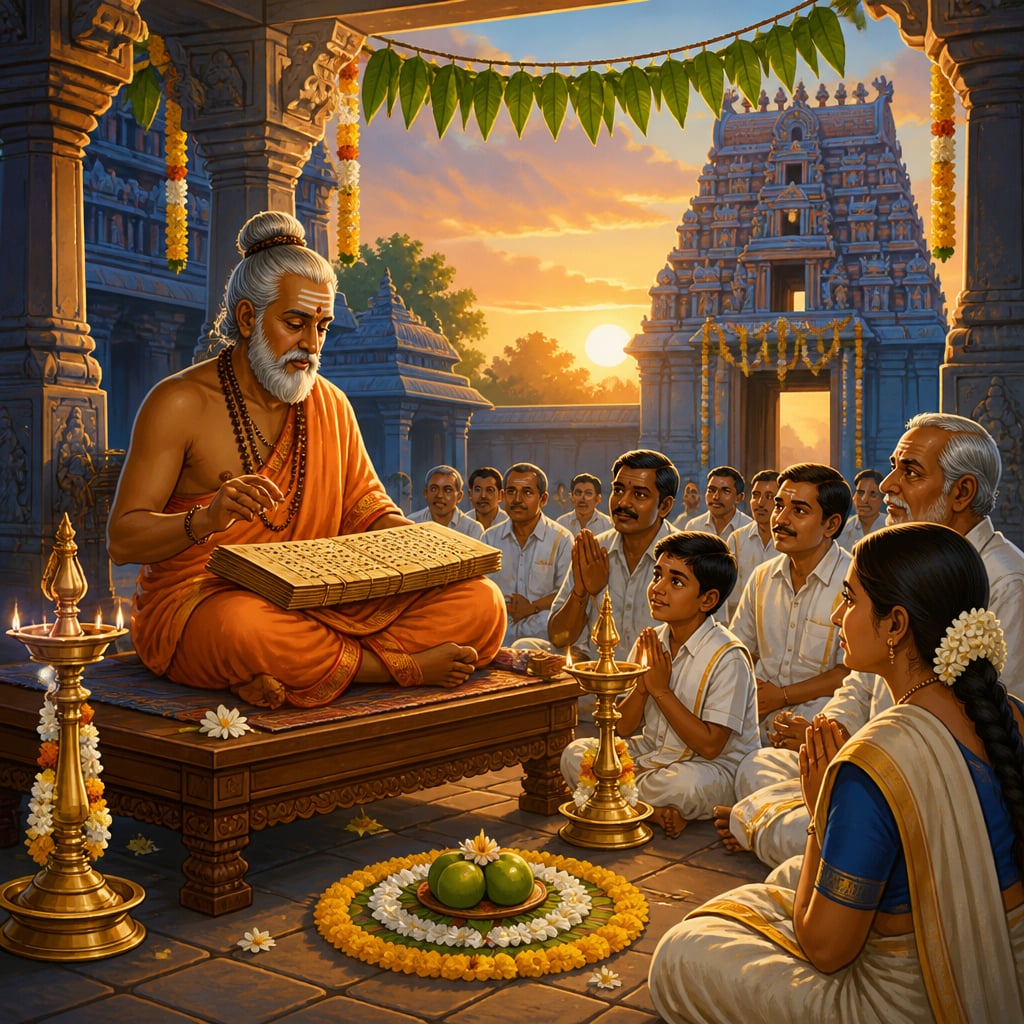
- Bhadrakali Temple Pañcāṅga Śravaṇam, Warangal: Like many major South Indian temples, the Bhadrakali temple at Warangal hosts an annual public reading of the new year's panchanga on Ugadi (Telugu new year). A traditional pandit reads the year's tithis, eclipses, ayanas, and significant muhurtas aloud in Sanskrit and Telugu, often before several thousand devotees. The reading is one of the few surviving public performances of mathematical astronomy as a community event. Similar ceremonies occur on Ugadi and Gudi Padwa at temples across Andhra Pradesh, Karnataka, Maharashtra, Tamil Nadu, and Kerala.
Reflection
- What is one moment in your own life, a birthday, an anniversary, the start of a project, that you mark by date alone, and how might it feel different if you marked it by an astronomical condition instead?
- Why do you think the panchanga survived continuously for over two thousand years while every other ancient calendar of comparable sophistication did not?
- Should mathematics serve daily life, daily life serve mathematics, or are these the wrong categories entirely?