Jya: The Bowstring That Became Sine
How Indian astronomy invented trigonometry and a mistranslation carried it west
Long before Europe spoke of sines, Indian astronomers at Kusumapura had tabulated the half-chord and called it jya, the bowstring. This lesson traces how that Sanskrit word became the Latin sinus through a chain of three languages, and why the half-chord is the object that makes modern trigonometry work.
The Slate at Kusumapura
In 499 CE, in the astronomical college at Kusumapura on the banks of the Ganges near modern Patna, a twenty-three-year-old scholar named Āryabhaṭa sat down to compose two lines of Sanskrit verse. He had in front of him a palm-leaf folio, a reed pen, and a problem. The Gupta empire, the political order under which the college had been built, was visibly fraying. Libraries burned. Manuscripts rotted in the monsoon. Whatever he wrote down had to survive not by being stored but by being memorized.
He wrote makhi bhakhi phakhi dhakhi ṇakhi ñakhi ṅakhi. Decoded through the alphanumeric cipher he had stated three verses earlier in the same chapter, those seven syllables read 225, 224, 222, 219, 215, 210, 205. They are the first seven sine-differences at intervals of 225 minutes of arc across a quadrant of a circle, and Āryabhaṭa had just compressed the earliest surviving trigonometric table in world mathematics into a single couplet. The word he used for the object being tabulated was jyā, bowstring. Fifteen hundred years later, after the word had been mistransliterated into Arabic and then mistranslated into Latin, the same object would be called sine. This lesson is the story of how a piece of archery vocabulary became the beating heart of modern science.
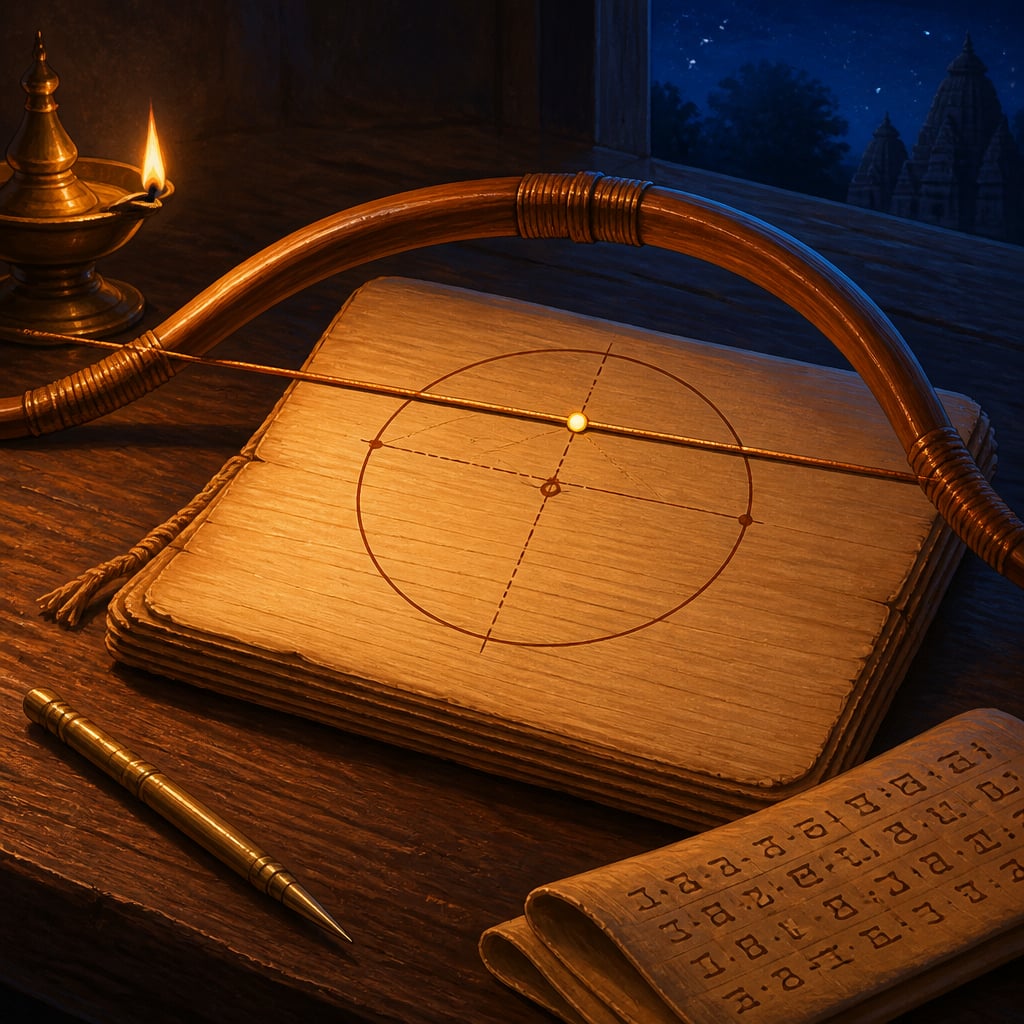
The Greek Chord and the Indian Half-Chord
The Greek astronomers had trigonometry, after a fashion. Hipparchus of Nicaea, around 150 BCE, compiled what is traditionally named as the first Western table of chords. Three centuries later, Ptolemy published an elaborate chord table in his Almagest. A chord is the straight line joining the two ends of an arc. If you imagine an archer drawing a bow, the arc is the curved wood and the chord is the taut string stretched between the two tips. The Greek word for this line was chordē, which originally meant, yes, a bowstring.
So far, Greek and Indian mathematics agree. An arc needs a measure, and the string stretched across its mouth is the natural candidate.

But the Indian astronomers, starting at Kusumapura and Ujjain in the fifth century CE, made a single small change that turned the whole subject inside out. They did not work with the full chord. They worked with its half. Drop a perpendicular from the midpoint of the arc down to the chord, cutting it cleanly in two. Each half is what the Indians called ardha-jyā, half-bowstring. And this half-bowstring is, in modern language, exactly the sine.
The reason this matters is structural, not cosmetic. Every formula in the full-chord system has a factor of two that disappears in the half-chord system. More importantly, the half-chord is literally the side of a right triangle inscribed in the circle, which means every result in half-chord trigonometry can be moved directly into any geometry problem involving right angles. The chord is an awkward object that tracks the whole arc at once. The half-chord is, in structural terms, the correct one. The modern sine table is an Indian tool.
Aryabhata's Table
The earliest surviving half-chord table appears in the Āryabhaṭīya, a compact astronomical work composed by Āryabhaṭa at Kusumapura (near modern Patna) in 499 CE. In the Gītikapāda, the opening chapter, Āryabhaṭa gives the twenty-four differences between successive half-chords at intervals of 225 minutes of arc, or 3 degrees and 45 minutes, across a quadrant. The table was computed to an accuracy of the nearest minute. It was, so far as the surviving record shows, the first of its kind anywhere in the world.
The encoding is extraordinary. Āryabhaṭa did not write the numbers out in the ordinary Sanskrit forms. He used a custom alphanumeric system in which consonant-vowel syllables stand for numerical values, and he compressed the entire twenty-four-entry table into a single verse. It begins with the nonsense-looking syllables makhi bhakhi phakhi dhakhi, and if you know the decoding rule, those four syllables read 225, 224, 222, 219. These are the first four sine-differences in minutes. The whole table fits into two lines of verse. A thousand years before the first European mathematician would print a sine table, a Sanskrit astronomer had encoded one into a mnemonic that a student could memorize in a minute.
And he did not stop at the table. In the Gaṇitapāda, the mathematics chapter, Āryabhaṭa explains how to generate such a table in the first place. The method is a second-order recursion on the differences between successive sines. In modern terms, he noticed that the second differences of the sine function are themselves proportional to the sine, which is a statement of the differential equation that defines the sine function in any modern textbook. Āryabhaṭa did not have the language of differential equations. He had a recursion and a table, and he knew exactly why they worked.
The Long Journey West

In 773 CE, a Sindhi astronomer arrived in Baghdad carrying astronomical texts in Sanskrit. The caliph al-Manṣūr had them translated into Arabic under the title Zīj al-Sindhind, the astronomical tables of India. Āryabhaṭa's half-chord methods, together with the work of Brahmagupta that built on them, entered the Arabic mathematical tradition through this channel. In the Arabic translation, the Sanskrit jyā was written phonetically as jiba, a cluster of consonants with no independent meaning in the language. It was just a transliterated sound.
Here is where the mistake happens. Arabic script normally omits short vowels. So the word jiba, written with the consonants j-b, looks identical on the page to a different Arabic word also written j-b, which is pronounced jaib and means bosom, or fold, or bay. Several centuries later, when the Toledo translators began rendering Arabic astronomical texts into Latin, they reached for a dictionary, saw jaib, and wrote sinus, the Latin word for a fold in a garment. Gerard of Cremona, working in Toledo around 1150 CE, canonized the usage in his translation of the Almagest. From sinus came the Italian seno, the French sinus, and the English sine. The original meaning had been bowstring. The misreading made it a fold of cloth. The mathematics underneath did not care. It passed through the error untouched, because a table of numbers is the same table regardless of what you call the rows.
Why the Half-Chord Won
The half-chord won because it is the right object. Every piece of modern engineering that involves a wave, from the electromagnetic spectrum to quantum mechanics, uses the sine function as its basic building block. When a signal engineer decomposes a radio broadcast into its frequency components, she is running a Fourier transform, which is a sum of sines. When a doctor reads an MRI image, she is looking at a picture reconstructed from sines. When an architect computes the force along a truss, she is multiplying loads by sines. The modern world, in a very literal sense, runs on the half-bowstring.
The next six lessons in this chapter unfold the rest of Indian astronomical mathematics. Āryabhaṭa's rotating Earth, the detailed computation of sine tables, Varāhamihira's synthesis of world astronomies, Bhāskara II's elegant siddhānta, the mathematical prediction of eclipses, and the living pañcāṅga calendar still used for every Hindu festival. But the foundation is the move made at Kusumapura in 499 CE. Take the full chord of an arc, cut it in half, treat the half as the fundamental object, and build everything else from there. Every sine you have ever computed is a child of that cut.
Key figures
Āryabhaṭa
476 to 550 CE, Kusumapura (near Pāṭaliputra, modern Patna, Bihar)
Varāhamihira
c. 505 to 587 CE, Ujjain, Mālava
Bhāskara I
c. 600 to 680 CE, Valabhī (Saurāṣṭra) and Aśmaka
Case studies
From Jyā to Sinus: A Thousand-Year Chain of Mistranslation
In 773 CE, a Sindhi astronomer arrived at the court of the Abbasid caliph al-Manṣūr in Baghdad carrying Sanskrit astronomical texts, including the Brāhmasphuṭasiddhānta of Brahmagupta. The caliph commissioned a team of scholars to translate them into Arabic. The resulting work, Zīj al-Sindhind, was the first major channel through which Indian mathematics entered the Arabic-speaking world. The translators faced a vocabulary problem. The Sanskrit jyā, meaning bowstring and by extension half-chord, had no equivalent Arabic mathematical term. They did what translators usually do with proper nouns: they transliterated the sound. They wrote it as jiba. This was not an Arabic word. It was a cluster of three consonants, j-y-b, that signified the Sanskrit sound and nothing else. For four centuries, Arabic mathematicians used jiba as a technical term imported from India, the way modern English uses karma or yoga. Then, in twelfth-century Spain, Gerard of Cremona sat down in Toledo to translate the Almagest and an encyclopedia of Arabic astronomy into Latin. He needed a Latin word for jiba. He opened an Arabic dictionary. Because Arabic script omits short vowels, the three-consonant skeleton j-y-b matched not only the imported jiba but also the native Arabic word jaib, meaning the fold of a garment, a bosom, or a bay. Gerard took jaib at face value and reached for the Latin sinus, which carries exactly the same cluster of meanings. Fold. Bosom. Bay. From sinus came the English sine. The bowstring had been lost in translation twice.
The Indian term was not accidental. Jyā captured a precise geometric intuition: the chord of an arc is the bowstring of a drawn bow, and the half-chord is half of that bowstring. The metaphor travels seamlessly from archery into geometry, and every student who hears it sees the arc and the string at once. The Arabic jiba preserved the sound but shed the meaning, and the Latin sinus preserved neither. By the time the word reached the universities of Oxford and Paris, the original image was completely erased. A modern student who studies trigonometry without knowing the Sanskrit backstory is working with a word whose etymology is a bosom. The bowstring is still in there. It survived the translation only as a number. But the picture is gone, and the picture is what made the mathematics easy to teach in the first place. Jyā is a reminder that technical vocabulary is not arbitrary. It carries pedagogy in its very form, and careless translation can strip pedagogy away from results.
The etymological chain jyā → jiba → jaib → sinus → sine has been reconstructed in detail by historians of mathematics including Carl Boyer, Kim Plofker, and David Pingree. The reconstruction is not speculative. It is traceable through dated Arabic manuscripts and dated Latin translations. What survived the journey was the half-chord as a number in a table. What did not survive was the word that told you why the half-chord was the right object to tabulate. The modern word sine is the fingerprint of a mistake, and every time it is spoken it records the moment when Indian mathematical intuition was carried into Europe without its metaphor.
When you import a technique across a language barrier, import its name too. Transliteration is better than translation when the original word carries a picture. The word sine works as mathematics and fails as memory. The word jyā does both.
Gerard of Cremona is credited with translating more than seventy Arabic scientific and mathematical works into Latin between 1150 and 1187 CE. His rendering of jaib as sinus in the Toledo translation of the Almagest is the single moment at which the modern English word sine was born.
Āryabhaṭa's 24-Entry Sine Table in Two Lines of Verse
In 499 CE, a twenty-three-year-old mathematician named Āryabhaṭa sat down in Kusumapura, the old capital on the Ganges near modern Patna, and composed a 121-verse astronomical treatise called the Āryabhaṭīya. In the very first section, the Gītikapāda, he laid out the fundamental constants of his astronomical system: the value of pi, the dimensions of the solar year, the periods of the planets, and, in a single verse of two lines, a complete table of sine-differences for a quadrant divided into twenty-four equal arcs. The verse looks like gibberish. It opens with the syllables makhi bhakhi phakhi dhakhi and continues through twenty more such syllables before ending with the clear Sanskrit label ardha-jyāḥ, 'the half-chords'. Anyone who knew Āryabhaṭa's alphanumeric code, stated earlier in the same chapter, could decode each syllable into a number. The twenty-four numbers, read in order, give the successive differences of the half-chord function at intervals of 225 minutes of arc: 225, 224, 222, 219, 215, 210, 205, 199, 191, 183, 174, 164, 154, 143, 131, 119, 106, 93, 79, 65, 51, 37, 22, 7. Add these cumulatively and you get the sine values themselves. A student who memorized the two lines carried the entire analytic foundation of Indian astronomy in her head.
The compression is not stylistic excess. It is pedagogical infrastructure. Sanskrit mathematical texts were designed to be memorized, because manuscripts were expensive and easily destroyed, but a verse carried in the student's memory was safe. A twenty-four-entry table written out in ordinary numerical notation would have required twenty-four separate phrases and a significant block of text. Encoded as alphanumeric syllables, it fits in two lines. The decoding rule is itself a single verse earlier in the Gītikapāda. Together, these three or four lines of verse contain everything a student needs to reconstruct the table from scratch, and once the table is in memory the student has, in effect, the first-order approximation to the sine function for all time. This is the Indian mathematical aesthetic at its most concentrated. The method is not just the answer. It is the answer, the table, and the way to remember the table, all wrapped into a single mnemonic compact enough to survive the collapse of a civilization and still be decodable fifteen centuries later.
Āryabhaṭa's encoded sine table is the earliest known sine table in any mathematical tradition. Its values match, to within the accuracy of the nearest minute, the values that would later be printed in European tables compiled by Regiomontanus in the fifteenth century and Rheticus in the sixteenth. The gap between 499 CE in Kusumapura and 1464 CE in Nuremberg is nearly a thousand years. Nothing comparable existed in Greek, Chinese, or early Arabic mathematics in 499 CE. Āryabhaṭa did not inherit the table. He computed it.
A well-designed notation is a civilization-scale backup system. Āryabhaṭa's alphanumeric code turned two lines of verse into a machine that could regenerate the whole of classical trigonometry. When your knowledge has to survive without printing, without electricity, and without any guarantee of a teacher, compression becomes a form of preservation.
Āryabhaṭa's sine values computed from his twenty-four-entry table agree with modern values to within an average error of about 10 arcseconds across the full quadrant. This is roughly the accuracy of a good sextant reading, achieved by a Sanskrit verse a thousand years before the sextant was invented.
MRI Scans and the Half-Bowstring Inside Every Pixel
A magnetic resonance imaging machine does not take a picture of your body the way a camera takes a picture of a face. It slides you into a powerful magnet, fires a sequence of radio-frequency pulses at you, and listens for the faint radio signals that your body's hydrogen nuclei emit in response. The raw data is not an image. It is a time-series of oscillating radio signals. To turn it into the crisp cross-sectional images that radiologists read, the scanner runs a mathematical operation called a Fourier transform, which decomposes the complicated signal into a sum of pure sine and cosine waves. Each wave has a frequency, an amplitude, and a phase. Together, these waves reconstruct a spatial map of the tissue, because the magnetic gradient at each location in the body encoded itself into a particular frequency in the signal. Every pixel of an MRI image is, mathematically, a weighted combination of sines. The scanner uses roughly a hundred thousand such sinusoidal components per cross-section, and a full-body scan may involve billions of sine evaluations. Every single one of those sines is, in a traceable lineage, a half-chord. Every pixel is a jyā.
Āryabhaṭa's decision in 499 CE to work with the half-chord rather than the full chord was made for reasons that had nothing to do with medical imaging. He wanted a cleaner trigonometric object for astronomical computation. The half-chord is the side of a right triangle inscribed in the circle, which makes it the natural unit for any geometry involving perpendicular decomposition, which is to say, for any geometry at all. Fifteen hundred years later, when Joseph Fourier showed in 1822 that any reasonable function could be represented as a sum of sines, the sine he was using was the half-chord, routed to him through the Arabic jiba and the Latin sinus but geometrically unchanged since Kusumapura. An MRI machine is Fourier's theorem implemented in silicon and superconducting magnets. It is also, by unbroken descent, Āryabhaṭa's half-chord implemented in silicon and superconducting magnets. There is no step in the computation where a full chord would have worked as well. The innovation that put the modern medical imaging suite onto its current foundation was made in India fifteen hundred years before the first scanner was built.
MRI is now the dominant imaging modality for soft-tissue diagnosis worldwide, with an estimated 40,000 machines in clinical use and over 60 million scans performed annually. Every one of those scans computes, in its reconstruction step, tens of millions of sine values. The method is Āryabhaṭa's half-chord running at hardware speed inside hospital basements on every inhabited continent.
The right choice of primitive object compounds for centuries. Āryabhaṭa did not know what a Fourier transform was, let alone an MRI scanner. But he chose the half-chord because it was structurally clean, and that single structural decision is now quietly doing the computational work behind every diagnosis of a brain tumor, a torn meniscus, or a herniated disc in the world.
A standard brain MRI reconstructs its images from roughly a hundred thousand sinusoidal components per slice. A single clinical study with thirty slices therefore involves about three million sine evaluations, each one a computational descendant of the twenty-four half-chord values Āryabhaṭa compressed into two lines of Sanskrit verse in 499 CE.
Historical context
The Kusumapura and Ujjain Traditions of Classical Indian Astronomical Mathematics (5th to 8th century CE)
The period from Āryabhaṭa to Brahmagupta was one of the richest in the history of Indian mathematics. The Gupta empire had collapsed politically by the mid-sixth century, but its cultural and scholarly infrastructure persisted in regional courts. Kusumapura, the old Mauryan and Gupta capital near modern Patna, remained a center of astronomical learning even after its political decline. Ujjain, on the Tropic of Cancer, became the prime meridian of Indian astronomy and the home of Varāhamihira, and later Brahmagupta and Bhāskara II. The Valabhī kingdom in Saurāṣṭra was another scholarly center and home to Bhāskara I. What tied these scattered centers together was the Āryabhaṭīya, which spread rapidly after 499 CE and became the common reference for three generations of astronomers. By the time the Sindhi embassy carried Indian astronomy to Baghdad in 773 CE, the half-chord technique had been the standard tool of every Indian astronomer for three hundred years.
Every modern computation that involves a wave, a rotation, an oscillation, or a decomposition into frequency components is a computation in the half-chord system that Āryabhaṭa set down at Kusumapura in 499 CE. The modern word sine records the transmission route but erases the origin. Recovering the word jyā, and the geometric picture it names, is how you recover the intuition that made trigonometry easy to teach in the Indian tradition and makes it hard to teach now. The bowstring is not just etymological trivia. It is the picture that made the subject feel obvious to the first people who invented it.
Living traditions
The half-chord that Āryabhaṭa computed in 499 CE is the single most heavily used mathematical object in the modern world. Every signal processor, every GPS chip, every radio, every MRI scanner, every audio codec, every image compressor, every weather model, every structural analysis of a building or a bridge, and every simulation of a quantum particle runs on sines. Roughly speaking, the world's computers evaluate the sine function more often than they perform any other non-trivial mathematical operation. The name has been garbled. The word sine is a chain of Latin, Arabic, and Arabic-again misreadings that erased the bowstring image without touching the underlying mathematics. But the object is the same object. When your phone decodes a WiFi packet, it runs a Fast Fourier Transform, which is a sum of sines, which are half-chords, which are jyās. The bowstring that Āryabhaṭa stretched across a quadrant of the celestial sphere in Kusumapura is being redrawn several hundred billion times per second, worldwide, right now, on the device in your hand.
- Āryabhaṭa Research Institute of Observational Sciences (ARIES), Nainital: A premier Indian astronomical observatory operated by the Department of Science and Technology and named in honor of Āryabhaṭa. The institute hosts the 3.6-metre Devasthal Optical Telescope, one of the largest ground-based optical telescopes in Asia. Its naming is a deliberate act of historical recovery. Indian astronomy did not begin with the European telescopes of the eighteenth century. It began at Kusumapura in 499 CE, and ARIES carries that lineage in its name.
- Kusumapura and Patna Museum: Kusumapura, also known as Pāṭaliputra, was the capital of the Mauryan and Gupta empires and the working home of Āryabhaṭa, who composed the Āryabhaṭīya there in 499 CE. Very little of the ancient city survives above ground. Kumhrar Park, in the southwest of modern Patna, preserves archaeological remains of the Mauryan pillared hall and is the closest surviving site to Āryabhaṭa's world. The Patna Museum houses Gupta-era sculpture and artifacts that give a sense of the scholarly and courtly culture in which the young Āryabhaṭa would have worked. The city is also a pilgrimage for anyone interested in the mathematical history of India.
Reflection
- Āryabhaṭa's key move was to cut an awkward object (the full chord) in half and work with the cleaner version. Is there a large, awkward object in your own life, work, or thinking that would become simpler if you cut it in half and reasoned about just one side?
- The Sanskrit jyā means bowstring and carries a clear geometric picture. The English sine carries no picture at all, only a sound. What else in your working vocabulary has been hollowed out by translation, and can you restore the original image?
- Why did the half-chord win, eventually, in every mathematical tradition that took trigonometry seriously? What does it mean for one formulation of an idea to be the structurally correct one, independent of who discovered it or what language named it?