Sthanakramanka: The Genius of Place Value

How a single Sanskrit verse by Aryabhata gave the world the most important notation in mathematics

Learn why India's place value system, where position alone determines magnitude, was the most important mathematical innovation in human history.

The Line That Contains Everything

In 499 CE, a twenty-three-year-old named Āryabhaṭa sat at his writing slate in Kusumapura, the scholarly quarter of Pāṭaliputra near the Ganges, and composed the second verse of a short mathematics chapter. The palm leaf was rough under his stylus. The room around him was quiet. He wrote ten Sanskrit names for the powers of ten, from eka (one) to vṛnda (a billion), and then added five words: sthanāt sthānaṃ daśaguṇaṃ syāt. From place to place, each is ten times the last. He stated it the way a carpenter states how a joint is cut. The rule was so obvious to him that he did not pause to explain it. He moved on to the next verse.

Aryabhata inscribing the place-value rule on palm leaf at dawn

That single line is sthanakramanka, place-value notation. Pick up your phone and type 1,234. The 1 means one thousand, the 2 means two hundred, the 3 means thirty, the 4 means four. Every number you have ever written follows Āryabhaṭa's rule. This is the lesson about how that rule changed arithmetic everywhere it arrived.

What Came Before
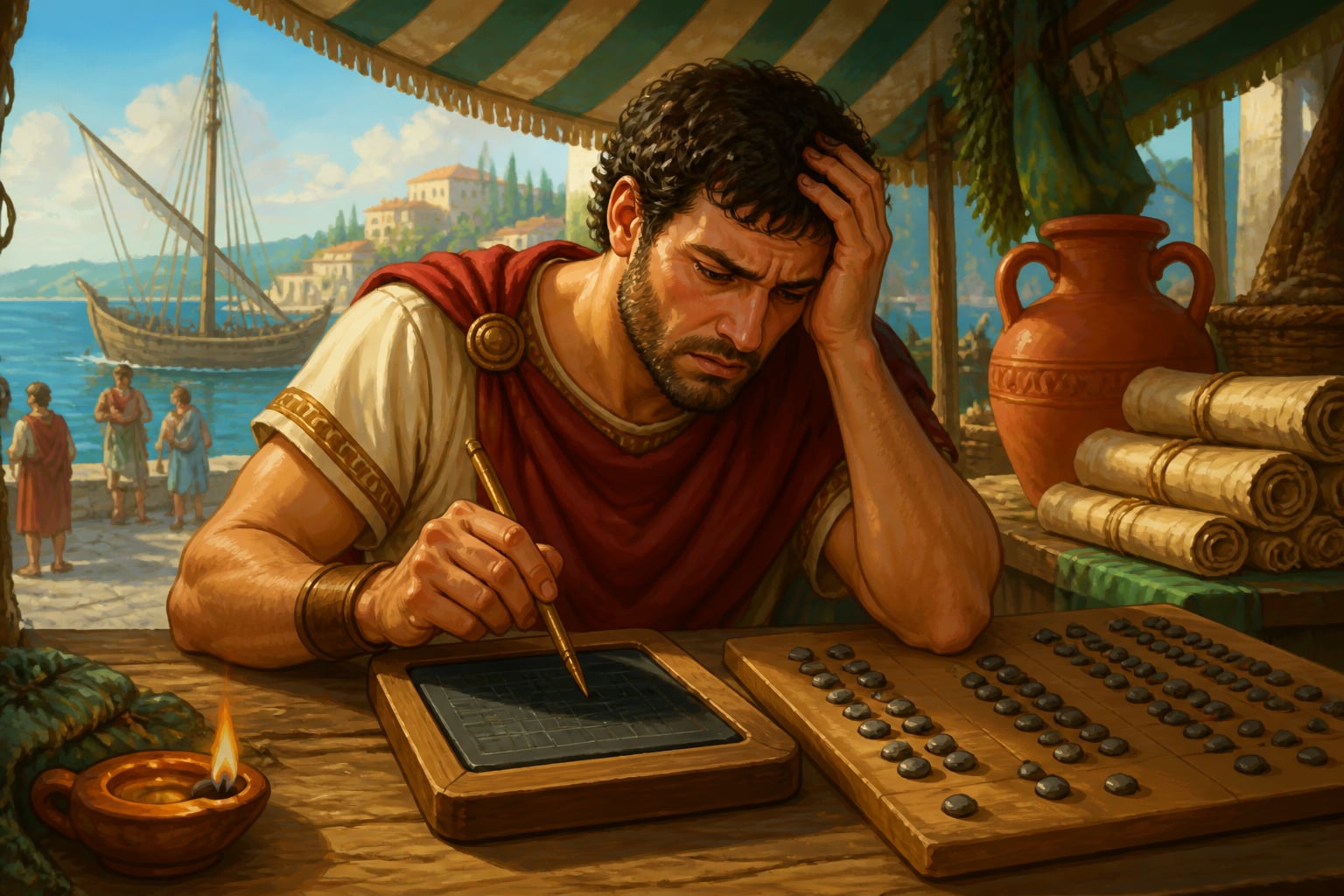
Roman merchant struggling with MCMXLVIII multiplication

To see what India invented, look at what India replaced. For most of recorded history, every literate civilization wrote numbers as collections of distinct symbols, each with a fixed magnitude that did not depend on position. Roman numerals worked this way. M was a thousand, no matter where you put it. X was ten. I was one. To write a number, you stacked the symbols additively: MCMLXXXIV. To add two such numbers on paper required moving the symbols around like beads on an abacus. To multiply was a chore even an experienced clerk approached with dread. To divide was an art form taught to a tiny minority of professionals.

Egyptian numerals followed the same logic. So did Greek alphabetic numerals, where each Greek letter stood for a fixed value. So did Hebrew gematria. So did Chinese counting-rod numerals at the mathematical level, although Chinese mathematicians had figured out positional manipulation on the rod board itself. The Babylonians, working in base sixty, had developed a partial form of place value but had no symbol for an empty column and no consistent rules about it.

In every one of these systems, the symbol carried the value. The position carried nothing.

What India Did

Indian mathematicians made a different choice, and they made it slowly and confidently over many centuries. They decided that the value of a digit would depend on where you wrote it. The same nine digits, plus the symbol for zero, would be enough to write every number in the universe, no matter how large. The leftmost digit would mean the most, the rightmost digit the least, and each step to the left would multiply your value by ten.

The most famous classical statement of this idea comes from Aryabhata, working at Kusumapura near modern Patna in 499 CE. In the second verse of the Ganitapada of his Aryabhatiya, he writes a single line that contains the entire system. He lists ten Sanskrit names for the powers of ten from one to a billion: eka, dasa, sata, sahasra, ayuta, niyuta, prayuta, koti, arbuda, vrnda. And then he says, with the unbothered confidence of someone telling a child how doors work, sthanat sthanam dasagunam syat. From place to place, ten times.

That sentence is the law of the system. The whole structure of arithmetic is contained in it.

Older Than Aryabhata

Aryabhata did not invent this. He inherited it. The Vajasaneyi Samhita of the Yajurveda, composed perhaps a thousand years before him, already lists Sanskrit names for powers of ten going all the way up to parardha, ten to the seventeenth. The Vedic civilization that named numbers that large needed a system in which large numbers could be talked about coherently, and the names by which they did this are decimal in spirit even before they were decimal in writing. Buddhist texts like the Lalitavistara have the young Siddhartha enumerating numbers in named units of ten, going up to ranges that would not be matched in European mathematics for another two thousand years.

The earliest dated written use of full positional notation with a symbol for zero is the Lokavibhaga, a Jain cosmological text whose internal astronomical references work out to August 25, 458 CE. By the time Aryabhata is writing in 499 CE, the system is already old enough to be assumed without explanation. By the time Bhaskara I writes his commentary on the Aryabhatiya in 629 CE, he is using the place-value system to perform calculations that would be unthinkable in Roman numerals, and treating the technique as routine. By the time the Bakhshali manuscript is buried in what is now Pakistan, perhaps in the 7th or 8th century, it contains pages of calculations done in fluent positional notation, including a dot used as a zero placeholder.

This is the texture of a mature technology, not a novelty. By the middle of the first millennium CE, the place-value system was so deeply embedded in the working life of Indian mathematicians and astronomers that they barely bothered to comment on it. They were too busy using it.

The Gift the Word Cannot Capture

Look at what sthanakramanka actually does for you. With ten symbols you can write any number. The number a billion, which would have required a Roman clerk to scratch out a half page of M's, can be written in ten digits. Addition becomes the rote application of a rule. Multiplication can be taught to a child. Long division becomes a procedure with steps, not a mystical art. The sheer cognitive load of arithmetic, which had limited every previous civilization's ability to do commerce, astronomy, and engineering at scale, drops by an order of magnitude.

Smartphone and palm-leaf side by side

Every modern person who has ever balanced a checkbook, calculated a tip, read a stock price, or written a phone number has been doing what Aryabhata did in 499 CE and what Vedic priests were doing implicitly a thousand years before that. The system is so natural to us now that we have to be told, with some force, that it was ever an invention. It is the kind of innovation that erases the world it replaced and then makes itself invisible.

The Quiet Revolution

There is a particular kind of greatness that does not announce itself. The place-value system was not introduced with fanfare. There is no dramatic moment in any Indian mathematical text where someone says, look at what I have done. The system simply emerges in the literature, fully formed, and then becomes the air in which all subsequent Indian mathematics breathes. Aryabhata states it once, in a single line, as if it were the most natural thing in the world. Bhaskara I assumes it. Brahmagupta assumes it. Mahavira assumes it. The Kerala school assumes it eight centuries later. Al-Khwarizmi inherits it and gives it to the Arab world, and Fibonacci inherits it from the Arabs and gives it to Europe, and at no point in this transmission does anyone seem to notice that the most important mathematical event in human history has occurred.

This is the deepest mark of a great idea. It is so good that, once you have it, you cannot remember what life was like without it.

Back on that palm leaf in Kusumapura, the verse was finished. Āryabhaṭa moved to the next problem. He did not know that the five words he had just set down would be running on every phone, every computer, and every cash register on earth fifteen centuries later.

Key figures

Aryabhata

476 to c. 550 CE, Kusumapura (modern Patna, Bihar)

Bhaskara I

c. 600 to 680 CE, Saurashtra and the Asmaka country

Sarvanandin

458 CE, southern India

Case studies

Roman Numeral Paralysis: Why an Empire Could Not Multiply

For nearly a thousand years, the Roman empire and its medieval European successors administered one of the largest political systems in human history while writing every number in a non-positional notation. A Roman tax clerk recording the year 1888 wrote it as MDCCCLXXXVIII, twelve characters of additive symbols. Adding two such numbers was not done on paper at all. The clerk transferred them to a counting board, the abacus in the original sense, and slid pebbles around. The Roman state had legions, aqueducts, and law courts. It did not have positional arithmetic. As a result, multiplication and division of large numbers were specialized professional skills, not universal literacies. Even the Roman emperors did not balance their own books. Banking, when it existed, was rudimentary. By contrast, in the same period, Indian merchants and astronomers in Pataliputra and Ujjain were performing pen-and-paper calculations that any literate clerk could check.

The Indian system of sthanakramanka, formalized by Aryabhata in 499 CE, did not depend on a physical apparatus. It worked on a palm leaf, on a strip of birch bark, in a tray of sand. Arithmetic became a notational practice rather than a manual one. This collapsed the cognitive load of computation by an order of magnitude. The Roman world, locked into additive notation, could never make this transition without abandoning its inherited symbol set. The fact that European mathematics did not adopt the Indian system until the 12th century, and did not fully replace Roman numerals in commerce until the 16th, is the measure of how powerfully a notation can lock a civilization into a slower way of thinking.

Roman finance never developed instruments at the speed Indian commerce did. The earliest European banks of the medieval period explicitly used the abacus alongside Roman numerals, and merchants who proposed using Indian numerals were sometimes accused of fraud, since 'ciphering' looked suspicious to non-mathematicians. The complete transition to positional notation in Europe took roughly four hundred years after Fibonacci first championed it in 1202 CE. The notation, not the people, was the bottleneck.

When a civilization gets stuck on a hard problem, the solution often is not more cleverness within the existing notation. It is replacing the notation. Before you grind harder on a problem, ask whether the way you are writing it down is doing the obstructing.

The number 1,888 takes 4 characters in Indian numerals and 12 characters (MDCCCLXXXVIII) in Roman numerals. The compression ratio of place value is not a stylistic preference. It is what makes pen-and-paper arithmetic feasible at all.

Binary as Place Value: Aryabhata Inside Every Smartphone

In 1937, a twenty-one-year-old electrical engineering graduate student at MIT named Claude Shannon submitted a master's thesis titled 'A Symbolic Analysis of Relay and Switching Circuits'. In it, he showed that any logical operation could be implemented using on/off electrical switches, and that the natural notation for these switches was a positional number system in base 2 instead of base 10. Every modern computer, from the first vacuum-tube machines of the 1940s to the phone in your pocket, is built on Shannon's insight. And Shannon's insight is, at its mathematical core, decimal place value performed in a different base. The Sanskrit law sthānāt sthānaṃ daśaguṇaṃ syāt becomes, in base 2, sthānāt sthānaṃ dviguṇaṃ syāt, from place to place twice as much. Aryabhata's exact rule, with the multiplier changed from ten to two.

The conceptual move that makes a smartphone possible is not the silicon. It is the willingness to let position carry meaning. Shannon did not invent positional notation. He inherited it from medieval European mathematicians, who inherited it from the Arabs, who inherited it from the Indians, who formalized it in the Aryabhatiya. The deepest hidden ingredient of every modern digital device is the Indian decision, fifteen centuries before silicon, that the value of a digit could depend on where you wrote it. The chip is the physical realization of an idea Aryabhata stated in a single Sanskrit verse.

As of 2024, the global semiconductor industry produces over a trillion transistors per second. Each transistor is a single binary digit, an aṅka in a base-2 sthāna. The total number of positional computations performed daily on Earth, across all computing devices, exceeds 10^25 and is rising. Every one of those operations is sthanakramanka. The Indian mathematicians who created the system are not credited on any silicon chip, but the chip would not function without the conceptual move they made.

An idea, once correctly formalized, becomes the substrate for things its inventors could never imagine. Aryabhata was not thinking about computers. He was thinking about how to write large numbers efficiently for astronomical calculation. Fifteen centuries later, his idea runs the global digital civilization. When you build foundations honestly, the future will use them for purposes you cannot foresee.

A modern smartphone processor performs roughly 10 billion base-2 positional operations per second. That is ten billion daily executions of Aryabhata's rule, in your pocket, every second you hold the phone.

Historical context

Classical Period of Indian Mathematics (5th to 7th century CE), late Gupta and post-Gupta era

India in this period is the wealthiest and most intellectually productive region of the Eurasian world. The Gupta empire (c. 320 to 550 CE) presides over a flowering of mathematics, astronomy, medicine, grammar, and philosophy. Aryabhata composes the Aryabhatiya at Kusumapura near Pataliputra in 499 CE at the age of twenty-three. Nalanda monastic university, founded a few decades earlier, is a teaching ground where Buddhist, Jain, and Hindu scholars exchange ideas in an open intellectual climate. By the time Aryabhata writes, the place-value system has been part of Indian scholarly practice for at least a generation, as the Lokavibhaga of 458 CE confirms.

Without sthanakramanka, no later mathematical achievement in this course is possible. Brahmagupta's rules for zero, the Kerala school's infinite series, the Aryabhatan trigonometric tables, the calculations of Sridhara and Mahavira, and ultimately the modern global mathematical edifice that descends from the Hindu-Arabic numeral system, all rest on the place-value foundation laid in the centuries leading up to 499 CE.

Living traditions

Every numerical operation performed anywhere on Earth today, on a phone, in a bank, in a particle accelerator, in a satellite navigation chip, in a hospital medication calculation, is performed in some descendant of the system Aryabhata wrote down in 499 CE. The international system of measurement is decimal because of place value. The metric system is decimal because of place value. The base-2 representation that runs every digital device is positional notation in a different base, descending from the same conceptual move. The global financial system uses decimal currencies because no other notation can be reconciled, audited, and computed at the speed modern commerce demands. There is, almost literally, no quantitative aspect of contemporary human life that does not silently depend on sthanakramanka.

Reflection

More in Dashamana: The Decimal Place Value System

All lessons in Dashamana: The Decimal Place Value System · Indian Mathematics: Ancient Genius, Modern Foundations course